Walk a snowy field in old Yoshida and you might see something strange. A single line of footprints, left by only one leg.
Villagers in this part of Ehime, now the town of Matsuno, knew what that track meant. Yukinba, the snow hag, was out. She comes with the snow. Old accounts say she carries off children.
What does she look like?
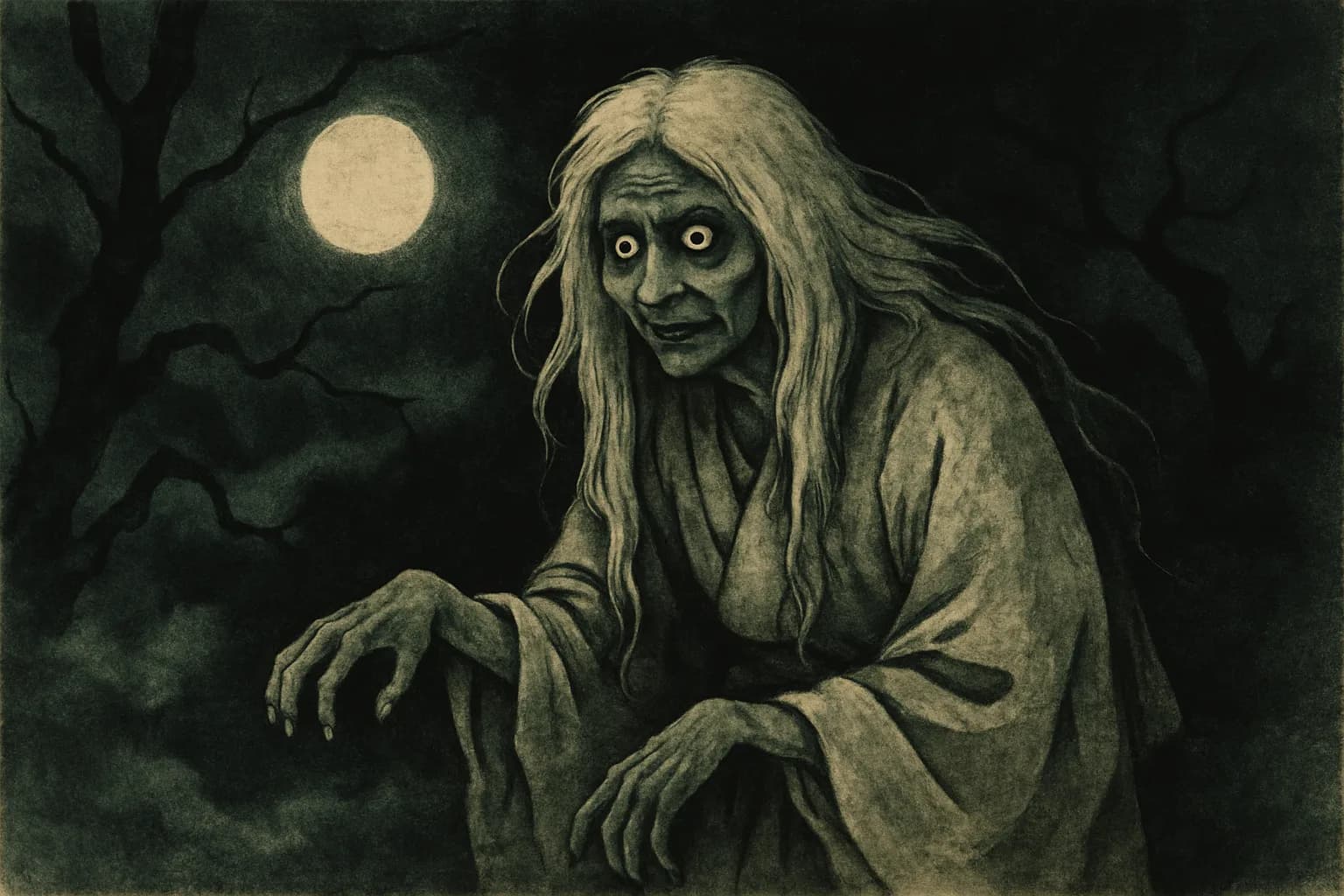
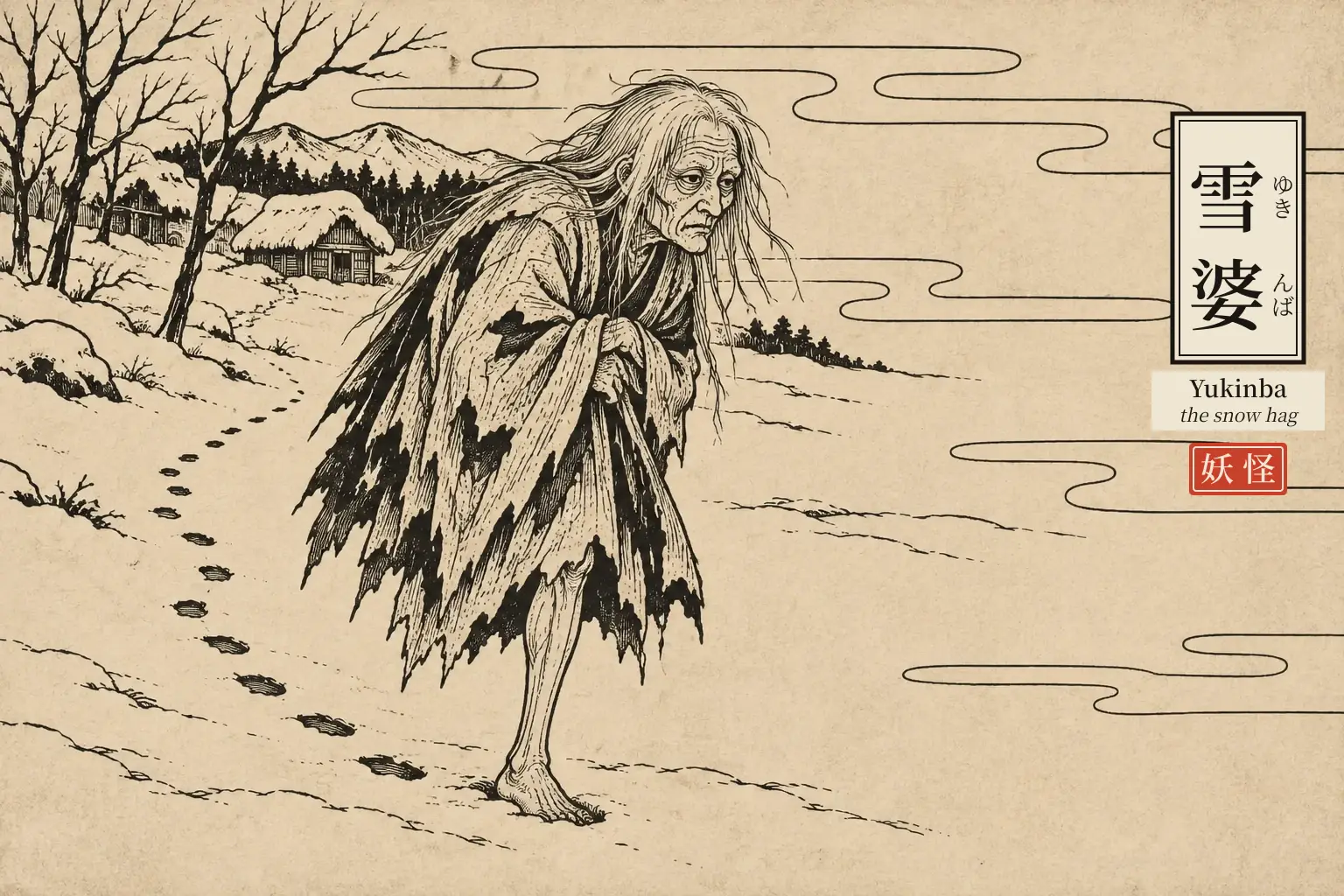
The Ehime record and one old scroll agree on this much. Yukinba is an old woman with only one leg.
She walks on that single leg the way anyone walks on two. That is the unsettling part. In fresh snow, she leaves a single-legged line of footprints.
A Meiji-era picture scroll called the Bakemono Emaki gives her a face. It draws her with wild, loose hair, and labels her with the kanji 雪姥 — a different spelling of "snow hag" than Yukinba's own 雪婆. No romanized reading for that label survives. No source records her height, her clothing, or what her voice said. The Yamanashi record, by contrast, describes no appearance at all — only a warning sign of her approach, covered below.
A traveler's close call
That Meiji-era scroll preserves one story, and it is not set in Ehime or Yamanashi at all. It happens in a place called Matsu-no-yama, in the Okuetsu region — old Fukui, a third place entirely.
One February, a man was crossing a snowy wheat field. A woman's voice called out to him. He looked up. A one-legged, wild-haired woman stood there. She lunged at him.
He ran. The snow kept falling for a while, then it stopped. The moment the sky cleared, she was gone too.
A warning carried on the wind
Ehime is not the only place that feared her. In Kamikuishiki, a village in Yamanashi, people called her Yukibanba instead.
There, the warning arrived before she did. On a cloudy evening in late autumn, a small flying insect called "shirotsuko" would appear. Seeing it meant one thing. Yukibanba had come near the mountain nearby.
Where it comes from
Yukinba first appears in print in 1928, in a folklore journal called Tabi to Densetsu, or Travel and Legend. The folklorist Fujisawa Morihiko recorded her there, in an article about skiing, snow, and the hauntings that come with it.
A second report followed in 1934, describing the Yamanashi version and her insect omen. The Ehime detail about children being kept indoors was later folded into a 1956 survey, Sōgō Nihon Minzoku Goi, compiled under the folklorist Yanagita Kunio.
Read plainly, Yukinba fits a common type of winter yokai. Parents needed a reason to keep children off frozen paths during a blizzard. A one-legged hag who steals children is vivid enough to keep a child indoors. That may be the whole function she served.
Ja.wikipedia lists yuki-onna, Japan's famous snow woman, as a related figure, though it draws no direct line between them. The two make a sharp contrast. Yuki-onna is beautiful and deadly, and known all over the country. Yukinba is grotesque, and her named legend stays local — a village in Ehime, a village in Yamanashi, and whichever place inspired an anonymous Meiji-era scroll.
Few sources outside those places mention her by name at all.