Every night, from the bottom of an old well, a woman's voice counts plates. Ichi mai... ni mai... san mai... One, two, three, all the way up through nine — and then, instead of ten, a scream, or a sob, or silence. Then it starts again. This is Okiku, and the sound she makes has been unsettling Japan for over three hundred years.
What does she look like?
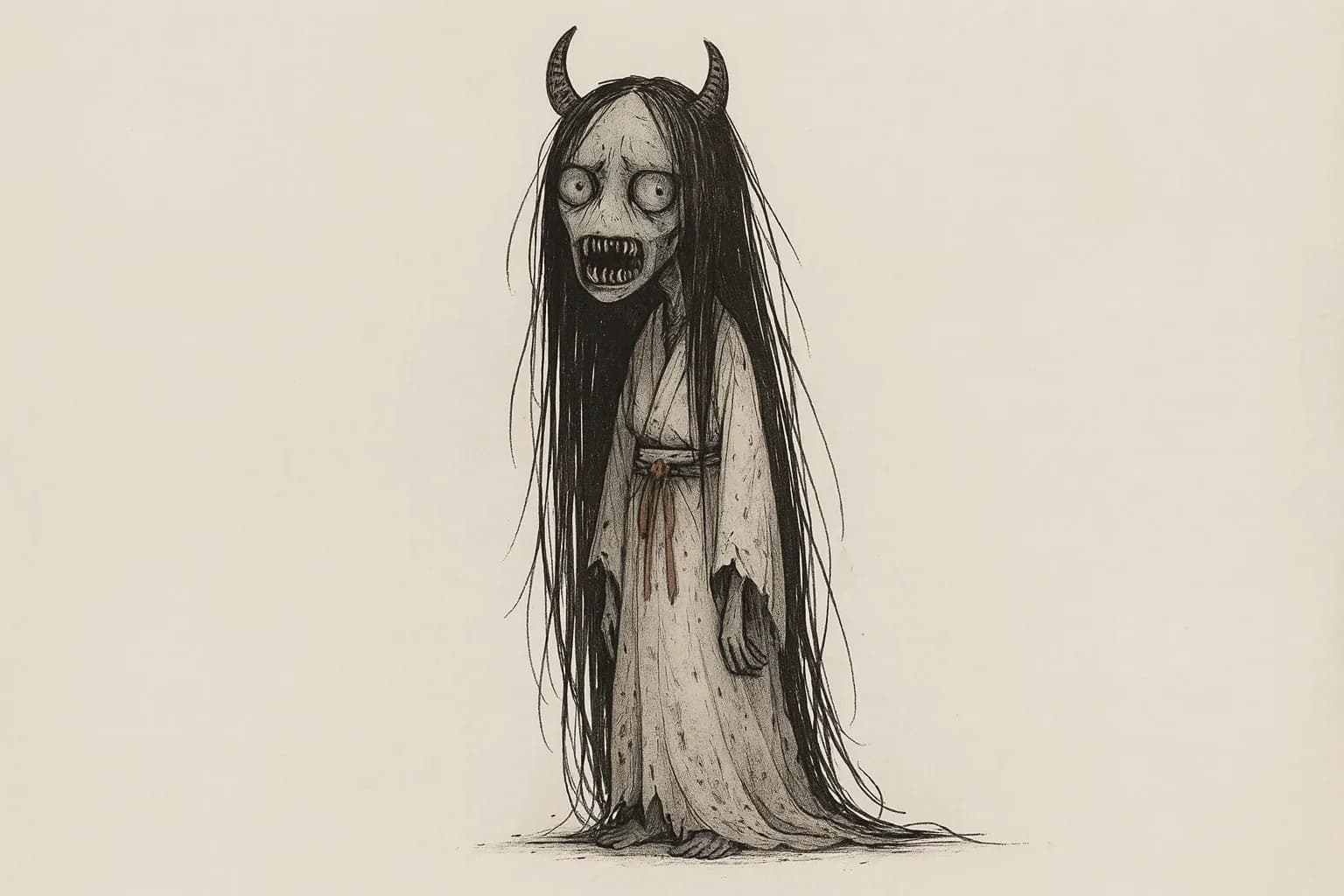
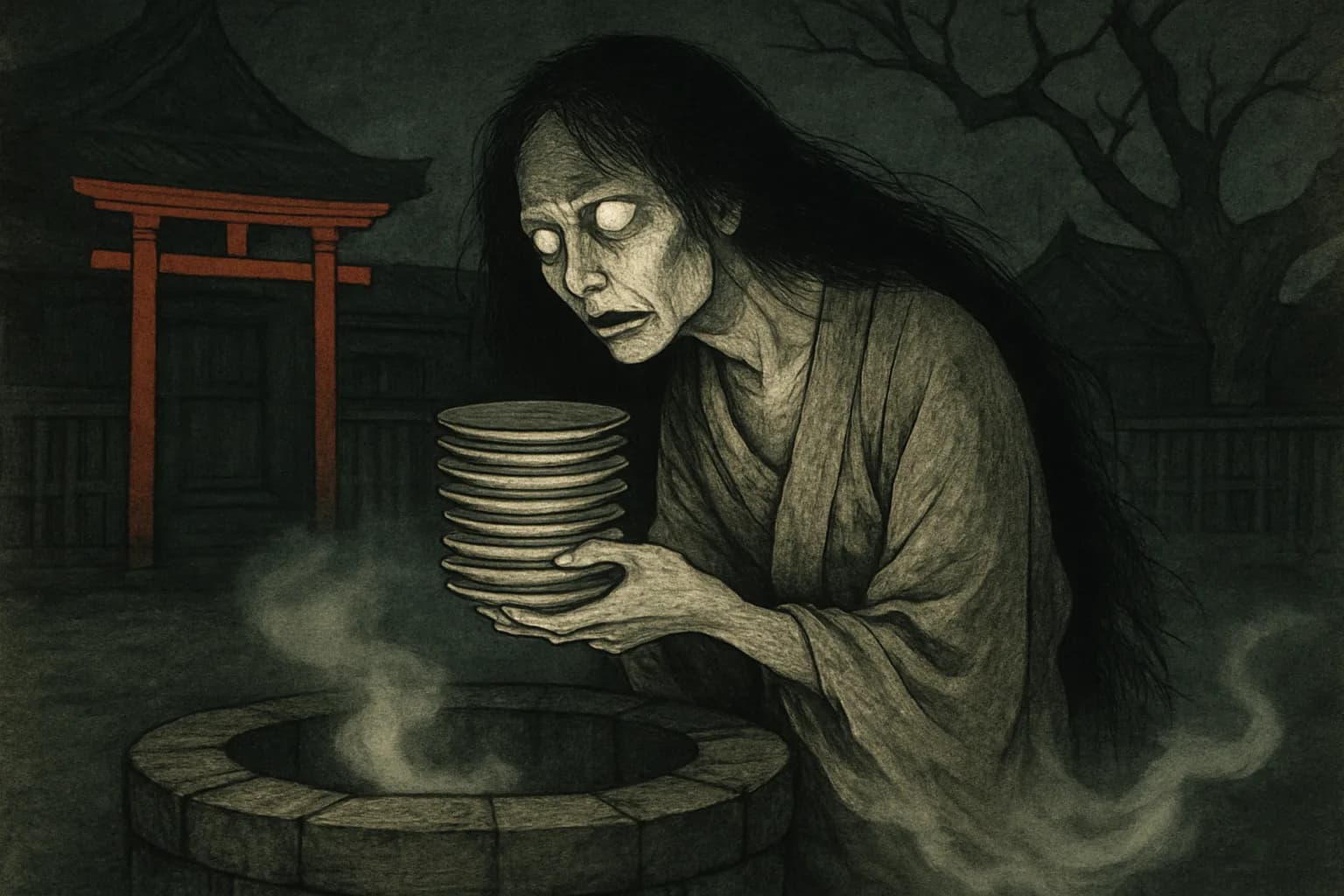
Sarakazoe follows the visual grammar of the yūrei rather than the beast-like yokai: a pale woman in a white burial kimono, black hair loose and dripping, no feet — she rises from the well's mouth as a drifting upper body, or is glimpsed only as a white shape moving under the water. Some tellings give her a bloodied throat or a face still fixed in the moment of her death. What every version agrees on is the well itself, and the sound. Sekien's own print, catalogued as Sarayashiki in his 1779 Konjaku Gazu Zoku Hyakki, shows her half-emerged from the well shaft, already mid-count.
The story: a missing plate
The tale is known as Sarayashiki (皿屋敷), "the mansion of the plates," and it exists in two rival versions that argue over where it really happened.
Okiku was a maidservant in a samurai household that owned a treasured set of ten imported plates — heirlooms, and irreplaceable. In every telling, one plate goes missing or is broken, and Okiku is blamed. In the crueler versions, the loss is not an accident: a retainer who desired her, or wished to be rid of her, hides the tenth plate himself and then offers her a choice — become his mistress, or be punished as a thief. She refuses. She is killed, and her body is thrown down the household well.
Her ghost rises from that well every night afterward to count the plates she was accused of losing, and every night she reaches nine and cannot go on.
Two castles, two versions
The Edo telling, Banchō Sarayashiki, places the household in the Bancho district near Edo Castle, its villain a hatamoto named Aoyama. The western telling, Banshū Sarayashiki, moves the whole story two hundred kilometers to Himeji Castle, where Okiku is a loyal servant murdered by the retainer Aoyama Tessan after she uncovers his plot against her master. Himeji still has the well: a low stone-ringed shaft in the castle's inner grounds, marked today as Okiku Ido, Okiku's Well, and visited by tourists who peer down at exactly nothing.
Neither version can be traced to a single verified historical murder, and folklorists generally treat the "real" Okiku as a later invention layered onto an older ghost-story frame — the two castles are rivals for a legend, not witnesses to the same crime.
Nine, and never ten
The detail that makes Sarakazoe endure isn't the murder, it's the counting. A woman condemned for one missing object, doomed to search for it forever and always fall one short: it's a haunting built entirely around an unfinished number. In some regional retellings, a bold guest survives a night near the well by shouting "ten!" the instant Okiku reaches nine — startled by the missing number finally being supplied, she vanishes instead of continuing, and does not return that night. It is less a defense than a mercy: giving the ghost the one thing she has been screaming for.
Where it comes from
Sarayashiki belongs to a wave of Edo-period kaidan — ghost tales performed, printed, and told at hyakumonogatari kaidankai, the "hundred ghost stories" gatherings where guests took turns telling frightening tales by candlelight, snuffing one candle after each story until the room went dark. Stories like Okiku's did real cultural work: they gave servants, who had no legal recourse against an abusive master, a folk avenger who could not be silenced or dismissed. A maid killed over a trumped-up accusation, who comes back specifically to keep counting the evidence against her killers, reads as a ghost story about accountability as much as fright.
The plates themselves are usually described as Korean or Dutch imports — genuinely valuable in an Edo household, and genuinely disposable in the way it later treated the woman blamed for one of them.
Okiku today
The playwright Okamoto Kidō adapted the story into the shin-kabuki play Banchō Sarayashiki in 1916, and it is still staged today, its Okiku written with more sympathy and interiority than the folk versions ever gave her. At Himeji Castle, a further piece of folklore grew up around the well: a local species of swallowtail chrysalis, bound and mottled in a way that locals thought resembled a woman tied at the wrists, is still called Okiku-mushi, "Okiku's bug," and was long taken as a sign that her spirit had never quite settled.
Western viewers who know the water-logged, black-haired ghost climbing out of a well in Ringu are looking, whether the filmmakers said so or not, at the same image Japanese audiences have carried since the Edo period: the well is never just a well.