Is the Okiku doll real? The doll is real. It sits in Mannenji, an ordinary-looking Buddhist temple in Hokkaido, northern Japan. The story about it is harder. It has been printed in at least three different versions. The girl's name, her father's role and even the year change from one to the next. Accounts differ, and no single version can be called the true one.
The legend says the doll's hair grows. It had a short bob when it was bought. After the girl who loved it died, the hair grew down to its shoulders.
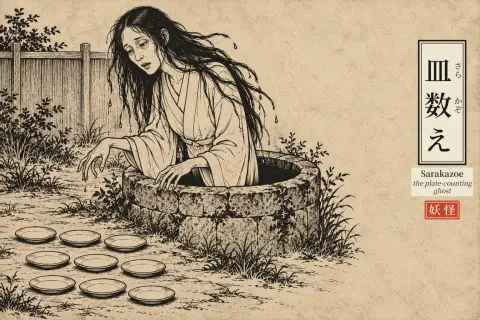
This is not the Okiku of the plate-counting ghost story, Sarakazoe. This Okiku is a little girl from Hokkaido.
What does it look like?
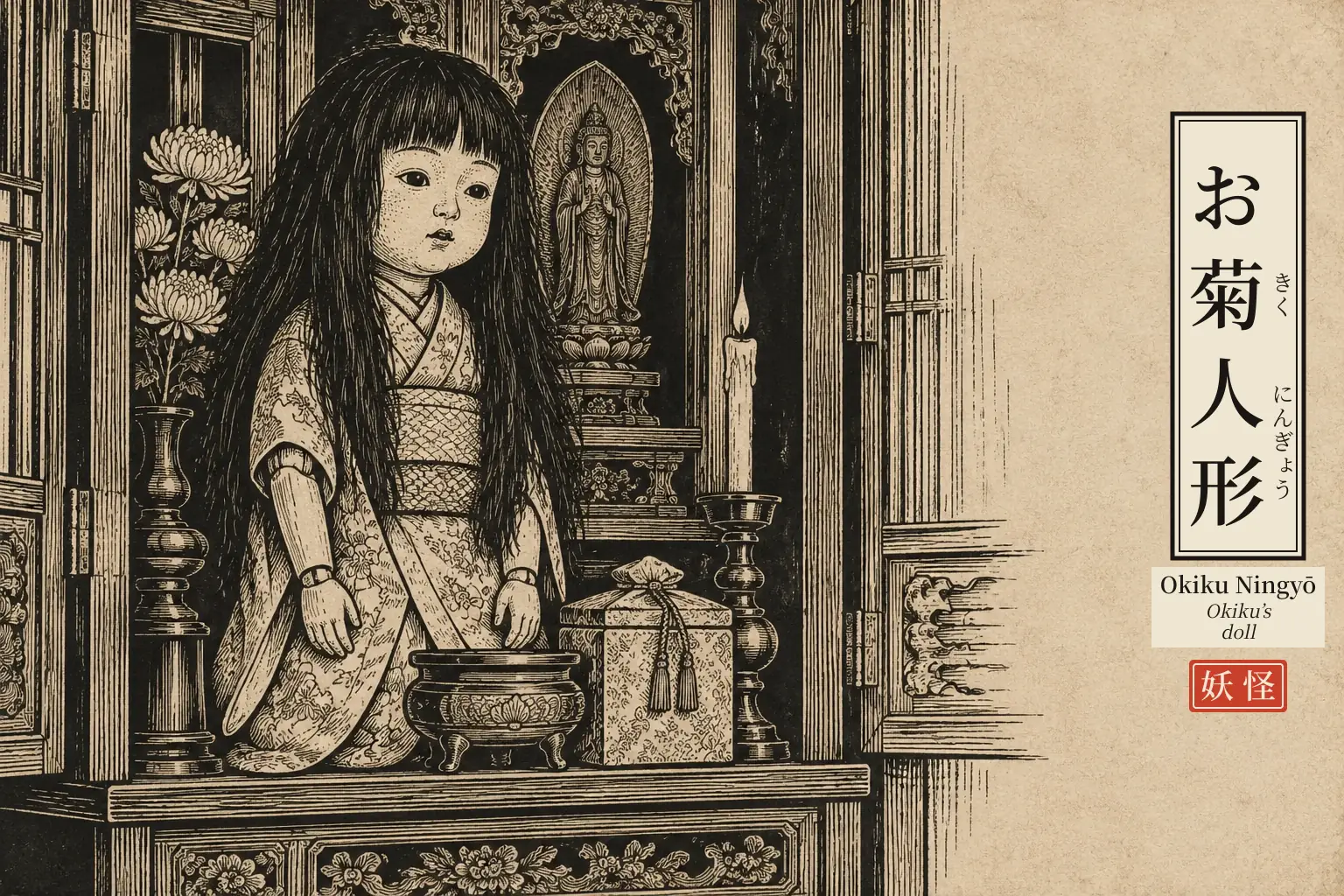
It is a Japanese doll with a bobbed haircut, called okappa. A list of magazine stories compiled by the researcher Narumi Akari calls it an ichimatsu doll, a classic Japanese doll with jointed arms and legs. The temple's own account adds a small detail. It was a doll "whose chest sounds", so it made a noise from inside.
In photographs its mouth is slightly open. Some books say something like teeth shows inside. A 1993 magazine went further. It said the doll's face had grown more adult, and its mouth was opening.
The folklore site Nihon Denshō Taikan visited the temple. Its writer found the doll more lovable in person than in photos.
The temple's story
This is the version Mannenji tells, in its account Okiku Ningyō Yurai. Other printed versions differ, as the table further down shows.
In 1918 a young man named Suzuki Eikichi went to an exhibition in Sapporo. On the way home, on 15 August, he bought a bobbed doll. He found it at a shop in Tanukikōji, a shopping street in Sapporo. It was a present for his little sister, Okiku (written 菊子). Japanese Wikipedia gives their ages as 17 and 3. Narumi's summary of the 1970 newspaper makes him 18.
Okiku played with the doll every day. Some retellings say she slept with it. On 24 January 1919 she died, aged 3.
At the funeral the family forgot to put the doll in her coffin. So they set it on the household Buddhist altar, next to her ashes. They prayed there morning and evening. In this version, the doll's hair then began to grow. The family came to believe Okiku's spirit had entered it.
On 16 August 1938 Eikichi was leaving to live in Karafuto, the southern half of Sakhalin. He left the doll at Mannenji, with the ashes of his sister and his father. After the war he came back for a memorial service. The hair was even longer. He gave the doll to the temple and asked for lasting memorial services there.
Is the story true? The versions disagree
The writer Koike Takehiko traced the first printed telling. He reported what he found in 1998. Narumi Akari set the versions side by side in a 2021 paper.
| Josei Jishin, 6 Aug 1962 | Young Lady, 15 Jul 1968 | Hokkaidō Shimbun, 15 Aug 1970 | |
|---|---|---|---|
| Who left the doll | The girl's father | The girl's father | Her brother Eikichi |
| Year | Left at the temple in 1958 | Bought in 1918 (Nihon Denshō Taikan); Narumi's table dates the story to 1913 | Bought in 1918 |
| The girl's name | 清子, not Kiku | Okiku | Okiku (菊子) |
| Who moved, and where | The father, to work in Honshu, Japan's main island | The father, to work at a coal mine in Karafuto | Eikichi, to Karafuto |
| Who saw the hair grow | The temple priest | The temple priest, in 1955, while cleaning | Eikichi |
In the 1962 version, the father leaves the doll and goes away to work. Nihon Denshō Taikan says he never came back. About three years later, he appears in the priest's dream, soaked through. He asks the priest to cut the doll's hair. Only then does the priest notice it has grown.
The 1968 article was by the same writer as the 1962 one. It tells a different history.
The temple's version first appears in a column in the Hokkaidō Shimbun in 1970. Nihon Denshō Taikan says the other versions stop appearing after that.
The sources also differ on how the girl died. The temple text gives no cause. Japanese Wikipedia says a cold. Narumi's summary of the 1970 newspaper says an illness.
So the honest answer is this. A real doll sits in a real temple. The version the temple tells today first appears in print, as far as Nihon Denshō Taikan reports, in 1970.
Does the hair really grow?
One explanation comes up often. In this kind of doll, one long hair is folded in half to make two. Over many years the fold can slip, and one side gets longer. Nihon Denshō Taikan points out a problem. If that were true, the hair should look thinner overall.
According to the temple, as that site reports, the hair keeps growing. So it is trimmed once a year as part of the memorial. The site says it has never heard of a photo of the trimmed doll being published. In its view, old and new photos mostly show the same length. A newer explanation says the hair now grows much more slowly.
Photography of the doll is not allowed. It is said the doll does not like to be photographed. Whether you can see it today is unclear. A 2015 magazine reported that it had been taken off public view because of wear, and we found no newer report.
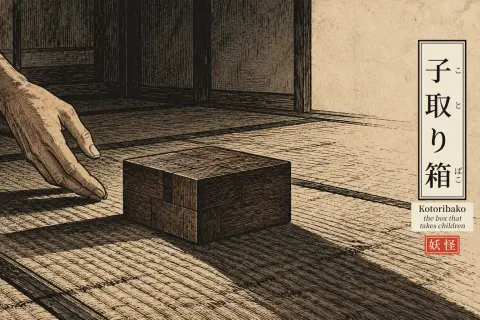
Two younger legends also center on a thing you should not keep. Hitori kakurenbo is a game of hide-and-seek played alone with a stuffed doll, posted online in 2007. Kotoribako is a small wooden box from a 2005 forum story, said to carry a curse.
Where it comes from
In this telling, the doll is haunted because a person's spirit moved into it. Narumi sorts doll ghost stories into types. The paper puts the Okiku doll among the ones where a spirit enters an ordinary doll.
From the 1970s, television and newspapers covered the doll again and again. Narumi argues that it made "the doll whose hair grows" into a story type of its own. The paper counts 23 such stories in popular magazines from 1990 to 2015, plus one in a newspaper. The paper notes that, apart from one storyteller's tales, most have a real doll that people can go and see.
Go deeper
Books worth owning if this world pulls you in.
- The Book of Yokai →Michael Dylan FosterThe most readable scholarly introduction to yokai — where they come from, what they mean, and the major creatures.
- Japandemonium Illustrated: The Yokai Encyclopedias of Toriyama Sekien →trans. Hiroko Yoda & Matt AltThe complete Edo-period bestiaries that so many of these entries trace back to, in full English translation.
Some links are affiliate links; if you buy through them we may earn a small commission at no extra cost to you.
The Okiku doll today
Mannenji belongs to the Seizan Zenrinji branch of Jōdo-shū, a Pure Land Buddhist school. It stands in Manji, once a coal-mining district. Manji was in the town of Kurisawa. Kurisawa merged into the city of Iwamizawa in March 2006.
The doll may have left a mark on Japanese temples and shrines too. A 2005 survey looked at 86 ningyō kuyō, memorial services for old dolls. Most began after the war, and their number rose sharply in the 1970s and 1980s. The survey points to the Okiku doll as one reason.