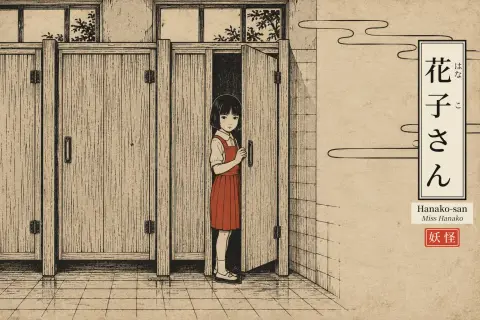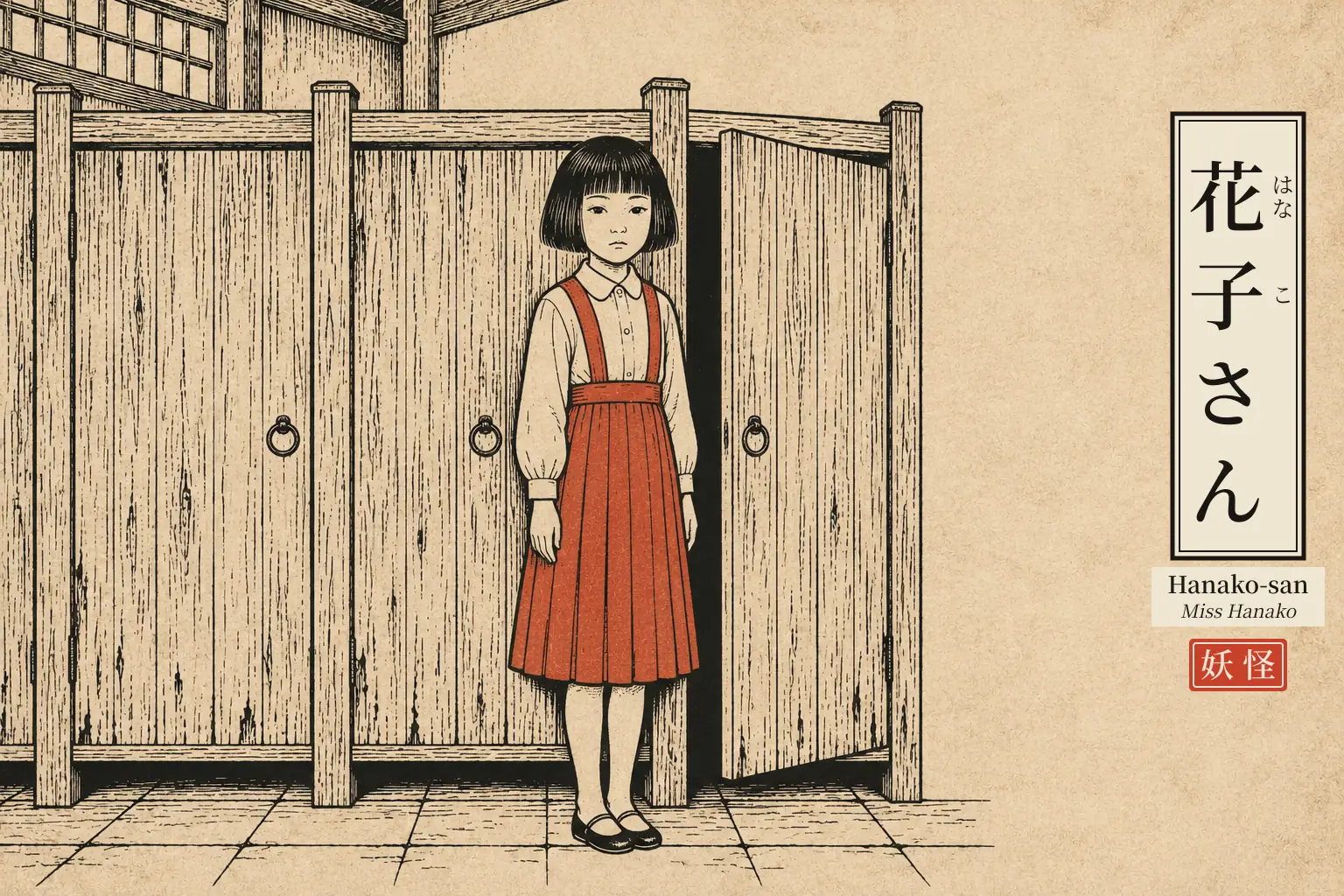
To summon Hanako-san, Japanese children go to the girls' toilet on their school's third floor. They knock three times on the door of the third stall. Then they ask, "Hanako-san, are you there?" In the story, a small voice answers hai. That means "yes."
Children across Japan have played this for decades, and every school tells it a little differently. In one school in Saitama, next to Tokyo, you knock 15 times on the fourth door. In Osaka, the voice scolds you like a teacher.
What you need
- A toilet with stalls. The classic place is a school's girls' toilet on the third floor.
- The third stall. Count from the entrance of the toilet room.
- A quiet time. Many tellings set it after classes, when the building is empty.
How to summon Hanako-san, step by step
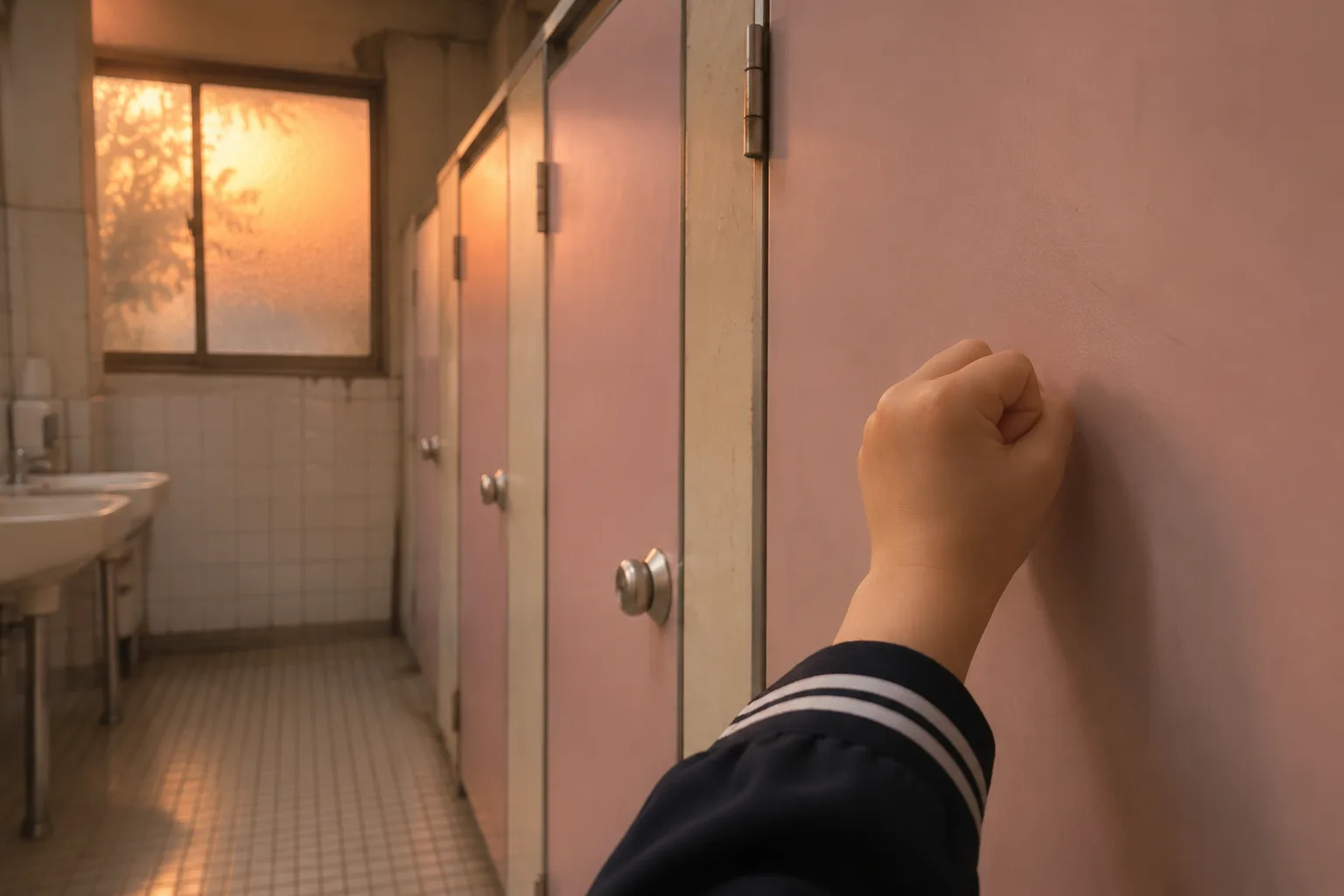 Our illustration, not a photo: after classes, a knock on the third door.
- Go to the third floor. Find the girls' toilet.
- Stand in front of the third stall. Do not open it yet.
- Knock three times.
- Ask out loud: "Hanako-san, irasshaimasu ka?" That means "Hanako-san, are you there?"
- Listen. In the story, a faint voice answers "hai," yes.
- Open the door, if you dare.
In the most common version, a girl in a red skirt stands inside. Her hair is cut in a short, straight bob. She pulls you in.
Why always the third? The oldest version of the rumor, from around 1950, was already called "the Third Hanako-san." The number was in her name from the start. And in stories, the third try is the one that is different. Goldilocks tastes three bowls of porridge, and only the third is just right. Two knocks are a joke. The third is when something answers.
What answers depends on what you say
Some children skip the question. They call out "Hanako-san, asobimasho," which means "let's play." The voice answers, "Yes. What shall we play?"
Be careful how you answer. In one telling, a child said "the strangling game." That is exactly what happened next.
Other schools report gentler replies:
- A Tokyo school, third-floor girls' toilet: call her name from the far end of the room, and she says, "What is it?"
- The same school, after 4 p.m.: say "Hanako-san, I'm sorry," and she says, "It's all right."
- Osaka: knock and call her, and she says, "Stop that, it's dangerous." Osaka people are famous for their strong local dialect. This ghost skips it and scolds you in textbook Tokyo Japanese, like a strict teacher. That is the joke.
- Yamagata: call her name as you leave the toilet. If the voice that answers sounds unpleasant, something bad will happen.
The words, in Japanese
If you want to say it the way Japanese children do, here are the lines from the stories.
| Japanese | Say it | Sounds like | Meaning |
|---|---|---|---|
| 花子さん、いらっしゃいますか | Hanako-san, irasshaimasu ka? | ha-na-ko-san, ee-ra-shai-mas-ka | Hanako-san, are you there? |
| 花子さん、遊びましょ | Hanako-san, asobimasho | ha-na-ko-san, a-so-bee-ma-show | Hanako-san, let's play. |
| はい | hai | hi | Yes. (Her answer.) |
| 花子さん、ごめんなさい | Hanako-san, gomen nasai | ha-na-ko-san, go-men-na-sigh | Hanako-san, I'm sorry. |
Say every syllable evenly. Japanese has no strong stress like English.
Every school has its own rules: 15 knocks, a flush, three seconds
The "third floor, third stall, three knocks" rule is not the only one. Children in different places learned different steps.
| Place | What you do | What happens |
|---|---|---|
| A Saitama school | Knock on the fourth door 15 times. Say "Hanako-san, let's play." | A voice says "yes." |
| A 1991 book of school ghost stories | Knock five times and call her name three times. | Only then will the door open. |
| A Gifu school | Walk around an old pit toilet (just a hole over a deep pit) three times, calling her name. | A voice says "yes." |
| Nagano | Knock on the third stall and call "Yukiko-san." | A voice says "yes." |
| Chiba | Spin around three times in the second stall on the second floor. Call "Mii-chan." Flush. | A voice says "yes." |
| Yokohama | Call her, then run. | If you do not get out within three seconds, you die. |
| Kurosawajiri, Iwate | Just enter the third stall. | A voice says "Third Hanako-san." A large white hand rises out of the toilet hole in the floor. |
The Iwate version comes from a time when a school toilet was often just a hole cut in the floorboards. That hole is where the hand comes from.
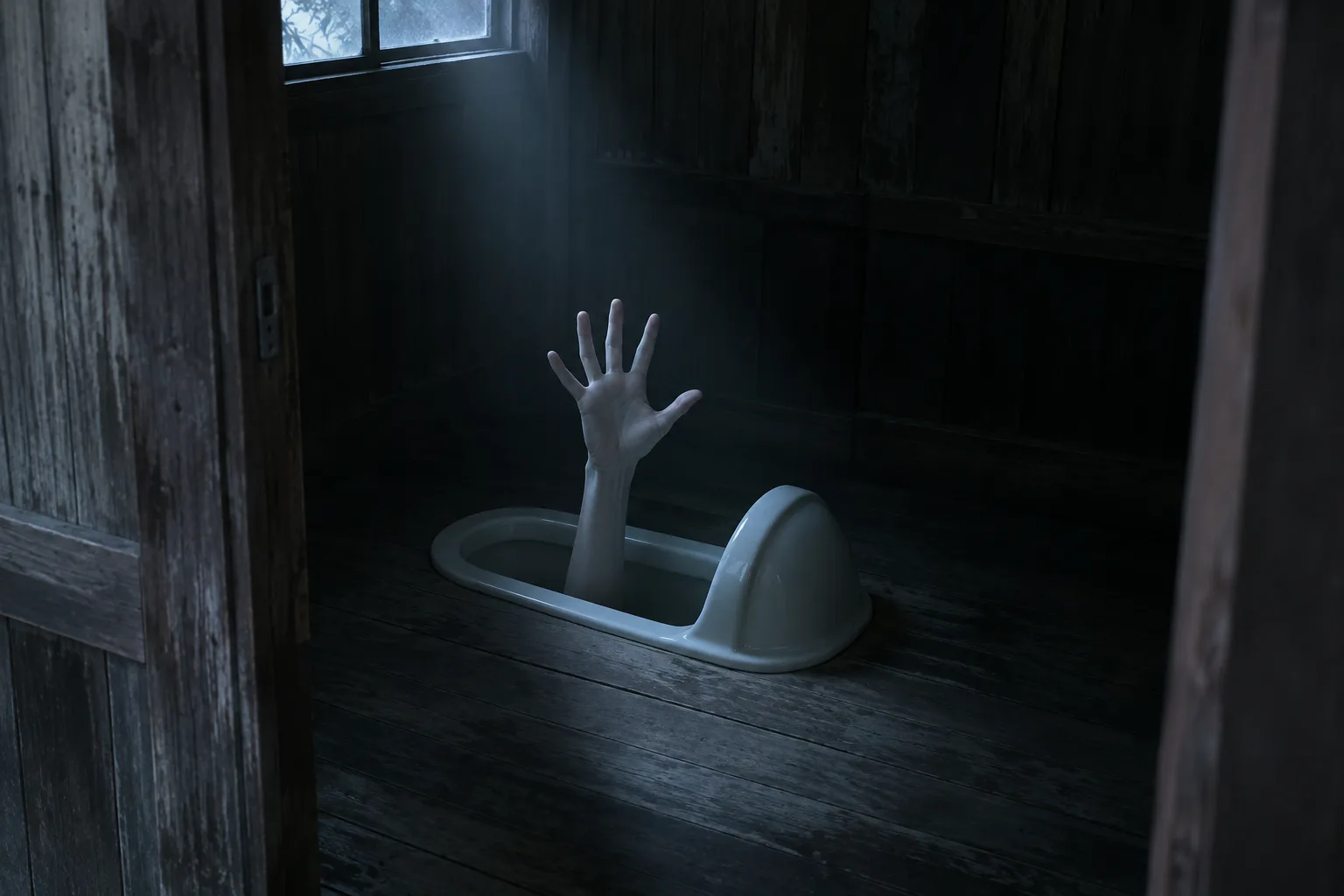 Our illustration, not a photo: the Iwate version, where the hand comes up out of the toilet itself.
Even her name changes. In Nagano she is Yukiko. In Chiba she is Mii-chan. One rumor says all the local Hanakos are cousins.
A perfect test score scares her away
Show Hanako-san a test paper marked 100, and she screams and vanishes. That is the best-known way out. No telling says why it works. Maybe because at school, nothing beats a perfect score.
The stories give a few other ways out.
- Do not force the door. In the five-knock version, forcing it open brings sleep paralysis. Or you disappear.
- Say yes when she asks to play. In Shimane, she chases children who refuse.
- Run, fast. In Yokohama, you have three seconds.
She may be a toilet god nobody prays to anymore
Hanako-san may be what is left of an old toilet god. To see why, start with the toilet itself.
In a school, the toilet is the one place where a child is alone behind a locked door. Old toilets were also dark, set at the edge of the building, with a deep pit below. People were uneasy there long before Hanako-san.
From the Edo period (1603 to 1868) into the 1930s, many Japanese homes honored a toilet god. Families left red-and-white dolls or flowers in the outhouse. In Japan, red and white together are the colors of celebration and good luck. That custom faded after World War II. But Hanako-san wears red and white, and her name means "flower child."
The rumor itself is much younger. In the 1980s, children spread "the Third Hanako-san" to schools all over Japan. By the 1990s, Hanako-san was in films, manga and anime.
In her first film, she was the hero
In her first film, in 1995, Hanako-san was not a monster. She protected the children. After that, she kept coming back.
- 1995: a live-action film from the Japanese film studio Shochiku. She watches over the children, and in the end she saves them from a stranger.
- 1996: an anime film. An eight-year-old actor voiced her.
- 1998: a horror film with almost the same title. It is not a sequel. In this one, the ghost everyone calls Hanako-san turns out to be an evil Japanese doll.
- 2013 and 2016: two more films. The second one sets her against Yōsuke-san, the ghost of the boys' toilet.
Do boys have a Hanako-san? And outside Japan?
Boys have their own versions. In Yokohama, the boys' toilet has its own ghost, Yōsuke-san. Another Yokohama story says to walk around a toilet in the boys' room three times, calling "Hanako-san." A bloody hand comes out of the bowl.
Outside Japan, we found no stories of her. Every version on this page comes from a Japanese school: its stalls, its floors, its quiet after classes.
Is Hanako-san real?
No one has found a real girl behind her. The stories cannot even agree on who she was. One says a stranger killed her in the third stall. Another says she fell from a library window in Fukushima. A third gives her a full life: born 1879, named Hasegawa Hanako, a member of the table-tennis club. None of them comes with a record.
People also say a TV crew once caught her voice on tape. That story is a rumor too. It is told, not shown.
Here is one way to read the ritual. A quiet toilet after school is a place where any small sound feels like an answer. The knock, the question and the wait turn that feeling into a game.
Read more about Hanako-san herself, about why Japanese urban legends come with rules, and about Japan's other urban legends.