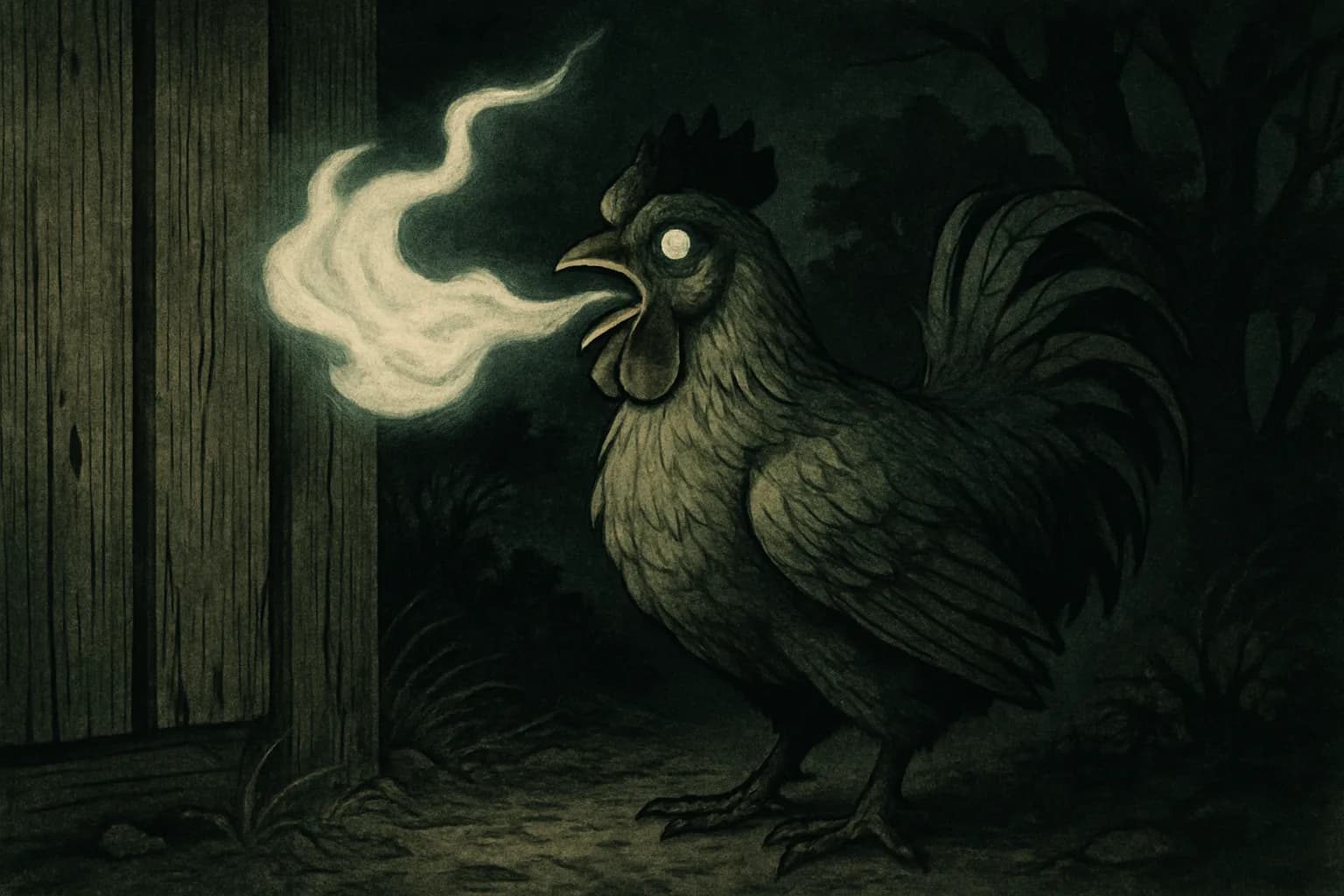
Deep in a stand of mountain bamboo in old Iyo Province, a light appears after dark — a pale, bluish flame flickering low among the stalks. Go and investigate, and you might just catch sight of what's making it: an enormous bird, chicken-shaped but far too large, wings rustling with a dry basa basa sound as it exhales the glow from its beak. Touch that fire and you'll find it's cold. Get too close to the bird itself, and both it and the flame simply vanish.
What does it look like?
The basan (also recorded as basabasa) is described as a huge fowl, roughly the size and shape of a large chicken or pheasant, with dull, wing-brushed feathers and a long tail. Its one unmistakable feature is the fire it carries in its breath — a faint, wavering flame that lights the undergrowth around it without giving off any warmth. Edo-period accounts are consistent on this point: people who stumbled across the phenomenon at night and worked up the nerve to approach reported that the light had no heat at all, which was usually the detail that convinced them they weren't looking at an ordinary bonfire or lantern.
A sound before a sight
Most encounters with a basan start with hearing, not seeing. Travelers and villagers moving through bamboo groves and forested hillsides at night would first catch the rustle of large wings — basa, basa — moving somewhere close but unseen. Only after that sound had unsettled them long enough did the ghost-fire appear, glowing among the leaves. The name itself is thought to echo this: some accounts tie basan directly to the onomatopoeia for a bird's wings beating the air, rather than to any literal meaning of the kanji later used to write it.
The creature's defining trait, though, is how it behaves under scrutiny. Basan folklore is built around a peculiar rule: the fire and the bird can only be seen from a distance. Approach with a lantern or simply walk toward the light with intent, and it winks out before you arrive, leaving nothing but bamboo and dark. Stories differ on whether the basan is genuinely dangerous or just supremely shy, but almost none of them describe anyone actually catching one.
The story from Iyo Province
The basan's most detailed telling comes from Ehon Hyaku Monogatari (絵本百物語), an Edo-period collection of regional ghost stories, which sets its account specifically in Iyo Province — the old name for what is now Ehime Prefecture, on the island of Shikoku. In that version, an elderly man living alone near a mountain describes seeing the strange fire glowing in a bamboo thicket near his home night after night. Curious, he finally works up the courage to go looking, and finds the source is not a spirit fire in the ghost-story sense but a living, enormous bird — one that disappears the instant he draws near, fire and all, leaving him unable to prove to sceptical neighbors that he saw anything at all.
That structure — a strange light, a witness who investigates, and a creature that refuses to be caught in the act of being seen — is common to a whole family of Edo-period "mysterious fire" yokai, of which the basan is one of the more vivid, because unlike a drifting orb of light, it comes with a body, a call, and a specific place in the landscape.
Where it comes from
Ghostly fires with no heat source were a recognized category of supernatural report across Edo-period Japan, often used to explain bioluminescence, marsh gas, or simply unfamiliar lights glimpsed at a distance in the dark. The basan personifies that phenomenon by giving it feathers and a body: rather than an unexplained flame drifting on its own, the light becomes the visible breath of a large, elusive bird that lives its own private nocturnal life in the mountains and only rarely crosses paths with people. Framing it as a bird rather than a pure spirit also ties it to a real anxiety of rural night travel — large, unfamiliar animal sounds in the dark, made stranger by a light that shouldn't be there.
Basan today
Basan is a minor figure even by yokai standards, but it has found a foothold outside folklore collections in an unexpected place: Atlus's long-running Shin Megami Tensei role-playing game series, which draws heavily on Japanese and world mythology for its roster of summonable demons and includes a fire-breathing avian basan among them. It's a modest afterlife for a creature whose entire folkloric personality is built around not sticking around to be seen — a cold flame in the bamboo, gone the moment anyone gets close enough to be sure of what they saw.