Japanese folklore calls them kaika (怪火), "strange fires." They are cold lights at night, with no lamp and no hand behind them. Our ledger holds seventeen of them. Fourteen have their own article, and this page puts those fourteen side by side.
The names confuse people because the lights look alike. What differs is the owner. A hitodama is a soul leaving a body. Onibi is a fire with no owner, rising where the dead lie. Kitsunebi is lit by a fox, on purpose. Almost every other ghost light in Japan is one of these three with a story added.
Why does every one need an owner? For most of history, a light on a dark road meant someone was carrying it. More on that at the end.
Fourteen lights, side by side
Each row comes from our own article on that light.
| Light | Whose fire it is | What it does | Oldest dated record |
|---|---|---|---|
| Hitodama 人魂 | A person's soul | Drifts low, away from the house | Man'yōshū (8th c.) |
| Onibi 鬼火 | No one. The dead, or a grudge | Splits and joins; comes at people | Wakan Sansai Zue (1712) |
| Kitsunebi 狐火 | A fox | Long rows; vanish and come back | Honchō Shokkan (1697) |
| Kosenjōbi 古戦場火 | Dead soldiers | Drifts in clusters | Tonoigusa (1677) |
| Ubagabi 姥ヶ火 | An old woman who stole lamp oil | Crosses 4 km in a moment | Saikaku (1685) |
| Kechibi けち火 | A vengeful spirit; a face inside | Rolls away; comes if you call it | Yanagita (1956) |
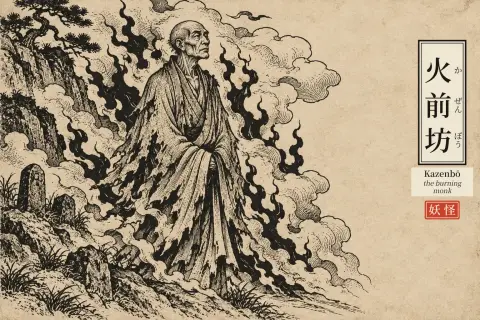
| Kazenbō 火前坊 | A monk who burned himself | Keeps a monk's shape | Sekien (1781) |
| Aosagibi 青鷺火 | An old heron | Flies over at wing height | Daigo Zuihitsu (1670) |
| Basan 波山 | A huge chicken-like bird | Gone by the time you look | Ehon Hyaku Monogatari (1841) |
| Minobi 蓑火 | Unclear: the drowned, gas, or an animal | Sticks to a straw raincoat; grows if brushed | Sekien (1781) |
| Inenbi 遺念火 | Two lovers who died badly | Two flames that stay in one place | Shimabukuro, Yanbaru no Dozoku (1929) |
| Takurō-bi たくろう火 | Two women who died violently | Two flames, side by side | Geihan Tsūshi (1825) |
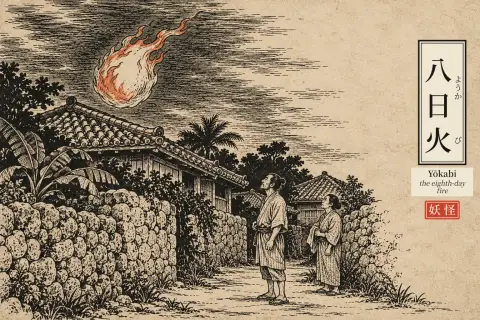
| Yōkabi 八日火 | Unclear; known by its date | A drifting fireball | Sakihara (1998) |
| Shirami シラミ | A drowned person | Clings to a boat and stops it | Oral; printed 2023 |
The full group, with pictures, lives on the ghost lights page.
A hitodama is the soul itself
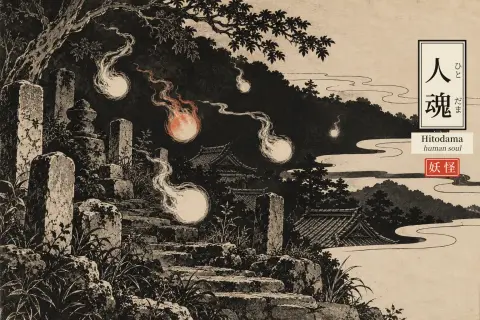
Hitodama means "human soul." It is the oldest light on the list. A poem in volume 16 of the Man'yōshū, an 8th-century poetry collection, mentions a hitodama that is sa-ao, "deep blue."
In many village stories, it leaves the body around the time of death. Then it drifts off toward the graveyard or temple. It flies low, and it has a tail like a slow comet.
So a hitodama is going somewhere. It does not haunt one spot. Toriyama Sekien drew it in his 1779 Konjaku Gazu Zoku Hyakki.
Onibi is the fire nobody owns
Onibi means "demon fire." The encyclopedia Wakan Sansai Zue (1712) describes it as a blue light, like a pine torch. It splits apart and joins up again. It comes close to people and drains their life force. The same book says it grows from the blood of men, horses and cattle killed in battle.
That is the key difference. A hitodama belongs to one person, at one death. Onibi belongs to nobody. It rises from the ground where the dead lie.
The two words do overlap, and the sources say so. Japanese Wikipedia notes that hitodama are sometimes called onibi, or even kitsunebi. It also says that, strictly, the hitodama is a different idea. Onibi was also a family name for many lights. An Edo-period scroll from Tosa even writes 鬼火 and reads it "kechibi." Use the words loosely, and you will be in old company.
Kitsune fire is called kitsunebi
The fox's light is kitsunebi (狐火), "fox fire." Sekien drew it in his first yokai book, Gazu Hyakki Yagyō (1776). In Yamagata and Akita it was also called kitsune-taimatsu, "fox torches." A long row of these lights in the hills was read as a fox wedding, kitsune no yomeiri.
Kitsunebi is the light with an author. A fox makes it, and the fox has a reason. Usually the reason is to lead you off the road.
At Ōji, in what is now northern Tokyo, the fires had a better use. On New Year's Eve, foxes were said to gather under a great tree. Farmers counted their lights to forecast the next rice harvest. Hiroshige printed the scene in 1857.
The other eleven add a face, a body or a date
The rest of the table is mostly one of the big three, made more exact. Some add a face, like ubagabi and kechibi. Saikaku wrote about ubagabi in 1685. One man in Kōchi caught a kechibi and died of fever. Kazenbō keeps the shape of a burning monk. Some add a body: a heron, or a bird like a chicken.
Others belong to a place or a date. Kosenjōbi keeps to battlefields. Yōkabi, "eighth-day fire," is the fireball seen around the tenth day of the eighth lunar month. In some villages it warned of a death. In others it meant good news.
If you see this on land, it is probably that
This key uses only what our sources say. Treat it as a rule of thumb.
 Someone in the house has just died. A soft ball of light slips out of the window, trailing a tail. That is a hitodama.
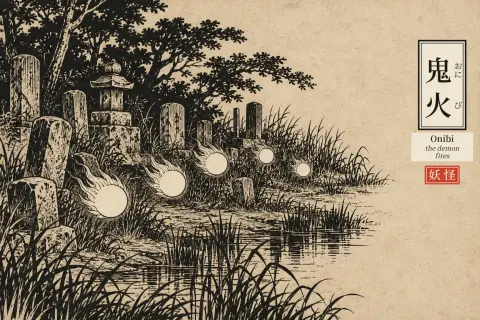 You cross an old graveyard after dark. A small blue flame hangs at head height, burning nothing. That is onibi.
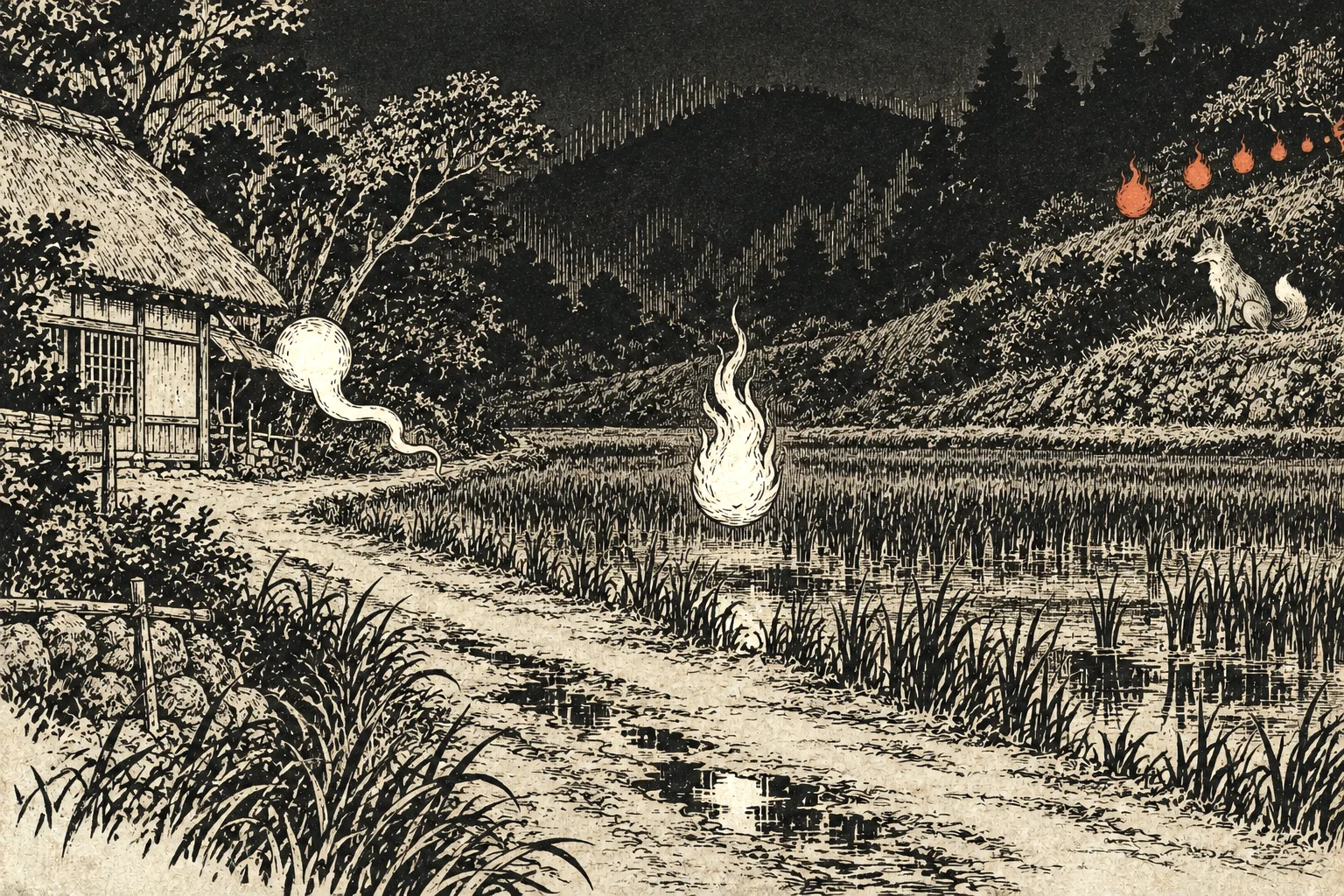
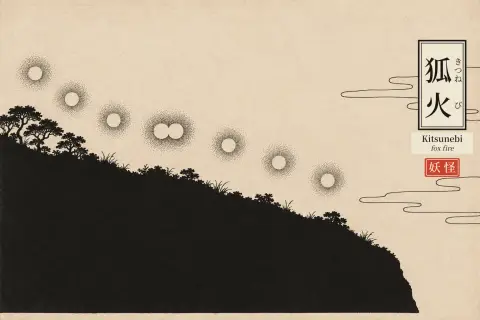 Far across the rice fields, a line of lights flickers. No road runs there. That is kitsunebi. Do not follow it.
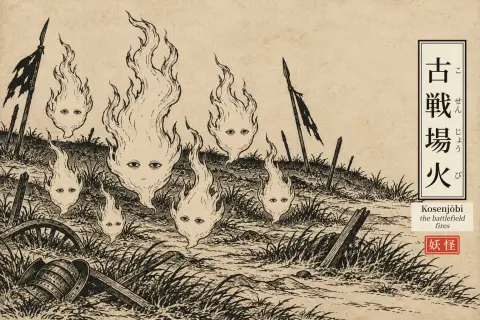 The field was a battlefield long ago. Fires with no wick drift low over the grass. That is kosenjōbi.
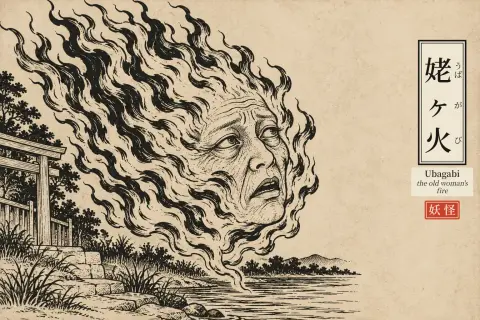 On a rainy night in Kawachi, a ball of fire drifts over the fields. An old woman's face is inside. That is ubagabi. Do not let it brush your shoulder.
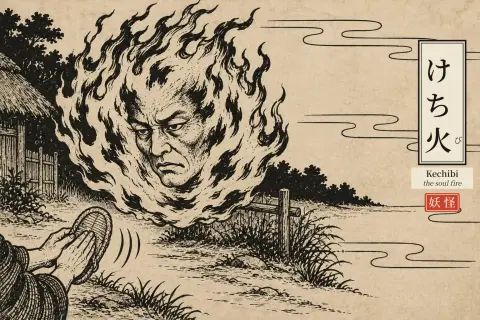 By the Monobe River in Kōchi, something bright rolls in the dirt. It has a face. Slap your sandal, and it comes closer. That is kechibi.
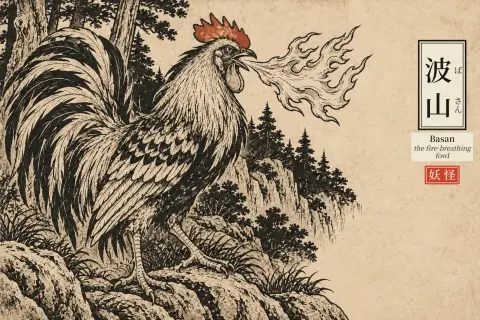 At night in a village in Iyo, you hear wings: basa, basa. A red flame glows from a bird's beak. Look outside, and it is gone. That is basan.
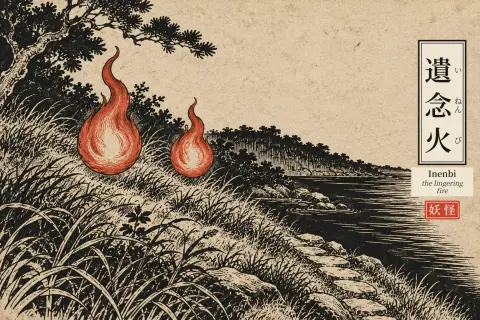 Two flames appear side by side on a slope in Okinawa. They keep to the same spot. That is inenbi.
If you see this on the water, it is probably that
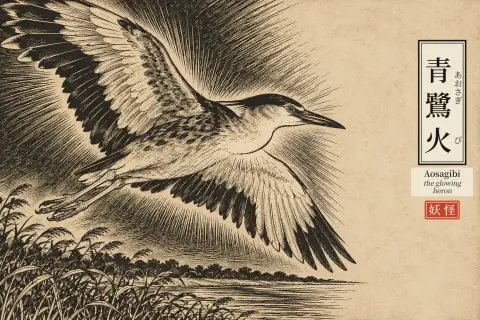 Over the marsh, a bird flies past with its body glowing blue-white. That is aosagibi.
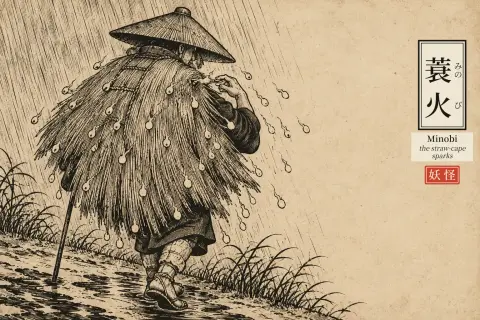 You are on a boat on Lake Biwa in the rainy season. Sparks cling to your straw raincoat. Brush them off, and they multiply. That is minobi.
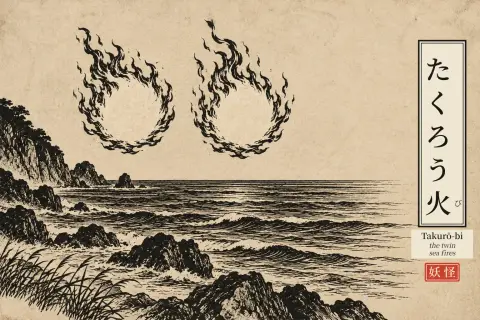 Off the Mitsugi coast on a summer night, two fires rise side by side. That is takurō-bi.
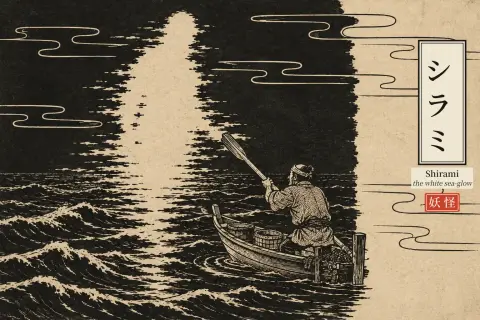 It is raining, and your boat suddenly will not move. A white light sits under it. That is shirami. Do not call it baka.
Every one of them breaks a rule of fire
An ordinary fire follows three rules. It needs fuel and gives off heat. Water puts it out. It ignores whoever is watching.
Japan's ghost lights break these rules. Some are said to give no heat: basan's flame burns nothing, and minobi is said not to be hot. Eight appear over water or wet ground. Three of those, ubagabi, minobi and shirami, come out on rainy nights. And seven react to the person who sees them, as the keys above show: they follow, multiply, come when called, or vanish.
People guessed at the cause for centuries
The guesses changed with the science of each age.
Burning bones. In the 19th century, many said phosphorus from buried bodies made onibi. Japanese reference works say the idea lasted until about the 1920s. Bones do not catch fire on their own.
Swamp gas. Rotting matter gives off gases that can catch fire in air. In Europe, Alessandro Volta suggested marsh gas in 1776. In 1976, Yamana Masao made a fake hitodama with burning gas.
Bent light. In 1977, Kakuta Yoshiharu argued that most kitsunebi were distant lights, bent by layers of air.
Electricity. In the 1980s, the physicist Ōtsuki Yoshihiko argued that hitodama are plasma in the air.
The eye itself. In 1933, the physicist Terada Torahiko wrote about a fireball his two children saw. He thought a real effect and a trick of the eye worked together.
Europe has its own fires, but not this one
English has the will-o'-the-wisp. Like kitsunebi, it lures travellers over bogs at night.
English "foxfire" is a different thing. It is the green glow of fungi on rotting wood. That light stays on its log. Kitsunebi travels, and a fox is carrying it.
Our reading: a light at night meant a person
This part is our own reading, not a record.
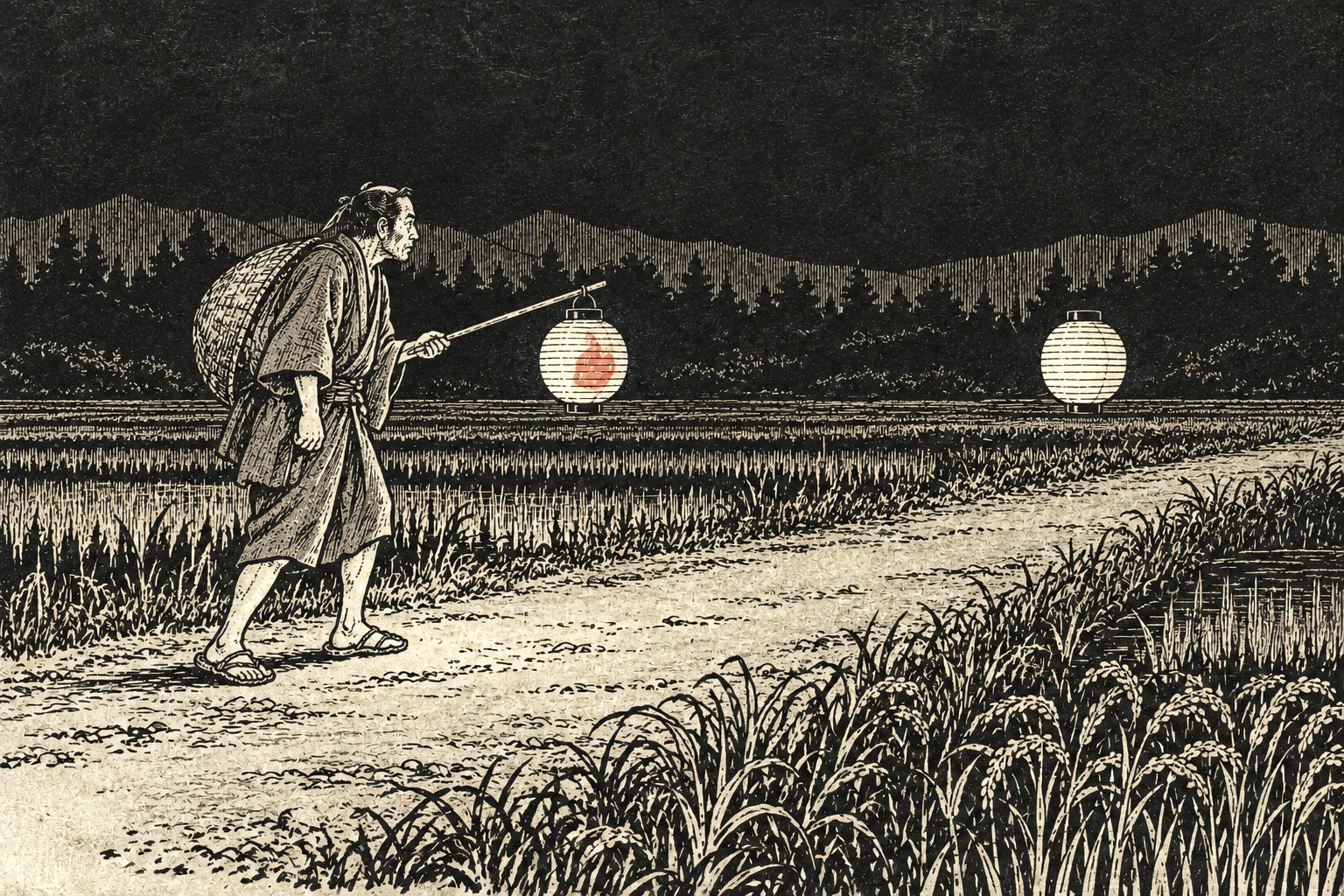
For most of history, a light on a dark road meant that someone was carrying it. A lantern had a hand. A torch had a walker. So a light with nobody under it raised one question first: whose is it?
Every name on this page is an answer to that question. A soul. A fox. A dead soldier. An old woman who stole lamp oil.
The rules point the same way. Do not follow it. Do not brush it off. Do not call it names. These stories read less like horror than like advice for the night road.