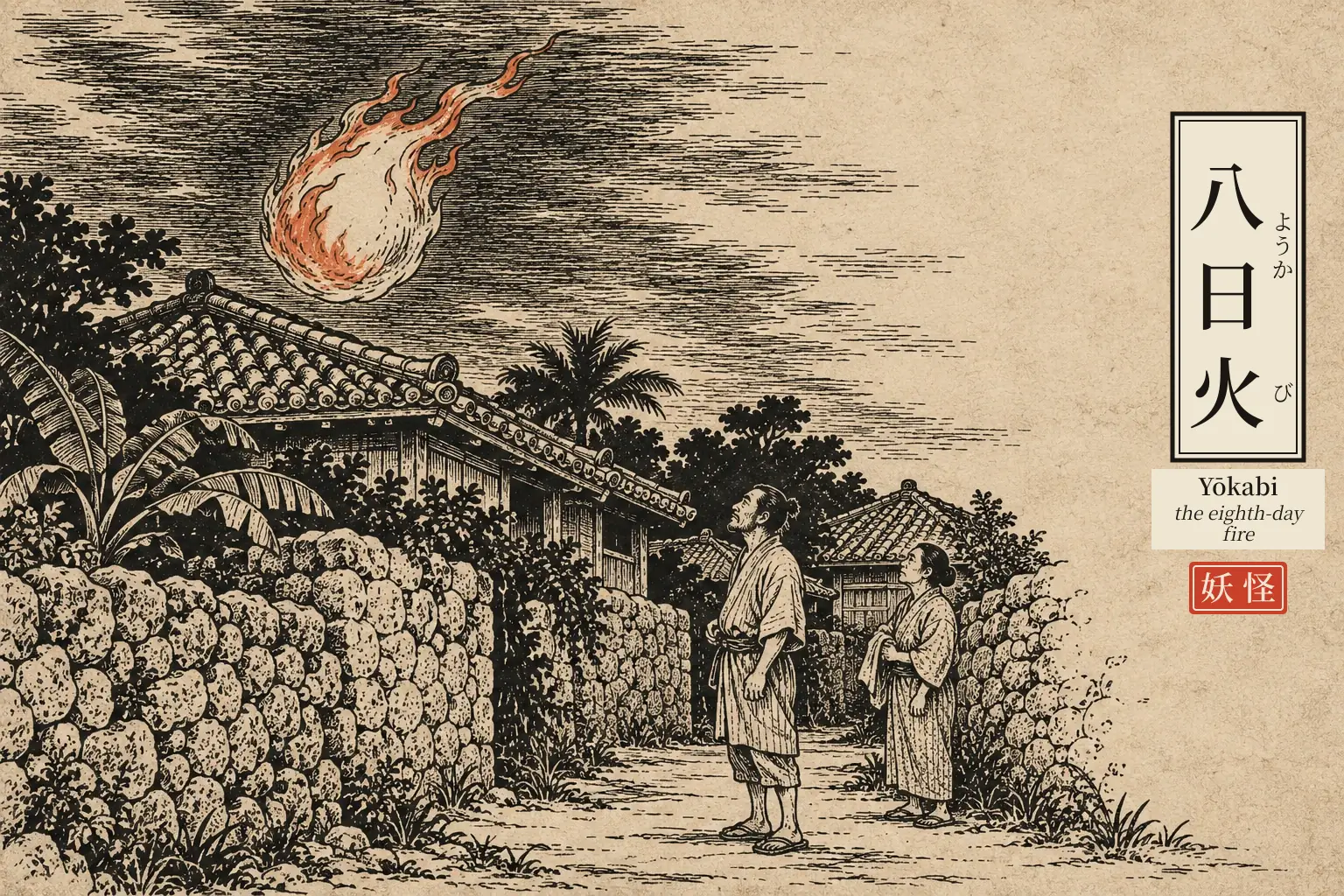
In Okinawa, a floating ball of fire is a hidama (火玉). People reported them all year round. But the fireballs seen around the tenth day of the eighth lunar month got a name of their own: yōkabi (八日火), "eighth-day fire." The name is literal. 八日 (yōka) is "the eighth day." 火 (bi) is simply fire. What made this fire worth naming wasn't how it looked. It was when it showed up, and what people thought that meant.
What does it look like?
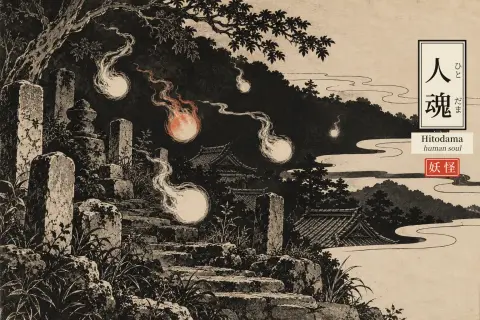
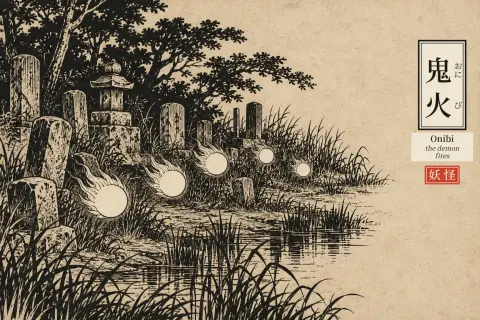
No source describes a shape beyond the hidama itself. It is a drifting ball of flame. No source gives a color, a size, or a fixed number of lights for yōkabi specifically. That puts it in the same broad family as other Japanese fire-yokai like onibi and hitodama — each its own local name for an unexplained light with no visible source.
The sources also record other names for the same phenomenon. 妖怪火 ("mysterious fire") is written with different kanji. It shares the exact same reading, Yōkabi. サンガイ火 (sangaibi) is another recorded name. No source gives an origin for that name. All three point back to the same underlying hidama.
A fire on the calendar
Most Japanese fire-yokai are tied to a place — a graveyard, a battlefield, a stretch of road. Yōkabi is tied to a date instead. Hidama appeared across the year, old accounts say. But only the ones clustering near the eighth lunar month's tenth day carried the yōkabi name, and its reputation with it.
Before World War II, the fire could be seen in many villages. These weren't rare, one-off sightings passed down as legend. They were a seasonal occurrence, recorded as common in the years before the war.
A fire that could mean either
What the fire meant depended on who was watching.
A hidama rising from a house warned of a coming death. Or some other misfortune settling on that household. That is the reading the sources give as the default. It matches how other Japanese fire-yokai function, as a visible warning tied to loss.
Some villages read it differently, though. They treated the same fire as a good sign instead. They called it a 吉兆 (kitchō, "lucky omen"), a sign of happier news, such as a birth in the family. The written record doesn't explain why these villages read it differently. It simply notes that both readings existed, side by side, across Okinawa.
Where it comes from
Fire with no visible fuel has always needed an explanation. Across Japan, that explanation usually involves the dead, or something left unresolved. Okinawa's yōkabi fits that pattern loosely, without pinning the fire to any one grudge or body, the way onibi stories often do. It reads less like a ghost story about one person. It reads more like a seasonal sign tied to a fixed date in the lunar calendar.
The clearest written account of yōkabi is not an old scroll. It is twentieth-century folklore research. Its author is 崎原恒新, romanized by convention as Sakihara Kōshin, though no source confirms that reading. The survey, titled "Okinawa no Yōkai Henka" (沖縄の妖怪変化), ran in the journal Nantō Kenkyū in 1998. It records the fire, the date, and both competing omens. It says the fire could be seen in many villages before the war.
Go deeper
Books worth owning if this world pulls you in.
- The Book of Yokai →Michael Dylan FosterThe most readable scholarly introduction to yokai — where they come from, what they mean, and the major creatures.
- Japandemonium Illustrated: The Yokai Encyclopedias of Toriyama Sekien →trans. Hiroko Yoda & Matt AltThe complete Edo-period bestiaries that so many of these entries trace back to, in full English translation.
Some links are affiliate links; if you buy through them we may earn a small commission at no extra cost to you.
Yōkabi today
Yōkabi has stayed a minor, regional entry in Okinawan folklore catalogues. We found no sign it has become as well known as kappa or tengu, and no mention of it in games or popular fiction. It turns up mainly in yokai reference databases and folklore surveys. Nothing in the record says whether the sightings common "before the war" have continued at the same rate since. What's left is the shape of the belief itself: a fire that needed no monster's face to carry a warning, only the right night of the year.