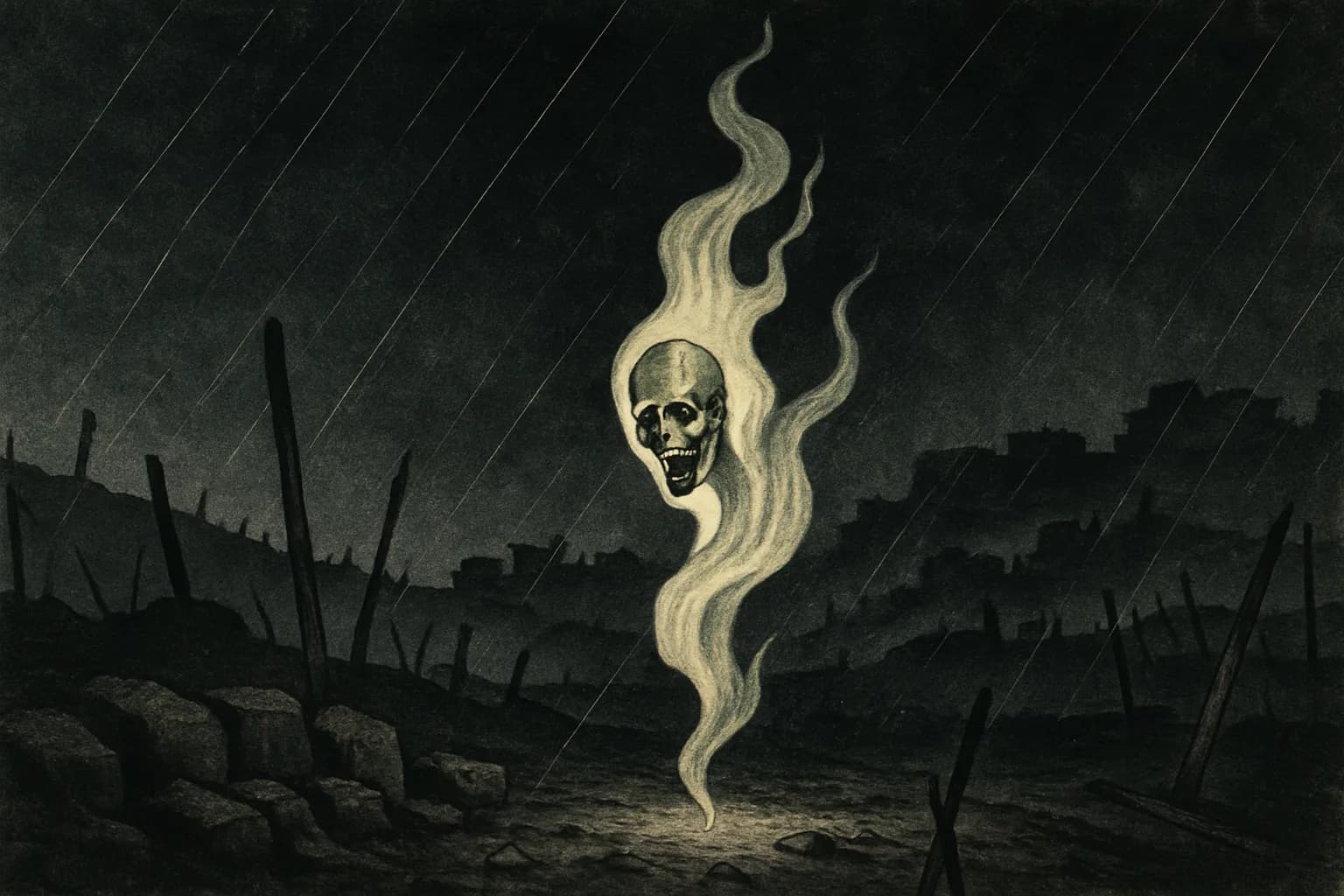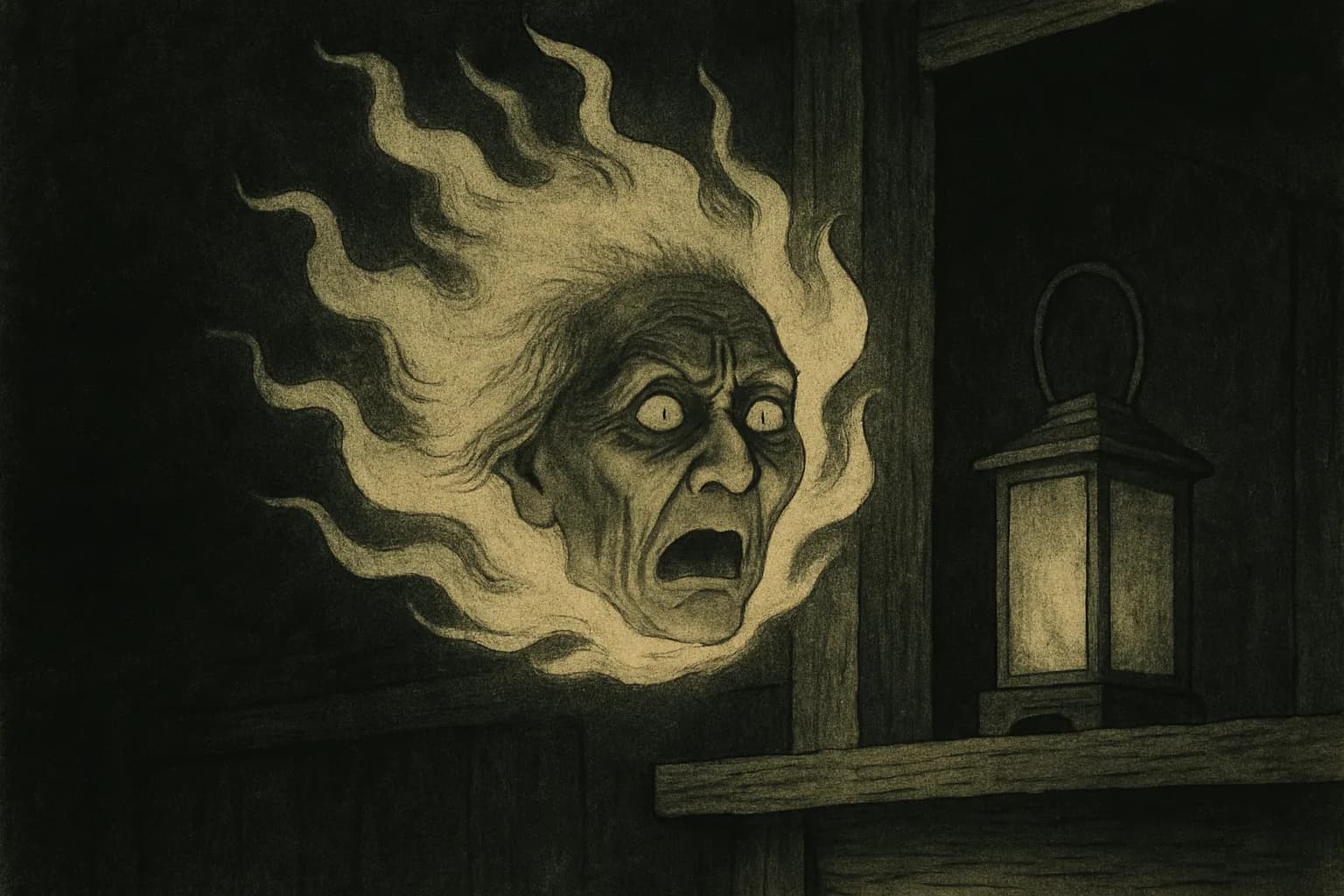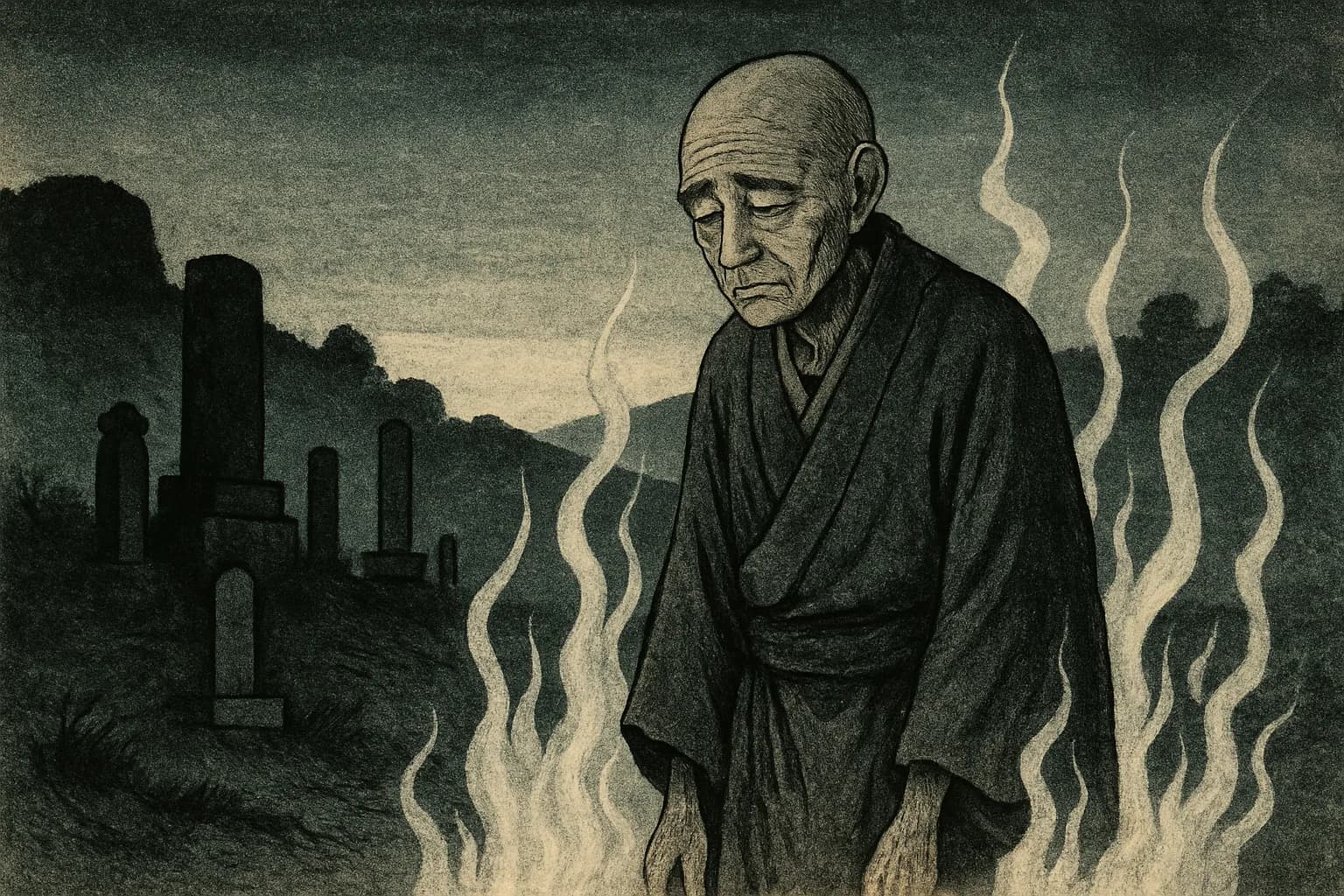
For more than a thousand years, the hills east of Kyoto sent up smoke every day. Toribeyama and the adjoining plain of Toribeno were among the city's principal cremation grounds from the Heian period onward, and the sight of that smoke rising over the ridge became one of Japanese poetry's standing images for death — "the smoke of Toribeyama," a phrase you can find in classical verse and in the Tale of the Heike, used the way English once used "returning to dust." Toriyama Sekien's Konjaku Hyakki Shūi (今昔百鬼拾遺, 1781) puts one more figure on that hillside: a monk who spent so long presiding over other people's cremation fires that when his own turn came, he simply never left. He is Kazenbō (火前坊), and by Sekien's telling he is still there, upright, burning.
What does it look like?
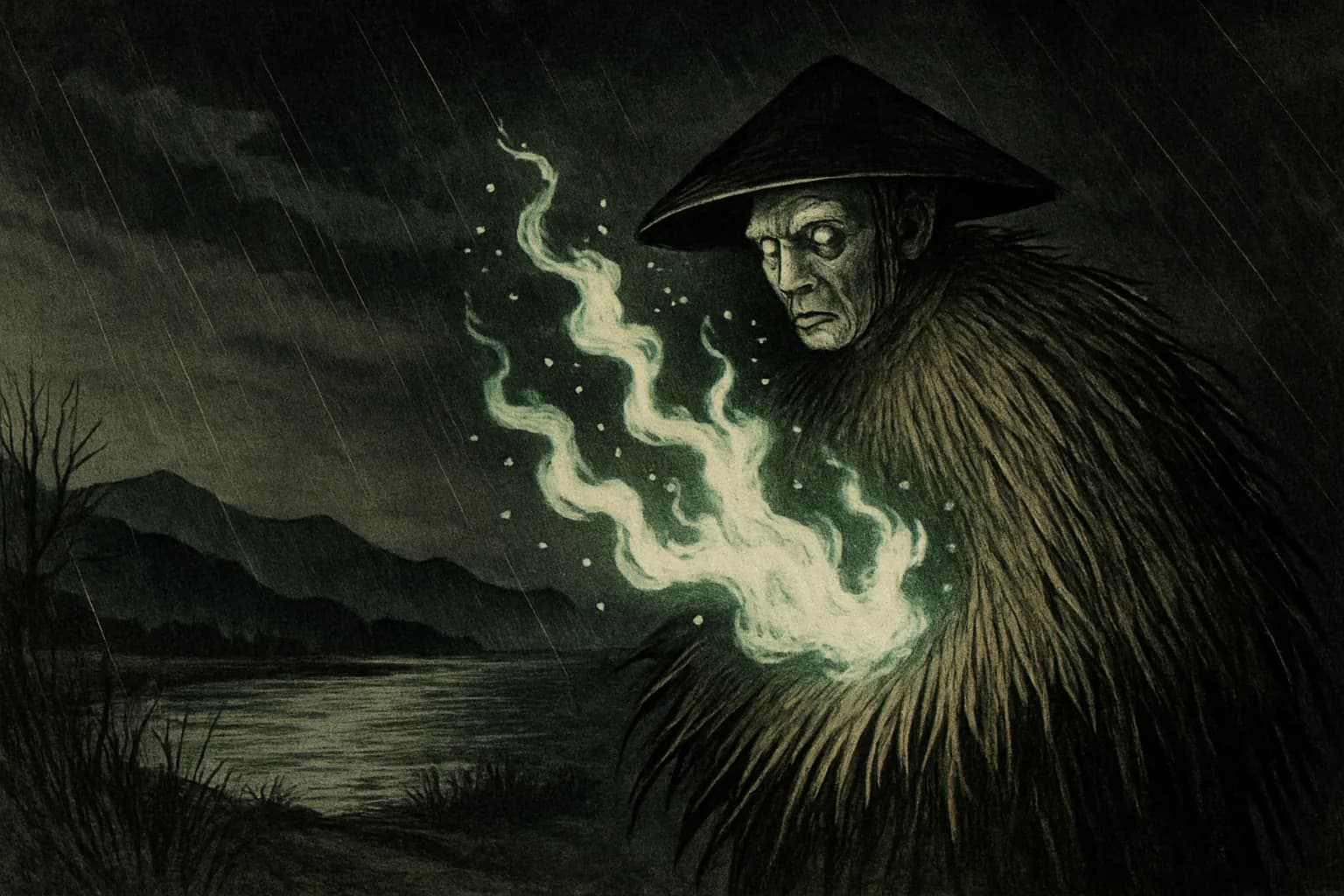
Sekien's print shows a solitary figure in a monk's robe, wreathed head to foot in fire, standing at the cremation ground the way he must have stood a thousand times before while alive — attending a pyre, not fleeing one. There is no gaping mouth, no clawed hand reaching for a victim. The stance is composed, almost dutiful. That restraint is exactly what makes the image work: this is not a demon lunging out of the dark, but a man carrying on his old post after the fire has, by every ordinary account, consumed him entirely.
The monk who couldn't put the fire down
Sekien's own note explains the name plainly: a monk who tended the funeral pyres of Toribeyama for years grew so fixed on the sight of flame consuming a body that the habit outlasted his life. Where Noderabō keeps ringing a temple bell nobody built anymore, Kazenbō keeps performing the one act he associated with death itself — except now he is both the mourner and the corpse, monk and pyre in a single standing shape. The kanji record the same collapse: 火前 (kazen), "before the fire," fused directly onto 坊 (bō), "monk," so that the job and the man are no longer two words but one.
Toribeyama, the mountain that never stopped smoking
Toribeyama's reputation was not invented for this print. Along with Adashino to the west and Rendaino to the north, it formed one of the three traditional disposal grounds ringing Heian-era Kyoto, and its name carried the weight of centuries of funerals by the time Sekien was cataloguing yokai in the 1780s. A monk stationed there was not an exotic detail — cremation and burial in that period were overseen by Buddhist clergy as a matter of course — which is presumably why Sekien needed no elaborate backstory to make Kazenbō legible to an Edo-period reader. Everyone already knew what kind of smoke rose from that hill.
Where it comes from
Kazenbō belongs to a small class of Sekien yokai built from the same premise: a person's occupation or obsession outlives their body and becomes the whole of the apparition. It sits close to the ghost-fires like kosenjōbi, the flames said to rise from old unburied battlefields, and to hitodama, the drifting soul-lights seen over graves — except that where those are impersonal phenomena, tied to a place rather than a face, Kazenbō keeps his shape. He is a fire that still remembers being a man, doing the one job that mattered enough to survive death.
Kazenbō today
Kazenbō never built a following the way the kappa or tengu did — he has no shrine, no mascot, no famous kabuki scene. He mostly survives inside reprints of Sekien's Hyakki Shūi, cited by yokai researchers alongside Noderabō and the other quietly persistent dead in that same volume, a minor entry in a catalogue of people who forgot they had died. Toribeyama itself is now Kyoto's Higashi Ōtani district, threaded with temples and a working cemetery, the smoke long since replaced by incense — though the old poetic phrase about its rising fumes is still there for anyone who goes looking for it.