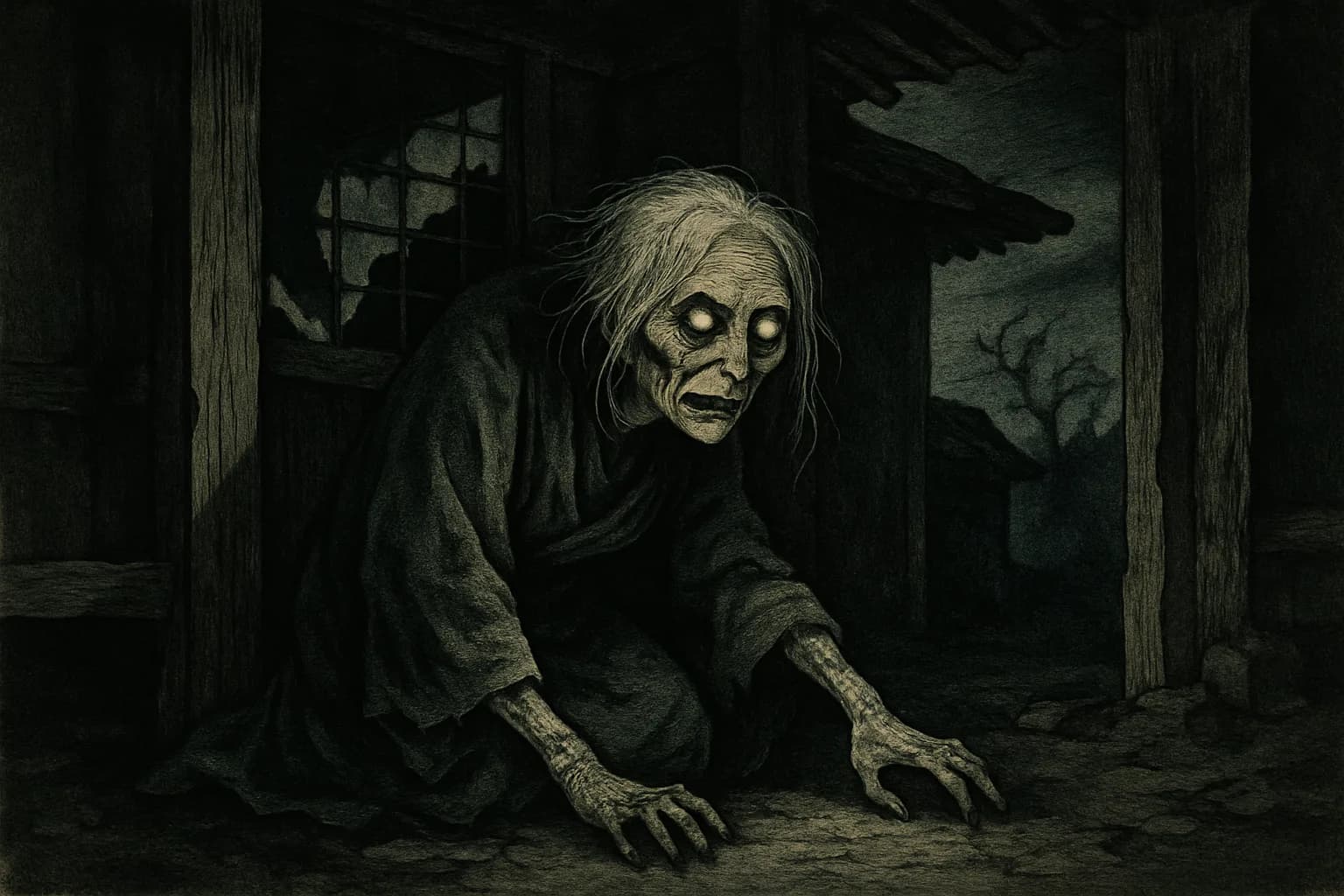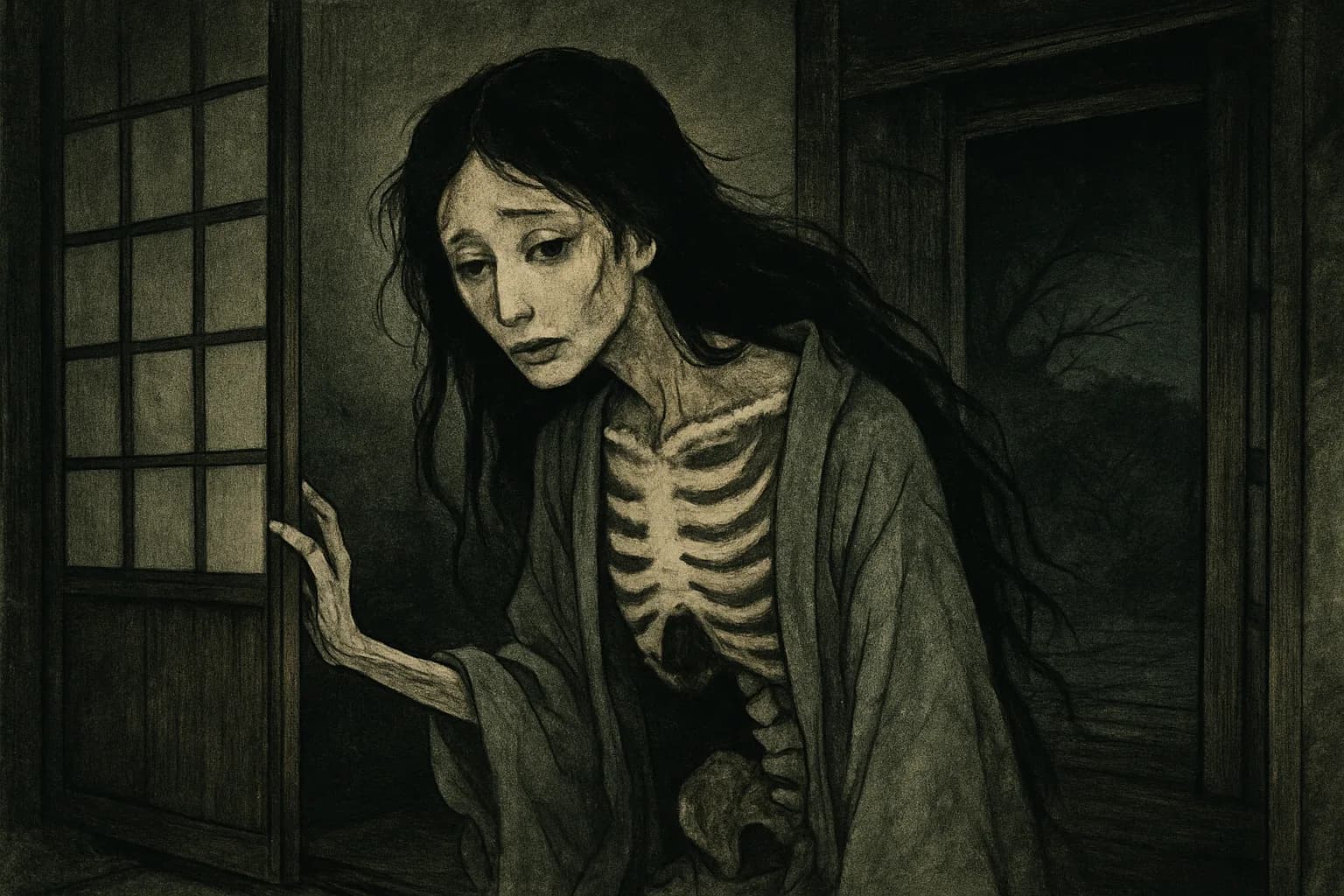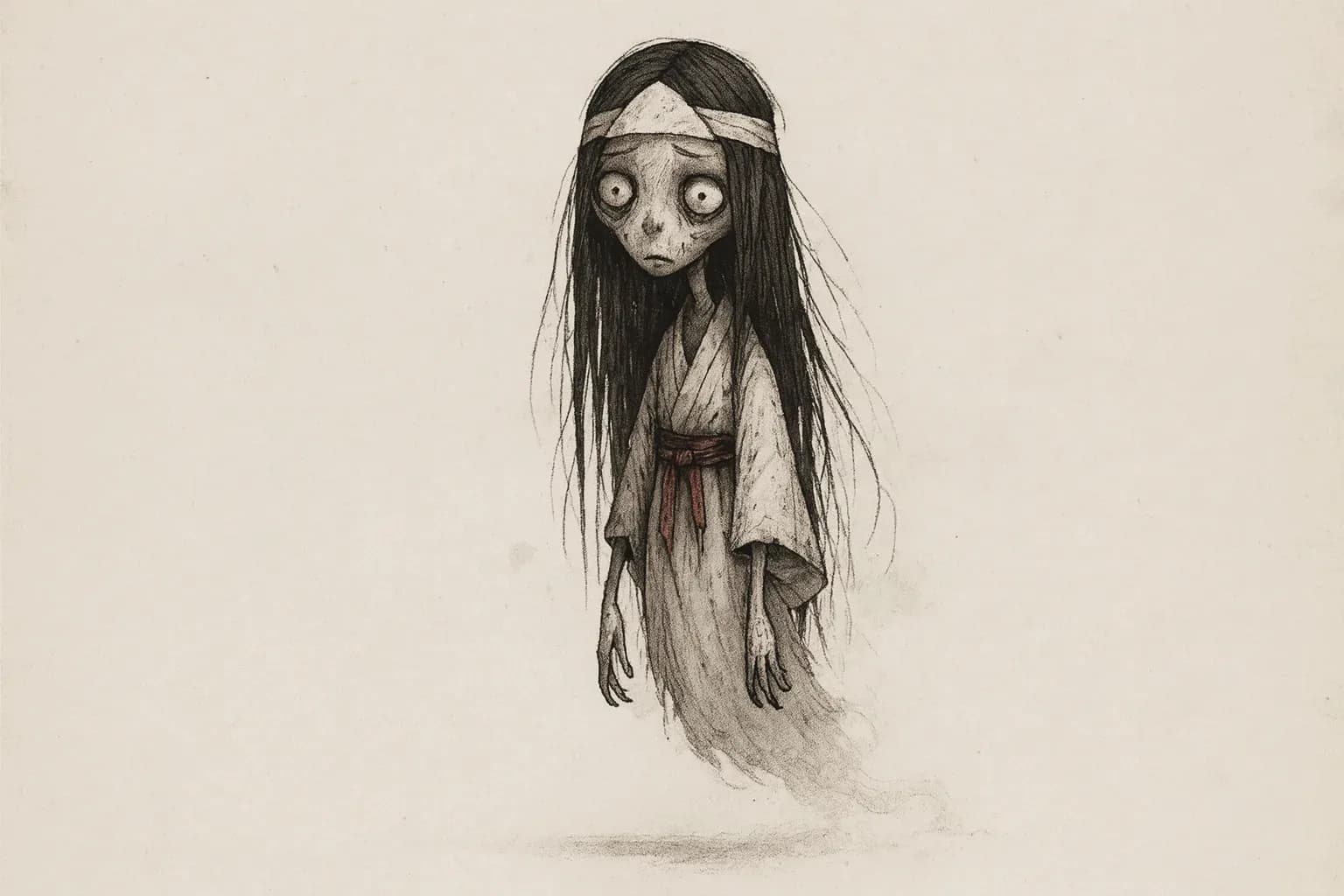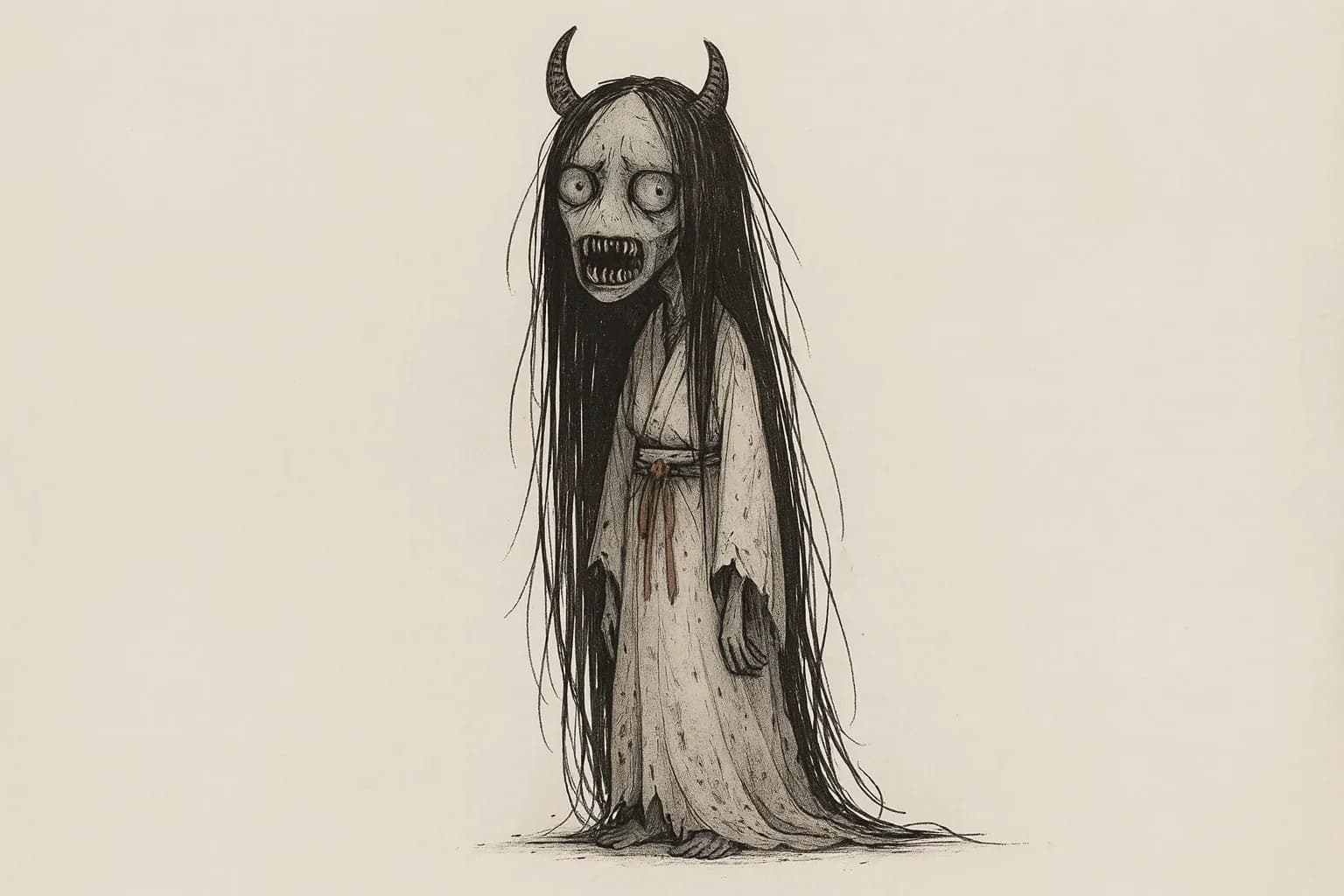
A traveler cutting through the hills at dusk hears it before he sees anything: the low, round toll of a temple bell, right on schedule, the way it has sounded every evening for centuries. He follows the sound to its source and finds the temple gate standing open — and beyond it, a bell tower with no bell, a hall with a collapsed roof, and grass growing up through the floorboards. Nobody has kept this temple in years. The ringing has stopped by the time he reaches it. This is Noderabō (野寺坊), "the monk of the wild temple," a yokai who never noticed that his temple, his congregation, and quite possibly he himself no longer exist.
What does it look like?
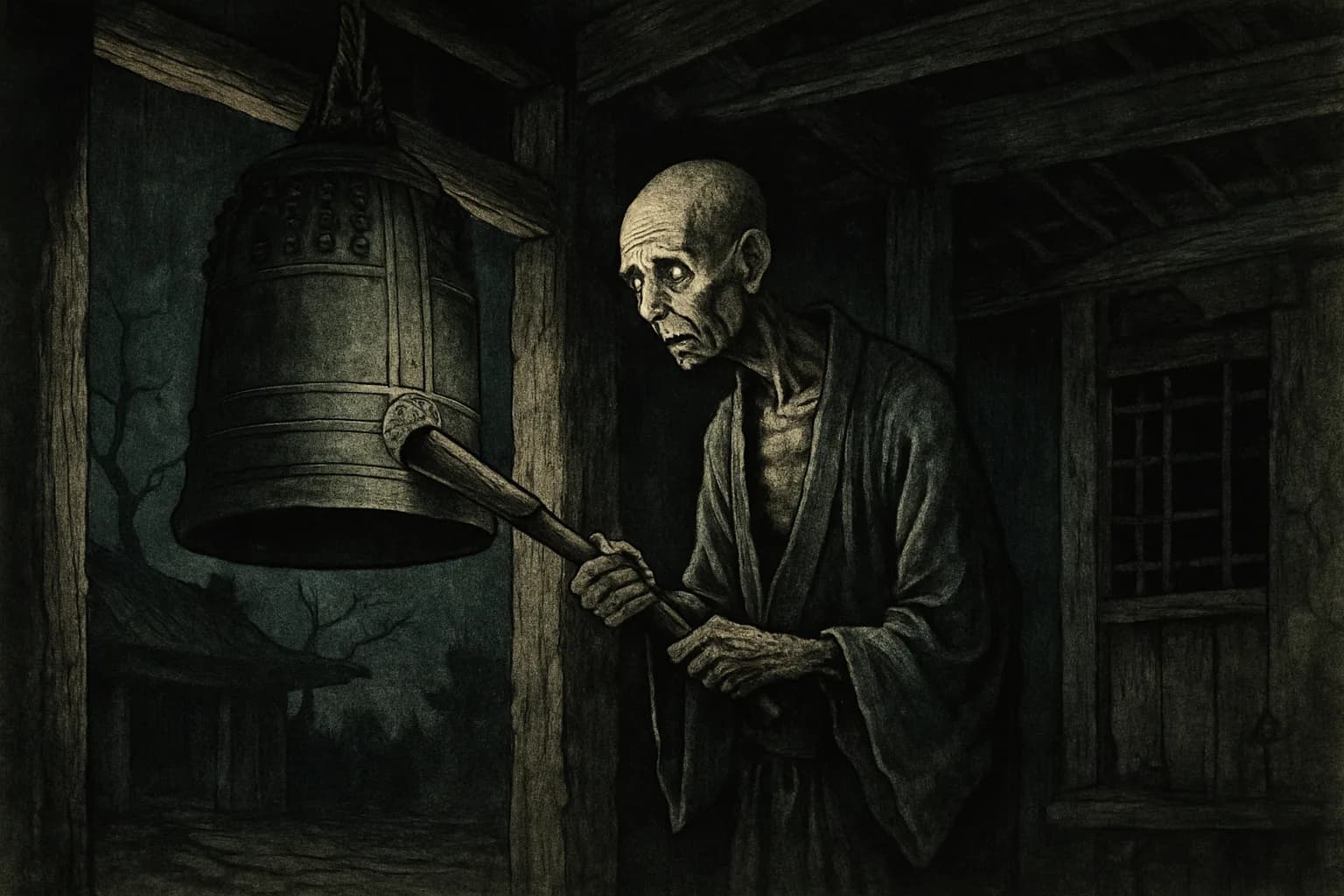
Toriyama Sekien drew Noderabō in his 1776 print collection Gazu Hyakki Yagyō (画図百鬼夜行, "The Illustrated Night Parade of a Hundred Demons") as a lone Buddhist priest, gaunt to the point of looking half-starved, standing at a temple bell in the dark with the rope or striker still in hand. There is nothing monstrous about the figure at first glance — no horns, no extra limbs, nothing that marks him as other than a working monk going about his evening duties. That ordinariness is the point. He looks exactly like what he used to be, doing exactly what he always did, in a place that stopped needing him long ago.
The bell that keeps its own schedule
In a functioning Buddhist temple, the evening bell — often called the bansho (晩鐘) or rung at the hour of iriai (入相) — marked the close of the day: a call to the last services, and a signal the surrounding village set its evening by. The sound of a temple bell at dusk was, and still is, one of the most familiar notes in Japanese religious and literary life; "the evening bell of Mii-dera," tolling across Lake Biwa, was even ranked among the classical Eight Views of Ōmi.
Noderabō's temple has none of that left. Its parish is gone, its buildings are falling in, and by most tellings its last resident monk died there alone — of hunger, of neglect, of simply being forgotten. What survives is the routine. Night falls, and the bell sounds anyway, on time, because ringing it was his job and nothing since has told him to stop.
An apparition made of habit, not malice
Noderabō is not counted among the dangerous yokai. He doesn't chase, curse, or drag anyone into the dark the way an ushi-oni or a nure-onna might. He is closer in spirit to the household tsukumogami that keep performing their old function long after their owners have forgotten them — except that what he can't let go of isn't an object, but a vocation. Sekien's Yagyō volume is full of these quietly persistent dead: figures whose hauntings are really just their old lives continuing on a loop, oblivious to the fact that everyone who mattered to that life is gone.
The unsettling part for anyone who actually goes looking, as in the traveler's story above, is the mismatch in time. The bell tells you the temple is still tended. The building tells you it has been abandoned for years. Both things are true at once, and the gap between them is where Noderabō lives.
Where it comes from
Small rural temples across Edo-period Japan were genuinely fragile institutions — dependent on a resident priest, a local patron, and a village able to support the upkeep. Famine years, a dwindling parish, or a priest who died without a successor could leave a temple to rot within a generation, and haiji (廃寺), the "ruined temple," was a real and recognizable category of place, not just a literary device. Sekien's Hyakki Yagyō books frequently work this way: he takes an ordinary, half-superstitious fear people already carried — of an empty temple, an unclaimed grave, a house nobody moved back into — and gives it one clean supernatural image. Here, that image is a bell that outlived its ringer.
Noderabō today
Noderabō never became a mascot the way the kappa or tanuki did, and there's no famous kabuki play or modern franchise built around him. He mostly survives the way many of Sekien's quieter creations do: reprinted in yokai encyclopedias, catalogued alongside the rest of the Hyakki Yagyō night parade, and occasionally invoked whenever someone wants a short, evocative image for the loneliness of a temple gone to ruin. He's a minor figure by design — which is fitting, for a ghost whose entire story is that nobody noticed he was still there.