In June 1990 a Japanese tabloid photographer went to a temple pond in Yamagata. Something with a human face rose out of the mud. Newspapers and TV shows soon called the fish jinmengyo — written 人面魚, "person (人) face (面) fish (魚)." The fish was a real koi. Its face was ordinary fish pigment.
What does it look like?
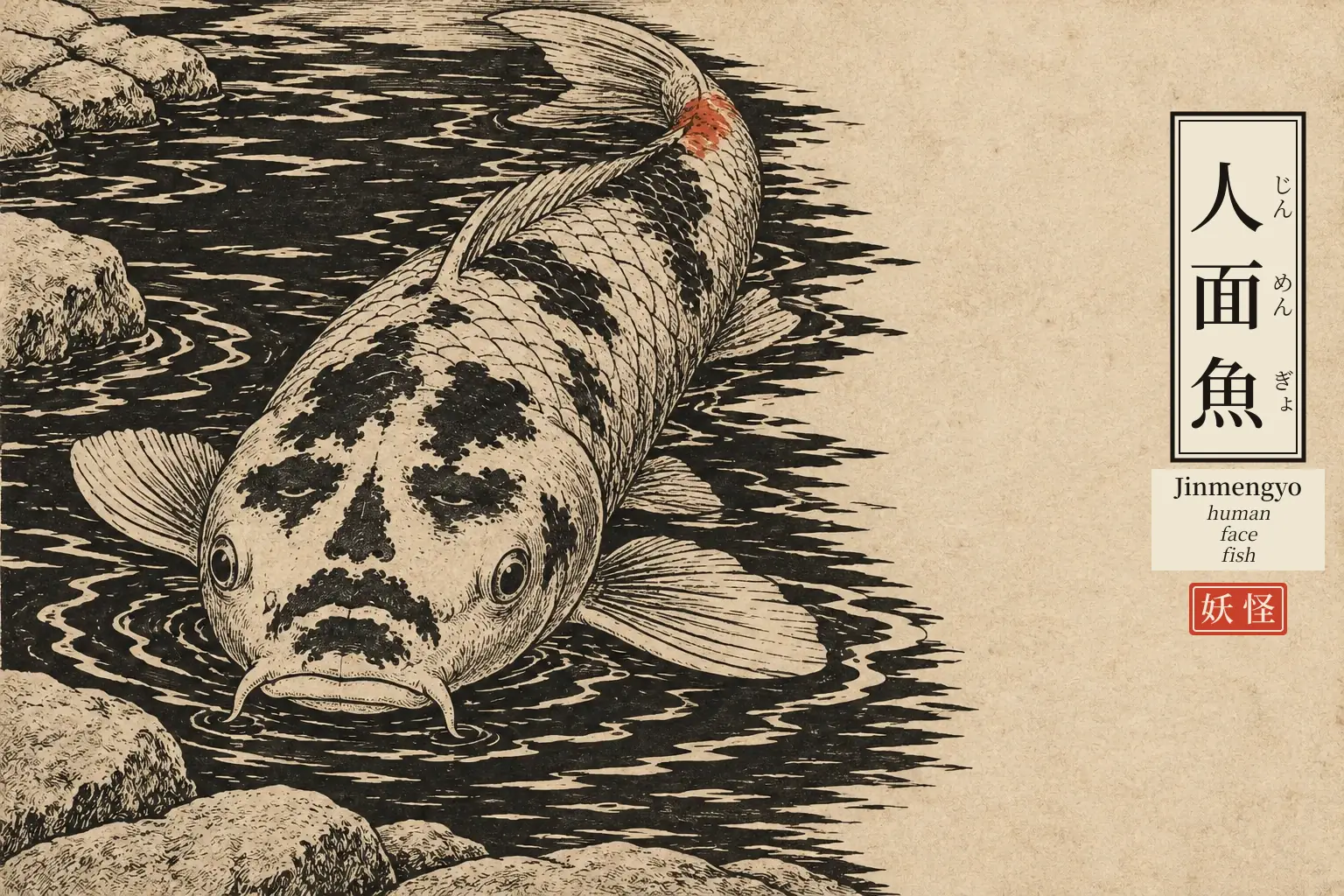
Jinmengyo is not one species. It is any fish, usually a koi. Its head carries a pattern that looks like a human face. Seen from the front and slightly above, the markings can look like a carved face.
A fish-genetics professor at Shimonoseki's Fisheries University was asked about one such sighting, in 2008. He said the illusion shows up most often on shiny gold- or silver-colored koi. On that fish, dark, shadowed patches happened to fall where a face's features would be. Two of them read as eyes.
The koi that started the whole story was not even golden. Tokyo Sports' own photographer recalled it as silver-bodied, about 50 centimeters long, with a red stain near its tail. News reports later called it a golden nishikigoi — an ornamental koi — and some retellings still do. As of 2020, a golden koi lived at the same pond too. Records show it was a different fish.
How the Kaibami Pond carp became a national obsession
Zenpō-ji's own worshippers already knew about the pond's odd-looking koi. In spring 1990 the weekly photo magazine Friday ran a reader's snapshot of the fish. The photo was taken from far away and came out blurry.
The tabloid Tokyo Sports saw the story and sent a photographer to the temple. He arrived at the pond around 8am on 10 June 1990. The fish rose slowly out of the dark, rain-muddied water. It stayed in view for about three minutes. It ignored the food he threw it. Two days later, on 12 June, the paper ran the photo on its front page. The headline read, "The rumored human-faced fish smiled."
TV variety shows and news programs picked up the story, and it became a nationwide boom. That summer, as many as 10,000 people came to Kaibami Pond in a single day. At least one visitor fell in. Reports of similar fish began arriving from ponds and rivers across Japan. Some were silver. Some were plain black carp, called magoi.
Part of the reason it spread so fast was timing. A rumor was already going around about jinmenken, a dog with a human face. People said it could even talk. People were primed to notice a human face on an animal.
Why "human faces" keep turning up
There is no single trick behind a jinmengyo. The fish are ordinary koi. What changes is where the pigment lands on each one's head. Shadowed patches in the right places can read as eyes and a nose to a human brain.
Psychologists have a name for this: pareidolia. It means seeing a face in a pattern that has no face at all. It is the same reflex that finds a face in wood grain, or a man in the moon.
The name has also drifted to creatures that have nothing to do with koi. Some deep-sea fish get called jinmengyo too, because of how their heads are shaped. The barreleye and the blobfish are two examples people point to online. The blobfish's famous droopy look is not how it appears in the deep sea, either. That shape only happens after the fish is hauled up. Its soft, pressure-adapted body loses its shape in the open air.
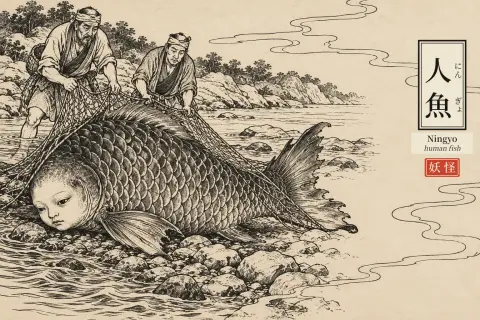
This is a different tradition from ningyo, Japan's mermaid legends, even though both get filed under "strange things found in water."
Jinmengyo today
The original frenzy eventually faded. It flared up again in 2019, when Japan's era name changed from Heisei to Reiwa. Some outlets dug up the old story and called the koi "the face of Heisei." Visitor numbers at Kaibami Pond rose again for a while during Golden Week that spring.
As of 2020, the signboard Zenpō-ji put up during the original boom was still standing. It read, "Jinmengyo's Kaibami Pond, 2-minute walk, about 200 meters." A golden koi with a face-like pattern lived in the pond too. Records show it was not the same fish that started the 1990 boom.
In 2021 the same photographer who shot the original scoop found a new trio of similarly marked koi. They were at a different temple, Suma-dera in Kobe. Thirty-one years after his first scoop, he had found another "human face." This one was smaller and silver-bodied, with a golden face instead of a red tail stain.