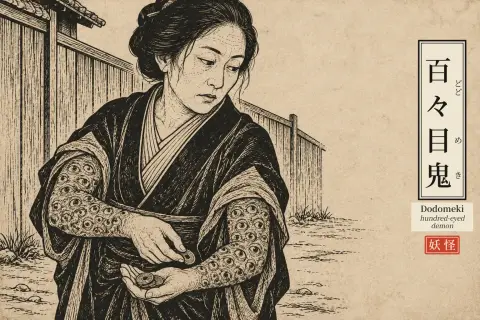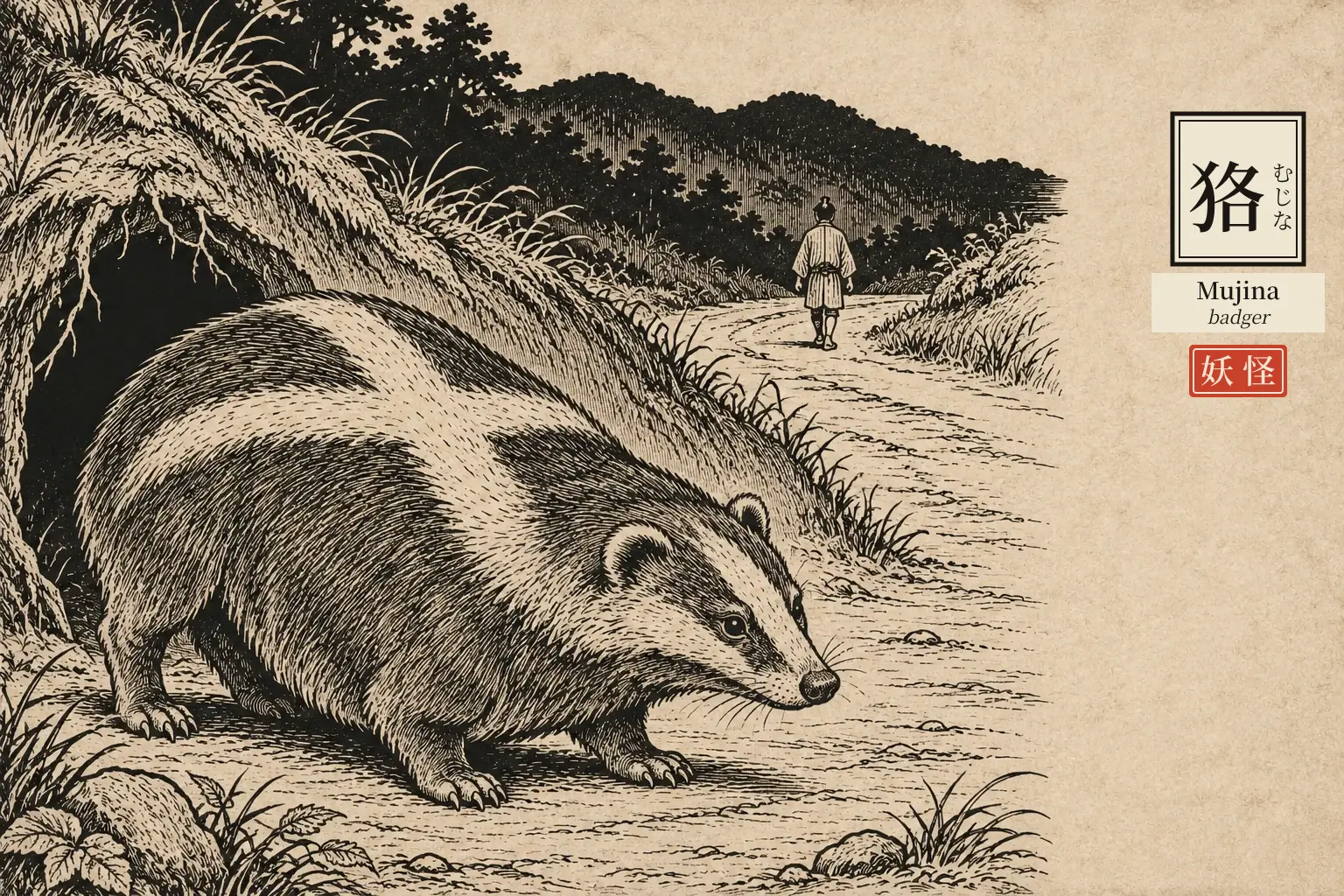
Ask a folklorist what a mujina (狢) looks like. The honest answer is: it depends who you ask. The name mostly points to the Japanese badger. But it has also meant the tanuki for centuries — and, by a more recent, minority reading, the masked palm civet too. Three different animals, one word — "the thing that fooled me on the road last night."
What does a mujina look like?
Witnesses describe a mujina as roughly dog-sized. Its front legs are shorter than its back legs. Its fur is brown. Old age changes it. Once a mujina gets old enough, white or black fur is said to grow across its back in the shape of a cross. That is when it gains the power to bewitch people.
The confusion over what animal "mujina" even names is old. It is also well documented. A regional name for the badger, mami, turns up in the Edo-period encyclopedia Wakan Sansai Zue (compiled 1712). That book lists it as its own kind of animal, separate from the tanuki. It describes a fat creature that dens in a mountain burrow. Its fur is short and brown. It cannot hear well, and moves too slowly to flee a person who spots it. Elsewhere in Japan, the same word for badger gets folded back into "tanuki" instead. A Tokyo neighborhood, Azabu's Mamianacho, takes its name from reading the character for tanuki as mami. Two names, one animal — depending on the century and the map.
A third candidate confuses things further: the masked palm civet. It is absent from Kyushu but lives on Shikoku and Honshu. Japan's naturalists only confirmed it was living wild here fairly recently, so most treat it as a species introduced from elsewhere. A minority view holds it was native all along, simply mistaken for a mujina — or even a raiju, a thunder beast.
How a mujina tricks you
Mujina folklore divides its tricks into three basic types. The first makes an ordinary field or road look like a deep, impassable river. The second turns horse dung into what looks like a steamed bun. It can also turn a cesspool into what looks like a bath — a trick built entirely on disgust. The third simply strips away your sense of direction. A familiar path home turns into a maze.
Most mujina stories play these tricks for laughs, or for mild misfortune. A few regions remember something nastier. They tell of an especially vicious mujina, known locally as an o-mujina, blamed for killing several people rather than merely humiliating them. Local histories from Koga, Noda, and Toda are cited as sources for this darker strain.
In the old Shimosa region — now Chiba and Ibaraki — a transformed mujina called kaburi-kozo was said to take the shape of a child. It wore an oddly short kimono, with a bowl-cut hairstyle. It waited on empty night roads and mountain paths, calling out "drink water, drink tea" at passersby. Japanese sources say such sightings stopped after the war, though none cites a record of this.
The story that may not be mujina folklore at all
The mujina's most famous modern appearance is not really about a mujina at all. Or at least, not provably.
In 1904, Lafcadio Hearn published a short story called "Mujina" in his collection Kwaidan. An old merchant from Kyobashi is hurrying along the Kii-no-kuni-zaka slope in Edo's Akasaka late at night — a stretch many travelers preferred to avoid after dark. He finds a young woman crouched and crying. When she turns to face him, she has no eyes, no nose, no mouth. He runs, gasping, to a soba stand. Before he can describe the face, the vendor asks, "Was it like this?" — and strokes his own face smooth and blank. Then the light goes out.
Hearn's story never uses the word that later became attached to it: noppera-bo, the modern term for a faceless ghost. It also never explains to the reader what a mujina actually is. Hearn stops to explain what soba is, but not that. He simply titled the story "Mujina," as though the shapeshifting badger were an obvious culprit to a Japanese reader.
Was it, though? Lafcadio Hearn's own great-grandson, Koizumi Bon, doubts it. He has argued the story is probably Hearn's own invention. His theory: a blend of an older Japanese motif, something huge looming out of the dark to frighten a traveler, mixed with a memory from Hearn's own childhood. Not a tale Hearn genuinely collected from Japanese tellers. If Koizumi is right, one of the mujina's best-known "legends" is a century-old piece of fiction wearing a folklore label.
Where it comes from
The earliest written trace we could find of a shapeshifting mujina is much older than any of this. The Nihon Shoki, Japan's early 8th-century chronicle, records an entry for the 35th year of Empress Suiko — 627 CE. It notes that "in the second month of spring, there was a mujina in Mutsu Province; it became a person and sang." That one line is usually read as proof. Japanese audiences already linked mujina with shapeshifting nearly 1,150 years before Toriyama Sekien drew one for his Konjaku Gazu Zoku Hyakki in 1779.
Between those two points sits most of the mujina's reputation. Most tellings keep it a nuisance, not a monster. It was more of an explanation. A missed turn in the dark. A path that suddenly feels wrong. A prank nobody will own up to. All of it could be pinned on an animal already notorious, alongside the fox and the tanuki, for not staying the shape it was born in.
An old proverb captures the whole family resemblance: onaji ana no mujina, "mujina of the same den." It describes people who look different on the surface but turn out to be the same kind underneath, usually said with suspicion. It likely grew out of a literal fact. Badger burrows really do get shared, at different times, by tanuki, foxes, and raccoons.
Read the original book
This entry draws on Lafcadio Hearn's Kwaidan (1904). Here is the book itself.
- Kwaidan: Stories and Studies of Strange Things →Lafcadio HearnThe classic 1904 collection of Japanese ghost stories that shaped how the West first met kaidan.
- Yūrei: The Japanese Ghost →Zack DavissonWhere Japanese ghosts come from, told through old paintings, kabuki and ghost stories.
Some links are affiliate links; if you buy through them we may earn a small commission at no extra cost to you.
Mujina today
The mujina-or-tanuki confusion once reached a real courtroom. During the Taisho era, a hunter was prosecuted under the hunting law, which regulated tanuki and mujina differently. The case turned on which animal he had actually caught, and it went all the way to the Daishin-in, Japan's pre-war supreme court. It is still remembered today as the Tanuki-Mujina Incident.
Outside of Hearn's story, still widely read in English through Kwaidan, the mujina has faded. Its shapeshifting cousins, the tanuki and the fox, went on to star in modern festivals, mascots, and animation. The mujina mostly stayed what it always was: a name nobody could quite agree on, and an excuse for whatever went wrong on the way home.