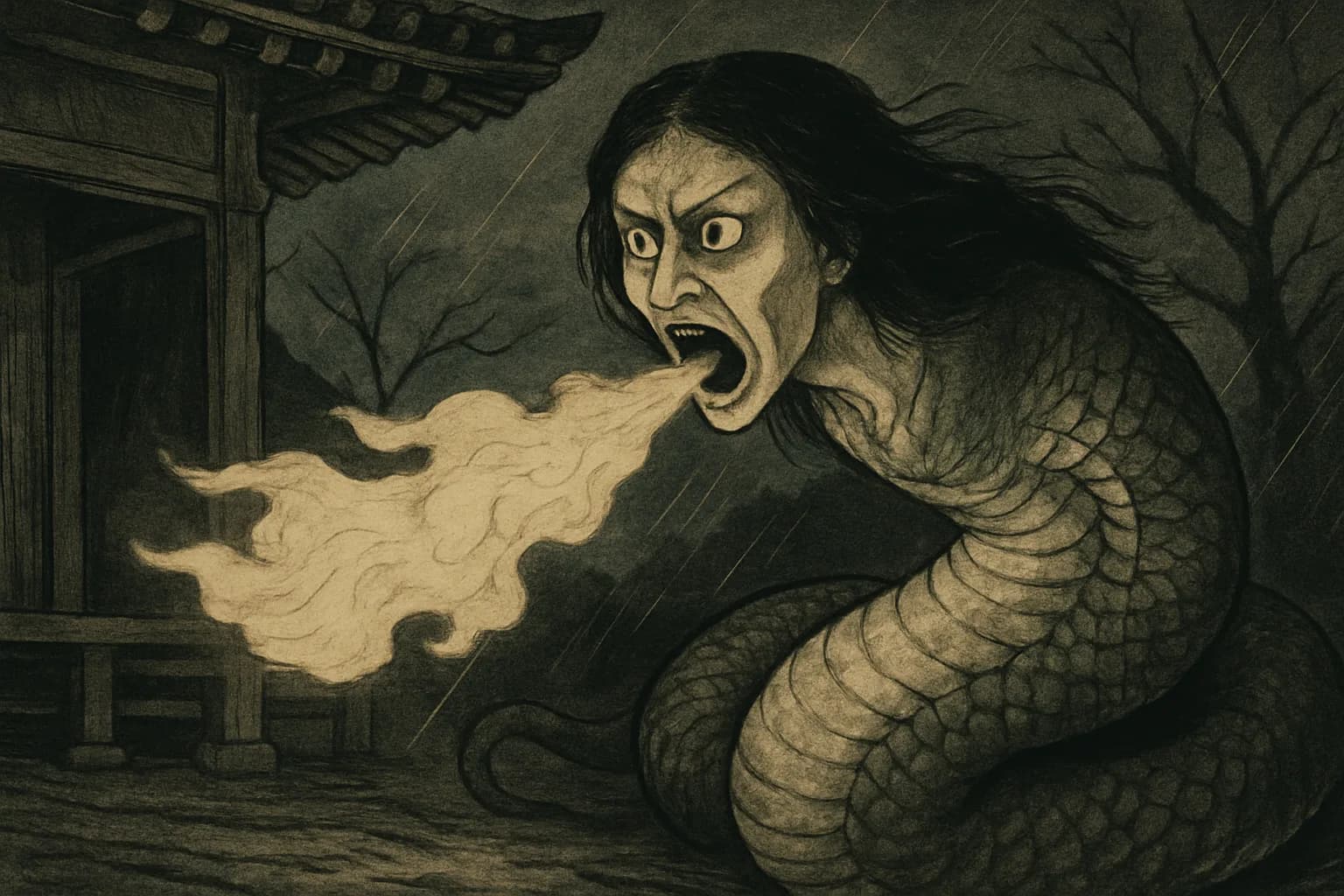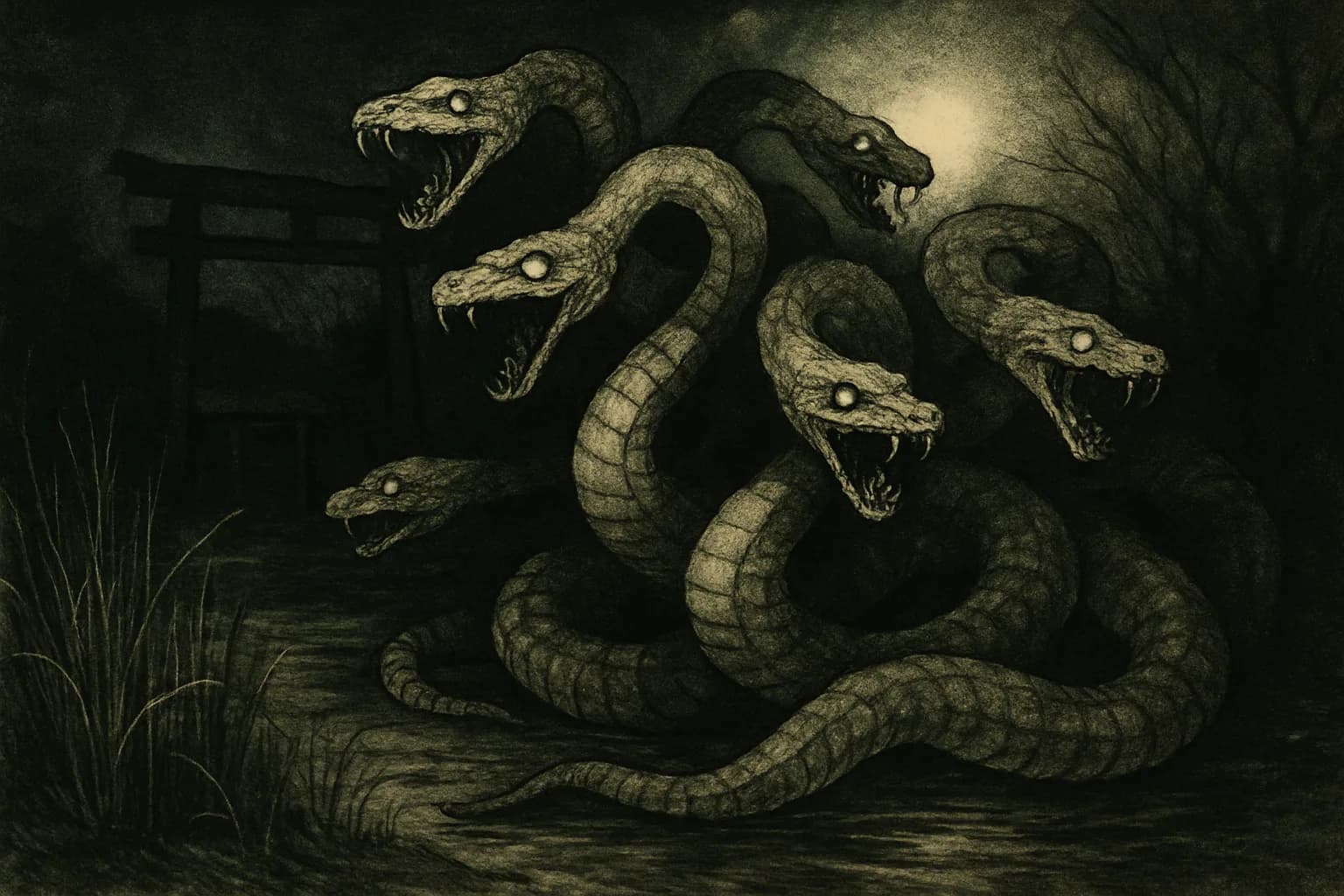
Yamata-no-Orochi is not a monster you fight in the dark. It is a monster you meet in daylight, drunk, and cut apart while it sleeps. Eight heads, eight tails, and a body long enough to cross eight valleys and eight hills — this serpent appears in Japan's two oldest written histories, the Kojiki (712) and the Nihon Shoki (720). It eats one daughter a year from a family in Izumo, in what is now Shimane Prefecture. Then it meets the storm god Susanoo, and loses.
What does it look like?
The old texts describe a creature closer to a landscape than an animal. Its eyes are red like hozuki, the papery-husked ground cherry. Moss, cypress, and cedar grow along its back. Its belly is always red and raw, as if inflamed or bleeding. Eight heads sit on eight necks, and eight tails trail behind, together spanning eight valleys and eight mountain ridges. In the myth, "eight" is not a literal count. It is the old way of saying "as many as there could be."
A family with one daughter left
An elderly couple, Ashinazuchi and Tenazuchi, once had eight daughters. One by one, Yamata-no-Orochi took them, a single girl each year. By the time Susanoo finds the couple, only the youngest remains: Kushinada-hime. They are weeping because the serpent is due again, and she is all that is left.
Susanoo has just been thrown out of heaven for his own misdeeds. He offers a trade: he will kill the serpent if he can marry the girl he saves. The couple agree. Susanoo turns Kushinada-hime into a comb and tucks it into his hair, keeping her close and out of danger while he works.
The sake trap
Susanoo does not charge the serpent. He builds a fence with eight gates and eight raised platforms, and sets a vat of strong sake behind each gate. The drink is called yashiozake, brewed and refined eight times over.
Yamata-no-Orochi arrives, finds eight vats waiting, and drinks from every one. Eight heads, eight cups. It falls into a heavy, drunken sleep.
Susanoo draws his sword and cuts the serpent to pieces. The Hii River, which still runs through Izumo today, is said to have turned red with its blood. Cutting through one of the middle tails, his blade chips on something hard inside. He reaches in and finds a second sword.
He gives that sword to his sister, the sun goddess Amaterasu. It later passes to a prince who uses it to beat back a wildfire, and from then on it is called Kusanagi — "the grass-cutter." Kusanagi-no-Tsurugi becomes one of Japan's three Imperial Regalia, alongside a mirror and a jewel. It is still said to be kept, unseen, at Atsuta Shrine in Nagoya.
Where it comes from
Scholars read the Orochi myth as more than a monster story. The Hii River, which winds through the valley where the legend is set, was historically rich in iron sand used for tatara steelmaking. One common reading connects the serpent's raw red belly to a river running with ore, and its hoard of a sword to a region that made weapons. In that reading, the tale of a god subduing a monster may record something plainer: outsiders taking control of a valley's iron and its river.
After the fight, Susanoo builds a palace for Kushinada-hime at a place called Suga. There he composes a short verse about the eightfold fence he raised around it. Later tradition names this Japan's first waka, its oldest form of poetry.
Yamata-no-Orochi today
The Hii River still runs through Izumo, past shrines that mark sites from the story. In the Iwami region of Shimane, a style of sacred dance-drama called Kagura performs "Orochi" as its signature piece: dancers work giant, glowing-eyed serpent costumes, sometimes fifteen meters long, coiling through the crowd at shrine festivals.
The story has also traveled well outside Japan. Capcom's video game Ōkami (2006) restages the fight closely: a boss named Orochi, eight vats of sake, and a village girl named Kushi standing in for Kushinada-hime.
Susanoo kept only one thing from the fight for himself: not treasure, not glory, but the wife he'd bargained for at the start.