Most yokai hide in a river, a woodpile, or the dark end of a hallway. The gashadokuro doesn't hide at all — it is taller than a temple gate, built entirely from bone, and you are meant to hear it coming before you ever see it.
What does it look like?
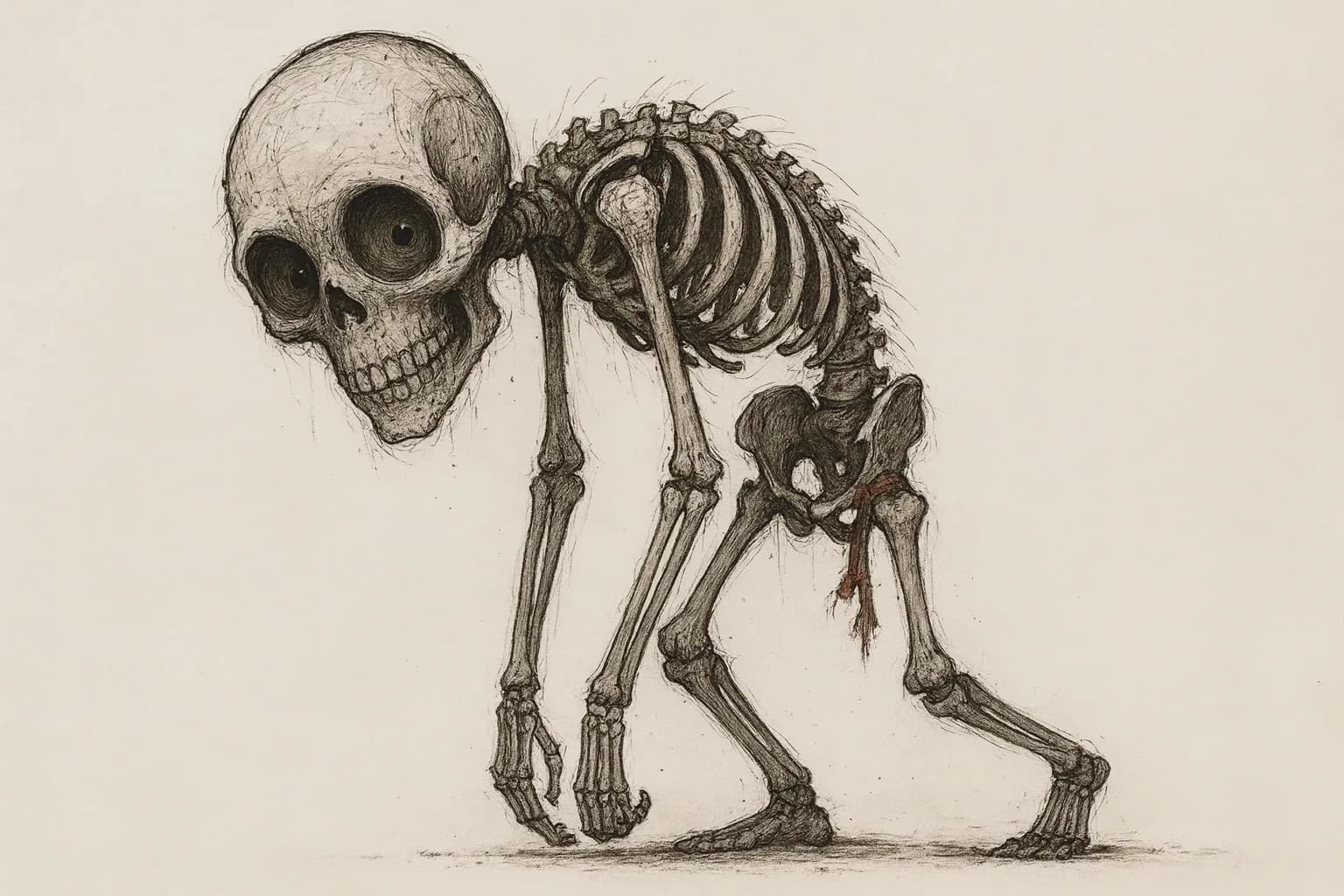
A gashadokuro is a skeleton on a scale no single human death could produce: some tellings put it at several times the height of a man, others make it tall enough to look down over a village roofline. It has no skin, no organs, nothing but bone held together by whatever fury put it in motion, and it moves with a loose, clattering gait — gasha, gasha — that gives the creature its name. That word, gasha, imitates the sound of bones knocking together; dokuro simply means skull or skeleton. Put together, the name describes exactly what you'd hear before you'd see anything at all.
Built from the forgotten dead
Where an ordinary skeleton is one person's remains, a gashadokuro is said to be many — the pooled bones of soldiers left on a battlefield, or of famine victims buried in mass graves without proper rites. Denied a funeral and the memorial rituals that let a spirit rest, the dead's collective grievance was thought to fuse their bones into a single enormous body, animated by pure resentment. It is less an individual monster than a debt come due: a warning about what happens when the dead are not properly cared for.
The ringing that warns you
Folklore is unusually specific about how a gashadokuro announces itself. Before it appears, a person is said to hear a high, thin ringing in their ears — like a bell struck once, over and over, from somewhere close by yet unlocated. That sound is the only warning given. If it's ignored, the skeleton emerges at the hour of the ox, deep in the night, and comes after whoever is nearby, seizing them and biting the head clean off. There is no bargain to strike with it and no famous countermeasure passed down, unlike the kappa's cucumber or the fox's fondness for fried tofu — a gashadokuro is simply something to have run from before it arrived.
Where it comes from
The skeleton itself is old imagery. Utagawa Kuniyoshi's woodblock triptych Sōma no Furudairi (相馬の古内裏, mid-1840s) shows the sorceress Takiyasha, daughter of the rebel Taira no Masakado, summoning a house-sized skeleton to attack the warrior Ōya no Tarō Mitsukuni at her father's ruined palace in Sōma — a scene drawn from Kyokutei Bakin's earlier yomihon fiction. It's the single most reproduced giant-skeleton image in Japanese art, and it almost certainly shaped what people now picture when they hear "gashadokuro." The name itself, though, doesn't appear in that Edo-period print or in Toriyama Sekien's catalogues. It's a 20th-century label grafted onto the older skeleton-apparition motif — a case where the concept and its most famous picture predate the word people now use for it by a century.
Gashadokuro today
The giant skeleton has become a stock monster in yokai-themed fiction, turning up as a boss-tier threat in manga and anime like Nura: Rise of the Yokai Clan and in video games that draw on the yokai catalogue for enemy design. Its appeal is obvious: no other figure in the folklore makes the debt owed to the unburied dead quite so literal, or quite so large.