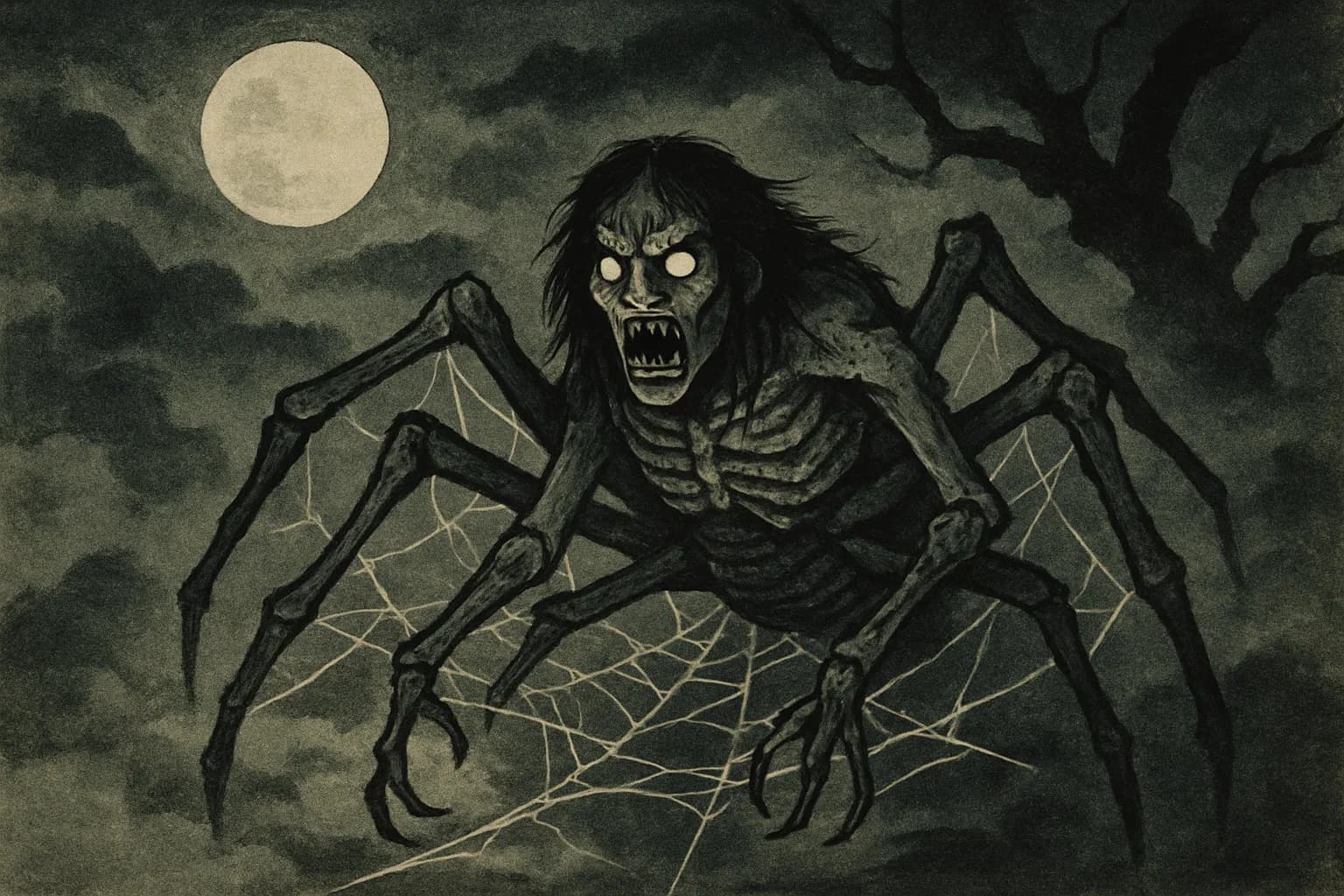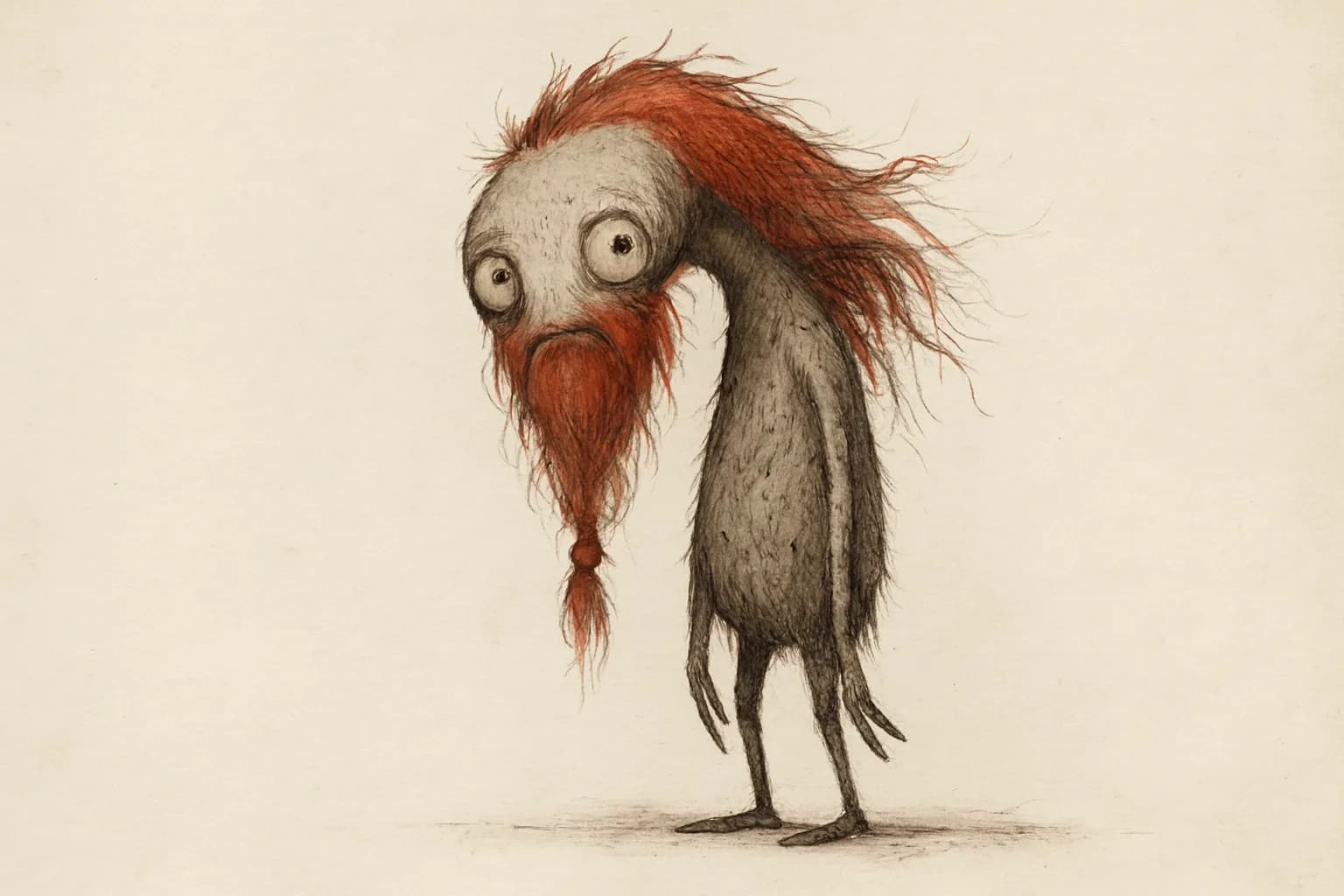
Around the turn of the eleventh century, daughters of Kyoto's noble households kept disappearing. No ransom notes arrived, no bodies turned up, and no witness lived to explain what had taken them. When the imperial court finally went looking for an answer, the trail led out of the capital entirely, into the mountains northwest of the city, to a fortress ruled by a giant who drank himself insensible on human blood mixed with rice wine.
What does Shuten-doji look like?
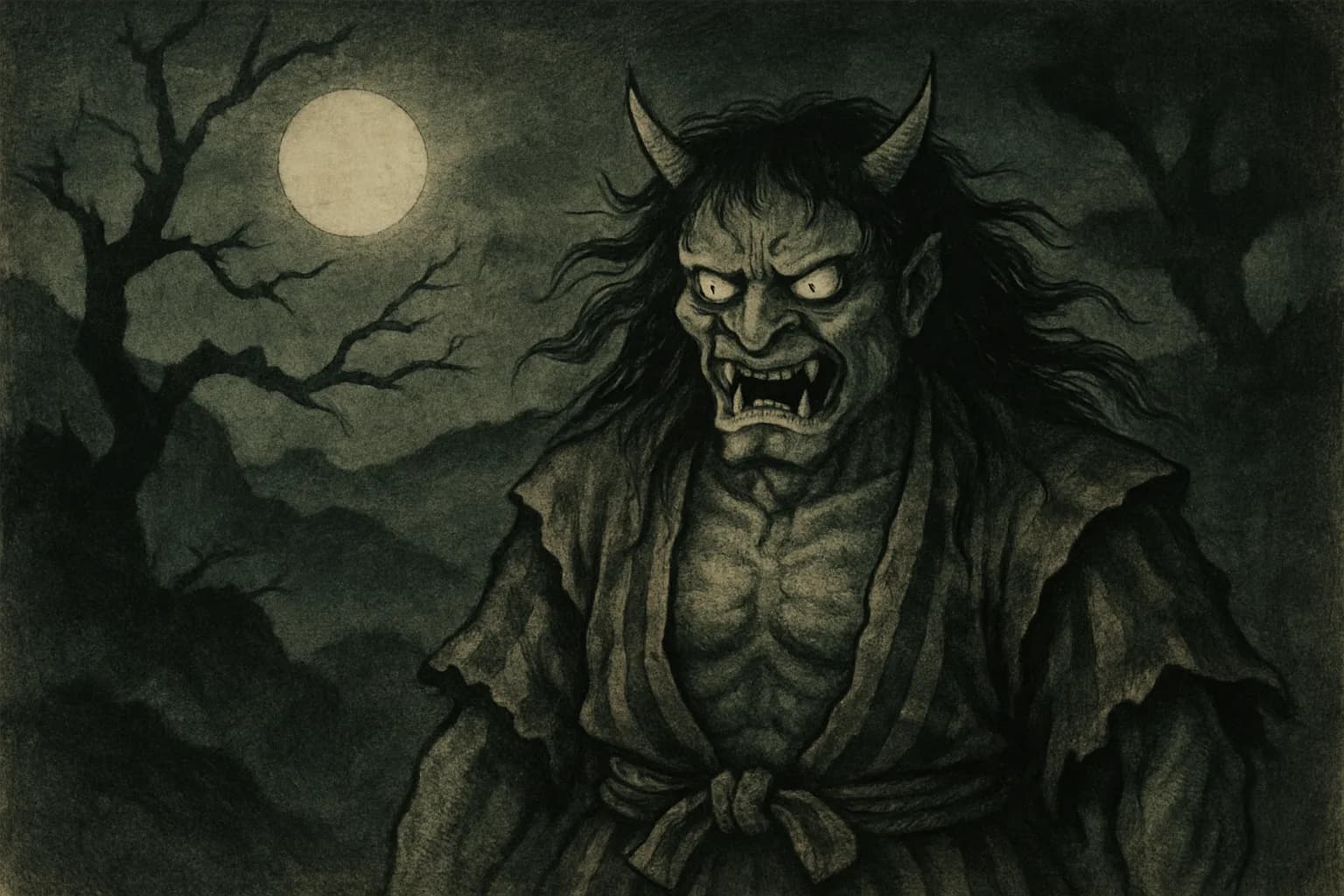
Accounts converge on a single image: an oni of enormous size, red-skinned, with a shock of untamed hair and — in the fuller descriptions — as many as fifteen eyes and five horns crowding a face permanently flushed from drink. That last detail is baked into his name. Shuten combines the characters for sake (酒) and gulping (呑); doji means "young boy," a term usually reserved for children or attendants. The mismatch is deliberate. Storytellers insisted that when he wanted something from a human, Shuten-doji could pass as a striking young man, and it was that borrowed face, not the horned one, that lured victims within reach.
Vanishings, and a court diviner's answer
The disappearances are placed during the reign of Emperor Ichijo. With ordinary investigation turning up nothing, the court turned to the onmyoji Abe no Seimei, whose divination pointed to a band of oni holed up on Mt. Oe, led by a chieftain calling himself Shuten-doji. The warrior Minamoto no Yorimitsu was ordered to deal with it, and he brought along four retainers still celebrated today as his shitennō — Watanabe no Tsuna, Sakata no Kintoki, Usui Sadamitsu, and Urabe Suetake — with the courtier Fujiwara no Yasumasa joining as a fifth.
A borrowed face and a poisoned cup
Six armed men could not simply storm an oni stronghold, so they didn't try. Yorimitsu's party dressed as yamabushi, wandering mountain ascetics who could travel and request lodging without raising suspicion, and climbed toward Oe in disguise. Along the way, three old men fell in with them — in truth the gods of Sumiyoshi, Hachiman, and Kumano — who handed over a cask of shinben kidoku-shu, "sake that aids men and poisons demons," brewed to taste delicious to a human throat and act as poison in an oni's blood.
It worked exactly as planned. Shuten-doji agreed to host the disguised warriors as guests, drank deeply from the cask they offered, and, loosened by his own liquor, told them his history: he had once lived on Mt. Hiei, and was pushed out when the monk Saicho built Enryakuji on the mountain, forcing him to relocate to Oe. Gorged on wine and confession, he and his retinue fell into a stupor.
The beheading
With the oni disarmed by drink, Yorimitsu and the shitennō bound Shuten-doji with rope given to them by the gods and struck off his head. Even severed, the head is said to have leapt from the floor and sunk its teeth into Yorimitsu — surviving only because he was wearing a second helmet beneath his own, a gift from the mountain gods that took the bite meant for his skull. The head was carried back to Kyoto as proof the killings were over.
Where the legend comes from
The fullest early telling survives in the Oeyama Ekotoba, an illustrated hand scroll from the fourteenth century, with later otogizoshi prose versions and a steady stream of Edo-period ukiyo-e keeping the story in circulation for centuries. Scholars generally read Shuten-doji less as a supernatural threat and more as a memory of actual bandit gangs operating out of the mountains ringing the capital, refitted over generations into a demon worthy of the Minamoto clan's most celebrated warrior. A tale about a general clearing out highway robbers is a footnote; a tale about a general beheading the king of the oni is a legend that legitimizes a dynasty.
There is also a real dispute about which mountain the story belongs to. One Mt. Oe sits near Kameoka, close enough to Kyoto for a night raid to make sense. The other lies further north in old Tango province, in what is now Fukuchiyama, and that town has claimed the association hard enough to build the Japan Oni Exchange Museum on the mountainside, a collection of oni masks and folk art from across the country, with an annual festival where locals still parade as Shuten-doji's band.
Shuten-doji beyond the scroll
The story never left the stage. It's one of the standard oni-taiji ("oni-slaying") plots of Noh and kabuki theater, performed under the title Oeyama alongside the equally famous Tsuchigumo cycle. More recently, Shuten Doji appears as a playable Servant in Fate/Grand Order and as a boss in the yokai-hunting game Nioh 2, both drawing directly on the Oeyama story rather than inventing a new backstory for him. In Fukuchiyama, hikers can still visit a cave that locals say was his lair.