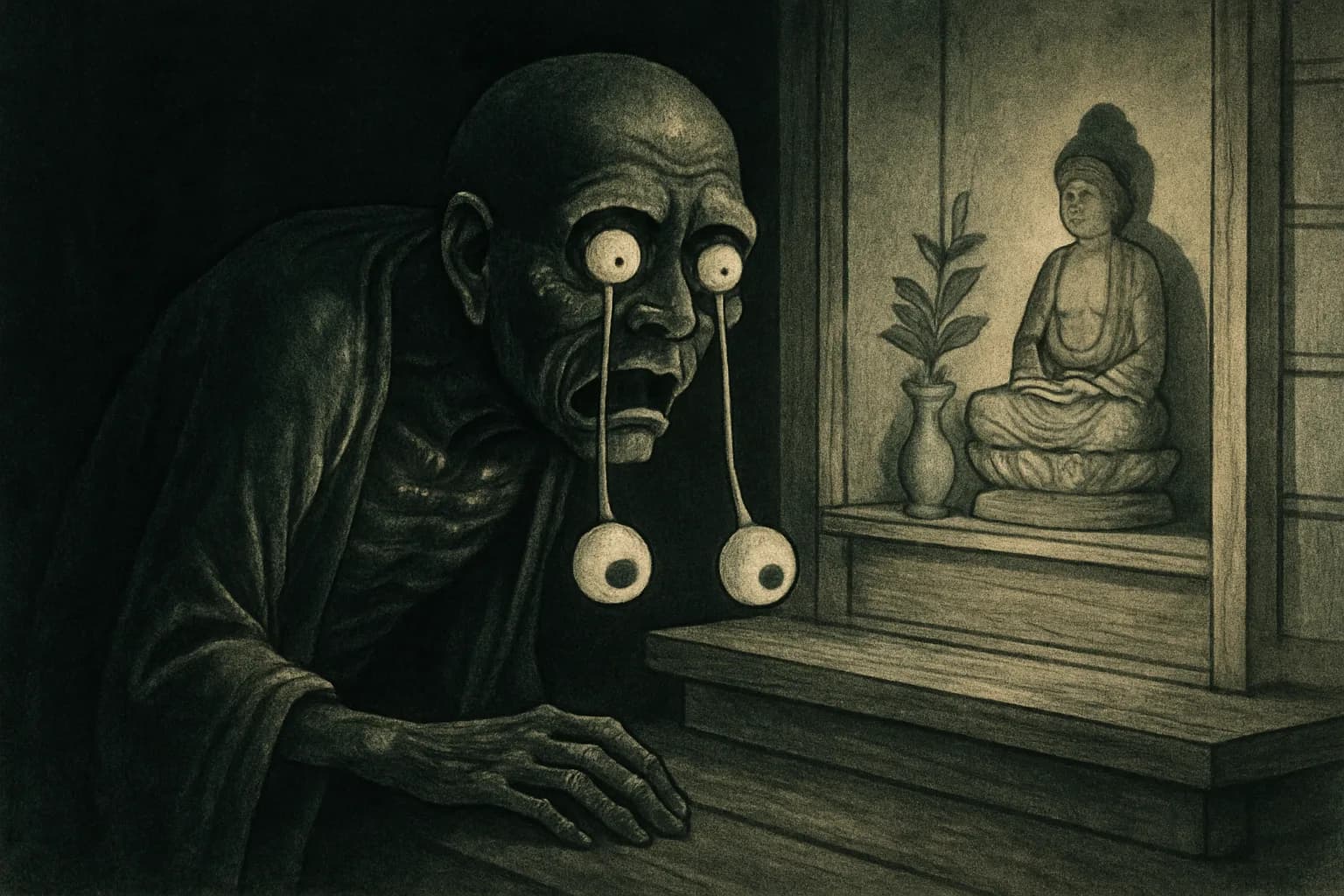
Every household Buddhist altar, or butsudan, is supposed to be a small daily chore: wipe the shelf, refresh the water and rice, light incense, keep the gilding from clouding over with dust and grease. Toriyama Sekien's nuribotoke is what happens when nobody bothers. In his 1776 print, a black, glistening figure hunches at the edge of a room, its lacquered surface catching what light there is, its eyes hanging loose from their sockets on long stalks like a snail's. It does not sit still and serene the way a Buddha statue is supposed to. It has come off its shelf.
What does it look like?
Sekien's nuribotoke is squat and heavy, its whole body coated in the same glossy black lacquer used to finish a butsudan's woodwork and the statues inside it — the same finish, in other words, that a devout household is meant to keep clean and unmarred. The most unsettling detail is the eyes: rather than sitting fixed in the face as they would on a proper Buddha image, they dangle outward on thin stalks, giving the figure a boneless, faintly reptilian look completely at odds with the calm expression Buddhist statuary is meant to have. It is recognizably a devotional object and recognizably wrong at the same time — an image built to look like something sacred that has slipped out of order.
An altar's neglect made visible
Sekien offers almost no narrative for the nuribotoke beyond the picture itself, which is typical of several entries in Gazu Hyakki Yagyo — some of his yokai come with an anecdote attached, others are left as a single unexplained image for the reader to puzzle over. What ties the nuribotoke to real household practice is the object it's built from: a butsudan is not meant to be decorative furniture. It houses ancestral tablets and a Buddha image, and Edo-period etiquette held that failing to tend it — letting the offerings go stale, the metalwork tarnish, the lacquer go uncleaned — was a real spiritual lapse, not just poor housekeeping. Sekien's black, misshapen figure reads as that neglect given a body: the family's own devotional image, distorted by years of being overlooked into something that no longer resembles reverence.
That makes the nuribotoke close cousin to the tsukumogami — the household tools and utensils that wake into yokai after a hundred years of use or abandonment — except that what has come loose here isn't a tool but the household's own object of worship, which makes the warning sharper. A dropped comb or a worn-out umbrella turning strange is mischief. A Buddha statue turning strange is a rebuke.
Where it comes from
The nuribotoke belongs to a small set of Sekien yokai drawn directly from the furniture of an ordinary Edo home rather than from older written legend — a category of his work where he seems to have been inventing new pictures for long-standing anxieties about care and neglect, rather than transcribing an existing folk tale. Whether or not any village told a fuller story about a nuribotoke before Sekien drew one, the image fit neatly into beliefs that were already widespread: that objects absorb something from long use, and that religious neglect in particular carries consequences. It sits in Gazu Hyakki Yagyo alongside other domestic hauntings — worn-out household goods, an old temple bell, a dust cloth grown filthy enough to move on its own — as part of Sekien's broader habit of finding monsters in the objects an Edo household was supposed to look after and sometimes didn't.
Nuribotoke today
Nuribotoke has stayed a minor figure even among yokai enthusiasts, appearing mostly in books and art that walk through Sekien's four picture scrolls entry by entry rather than in its own popular stories. Its clearest afterlife is as a design reference: the black-lacquered body and stalked eyes are distinctive enough that yokai encyclopedias and art reproductions reliably use Sekien's original print rather than a redesigned version, since there is no competing modern take to reckon with. For a household with a butsudan still in daily use, the nuribotoke's real legacy is simpler than any legend — it's the reason the incense gets relit and the offering bowls get washed before they're allowed to go too long unattended.