Why it looks like this
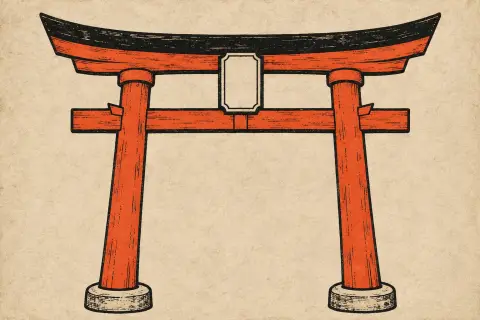
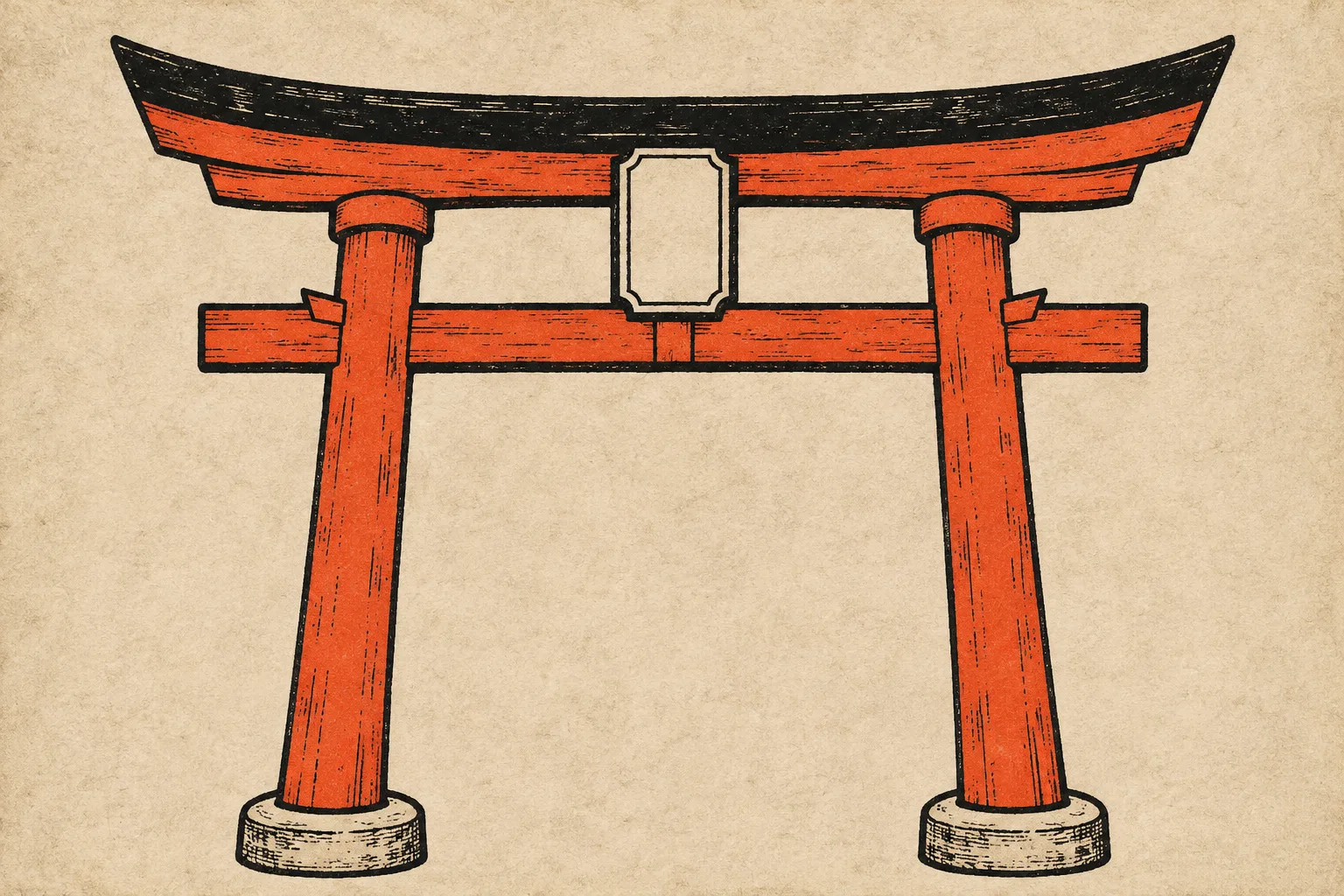
A torii is two pillars and two beams across them. Older names for it meant "a gate with no roof." The most common kind is the myōjin torii, with a top beam that curves up at the ends. The simplest kind, the shinmei torii, is straight and usually unpainted.
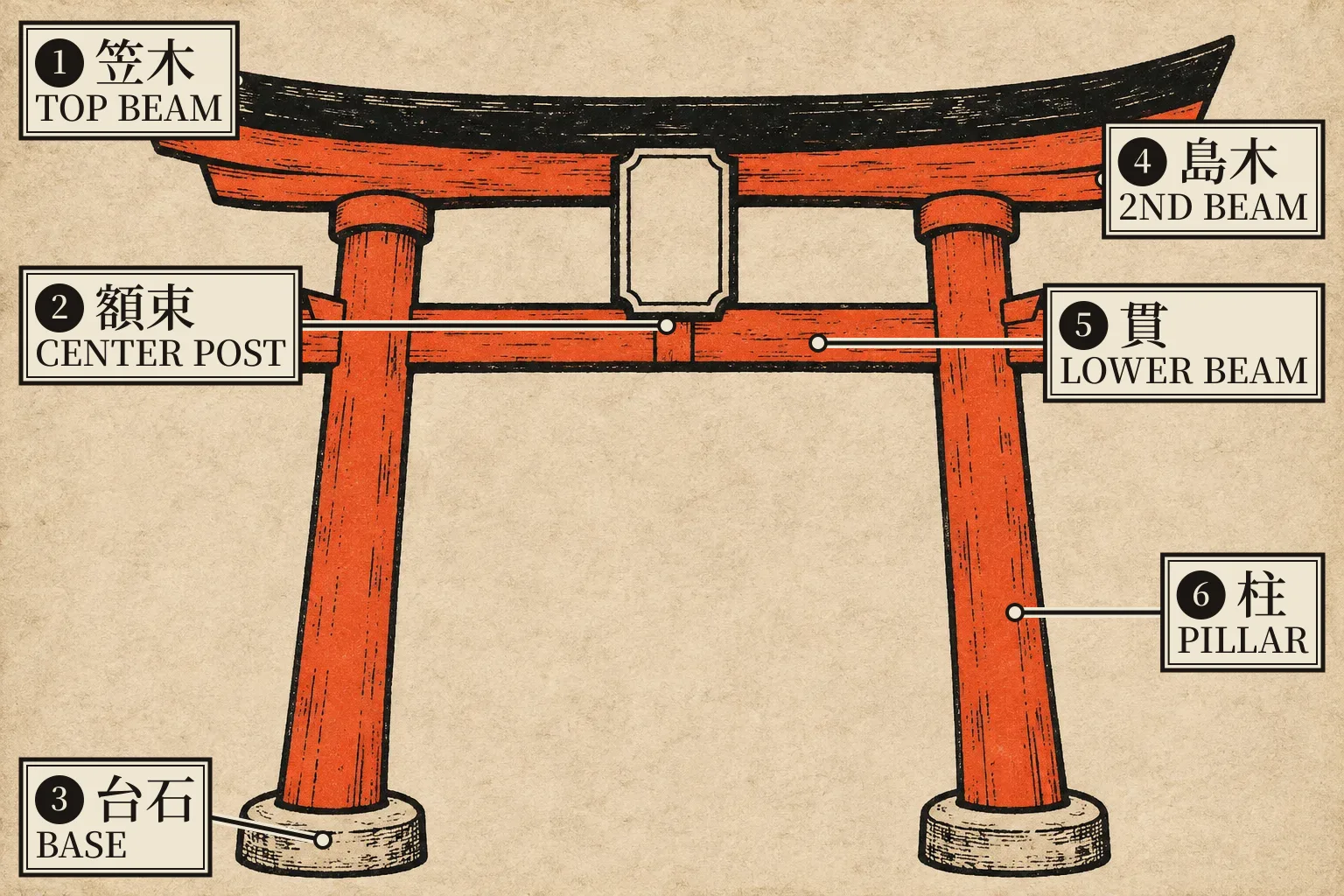 Our diagram. The table says what each part is, and why it looks that way where a source says.
| # | Part | Why it looks like this |
|---|---|---|
| 1 | 笠木 Kasagi (top beam) | The long top beam, reaching past both pillars. At Itsukushima's sea gate, about 7 tons of stone sit inside it. The weight presses the gate down, so it stands without being buried. (JTA) |
| 2 | 額束 Gakuzuka (center post) | A short post between the two beams. It holds a plaque with the shrine's name. Like a nameplate on a house, it tells you whose home you are entering. (Nihon Kokugo Daijiten, Jinja Honchō) |
| 3 | 台石 Base stone | The stone each pillar stands on. Some torii add a ring at the foot that protects the bottom of the pillar. (Sekai Daihyakka Jiten) |
| 4 | 島木 Shimaki (second beam) | A second beam just under the top one. The plain shinmei torii does not have it. (JAANUS, Daijisen) |
| 5 | 貫 Nuki (lower beam) | A straight beam that runs through both pillars. It ties them together, like the rung of a ladder, so they cannot spread apart. (Nipponica, Kokugakuin) |
| 6 | 柱 Hashira (pillars) | Two round pillars. On many torii they lean slightly inward. A wider base is harder to knock over, like a person standing with feet apart. (Sekai Daihyakka Jiten) |
Why are so many torii red?
Many torii are red because the paint did two jobs. Fushimi Inari, a shrine in Kyoto, says vermilion "is also said to be" a color that counters evil. It adds that the raw material, ni, made from mercury, has long kept wood from rotting. A government tourism text on Itsukushima says the same of its sea gate: the lacquer "further helps" protect the wood.
Mercury red was also rare and costly. Japan's Environment Ministry says red had been a sacred color since ancient times. Still, not all torii are red. Shinto's national shrine body says they are only "sometimes" painted, and the plain shinmei style is bare wood.
So the sources give two common reasons: a belief and a coating.
The temple torii with 586 secrets inside
Torii are not only for shrines. At Shitennōji, a Buddhist temple in Osaka, a stone torii stands at the West Gate. A monk named Ninshō built it in 1294. Some Buddhist temples have torii too. Here, the gate has a Buddhist meaning.
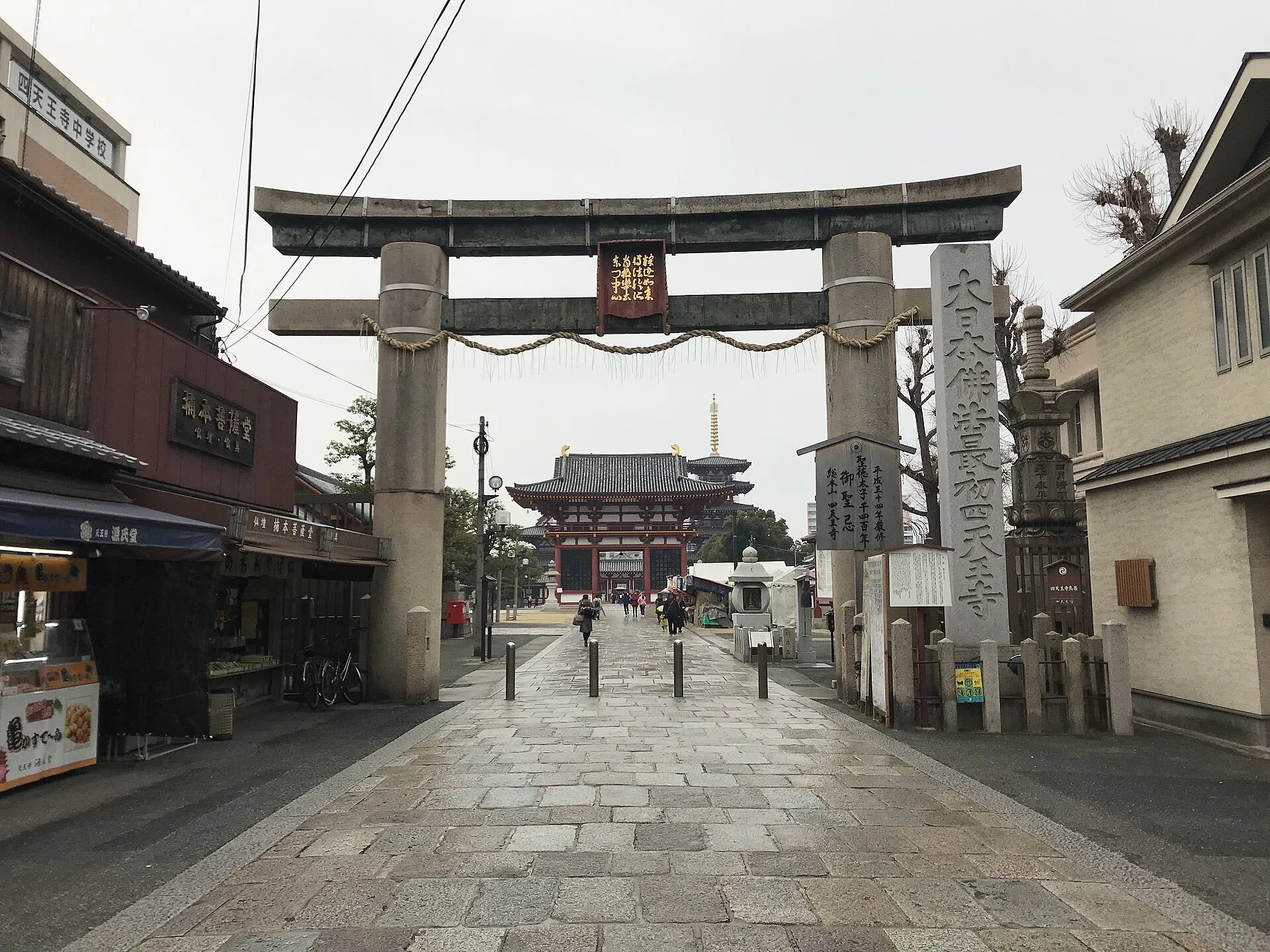 The stone torii at Shitennōji's West Gate, Osaka. Photo: そらみみ, CC BY-SA 4.0
Its beams look like stone, but two of them are wood, wrapped in copper. The city guesses this was to make the gate lighter. During repairs in 1997 and 1998, workers opened them. Between the copper and the wood were 572 hidden objects, and 14 more were found higher up. They included paper packets of human hair, bits of cremated bone, and wrapped umbilical cords.
Most were placed there during a repair in 1669. Osaka townspeople sealed them inside, hoping to be reborn in paradise. The city calls this gate "the entrance from this world to the Western Pure Land," the Buddhist paradise.
How does the sea torii stand in the water?
Itsukushima's Great Torii stands in the sea, off Miyajima. At high tide, it seems to float. It does not float, and it is not buried either.
It weighs about 60 tons, including 7 tons of stone packed inside its top beam. That weight alone holds it upright on the seabed. It is about 16.6 meters tall, with four support legs around its two main pillars.
Its main pillars are camphor, a wood that resists rot and insects, and the red lacquer helps protect them too. A gate has stood here since 1168, and today's gate was rebuilt in 1875. The camphor trees in its pillars are more than 500 years old. The gate is younger than the trees inside it.
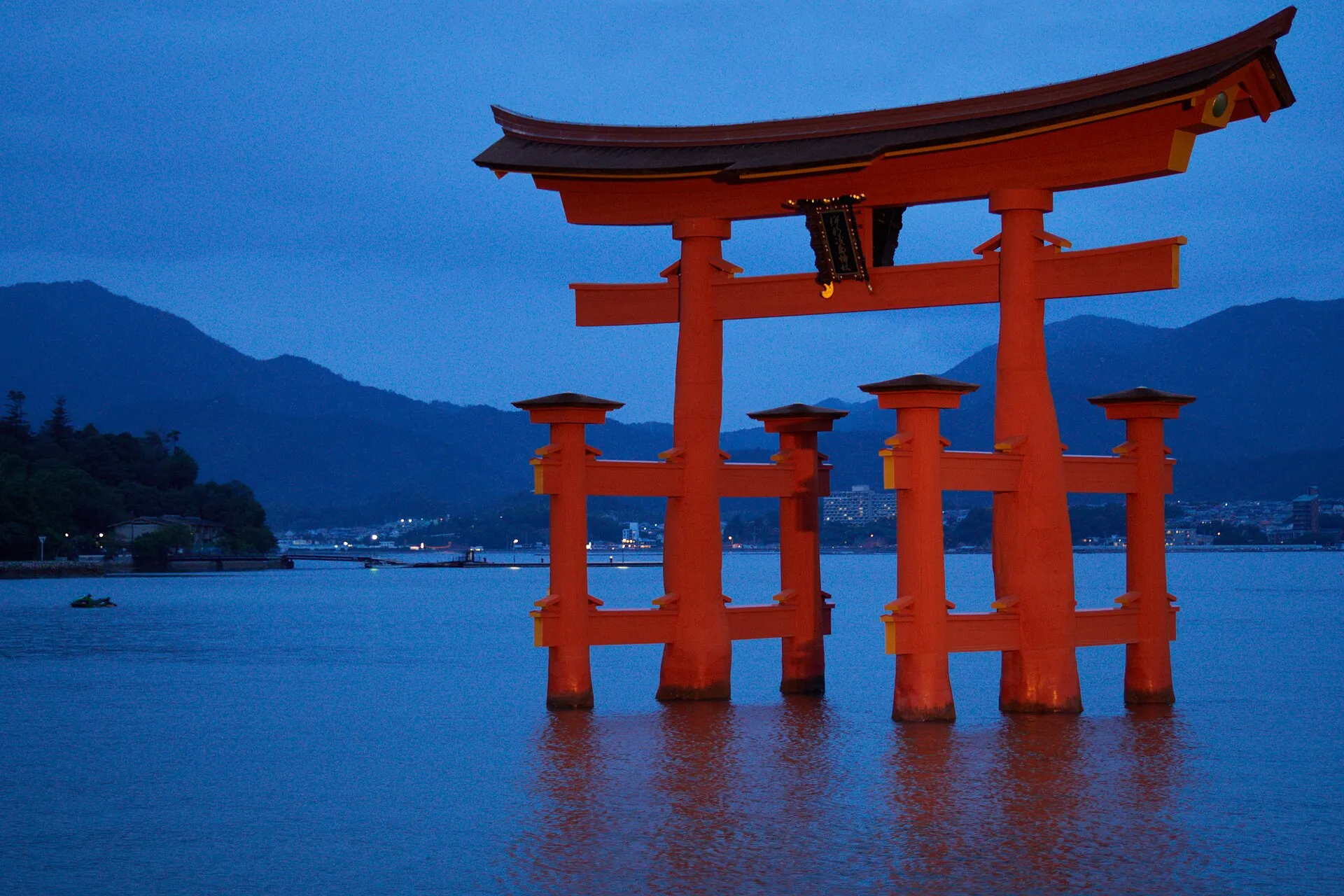 Itsukushima's Great Torii at high tide. Photo: lumoplank, CC0
Why are there thousands at Fushimi Inari?
They are thank-you gifts from people whose wishes came true. Fushimi Inari's famous tunnels hold about 10,000 torii, large and small, on paths up Mount Inari. The name senbon torii means "a thousand torii," but it is a way of saying "very many," not a count.
The shrine says the custom of offering a torii as thanks spread from the Edo period on. The idea is a pun. Your wish "passes through" (tōru), or "has passed," like a request that goes through in English. Turn around in the tunnel, and you see the donors' names and dates on the back of each gate.
In 2026, the shrine's price list started at 300,000 yen for a size-5 gate.
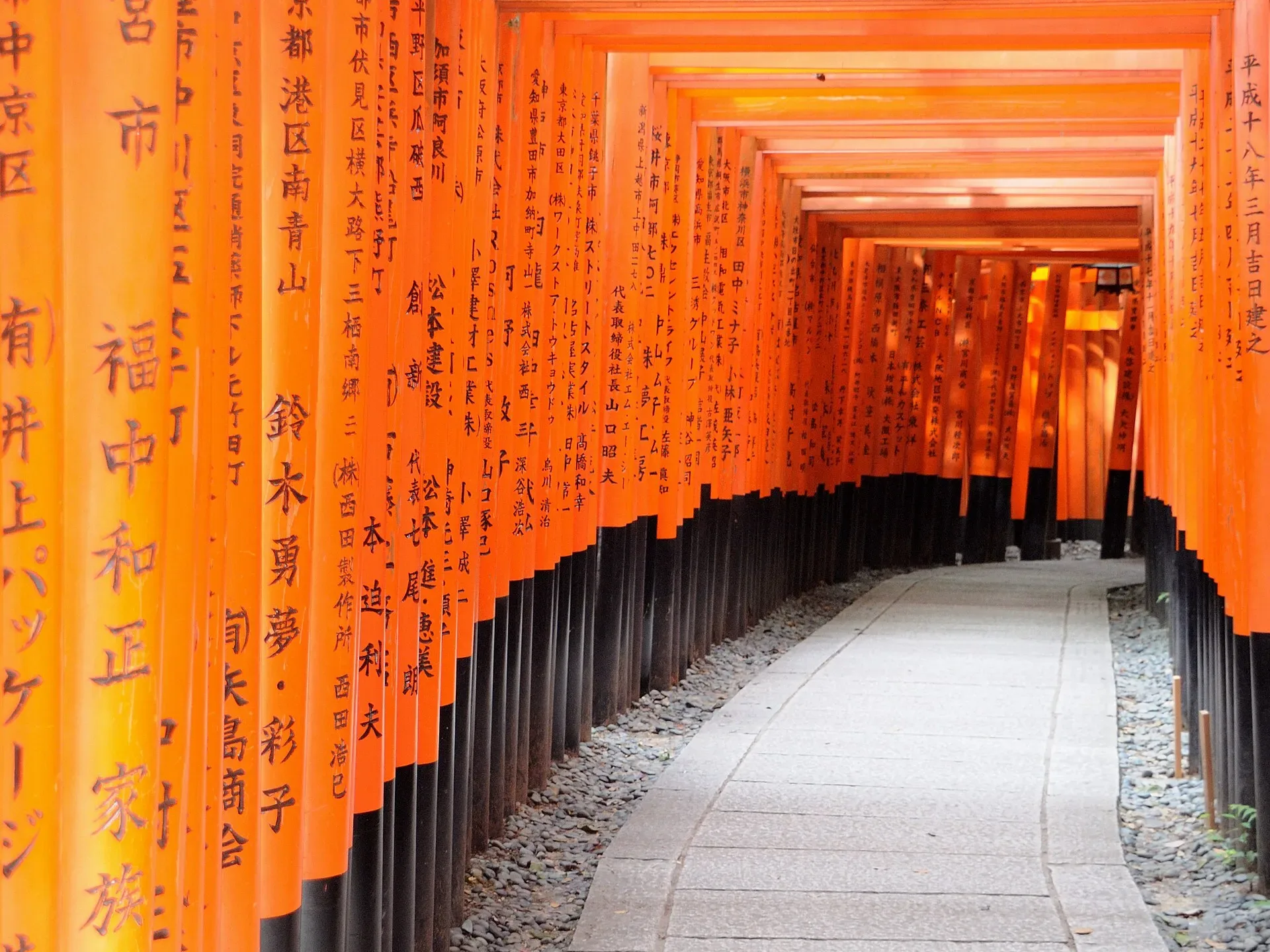 The backs of the gates at Fushimi Inari, each with a donor's name and date, August 2015. Photo: Josep M. Gracia, CC BY-SA 4.0
The unwritten rules: why people bow and walk at the side
Watch Japanese visitors at a shrine, and many stop at the torii and bow before passing through. Some also avoid the very middle of the path. So why do it?
Because the torii is a border. Shinto's national shrine body, Jinja Honchō, says you are entering a sacred space, so many people bow first. Its Japanese guide says to come "as if visiting the home of someone above you." The bow is a greeting at the gate.
The middle of the path is a different story. Some people see it as the path the kami walks. Jinja Honchō says this copies the way priests treat the exact center during rites. Then it adds: there is no strict rule for how to walk the path.
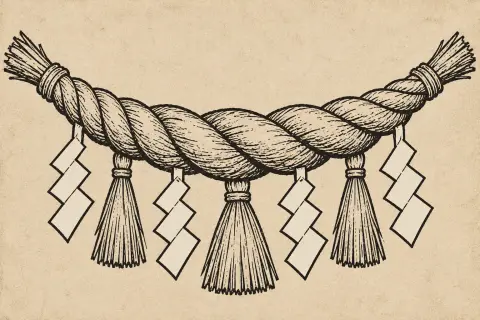
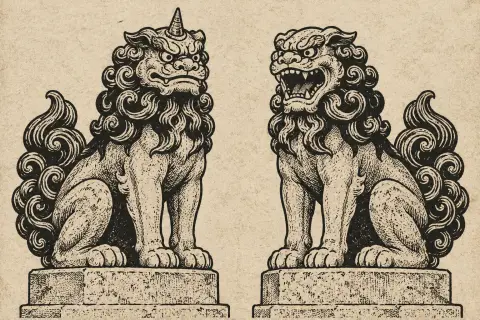
Past the torii, two more things often mark the same border: a pair of komainu, the guardian lion-dogs, and a shimenawa, a sacred straw rope.
The name: a bird that stays?
The kanji 鳥居 read as "bird" and "stay." So the name is often explained as "a bird perch." Two old dictionaries, from the 900s and 1100s, write it with other characters, 鶏栖, "a chicken's roost."
One old story fits that reading. When the sun goddess Amaterasu hid in a cave, the gods set roosters crowing to lure her out. Jinja Honchō gives "the roosts for those birds" as one theory of the torii's origin.
But the origin is not settled. One encyclopedia calls such stories baseless. Another thinks the name more likely grew from kado-sue, an old word written with the kanji for "gate" and "stay."
Frequently asked questions
What is the oldest torii?
Accounts differ. The earliest trusted written mention is a shrine inventory from 922. It lists four torii, including one in front of the shrine and one behind it. An older one, from 771, may be a forgery. As for gates still standing, one encyclopedia names Heian-era stone torii in Yamagata City. It gives the 1294 Shitennōji torii as an example with a known date. Another calls Shitennōji's the oldest.
Why does the top beam curve up, and why is its top black?
No source we read says. The parts have names and shapes, but these two choices have no written reason.
How many kinds of torii are there?
Dozens. Jinja Honchō says one count puts it at more than 60 forms. The two big families are the straight shinmei and the curved myōjin.
Why do shrines have more than one torii?
A torii marks a border, and a large shrine has sacred ground inside sacred ground. The gates are numbered from the outside in: the first torii, the second torii, and so on. Each gate you pass takes you one step closer to the main hall.
Can anyone walk through a torii?
Yes. Jinja Honchō says there are no specific restrictions for visitors of other religions or faiths, and that all shrines are open to everyone. It asks visitors to keep the grounds dignified and to pay their respects politely. Many people bow slightly before walking through, but its guide does not make that a rule.
Do Japanese people really bow at every torii?
Not everyone does. We found no survey on the torii itself. In one 2022 survey of 522 adults, about half said they knew the correct way to pray at a shrine.
Sources
- Kotobank: 鳥居, 笠木, 額束, 丹塗
- Kokugakuin University, Encyclopedia of Shinto: Torii; JAANUS: torii, kasagi, shimaki, nuki
- Jinja Honchō (English): FAQ, Entering a Jinja, Torii, pamphlet (PDF)
- 神社本庁 (archived): 鳥居について, 境内について, 参道について
- Fushimi Inari Taisha: FAQ, torii offerings; Highlighting Japan, Oct 2020; japan-guide.com
- Japan Tourism Agency: Great Torii, its pillars; MLIT (PDF); Itsukushima Shrine, repair
- Osaka City Board of Education: Shitennōji stone torii objects (PDF)
- Ministry of the Environment: mercury in tradition (PDF)
- Hankyu Travel survey, 2022