How to draw one
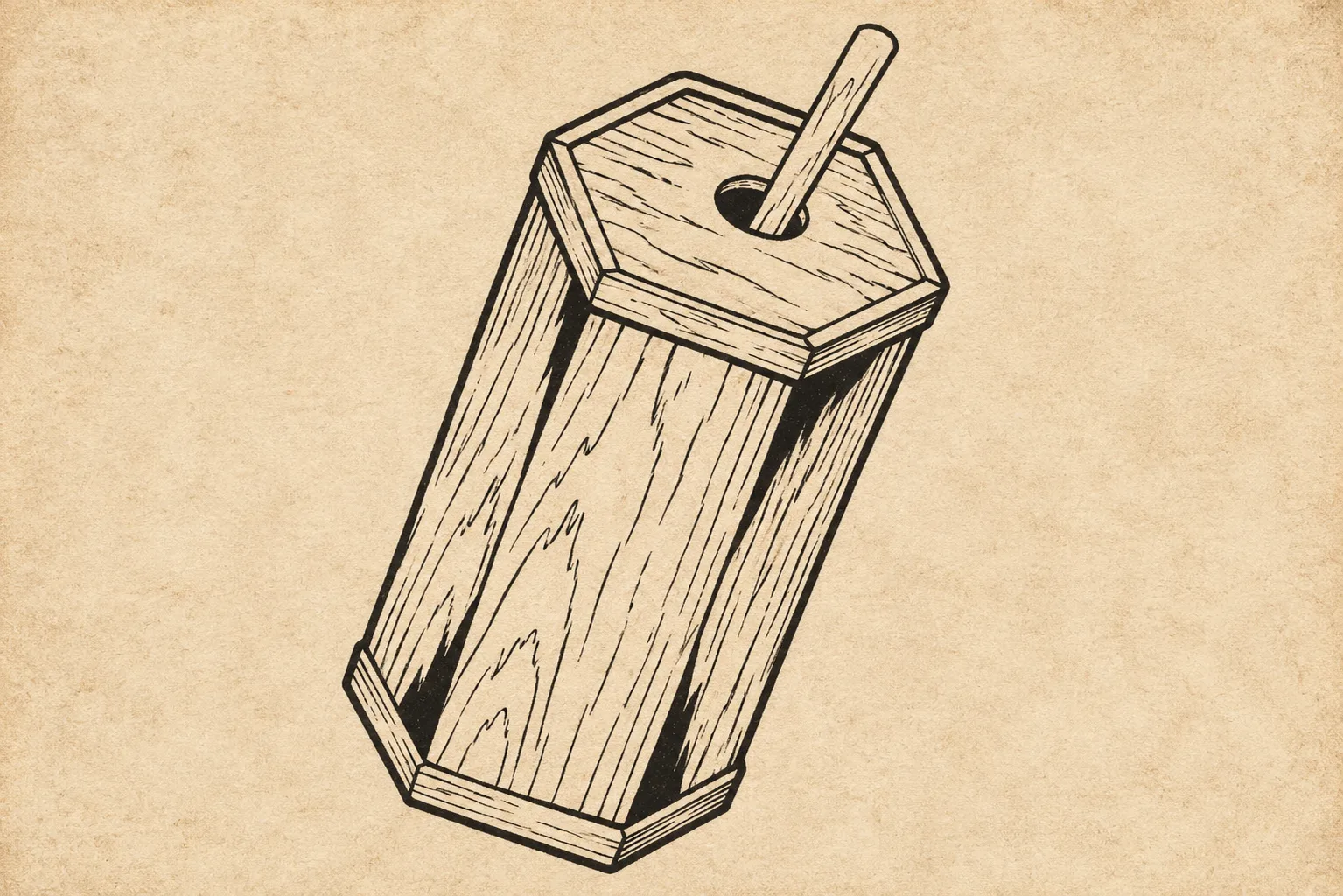
Pay first, then draw. At Sensō-ji it costs 100 yen. The old way is a box of sticks. You shake it until one stick slides out through a hole. The stick has a number. You take the slip with that number from a drawer.
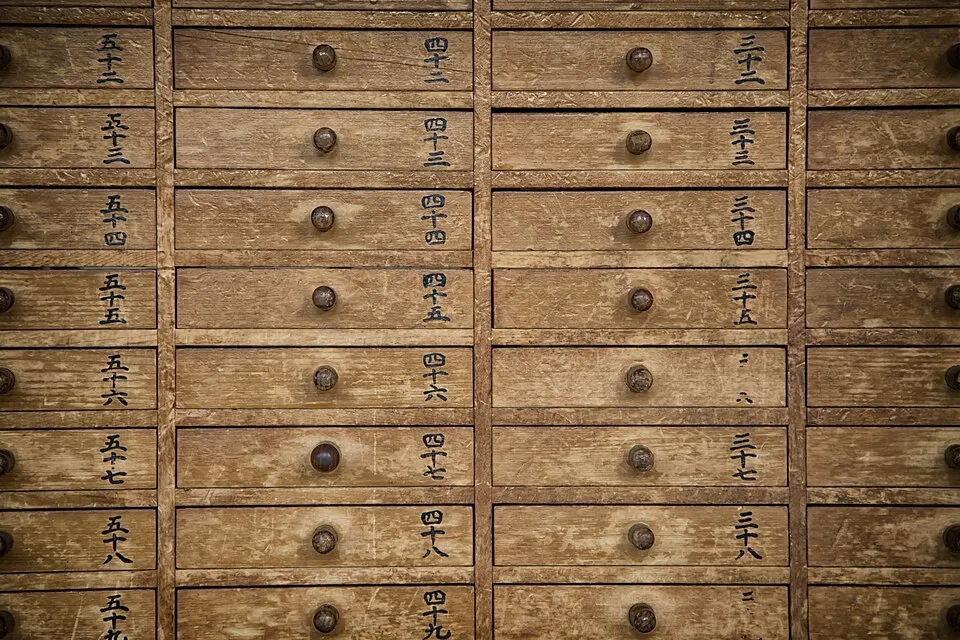 Numbered drawers for fortune slips. Photo: Yiannis Theologos Michellis, CC0
Some places let you pick a folded slip from a box or tray. Others use a coin machine. The Encyclopedia of Shinto shows people putting money in the offering box before they draw.
How to read your slip
A slip often has three parts. At the top are a number and the luck word. Many slips then have a short poem. Below that come one-line answers for each part of your life.
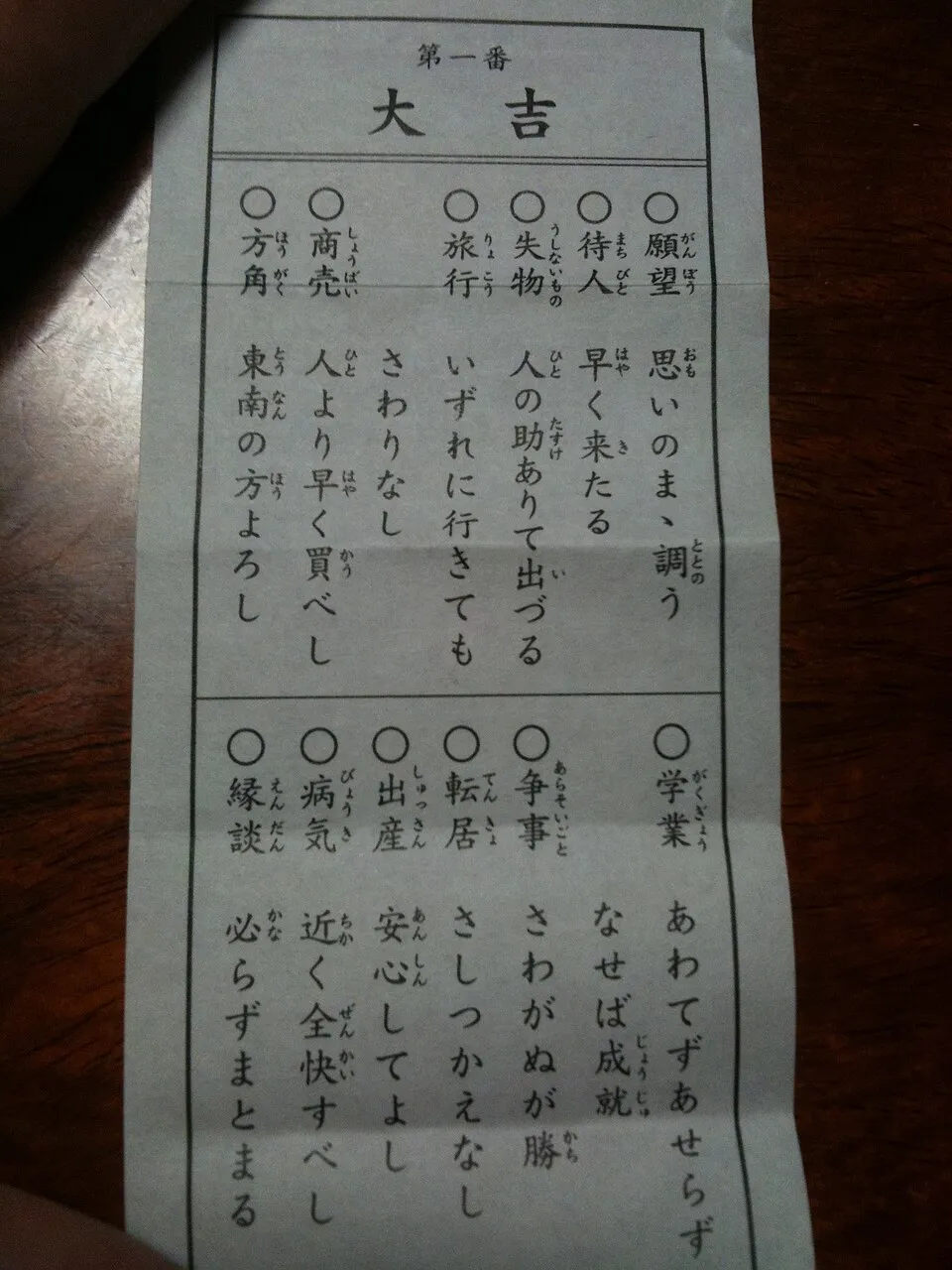 A slip that drew great luck (大吉), number 1. Each circle marks one topic. Photo: Ph0kin, public domain
Here are the topics on the slip above, in its order.
| On the slip | Say it | Rough meaning |
|---|---|---|
| 願望 | ganbō | Your wish |
| 待人 | machibito | The person you are waiting for |
| 失物 | ushinaimono | Something you lost |
| 旅行 | ryokō | Travel |
| 商売 | shōbai | Business, buying and selling |
| 方角 | hōgaku | Your lucky direction |
| 学業 | gakugyō | Study |
| 争事 | arasoigoto | Quarrels and disputes |
| 転居 | tenkyo | Moving house |
| 出産 | shussan | Childbirth |
| 病気 | byōki | Illness |
| 縁談 | endan | Marriage talks |
The answers are short and old-fashioned. On this slip, the lost thing "will turn up, with someone's help." The direction line says "the southeast is good."
Each place writes its own slips, so the topics change. Tōdai-ji, a great temple in Nara, prints English on its slips. Its English for machibito is "A person whom you wait for."
Can't read the poem?
Many shrine slips carry a waka, a short Japanese poem. Some temple slips carry a Chinese poem instead: four lines of five characters each.
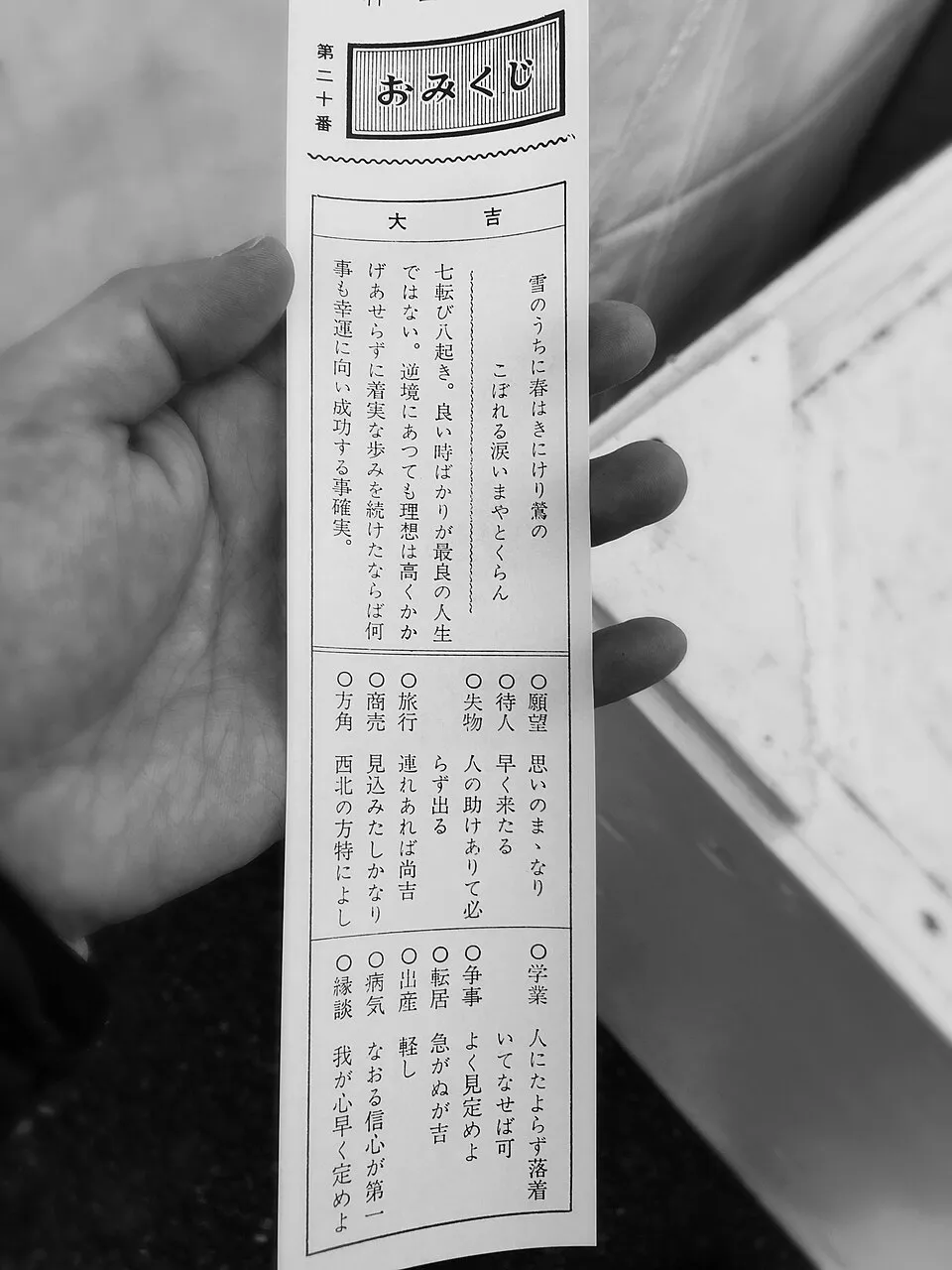 A great-luck slip, number 20, with a waka at the top. Photo: Shinji, CC BY 2.0
A Japanese magazine article on shrine manners says to read the poem first, even before the luck word. At a shrine, it says, the poem carries the god's message.
Our tip: start with the topic lines below. They give the advice in plain words.
The order of luck changes from place to place
Sources give no single order. It depends on the shrine or temple. Daikichi (大吉), great luck, is the top almost everywhere. Below it, sources give different orders.
| Who says | Best to worst |
|---|---|
| Encyclopedia of Shinto (Kokugakuin University) | daikichi, chūkichi, kichi, shōkichi, suekichi |
| Japanese Wikipedia, its "basic" order | daikichi, kichi, chūkichi, shōkichi, kyō |
| A Japanese magazine, common order 1 | daikichi, kichi, chūkichi, shōkichi, suekichi, kyō, daikyō |
| A Japanese magazine, common order 2 | daikichi, chūkichi, shōkichi, kichi, suekichi, kyō, daikyō |
Kichi (吉) is luck. Chū is middle and shō is small. Suekichi sits near the bottom, but it is still a kind of kichi. Kyō (凶) is bad luck, and daikyō is great bad luck.
So a kichi can be second best at one shrine and fourth at another. Kyoto's city tourism site says the number, order and odds all differ by shrine or temple. Some places show their full list on a large wooden board.
Some shrines have no bad luck
Many shrines do not stock bad-luck slips at all. The Encyclopedia of Shinto gives the reason: bringing good fortune is central to a shrine's work. People come to a shrine to ask for good luck. A slip of bad luck works against that. Japanese Wikipedia adds that bad luck was more common in the past, and some places have cut it back.
Meiji Jingu in Tokyo has no luck word at all. Since 1947, its omikuji has been different. Each slip is one of 30 poems by Emperor Meiji and Empress Shōken, with an explanation and an English translation.
Why poems? The shrine says it wanted an omikuji that fits Meiji Jingu, not an ordinary one. Its gods are that emperor and empress. So each slip is a word from the shrine's own gods.
Some temples keep a lot of it
Sensō-ji in Tokyo often hears that its slips have a lot of kyō. The temple answers that they are simply the omikuji of old times. A travel guide, MATCHA, says about 30 of its 100 lots are kyō. The temple's own page gives no number.
Sensō-ji also says kyō is nothing to fear. Live with patience and sincerity, it says, and kyō turns to kichi.
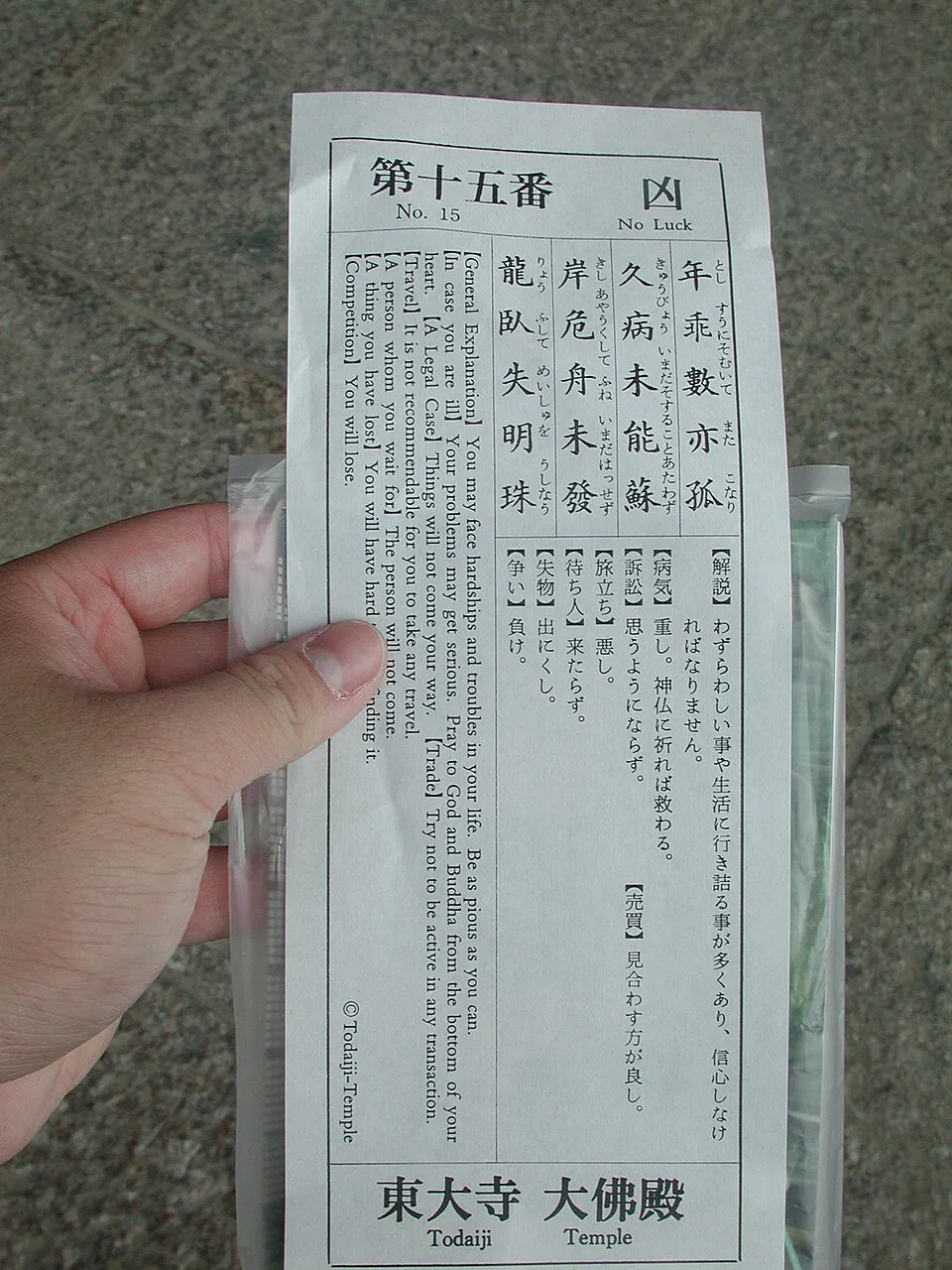 A bad-luck slip (凶) from Tōdai-ji in Nara, number 15. The temple's own English says "No Luck." Photo: Pramook, public domain
Tie it or take it home?
You will see slips tied in rows on trees, ropes and racks. The Encyclopedia of Shinto says good slips are usually taken home, and bad ones are often tied.
Shrines explain the tying in different ways.
- Kanda Myojin, a shrine in Tokyo: you do not have to tie it. Tying means leaving bad or unwelcome words at the shrine. Take a good slip home. Take a bad one home too, if you want it as a warning.
- Sensō-ji, a temple in Tokyo: if you draw kyō, pray to Kannon and tie the slip at the set place. This makes a bond (go-en), the temple says.
- Japanese Wikipedia: tying has been done since the Edo period, because "to tie" (musubu) also means to make a bond.
Already took a bad slip home? That is fine by Kanda Myojin's answer: you may keep it as a warning.
Tie it only where the shrine or temple sets a place for it. Sensō-ji asks for this, and so does the magazine article.
Can you draw again?
No shrine page we read gives a rule. The magazine article says there is no fixed rule. But do not draw again just because you dislike the result. Drawing at a different shrine is fine.
Kyoto's tourism site tells of the warlord Akechi Mitsuhide. He is said to have drawn three times until he got a good result.
Shinto or Buddhist? Both
At shrines, drawing lots was a way to ask the kami, the gods, for their will. In old times, lots chose heirs and festival hosts. A lot handed the choice to the gods, or to pure chance. Either way, no person had picked the winner, so it felt fair.
It was even used for a shogun, Japan's military ruler. In the Muromachi period (1336–1573), the great lords could not agree on an heir to the shogun Ashikaga Yoshimochi. So the heir was chosen by lot at Iwashimizu Hachiman Shrine.
Temples have their own line. Sensō-ji calls its slips Kannon hyakusen, "the hundred lots of Kannon." Kannon is the Buddhist figure of mercy. The temple says omikuji spread through Ryōgen (912–985), a monk of Mount Hiei, a great temple mountain near Kyoto. A local tourism guide calls his old hall there "the birthplace of omikuji."
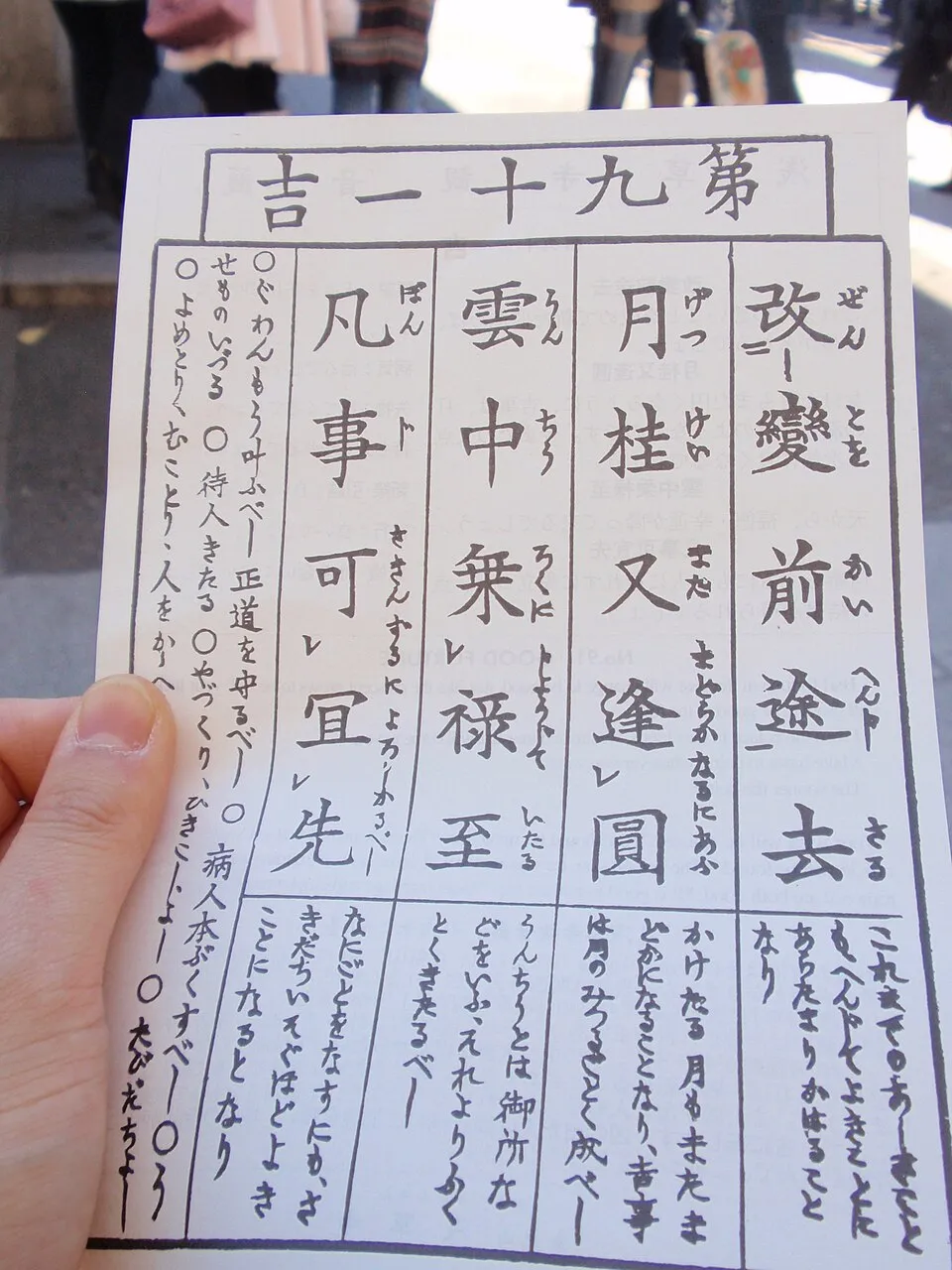 A temple slip, number 91, luck (吉). The four big lines are a Chinese poem of five characters each. Photo: C121749n, public domain
A Mount Hiei guide and Japan's tourism agency credit him with omikuji. But no dictionary we read links him to omikuji, so treat it as a temple tradition.
Who prints them
Many of the most widely sold slips come from one maker. The Encyclopedia of Shinto says the text of the most widely sold slips belongs to Joshidōsha, in Yamaguchi Prefecture.
It began in 1906 as a women's Shinto group at Nisho Yamada Jinja, a local shrine. Yamaguchi's tourism site says the shrine started it as an early push for equal rights for women and men. The group also designed the omikuji vending machines seen at shrines and temples across Japan.
The name
Omikuji is often written 御神籤. The o is a polite prefix, and 神 is a god. The last character, 籤 (kuji), means a lot you draw.
籤 has the bamboo radical. An old Japanese dictionary, the Wamyōshō, reads it as "bamboo skewer." In China, too, 籤 meant a bamboo skewer drawn from a tube to tell fortunes. Many omikuji boxes still use sticks.
Frequently asked questions
What is the difference between omikuji and omamori?
An omamori is a charm you keep for protection. An omikuji is a fortune you read. You can tie an omikuji at the shrine. An omamori is returned to a shrine or temple after about a year.
How much does an omikuji cost?
At Sensō-ji it was 100 yen, as above. At Tokyo Daijingu, a regular slip and a love slip were 200 yen each. These prices were read in November 2026 and can change.
I can't read Japanese. What can I do?
Look for a place that prints English. Tōdai-ji prints English on its slips. Meiji Jingu's slips come with an English translation. Or match the topics on your slip with the table above.
Is a bad-luck slip really bad?
The temple and shrine we read do not treat it as a curse. Sensō-ji says patience turns it to good luck. Kanda Myojin says you can leave it at the shrine, or keep it as a warning.
Sources
- Kotobank: おみくじ, 神籤, 籤, 良源, 御
- Kokugakuin University, Encyclopedia of Shinto: Omikuji, Do shrines issue "inauspicious" fortunes?; Basic Terms of Shinto: O-mikuji
- Japanese Wikipedia: おみくじ, 良源
- Shrine and temple pages: Sensō-ji FAQ, Meiji Jingu and its FAQ, Kanda Myojin FAQ, Tokyo Daijingu
- Mount Hiei: Hieizan guide (PDF); Japan Tourism Agency, Shiki Kōdō, Enryakuji, Meiji Jingu omikuji
- Yamaguchi Prefecture tourism: Nisho Yamada Jinja; Kyoto Travel: Omikuji fortune
- MARIKO, Serai.jp, 2018; MATCHA: Sensō-ji omikuji
- Photos of slips on Wikimedia Commons: great luck, waka slip, Tōdai-ji, Chinese-poem slip