Why the face looks like this
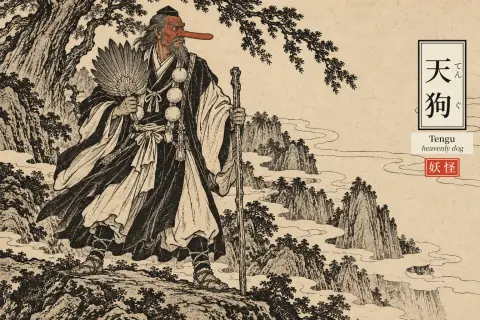
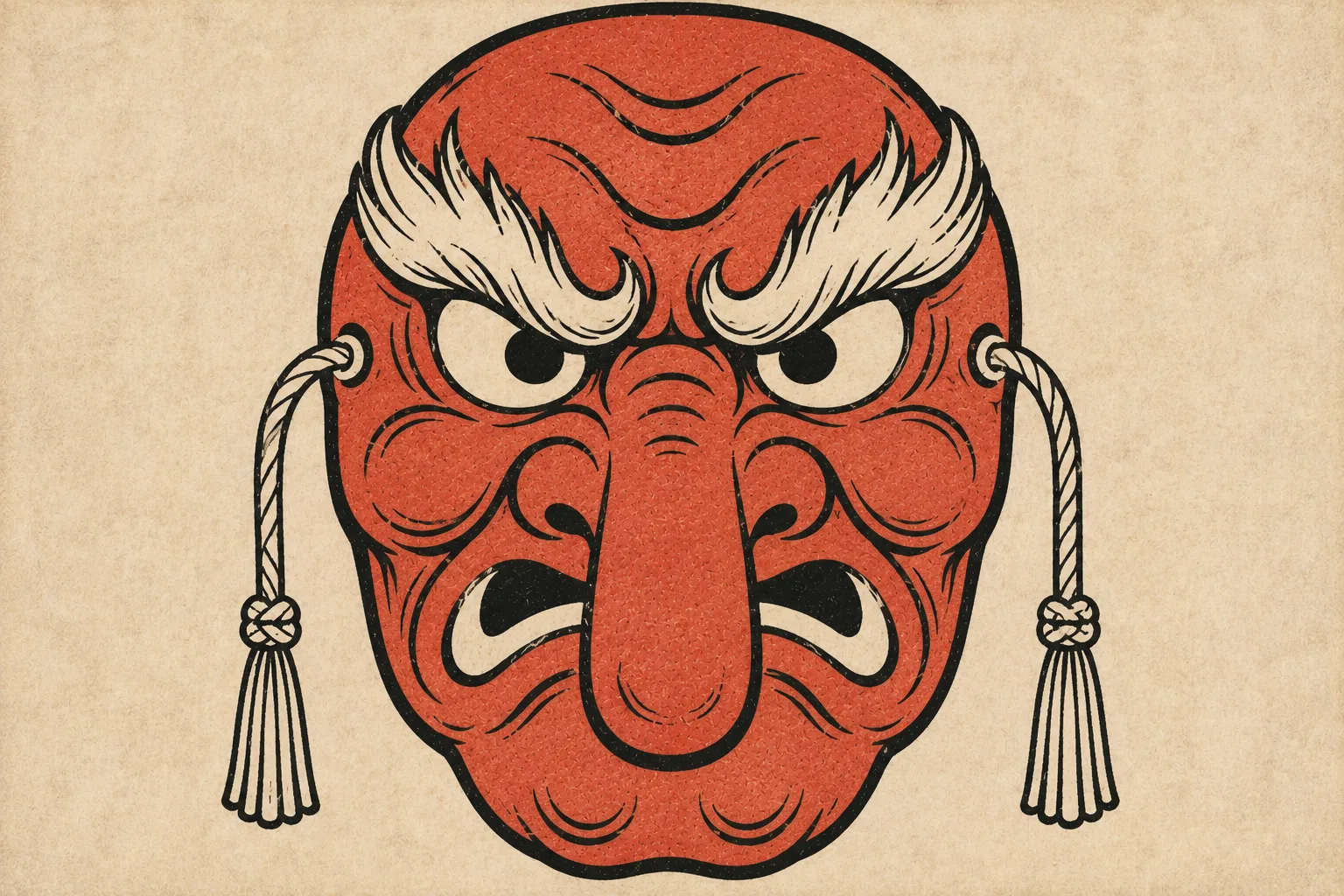
The great tengu has a red face and a long nose. There is a second kind, the crow tengu, or karasu tengu, with a bird's head and a beak.
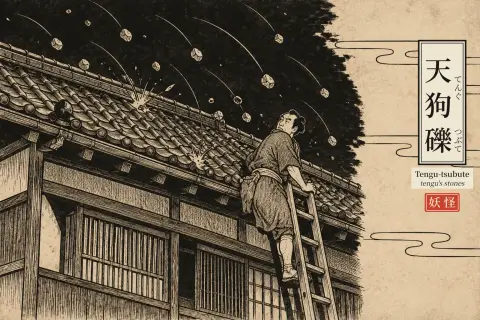
Why the long nose? Our guide Why do tengu have long noses? traces it. In short, the word first named a roaring shooting star, given the Chinese name "heavenly dog." Later the tengu became a mountain spirit pictured as a bird. Then it took the look of a monk, and of a mountain ascetic. The long nose came late.
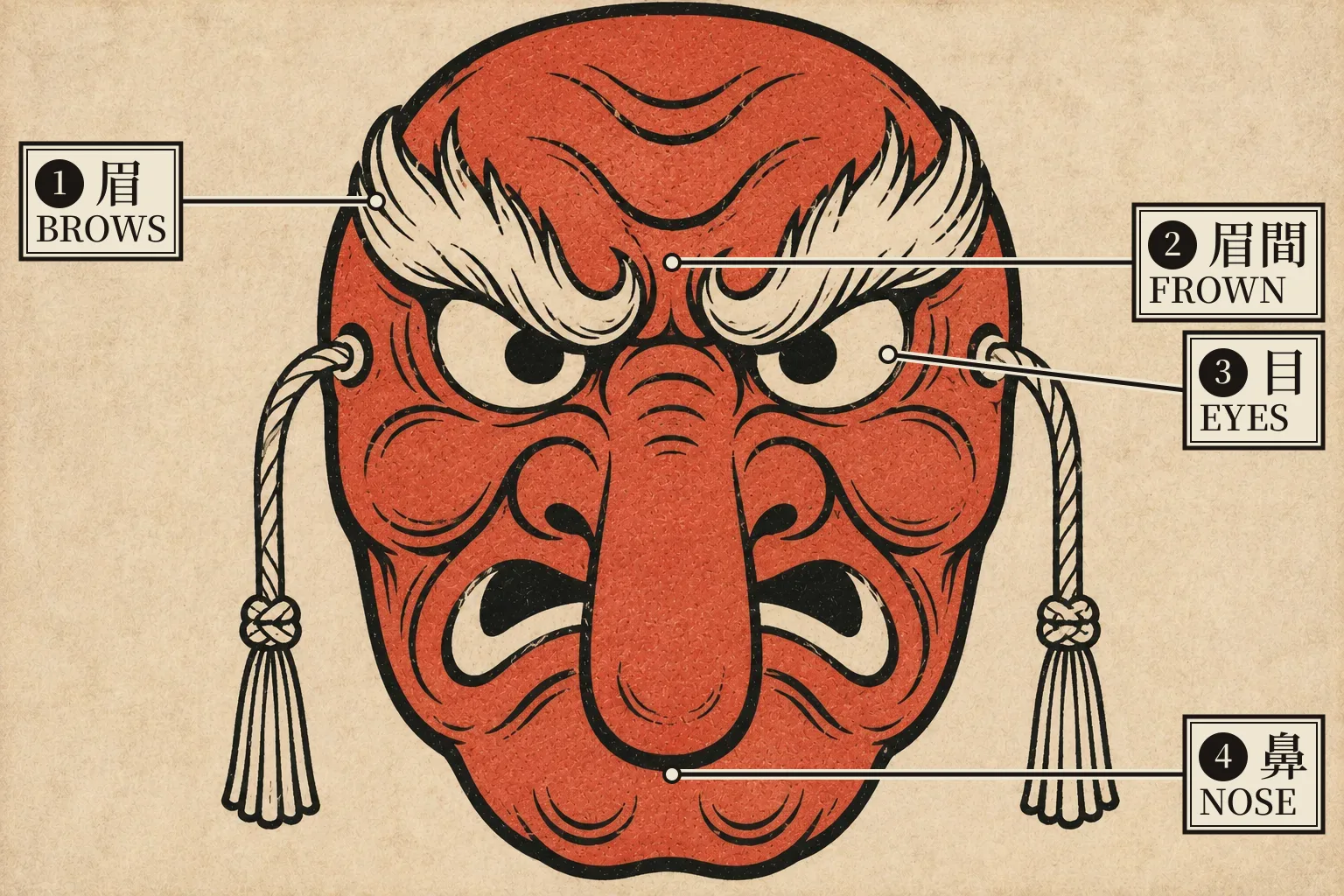 Our diagram. Each row says why that part looks the way it does.
| # | Part | Why it looks like this |
|---|---|---|
| 1 | 眉 Brows | White, bushy brows flare up above the eyes. In folk belief the tengu is a red-faced mountain monk with long white hair, and white hair marks an old man. So the brows make him old. (Kotobank) |
| 2 | 眉間 Frown | Deep lines between the brows. Dictionaries trace the tengu mask to Chidō, the lead mask of a temple dance from 612, which walked first to drive evil away. So a face with that job looks angry. (Kotobank; JAANUS) |
| 3 | 目 Eyes | Big, round, glaring eyes. Japan's first history, the Nihon Shoki (720), says Sarutahiko's eyes shone like a great mirror. At festivals his part wears a tengu mask, so the eyes are big and fierce. (Nihon Shoki; Kotobank) |
| 4 | 鼻 Nose | A thick red nose hangs almost to the chin. The Nihon Shoki gives Sarutahiko, the god who walks first, a nose seven hand-spans long, and at some festivals this face plays him. So the tengu has his nose. (Nihon Shoki; Kotobank) |
Both the nose and the eyes come from one old picture of Sarutahiko. Long before that, the temple-dance mask Chidō, with the tallest nose of its kind, walked first to clear the road.
Why it leads the parade
At some festivals the tengu mask has one clear job: it is the face of Sarutahiko, the god who shows the way.
In Japan's old myths, Sarutahiko guided the gods' grandson on his way down from heaven to earth. Japan's oldest official history, the Nihon Shoki, describes Sarutahiko's long nose and red mouth. One dictionary says this face recalls a tengu.
So when a shrine's portable shrine, the mikoshi, is carried through town, the person playing Sarutahiko wears a tengu mask and walks first at some festivals. In the town of Hakui, people think of the festival tengu as Sarutahiko. In Kamakura, the Sarutahiko of a masked parade wears one too.
Not every tengu mask is Sarutahiko. In Noh plays and temple dances, the tengu does other jobs.
Tengu mask or oni mask?
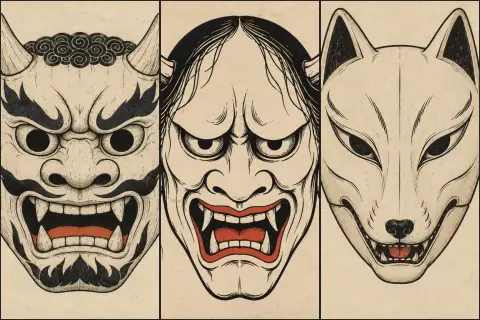
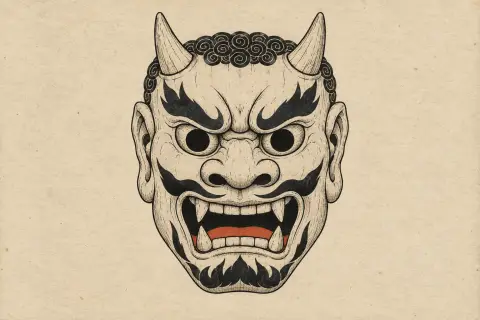
At mountain temples, the two were partners. In old temple dances, tengu masks and oni masks were the ones used most, and both were believed to drive evil away. One encyclopedia says that, as spirits of the mountain, oni and tengu were the same.
The difference shows up elsewhere. At Setsubun, families chase the oni out of the house with beans. At a shrine festival, a tengu-faced Sarutahiko walks first through the streets.
Tengu masks, like oni and okame masks, have also been sold as toy masks since the Edo period (1603–1868). A shop-bought tengu mask belongs to that long line of toy masks.
The name
The kanji 天狗 mean "heaven" and "dog." In China, the tail of a shooting star was likened to a heavenly dog.
In Japan, the word first appears in the Nihon Shoki, for a roaring star crossing the sky. An old reading of that text gives the word as amatsu-kitsune, "heavenly fox." One encyclopedia notes that this star is quite different from the later mountain spirit.
Frequently asked questions
Is a tengu mask good or bad? It depends on its job. At some festivals it plays a god who leads the way, and in old temple dances it helped drive evil away.
Why is the tengu mask red? The great tengu is pictured with a red face. Why red, the dictionaries we read do not say.
Sources
- For the diagram: Kotobank, 治道, Nihon Shoki, book 2 (Wikisource), Kotobank, 天狗 (Daijisen; Heibonsha World Encyclopedia)
- Kotobank: 天狗, 仮面, 猿田彦
- JAANUS: tengu
- Hakui History and Folklore Museum: tengu mask
- V&A: tengu mask