Why it looks like this
This is not only an old custom. A national group of rice-cake makers counted about 3,800 tonnes of kagami mochi made from April 2023 to March 2024, a food trade paper reports. That is down from more than 6,000 tonnes a year in 2012 and 2013. The same paper said in 2019 that the main reason was a shift to smaller cakes. It also worried that people were drifting away from the custom.
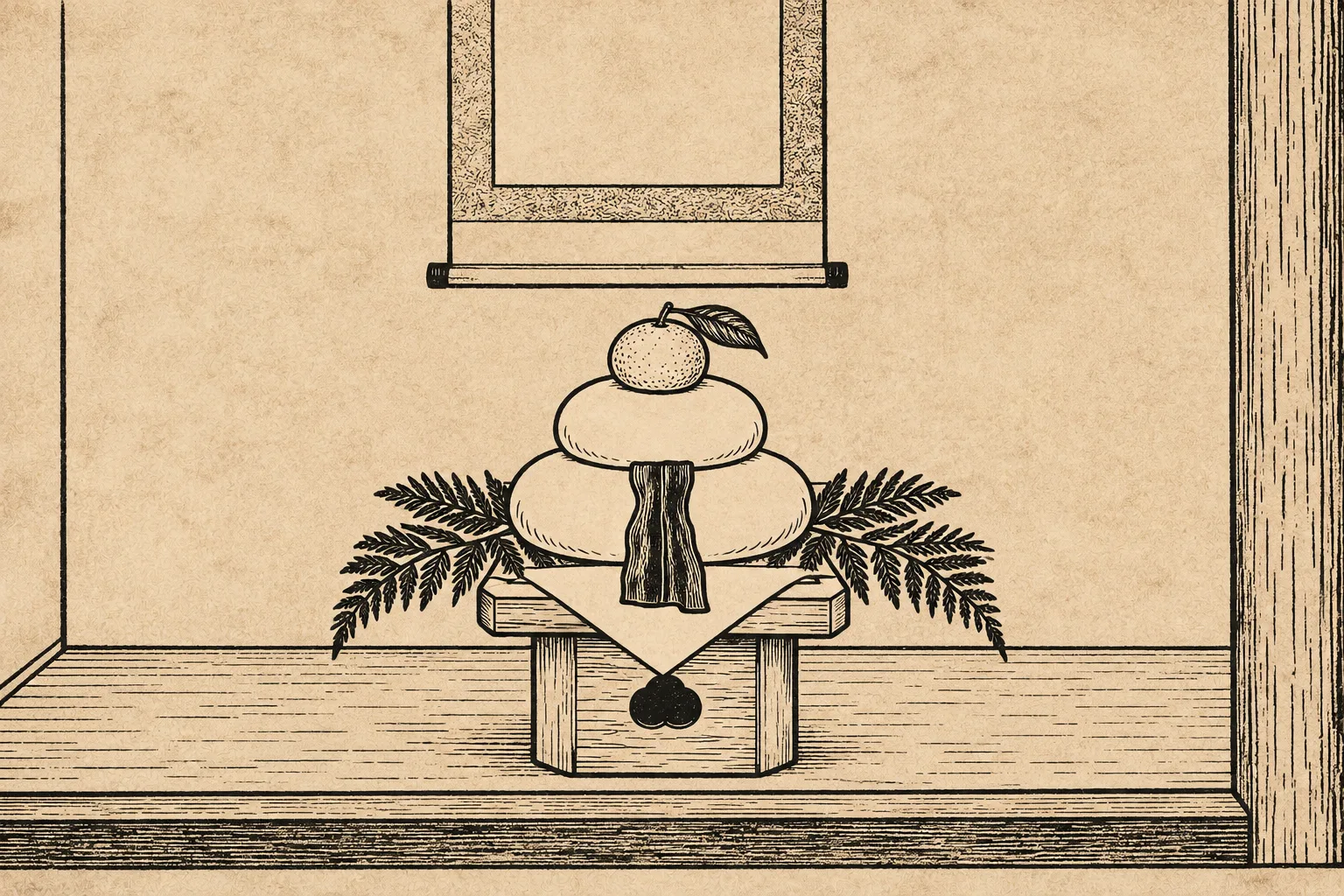
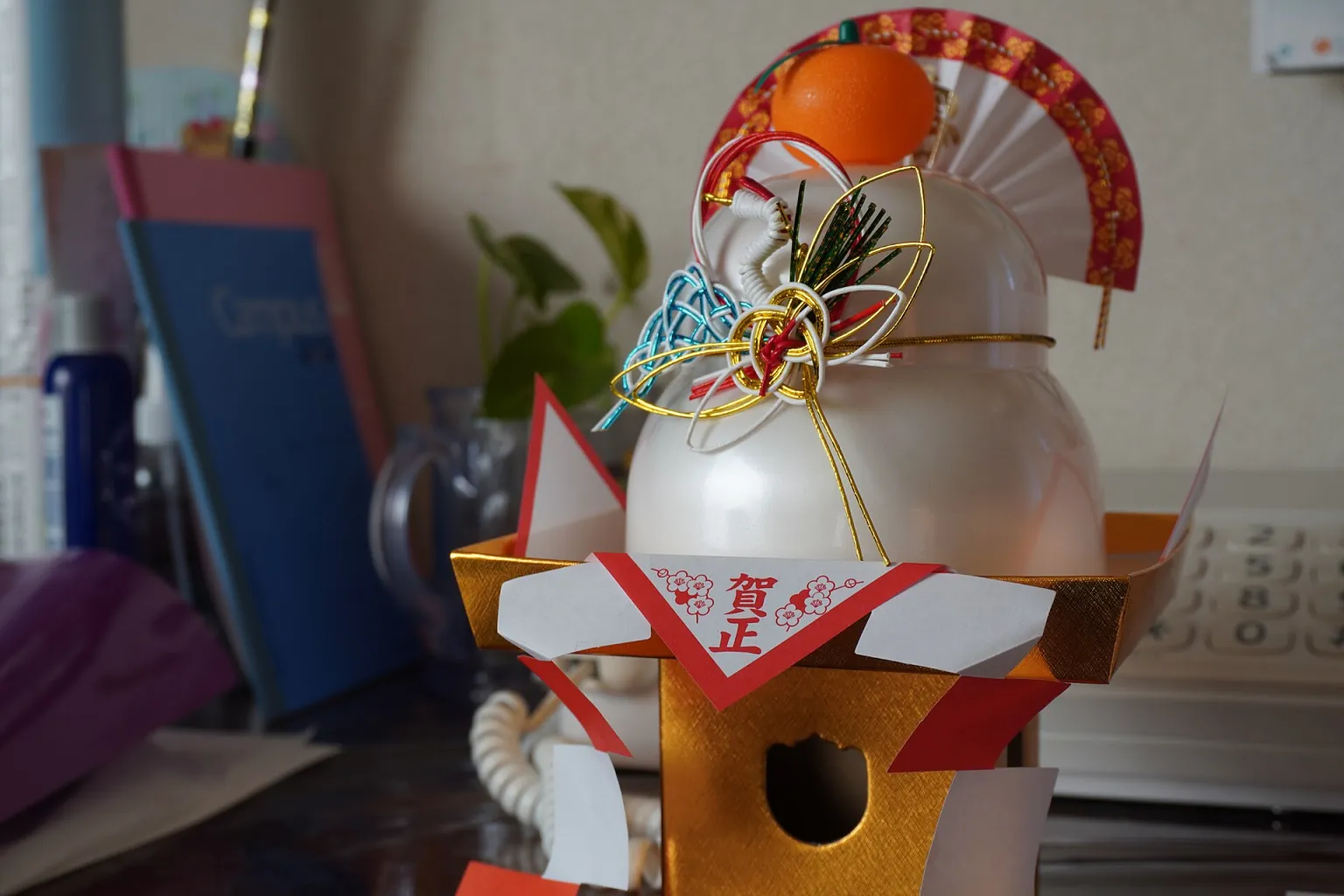
A kagami mochi is two flat, round rice cakes, a big one under a small one. Some places stack three. A small bitter orange usually sits on top. It stands on a wooden tray, set in the tokonoma, the alcove of the main room, or on the kamidana, the god shelf.
Why round? Sources give two answers.
- A mirror. Old mirrors in Japan were round bronze disks. Dictionaries explain the name by that shape.
- A soul. Two encyclopedias describe an older custom: round cakes, one for each family member's soul, offered to renew those souls. Britannica says this custom later merged with an offering to the year god, and kagami mochi took its present form. The Japan Kagami Mochi Association, a makers' group, says the round shape is said to copy the soul, or the heart.
Why two? An encyclopedia says stacking them is said to bring luck, because fortune piles up. The farm ministry and the makers' group also say the two cakes stand for the sun and the moon.
What does each part mean?
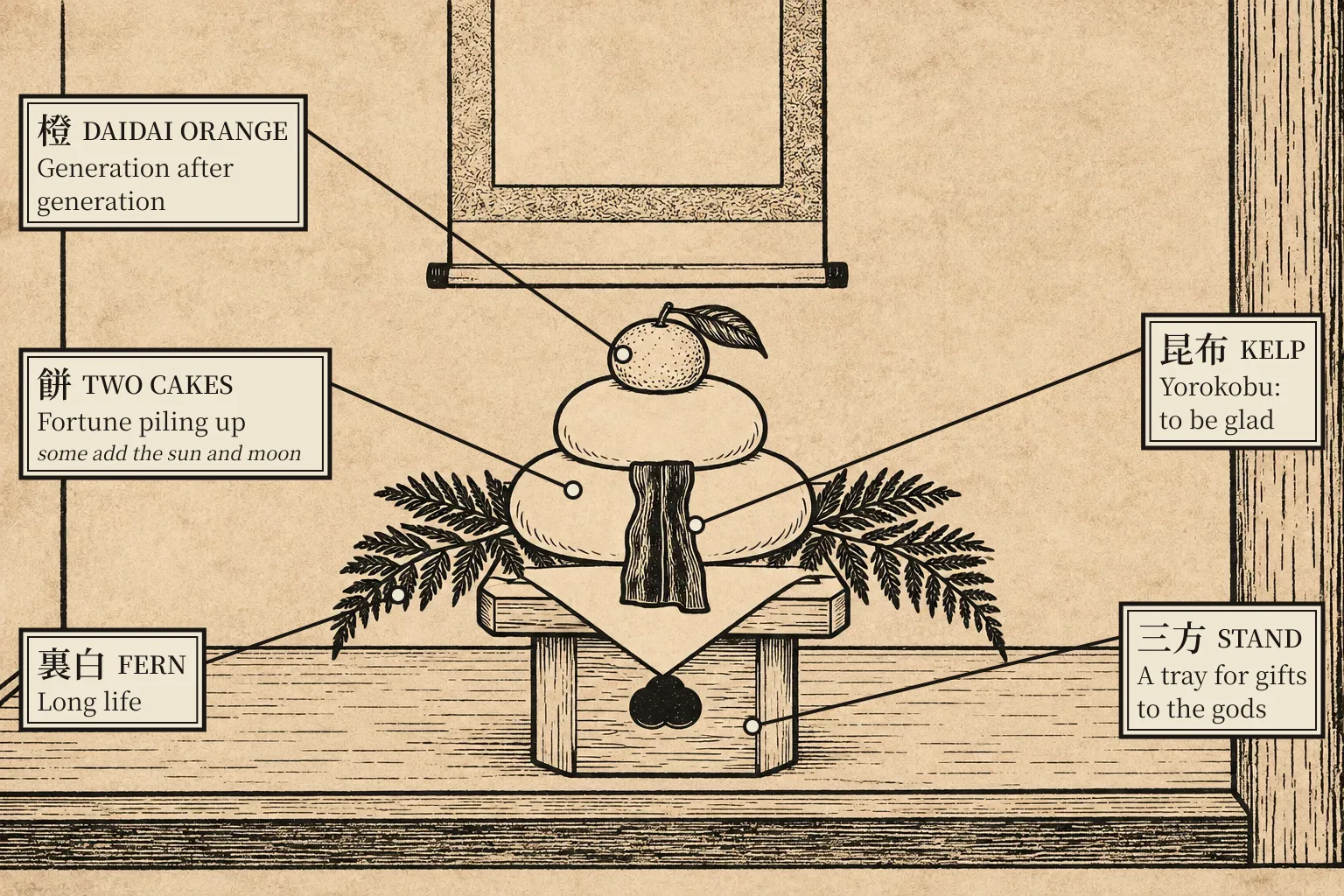
The farm ministry says every decoration has a meaning. Several are puns.
| Part | Its wish | Who says so |
|---|---|---|
| Two round cakes | Fortune piling up; some add the sun and the moon | Encyclopedia, farm ministry, makers' group |
| Daidai (bitter orange) | Family lasting "generation after generation" | Dictionaries, farm ministry |
| Urajiro (fern leaves) | Long life; old leaves stay while new ones grow | Dictionary, farm ministry, makers' group |
| Yuzuriha (leaves) | The family line handed down | Dictionary, farm ministry, makers' group |
| Kombu (kelp) | A pun on yorokobu, "to be glad" | Dictionary, makers' group |
| Lobster | A long life, until your back bends | Dictionary, makers' group |
| Dried persimmons on a skewer | Good things come; wealth gathers | Makers' group |
The orange's name, daidai, sounds like 代々, "generation after generation." Dictionaries explain why: the fruit does not fall, but stays on the tree into the new year. It is an odd fruit in another way, too. It ripens yellow in winter, and if left on the tree, it turns green again the next summer.
The wooden stand is a sanbō, a tray with carved holes for offerings to gods. Paper goes under the cakes. The makers' group says today's display is simpler: the stand, paper, cakes, orange, a few leaves and kelp.
Why is it called a "mirror"?
Kagami means mirror. In old Japan, mirrors were also tools for rites. A Japanese encyclopedia says a mirror could be the place where a god comes down, and the body of the god in a shrine.
Some sources link the cake to the Yata no Kagami, a sacred mirror kept at Ise Grand Shrine. Japan's farm ministry says the cake is said to copy it.
When should you put it up?
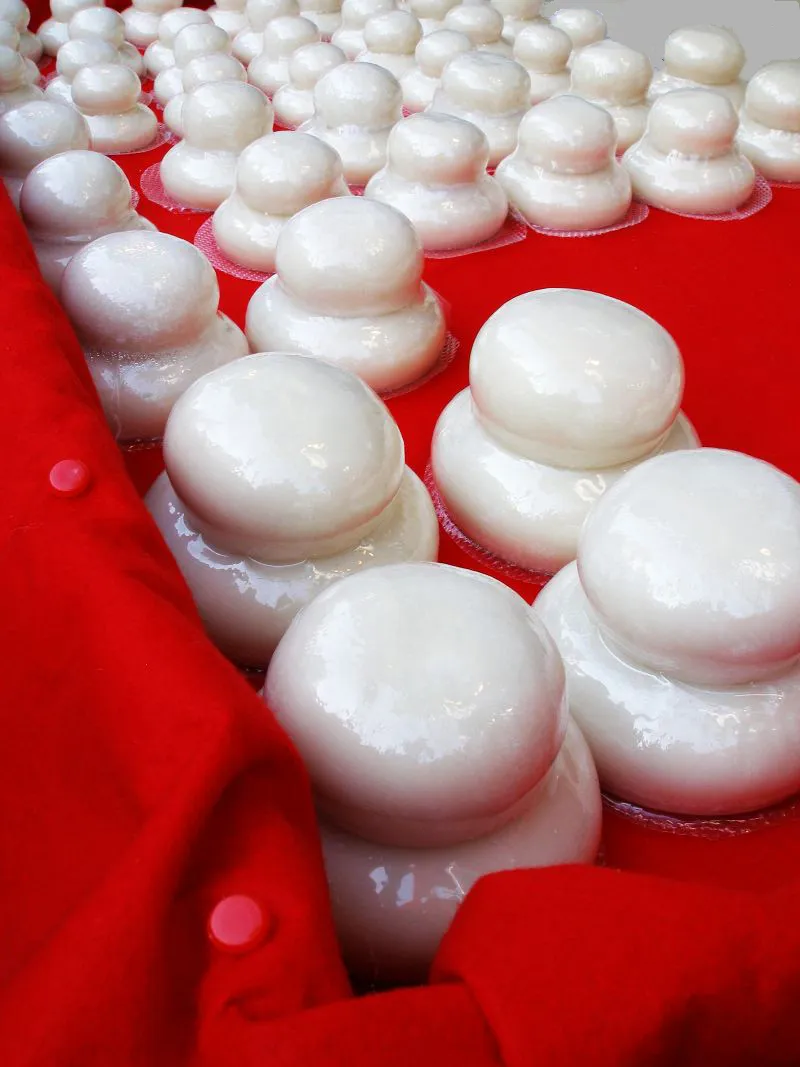 Kagami mochi without decorations, December 28, 2006. Photo: tanakawho, CC BY 2.0
The makers' group says to put it up early.
- December 28 is often called the best day. Japanese Wikipedia says 8 is a lucky number, because the shape of 八 widens toward the bottom.
- December 29 is avoided, says Japanese Wikipedia. The 9 can be read ku, which sounds like "suffering." Some areas read 29 as fuku, "luck," instead.
- December 31 is avoided. This is called ichiya kazari, "one-night decorating." A dictionary says it lacks sincerity toward the god and suggests a funeral. The makers' group agrees the 31st is not good.
Where should it go? Besides the alcove and the god shelf, the makers' group names the entrance. It also suggests small ones for the house gods, such as the kitchen god Kōjin, the water god Suijin and the toilet god Kawaya-gami.
When do you eat it?
You take it down and eat it on kagami biraki, "opening the mirror." In most of Japan, this is January 11. The makers' group says the god stays until January 7, the end of matsu no uchi. The cake stays up at least until then.
The day is not the same everywhere. Kyoto and some nearby areas open it on January 4. Where matsu no uchi lasts to the 15th, it may be the 15th or the 20th.
Break it, never cut it. Use your hands or a wooden mallet. The farm ministry says pointing a knife at an offering is bad luck. The makers' group and Japanese Wikipedia say a knife suggests seppuku, the samurai's ritual suicide. The word "break" is also unlucky. So people say "open" instead.
By then the cake is dry and hard. The pieces go into ozōni, a New Year soup, or shiruko, a sweet red-bean soup.
Why eat it at all? Sources give more than one answer.
- The god's power. The farm ministry says the god's power rests in the cake, so it should be eaten, not thrown away.
- Strong teeth. Japanese Wikipedia says eating the hard cake is also hagatame, a wish for strong teeth and a long life.
- Ending the New Year. An encyclopedia suggests that taking it down was first meant to mark the end of the New Year festival.
Where kagami mochi comes from
The oldest mention we found is in The Tale of Genji, written in the early 1000s. Its New Year chapter names a mochii-kagami, a "rice-cake mirror," next to the hagatame. One encyclopedia says kagami mochi became common in the Muromachi period.
 A modern packed kagami mochi, January 1, 2020. Photo: clvs7, CC0
Today, many are sold in a plastic case shaped like the two cakes, with small wrapped rice cakes inside. For the rest of the New Year days, see Japanese New Year, day by day.
The name
Kagami mochi is written 鏡餅. The first character means "mirror." The second means mochi, rice cake made from steamed and pounded sticky rice. So the name means what it looks like: a mirror rice cake.
Frequently asked questions
Can you eat the orange?
It is a real fruit, but a daidai is very sour and bitter. A dictionary says it is used for marmalade. Japanese Wikipedia says a mikan or a yuzu is used when daidai is hard to find.
Can I put up kagami mochi in a year when someone in my family died?
The makers' group says yes. It suggests offering one for the year's health and luck.
Why January 11, and not the 20th?
Dictionaries say the day used to be the 20th and moved in the Edo period. One common explanation: the shogun Tokugawa Iemitsu died on the 20th day of the fourth month in 1651, so the 20th became a day to avoid.
Is the cake linked to Japan's three sacred treasures?
The makers' group and Japanese Wikipedia say so. The cake is the mirror, the orange is the jewel, and the skewered persimmons are the sword.
Sources
- Kotobank: 鏡餅, 鏡開き, 歳神, 一夜飾り
- Kotobank: 橙, 三方, 鏡, 餅, 源氏物語
- Japan's Ministry of Agriculture (MAFF): kagami mochi and kagami biraki, aff magazine, rice cakes of the seasons
- Japan Kagami Mochi Association (makers' group, pages supervised by the folklorist Shintani Takanori): FAQ, how to offer, kagami biraki, the secret of kagami mochi, essay
- Japanese Wikipedia: 鏡餅, 鏡開き
- Weathernews (Japan), an interview with the Japan Kagami Mochi Association: 鏡餅の飾り方と鏡開きの作法
- Nihon Shokuryo Shimbun (food trade paper), October 21, 2024: kagami mochi feature