Japanese villages had two names for what lived in their rivers. One was a god they fed with rice cakes. The other was a creature they warned their children about. The god is Suijin, the water god. The creature is the kappa.
They are not the same thing. But folklorists have noticed how close they sit. This entry is about the god, and about that line between them.
The name is simple. 水 (sui) means "water" and 神 (jin) means "god". Another reading, minakami, appears in a poem in the Gosen Wakashū (c. 951–953).
Where the god lives
Suijin is not one god with one shrine. It is a name for the god of whatever water is nearby. The Nihon Daihyakka Zensho encyclopedia lists the river god, the spring god, the waterfall god, the pond god and the well god. Each is called by the water it guards.
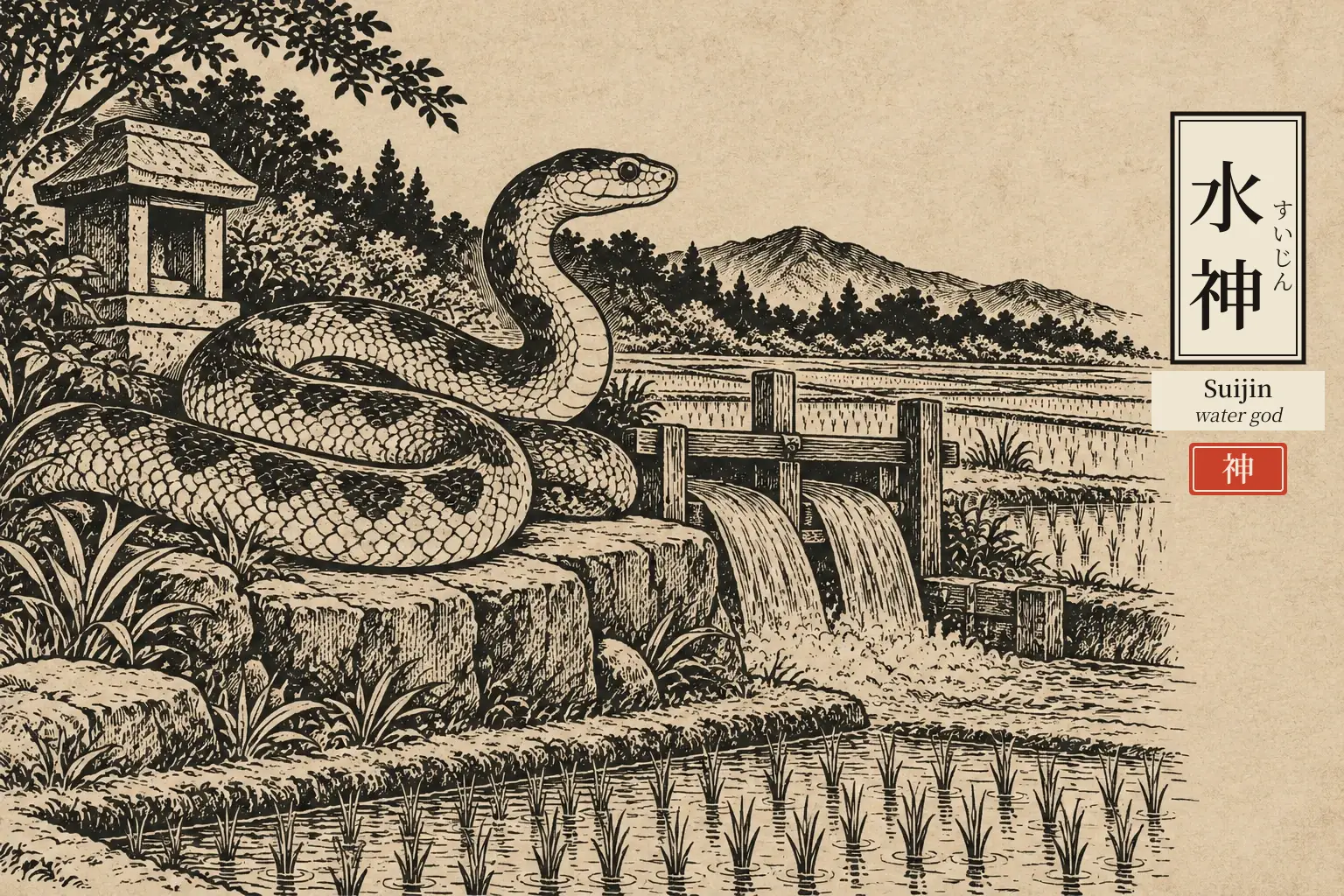
For rice farmers, the most important water is in the paddy. The folklorist Miyata Noboru describes the usual place of worship. It is a small stone shrine at the irrigation weir, or at the edge of a rice field.
Higher up, at the spring where a river starts, the same god takes another name. There it is Mikumari, "the one who divides the water". It decides how much reaches each valley below. Up there it is treated as the mountain god. Down at the paddy it is treated as the god of the rice field, ta-no-kami. Miyata writes that the three can no longer be clearly told apart.
A rice-planting song makes the link plain. It says the god of the rice field was born to the sun god and the water god.
There is a smaller Suijin too. Wells, springs and river washing places had their own. That god was not directly tied to rice. It guarded the water a household drank and cooked with.
What it looks like
Suijin has no single face. People pictured it in many shapes:
- A snake. This is a common form in folk tradition.
- A dragon. Chinese dragon-god belief shaped the Japanese water god. In many places the two became one.
- An eel, a frog, a fish, a monkey or a spider.
- A pond snail. Some places used the snail as the god's shape in rain rites. A few would not eat snails at all, because a snail was said to have saved them from a fire.
- A woman. She is often a goddess, sometimes a mother with a small child. Legends of "weaving pools" (hataori-buchi) say she sits at a loom on the bottom of the pool.
The kappa is on this list too. One encyclopedia, the Sekai Daihyakka, names it as the god's most typical emblem. Many folk tales imagine the water god taking a kappa's shape.
The god and the kappa
Here is the line this shelf exists to draw.
A kappa drags people into the water. Suijin keeps the water flowing to the fields. One is mostly feared. The other is mostly fed.
Yet the two keep crossing. The Nihon Daihyakka Zensho says the kappa "is said to be" the water god in a fallen state. That is a reading, not a record. The sources we found cite no old text that says the god became a kappa. But there is some support in practice. In parts of Kyushu, at river festivals, people worship the kappa itself as the water god.
The calendar shows the overlap too. On the first day of the twelfth month came Kawabitari, "river-soaking day". Rice cakes were offered to the water god. On the same day in the Kanto, children dipped their bottoms in the river at dawn. This was so the kappa would not take them. In the Chugoku region, people rubbed sweet rice cakes on their knees so they would not slip in the river. The foods eaten that day are thought to have been offerings to the water god at first.
So one day held both. Villages fed the god, and in the Kanto children guarded themselves against the kappa.
How villages kept it
Water rites were shared work. Households that drew from one shared water source formed a suijin-kō, a water-god association. Members took turns hosting the rites.
The rites changed from place to place:
- In Okayama, many villages worshipped the water god at Tanabata. They cleaned out the well on the same day. At New Year, they left an offering when they drew the year's first water.
- In Kumamoto, river festivals were held at the spring and autumn equinoxes. The water god was said to like aubergines, so aubergines were offered.
- In towns, the main summer festivals followed the Gion and Tsushima cults. Floods and epidemics came in summer. The festivals were held to drive them away.
Most water-god festivals fall in the sixth month or the twelfth. Prayers asked for rain, for safety from floods and sickness, and for a good harvest.
In a drought, a village might go to the pool where the god lived. They took its water and sprinkled it at the shrine or the water source. Some washed many wooden measures (masu) in the god's pond to call the rain.
How old it is
The Kojiki (712) and the Nihon Shoki (720) already name a water goddess, Mizuhanome. The word 水神 itself appears by 900. Sugawara no Michizane used it in a farewell poem in his Kanke Bunsō. In it he prays to the water god for a traveller's safe crossing of the rivers.
A song of 1705–06 sets the god in a familiar landscape: "In the river, the water god. In the valley, the kodama."
One old image survives at Kongōbu-ji on Mount Kōya. It is a gilt bronze statue of the water god, kept inside a small shrine cabinet. It is registered as an Important Cultural Property.
God or kappa?
So what lived in the village river: a god or a kappa? The villages never had to choose. On the same winter morning, they fed the god rice cakes. Their children dipped in the river so the kappa would not take them.
Water gave the rice and the drinking water. It also drowned children. One river, two faces. Suijin is the face a village fed. The kappa is the face it feared.