An emperor once heard thunder at the worst possible moment. He did something stranger than wait it out. He sent a man to go and get it. The story is in the Nihon Ryoiki, an early ninth-century tale collection. The attendant Sugaru tied a red flag to his halberd and rode out. He shouted an order at the sky. He came home with the thunder itself, carried in a palanquin.
What he caught was Raijin (雷神), Japan's god of thunder. The name is simple: 雷 (rai), "thunder," and 神 (jin), "god."
What does he look like?
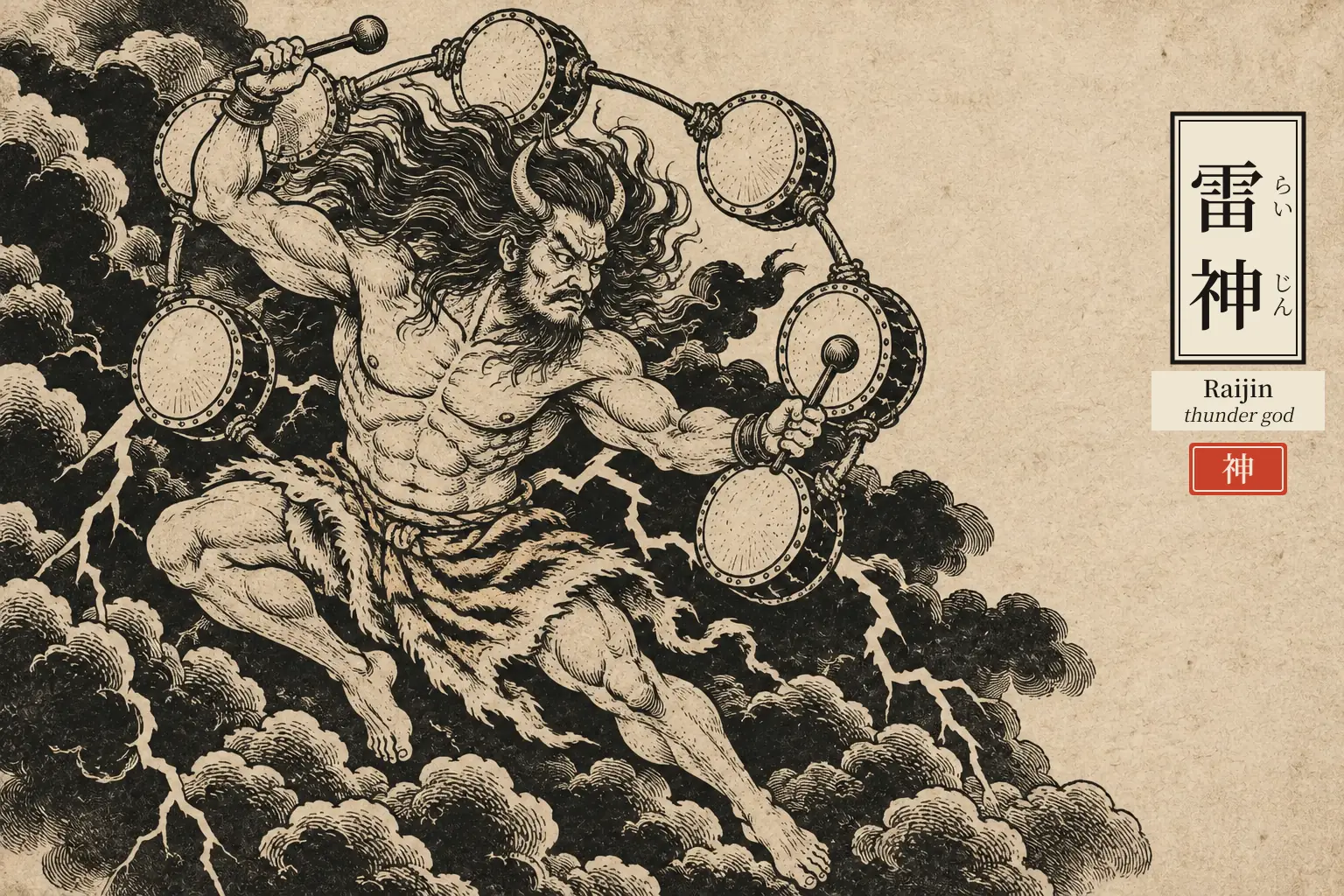
The image most people know comes from a folding screen, Wind God and Thunder God, by Tawaraya Sotatsu. It was painted in the 17th century and carries no date. Today it is a National Treasure. On it, Raijin has the shape of an oni, a demon. He has the horns of an ox and wears a tiger-skin loincloth. He beats a ring of drums set around his body like a crown.
In the comic folk paintings called Otsu-e, he is clumsier. He has dropped a drum, and he fishes for it from the clouds with a pole.
This is not the oldest image of him. A Kamakura-period wooden statue of Raijin stands at Sanjusangendo in Kyoto. A matching Wind God statue stands beside it. Both are credited to sculptors of the Kei school. Sotatsu is said to have used them as his model, centuries later.
Why does a god look like a demon?
Raijin is a god, not an oni. So why does he wear an oni's horns and tiger skin?
The usual answer is a direction on the compass. Old Japan named the directions after the twelve zodiac animals. The northeast sat between the ox (ushi) and the tiger (tora). It was called ushitora, "ox-tiger." It was also called kimon, the "demon gate," the side where bad things come in.
So, the explanation goes, the oni got an ox's horns and a tiger's skin. He wears the name of his direction as clothes. Raijin, a frightening power from the sky, was drawn in the same costume.
This is an explanation, not a record. No old text says a painter chose the look for this reason. But once you see it, the picture reads like a word puzzle.
Born in a fit of rage
The oldest story is older than any picture. In the Kojiki, Izanami dies giving birth to the fire god Kagutsuchi. Her husband Izanagi follows her into Yomi, the underworld, to bring her back. She tells him not to look at her. He lights a torch anyway.
He finds her corpse crawling with maggots. Eight thunder gods have grown across her body. One sits on the head and one on the chest. One sits on each hand and foot, and there are more besides.
Izanami is ashamed at being seen like that. She sends the eight thunder gods after him, with fifteen hundred warriors of the dead. On the slope back to the living world, Izanagi throws three peaches at them. The army turns back.
The Nihon Shoki, Japan's other oldest history, tells a close variant. There, Izanagi throws his staff, and it becomes a new god, Funado. It stands there to keep the thunder gods out for good. The two books disagree on most of the body parts. Both agree on three: the head, the chest and the genitals. Both count eight gods in all.
A tree, and a fish
A calmer, odder story sits in the Nihon Shoki, under the year 618. Men were sent to Aki Province, now Hiroshima, to cut timber for a ship. They found good wood on a mountain. Someone warned them that a thunder god lived in that tree. They cut it anyway, on the emperor's order. Lightning and heavy rain followed at once.
Their leader, Kawabe no Omi, drew his sword. He called up to the sky: "Thunder god, do not harm the workers. Strike me instead." Then he stood and waited. The lightning came down more than ten times. It could not touch him. At last the thunder god turned into a small fish, caught in the branches of the tree. The men took it and burned it.
The man who caught the thunder
The Nihon Ryoiki tells the fullest story. Emperor Yuryaku was startled by a thunderclap at an embarrassing moment. Humiliated, he ordered his attendant Sugaru to bring the thunder to him. Sugaru rode out shouting at the sky. He found a fallen bolt of lightning and carried it back to the palace in a palanquin.
It shone so brightly that the emperor made offerings to it. Then he had it returned to where it fell. That spot near Asuka is still called Ikazuchi-no-Oka, Thunder Hill.
Years later, Sugaru died. The emperor built his tomb at the same spot. He raised a pillar that read "Tomb of Sugaru, who caught the thunder." The thunder was insulted. It struck the pillar and split it open, and got its own foot stuck in the crack. Caught a second time, it was let go. The pillar was changed to read "Tomb of Sugaru, who caught the thunder, alive and dead."
The Nihon Shoki has a separate tale about Sugaru. The emperor sends him to catch the true form of the god of Mount Miwa. He comes back with a great serpent. It roars, and its eyes flash. The frightened emperor covers his eyes. The mountain was then named Ikazuchi, "Thunder."
Living with him
Folk belief gave Raijin a short temper, and people planned around it. In summer, children are told not to go around with bare bellies. "Kaminari-sama will come and take your navel," they hear.
One explanation is grim. Bodies struck by lightning were said to show the skin near the navel burned black. Another is practical. After a storm, the air turns cold fast, and a child with a bare belly gets an upset stomach. In that reading, the saying is a health warning in disguise.
In an actual storm, people hid inside a mosquito net. Or they chanted "kuwabara, kuwabara."
The best-known story traces the chant to Sugawara no Michizane. He was a scholar-official who died in exile. People believed he became Tenjin, a thunder god, and took revenge on the capital. Every estate in the city is said to have felt his storms, except Kuwabara. That land had once been his own. So people say its name to be spared.
Other stories tie the chant to a well in Izumi Province. The plainest one is in the word itself. Kuwabara means "mulberry field," and lightning was said never to strike a mulberry tree.
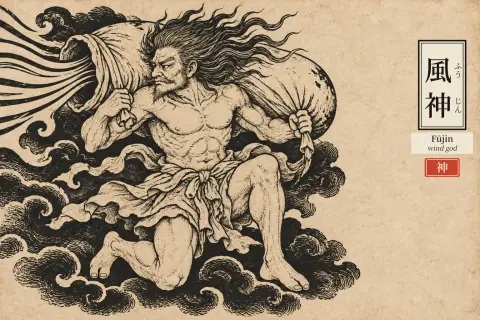
Raijin is often shown with Fujin, the wind god, as on Sotatsu's screen. They are two gods of two kinds of weather, standing side by side.
Raijin today
In the next century, the painter Ogata Korin copied Sotatsu's screen. His version is now an Important Cultural Property, kept in Tokyo. Both paintings are still the standard image of the god. They turn up on museum posters and on sweet wrappers.
On the Noh stage, Raijin plays the climactic second role in the play Raiden. In Kabuki, the priest Narukami turns into a thunder god. He anchors one act of the long play Narukami Fudo Kitayama-zakura. In haiku, his name is a kigo, a season word. It belongs to summer, along with plain "thunder."