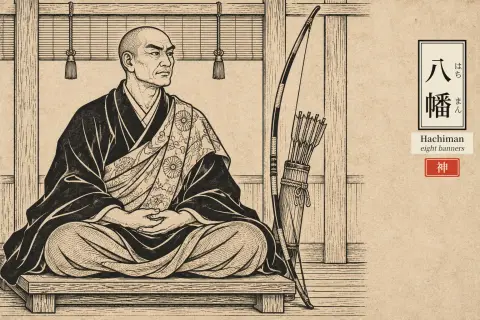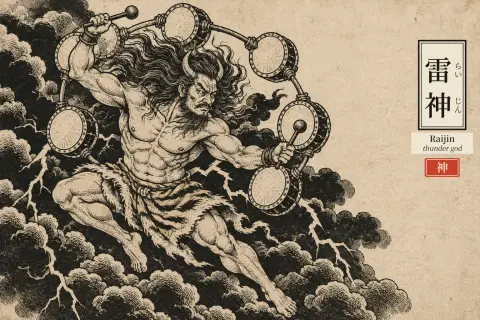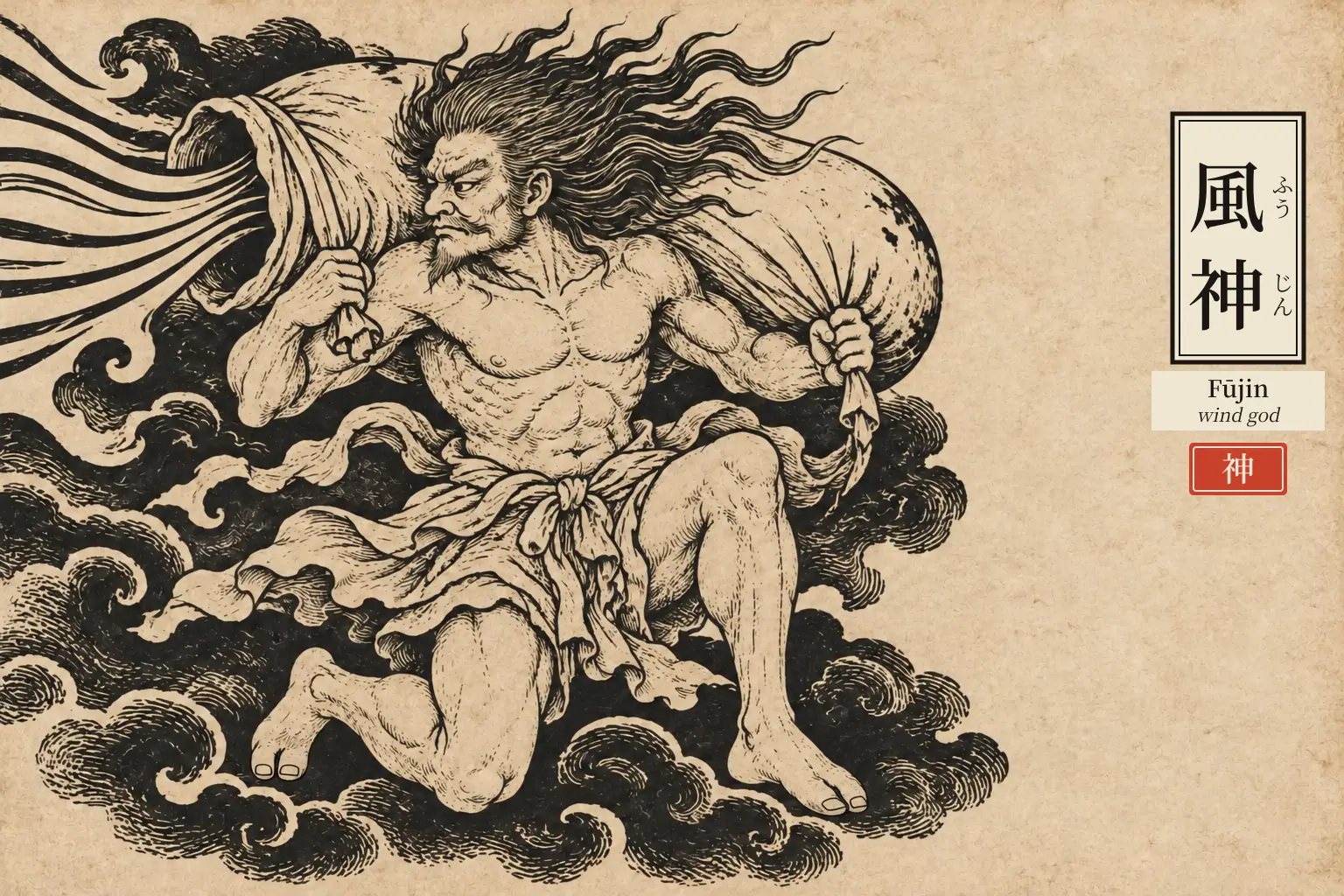
During the Mongol invasion of 1281, the imperial court sent an envoy to Ise Shrine. He prayed at two shrines to the wind. The invaders withdrew, and the retreat was credited to a divine wind, the kamikaze. In 1293 both wind shrines were raised in rank and given new names. They serve the wind gods Shinatsuhiko and Shinatobe. In art, the wind god is called Fujin (風神). The name is plain: 風 (fū), "wind," and 神 (jin), "god."
Three things called the wind god
Japanese uses one phrase, kaze no kami, for at least three different things. They are easy to mix up.
The first is a god in the oldest histories, who rules the wind. He has a name, Shinatsuhiko, and a birth story. The old texts give little more.
The second is the figure most people picture: a demon-like god, an oni, with a bag of wind on his back. He comes from Buddhist art, not from the myths.
The third is a plague god. From medieval times, kaze no kami also meant the spirit that spreads colds. It shares the name but is not the same being.
There was even a fourth use. In Edo, some beggars went door to door when colds were spreading. They wore masks, beat a gong or a drum, and claimed to drive the cold-god away. They asked for money in return.
What does he look like?
Japan's oldest surviving statue of the wind god stands at Sanjusangendo in Kyoto. It was carved in the Kamakura period and is now a National Treasure. He kneels on his right knee, with the left knee raised. The wind bag rests across his back. He has four fingers on each hand and two toes on each foot. He is 111.5 cm tall, painted, with eyes of crystal. A thunder-god statue stands at the far end of the hall, posed as his mirror image. Both are thought to be by sculptors of the Kei school.
The Taiheiki, a 14th-century war chronicle, tells of a blue demon-god at Ise who raised a great wind from a bag. By the Muromachi period, then, the blue oni with a bag was a fixed picture.
The best-known version is Tawaraya Sotatsu's folding screen Wind God and Thunder God, from the first half of the 1600s. It is a National Treasure, owned by Kennin-ji temple in Kyoto. Sotatsu's wind god holds the bag in both hands. The wind god was usually painted blue, but Sotatsu made him green. Around 1711 Ogata Korin made a careful copy, now in the Tokyo National Museum. In Sotatsu's version the two gods sit at the very edges and look down at the world. In Korin's, they fit inside the frame and look at each other.
A name and a breath
The Kojiki (712) lists Shinatsuhiko among the gods born to Izanagi and Izanami. It says he is the god of wind, and moves on. The Nihon Shoki (720) gives a variant. In it, the wind god Shinatobe is born from a breath that blew away the morning mist. Accounts differ on whose breath it was. Some summaries say Izanami's, others say Izanagi's.
The scholar Motoori Norinaga read shina in the name as "long breath." Another Edo scholar, Kamo no Mabuchi, thought the wind gods began as a male and female pair. Tatsuta Taisha's records still pair a male and a female wind god.
The wind god had a state shrine early on. In 675, the Nihon Shoki says, Emperor Tenmu sent envoys to worship the wind god at Tatsuta, in Nara. Tatsuta Taisha still holds a wind-calming festival in early July.
Did the bag come from Greece?
This is where the scholars split. The bag is the strangest part of the god, and scholars disagree about where it came from.
| View | What it says |
|---|---|
| Matsumoto Eiichi (1929) | Wind gods in Central Asian cave paintings hold a swelling cloth. At one cave, Simsim, the god clearly grips the mouth of a bag. Their style matches Gandharan art further west, and it all goes back to Greece and Rome. |
| The other view | Homer's Odyssey has a bag of winds, but no known ancient artwork shows it with its owner, Aeolus. The shapes differ too. On this view, the cloth only became a clear bag in China, in the 6th to 8th centuries. |
Some of the pieces themselves are well known. The Tower of the Winds in Athens, from the 1st century BC, shows the north wind, Boreas, with a bag on his back. A 2nd-century Boreas from Hadda, in today's Afghanistan, was made in the Gandharan style. A 6th-century ceiling at Dunhuang, in western China, shows a wind god with a bag beside a thunder god in a ring of drums.
There is also a theory about his missing wings. Gold coins of the Kushan king Kanishka I, from the 2nd century, show a winged wind god running with a cloth. The label is ANEMOS, Greek for "wind." His copper coins, and coins of the later king Huvishka, show nearly the same figure with no wings, labelled OADO. One theory says the wings were lost here. That would explain why Chinese and Japanese wind gods have no wings like the Western ones.
The pair of wind and thunder gods reached Japan mainly through Buddhist images. In them, the two attend the Thousand-armed Kannon. These images were popular from the late Heian to the Kamakura period.
The wind that makes you sick
Medieval Japan believed moving air could hurt crops and fishing, and get into the body. That belief is thought to be why the word for a cold, kaze, is written 風邪, "evil wind."
In the Edo period, when colds spread, a town would make a straw figure of the wind god. People paraded it through the streets, chanting okure, okure, "send it off." Then they threw it out of town or into a river.
The yokai book Ehon Hyaku Monogatari (printed 1841) gives this wind god a body of bad air. It drifts on the wind and slips into gaps, even the gap between warm and cold. When it meets a person, it blows a yellow breath, and the person falls ill. The yellow, one reading says, is the dust blown in from China's yellow earth before rain. In western Japan, falling suddenly ill outdoors is still called kaze ni au, "meeting the wind."
Fujin today
Across Tohoku, people worshipped a half-yokai wind god called Kaze no Matasaburo, and gave him shrines. In Niigata and elsewhere, a wind god of the same root is called Kaze Saburo. The writer Miyazawa Kenji took this wind god for his short story Kaze no Matasaburo.
Fujin is usually shown with the thunder god. At Sanjusangendo he stands at the north end of the hall, with the thunder god at the south. For about 84 years, from around 1934 until July 2018, the two statues stood on the wrong sides. Then the temple swapped them back.