Hachiman is usually introduced as Emperor Ojin, deified. Skip that for a moment. It is where most writing about him goes wrong. The oldest histories of Japan never make that link. The Kojiki does not make it. Neither does the Nihon Shoki. Neither does the Shoku Nihongi. The link shows up later, in the Todai-ji Yoroku and the Sumiyoshi Taisha Shindaiki. Both were written well after Hachiman worship was already old. Historians read this as a later merger of a shrine god with an imperial ancestor. It is not a fact the god arrived with.
What the records do agree on is stranger. Hachiman (八幡) is a war god. For more than a thousand years, he was also a Buddhist bodhisattva.
Eight banners
The name reads, literally, "eight banners." Hata (幡) means a flag. It is a yorishiro, an object a god can drop into from the sky. The name multiplies that by eight, an old way of saying "many."
Two stories explain the number. Empress Jingu is said to have planted eight banners at an altar on Tsushima. This was on her way home from a legendary campaign against Silla. Eight banners are also said to have fluttered over a roof. That happened, the story says, when her son, the future Emperor Ojin, was born.
The characters 八幡 first appear in writing in the Shoku Nihongi, under the year 737. For centuries, people read them the native way: Yahata. The Nihon Ryoiki uses that reading too, and so does the Tale of Genji. The Chinese-derived reading, Hachiman, came later. Buddhist clergy carried it in, as the god absorbed Buddhist rank.
A god who gives orders
Hachiman's head shrine is Usa Jingu, in Usa, Oita, on the island of Kyushu. The shrine's own tradition places his first revelation there in 571. Oga no Higi is said to have received it. From Usa, the god's reputation grew on oracles. He did not just answer questions. He acted.
In 720, the Hayato people of southern Kyushu rebelled. The court asked Usa Hachiman for guidance. The answer was not advice. It was a declaration: the god himself would go and put the rebels down. The campaign killed many Hayato. Afterward, the shrine began holding hojo-e, a ceremony that releases captured animals. It is said to atone for the killing.
In 769, a monk named Dokyo made a move for the throne. He announced an oracle from Usa Hachiman that named him heir. The court sent a courtier, Wake no Kiyomaro, to Usa to confirm it. He came back with a different oracle: sweep away the lawless. Dokyo's claim collapsed. One later theory suggests something bolder. Shotoku staged the whole affair herself, to put Dokyo on the throne by her own will.
One of the best-known oracles came in 749. Workers were raising the Great Buddha at Todai-ji, in Nara. A Usa Hachiman priestess named Oga no Asomi Morime carried word to the capital. He had come, she said, to help finish the statue. He arrived, by this account, in a palanquin topped with a bronze phoenix, matching the emperor's own.
Three gods, one shrine
Most Hachiman shrines do not enshrine Ojin alone. They hold a trio called the Hachiman Sanjin: Emperor Ojin, a goddess named Hime-gami, and Empress Jingu, his mother. Some shrines swap in Emperor Chuai or Tamayori-hime instead. A few, such as Umi Hachimangu, are prayed to for an easy birth.
The chronicle Jokyuki ranks Hachiman just below Amaterasu as guardian of the throne. It states plainly that Japan's throne rests on the will of Amaterasu at Ise and Hachiman Daibosatsu. The imperial house treated Usa and Iwashimizu as a second ancestral shrine, right after Ise.
Why a war god wears a monk's robe
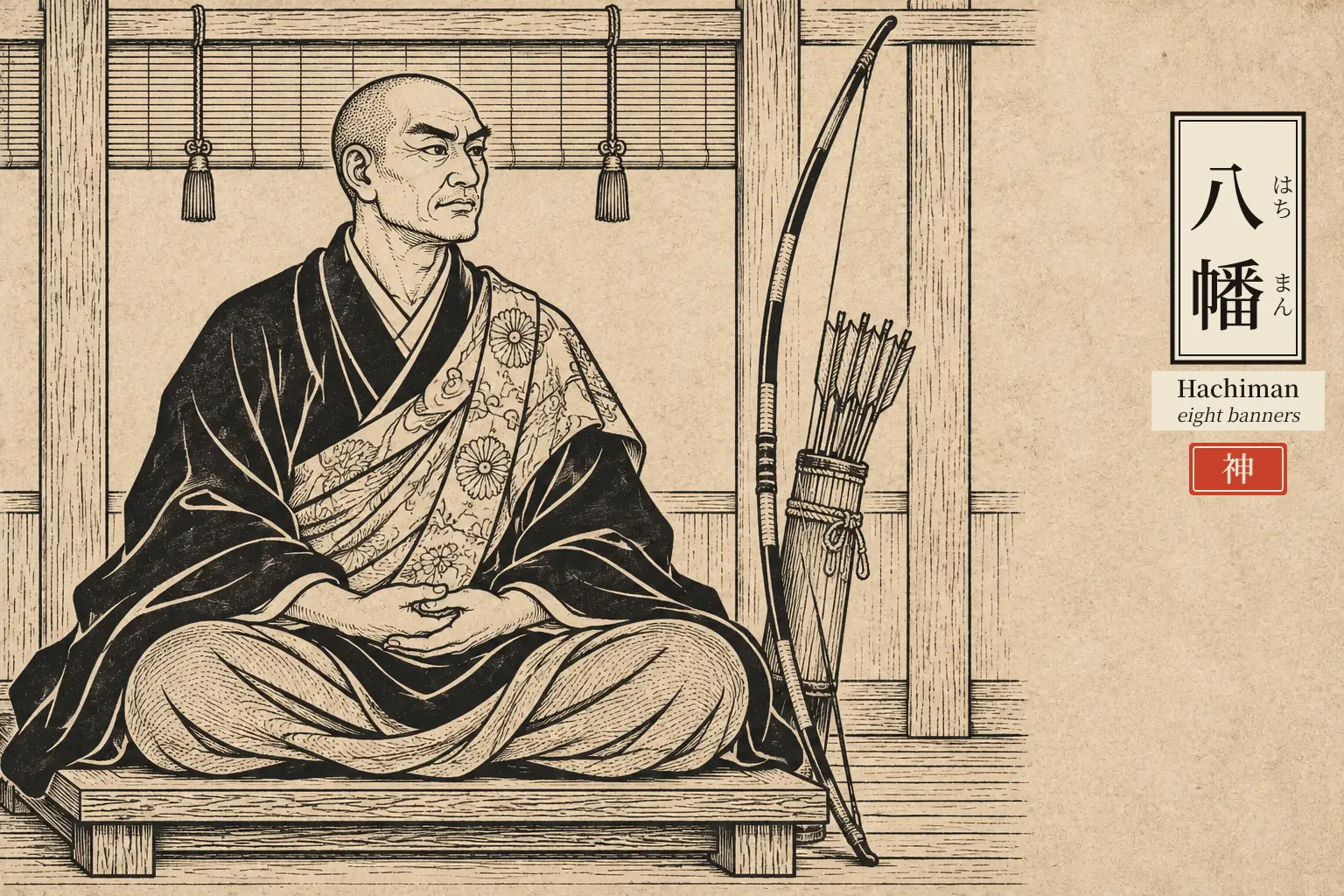
By the early Heian period, artists began painting and carving Hachiman as a Buddhist monk. This form is called sogyo Hachiman, "monk-form Hachiman." A seated wooden statue shows him this way. It was carved in 1326. Today it sits at the Tokyo National Museum, on loan from Akana Hachiman Shrine. It is registered as an Important Cultural Property.
The robe was not decoration. In 781, the court granted him a title: Hachiman Daibosatsu, "Hachiman the Great Bodhisattva." Buddhist theory went further. It named Amida Nyorai as his honjibutsu, his original Buddha form. The monk Nichiren disagreed. He argued the true form behind him was Shakyamuni instead. Shrines built jingu-ji, attached Buddhist temples, to serve the god in both roles at once.
The soldiers' god
Centuries later, warrior clans claimed Hachiman as their own. Minamoto no Yoshiie held his coming-of-age ceremony at Iwashimizu Hachimangu. He took the name Hachiman Taro Yoshiie. When Minamoto no Yoritomo founded the Kamakura shogunate, he brought the god with him. Yoritomo enshrined him as Tsurugaoka Hachimangu. Warriors called him Yumiya Hachiman, "bow-and-arrow Hachiman." The Ashikaga shoguns, after them, pushed his worship harder than any warrior government before or since.
The Shomonki records a stranger claim. In 939, the rebel Taira no Masakado stood at a provincial office in Kozuke. There, he was told, Hachiman Daibosatsu guaranteed his claim to be a "new emperor." Centuries later, Toyotomi Hideyoshi wanted the same kind of honor. He reportedly asked to be enshrined after death as Shin Hachiman, "new Hachiman." The emperor refused. He granted a different title instead: Hokoku Daimyojin.
1868, and after
In 1868, the Meiji government separated Buddhism from Shinto by decree. Hachiman shrines lost their jingu-ji. The monk-form statues were taken down. The government banned the title "Hachiman Daibosatsu" outright. A Buddhist rank, stapled onto a Shinto god, no longer had an official place.
The habit did not disappear. Through the Second World War, air bases flew banners reading "Namu Hachiman Daibosatsu." The banned title kept flying anyway. Some units even named themselves after it. A thousand years of habit outlasted the ban against it by seventy-seven years.
Today, shrines carrying Hachiman's name number somewhere between ten and twenty thousand. Only Inari's fox shrines outnumber them. Usa Jingu, Iwashimizu Hachimangu, and Tsurugaoka Hachimangu still draw large crowds today. All three still trace back to eight banners at an altar in Tsushima.