Why the face looks like this
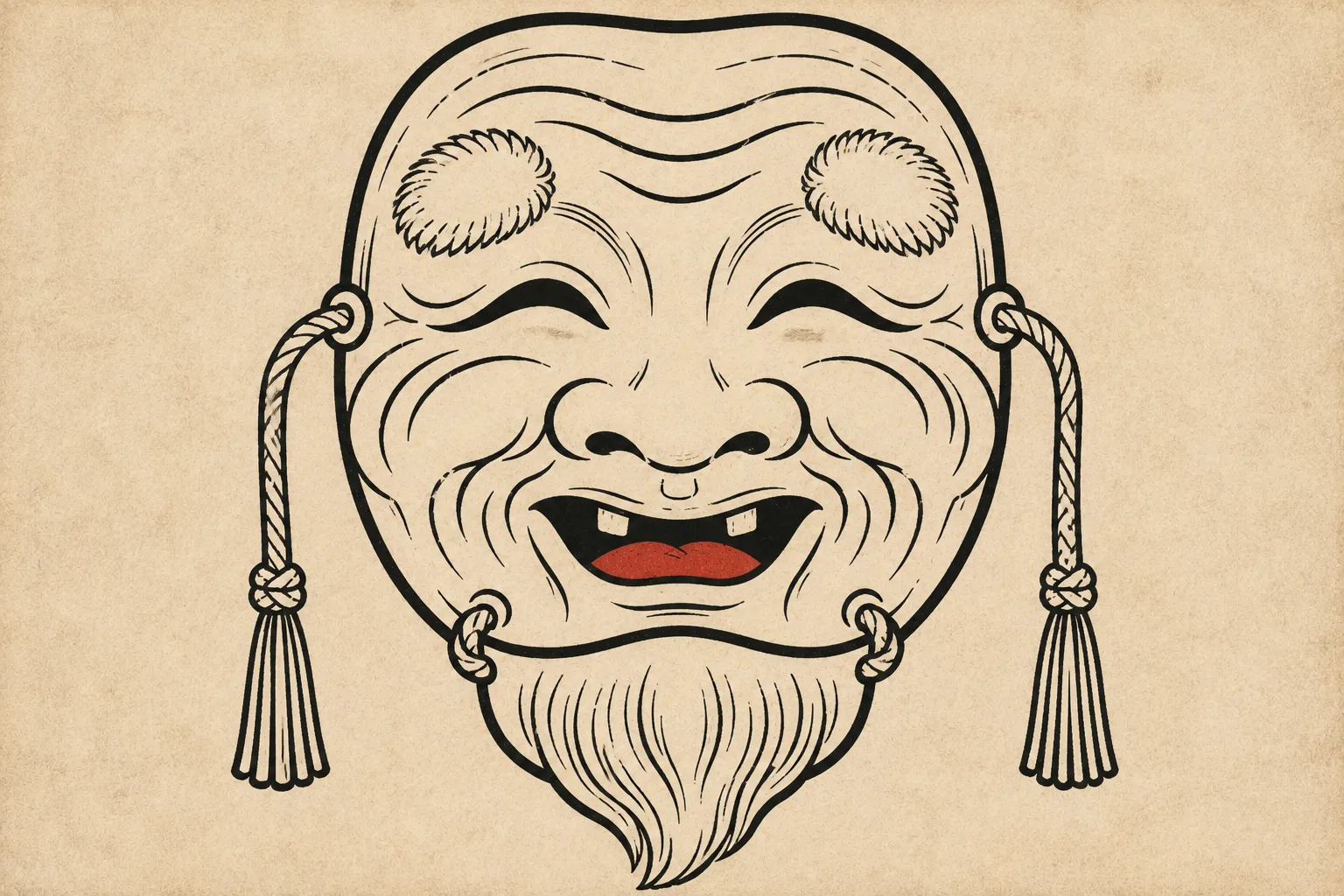
The white okina mask has deep wrinkles carved in round patterns on the forehead and cheeks. The eyes are wavy slits, full of mirth. The mouth laughs, with only a few stubs of teeth. Tufts of hemp or fur are glued on as eyebrows, and a long white beard hangs below.
The chin is a separate piece, tied on with hemp cords.
Why an old man? The sources give two reasons. In Japanese legend, gods often appear as revered old men; in the Noh play Takasago, the god of Sumiyoshi comes on stage as one. And old people stand for a long life, so rites that pray for one seem to have used an old man or woman from early times.
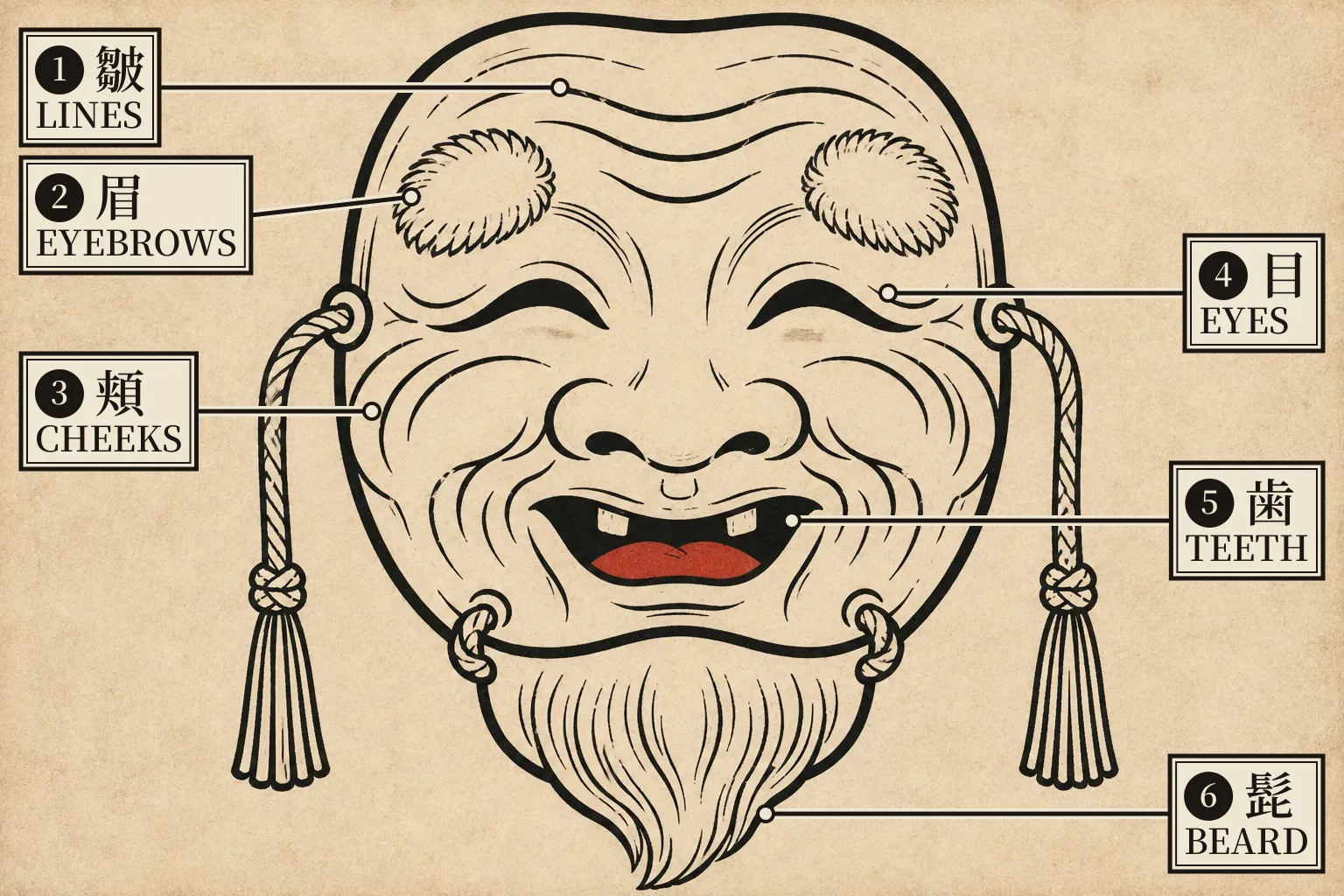 Our diagram. Each row says why that part looks the way it does.
| # | Part | Why it looks like this |
|---|---|---|
| 1 | 皺 Lines | Wavy lines cross the forehead. Okina is a god shown as an old man, and old age meant wisdom and the long life his dance prays for. So the lines show that age. (JAANUS; Kotobank) |
| 2 | 眉 Eyebrows | Two puffs of white hair, set high and not carved. Iwaki City's museum says brows like these follow sacred rules, to show a pure world apart from daily life. So they mark him as holy, not just old. (Iwaki City Museum; JAANUS) |
| 3 | 頬 Cheeks | Round and full, ringed by neat lines. A full face looks well fed and lucky, so Japanese calls it a fukusō, a "lucky face," fit for a god of good harvests. (Kotobank; Nomura Art Museum) |
| 4 | 目 Eyes | Curved slits, like eyes closed in a big laugh. Fierce Noh god masks glare, so a god's face that laughs makes okina stand out. (Kotobank; JAANUS) |
| 5 | 歯 Teeth | Only two upper teeth are left. Old people lose their teeth, and great age meant a long, blessed life. So the gaps show a blessing, not weakness. (Hayama Town; Iwaki City Museum) |
| 6 | 髭 Beard | A long beard of real white hair. White hair stood for long life, and many Japanese gods appeared as old men, so the beard shows the long life he prays for. (Iwaki City Museum; Kotobank) |
His dance is older than Noh itself: it was first recorded at a shrine festival in 1283. The fluffy eyebrows and the chin, carved as a separate piece and tied on with cord, are the two signs JAANUS gives for the oldest type of Noh mask.
White mask, black mask
The play Okina uses two masks, and the color tells you who is dancing.
White is for Okina. Black is for his partner Sanbasō, played by an actor from kyōgen, the comic plays that go with Noh. The black mask looks very much like the white one, but it is usually smaller, with horsehair brows and beard.
Sanbasō wears the black mask for a bell dance that celebrates fertility. Why these two colors, the sources we read do not say.
A rite, not a story
Okina has no plot. The actors play gods who dance for peace, prosperity and safety across the land. Dictionaries add good harvests and long life to the wishes.
Putting on the mask is part of the rite, and it is believed to turn the actor into a god. The actors purify themselves before they take the role. The play is treated as sacred and set apart from other Noh. Today it is performed on special occasions.
How old is it?
Okina is the oldest type of Noh mask. It comes from sarugaku, the older performing art that grew into Noh, late in the Heian period, which ended in 1185.
The first reliable record of the play is a festival record of 1283. The oldest okina mask with its original date written on it is from 1477, at Itsukushima Shrine.
The name
The kanji 翁 means "old man." It is read okina.
Frequently asked questions
Is the okina mask a god? In the play, yes. The actor is believed to become a god when he puts it on.
Sources
- For the diagram: JAANUS chichinojō, Iwaki Digital Museum, okina mask, Hayama Town, okina mask, Kokugakuin University digital museum, JAANUS okinamen, JAANUS kiriago, Kotobank, 翁, Tokyo National Museum, okina mask (Japan Search), Nomura Art Museum, okina mask (Google Arts & Culture)
- Kotobank: 翁, 翁面
- JAANUS: okina, sanbasō
- the-noh.com: Okina, Masks
- Kokugakuin University, Encyclopedia of Shinto: Okina