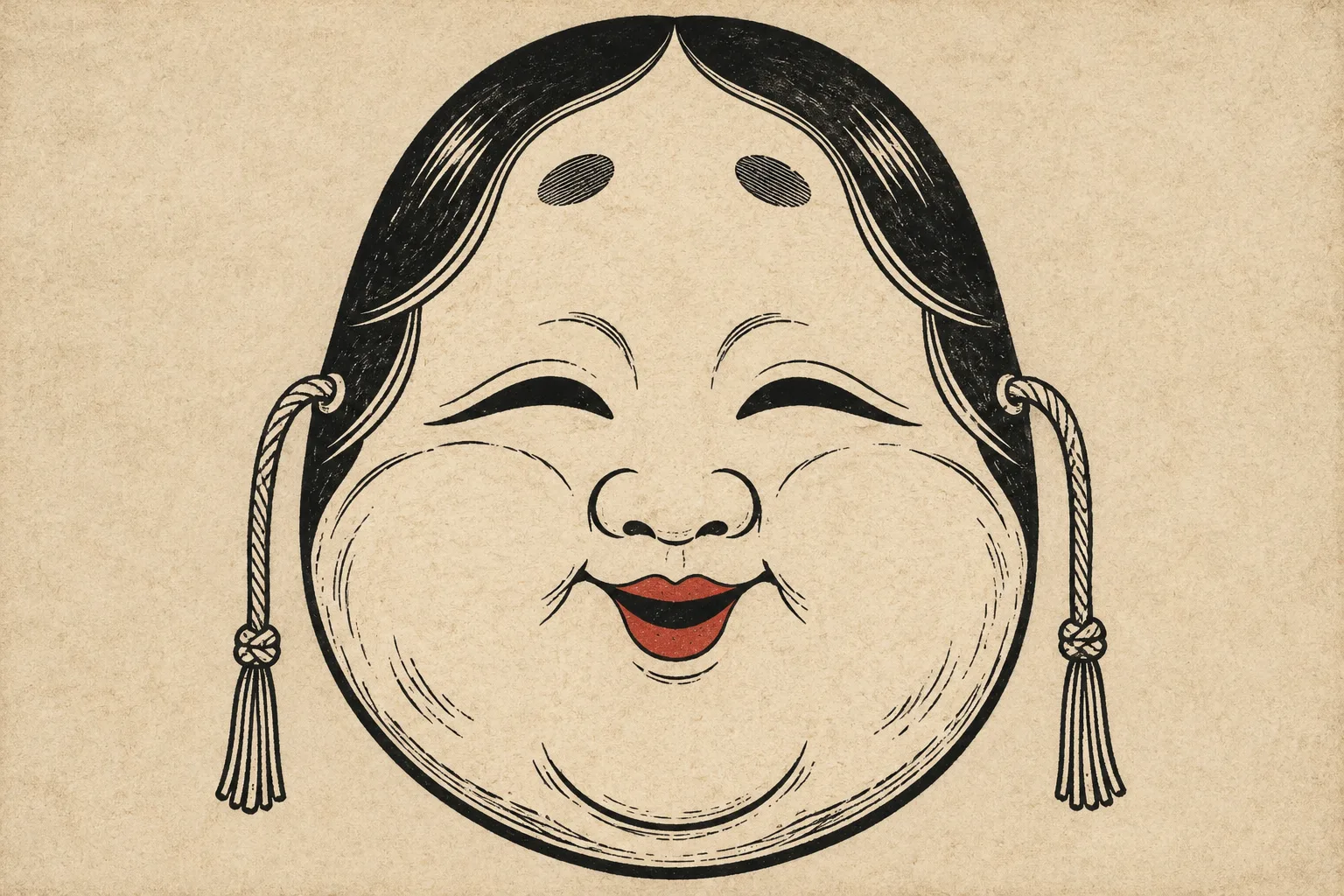
Why the face looks like this
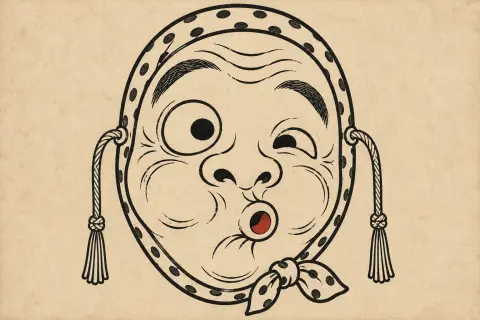
Okame has full cheeks that swell at the bottom, and a small low nose. Her eyes slant down and crinkle with laughter. One Japanese encyclopedia calls the face "blessed-looking." Why a round face counts as lucky, the sources we read do not explain.
She comes from kagura, the sacred dances at local shrines. In village kagura she plays a comic middle-aged woman. Near the end of the show, she often ends up as the one who scolds. Her partner is hyottoko, the clown with the pursed mouth.
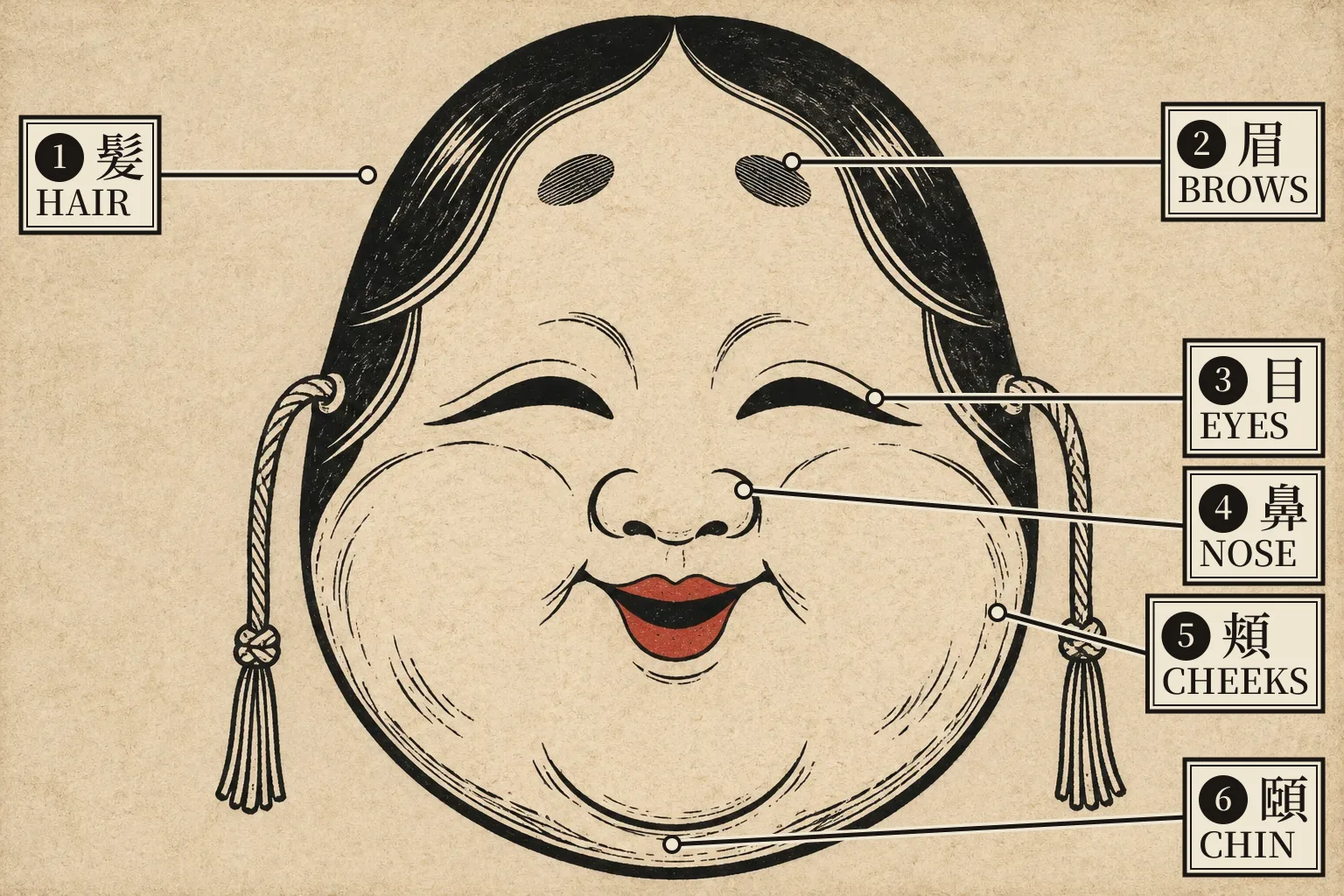 Our diagram. Each row says why that part looks the way it does.
| # | Part | Why it looks like this |
|---|---|---|
| 1 | 髪 Hair | Long hair, parted in the middle, hangs loose. That was the style of old court ladies, while ordinary women of the 1700s tied theirs up. So her hair is a court lady's style. (JAANUS; Kotobank) |
| 2 | 眉 Brows | Two ink ovals high on the forehead, not real brows. Court nobles once plucked their brows and painted ovals like these, so her brows copy that court style. (Kotobank; JAANUS) |
| 3 | 目 Eyes | Thin curves that droop at the ends, with creases above. A big laugh pushes the cheeks up and creases the eyes, so these are laughing eyes. (JAANUS; Nihon Daihyakka Zensho) |
| 4 | 鼻 Nose | Small and low, sunk between the cheeks. In the Edo period (1603–1868), a beauty had a straight, high nose, so this face was the opposite of pretty. (Kotobank) |
| 5 | 頬 Cheeks | Huge, and widest at the bottom. Round, full cheeks looked like a person with plenty, so Japanese calls this face fukufuku-shii, "rich and happy-looking." (Kotobank; JAANUS) |
| 6 | 頤 Chin | Round, with the face widest at the bottom. One old dictionary says the fuku ("swelling") in her other name, Otafuku, meant this full lower face. Written 多福, it also reads "much luck," so the name works both ways. (Daigenkai via Nihon Daihyakka Zensho) |
Her face was lucky but not pretty. Edo-period beauty meant a long "melon-seed" face, so by 1770 "otafuku" was also a tease for a plain woman. Japanese even has a word for her face: sanpei niman, "three flat, two full."
Lucky face, or insult?
Both, depending on where the face appears.
As a charm, okame's face is hung on lucky New Year rakes. Since the Edo period (1603–1868), she has often been painted on votive tablets and gifts for happy occasions. A 1712 painting of the seven lucky gods at Kiyomizu-dera temple in Kyoto shows her too. In the early 1800s, a pair dressed as the lucky doll Fukusuke and okame went door to door giving blessings.
As a word, though, "okame" also became an insult, aimed at women with full lower cheeks like the mask's. In the Kansai region, the same face is called ofuku, "Miss Luck." People use it as an insult there, yet merchant houses still display it as a lucky face.
So the same face could mean luck on a rake and plainness in a joke.
Is she a goddess?
Some link her to the goddess Ame-no-Uzume. One encyclopedia says only that okame is "sometimes taken to be" that goddess, so treat it as a link, not a fact.
How “Okame mask” is spelled
お多福 · Okame mask · spelled ta-fuku
The name
Dictionaries trace the name to oto-gozen, an old word for a youngest daughter. The lucky spelling fits her face, but it is not where the name began.
The characters in お多福, otafuku, look like "much fortune." One old dictionary reads o-ta, the first part of the name, as a form of otogoze, another name for the mask, and fuku, the second part, as a swollen chin. Another account says "okame" may come from a shrine maiden named Kame, in the 1500s. The mask goes by all of these names: okame, otafuku, ofuku and otogoze.
Frequently asked questions
Is an okame mask good luck? Yes, as a charm. Her face is put on lucky rakes, votive tablets and gifts.
What is the difference between okame and otafuku? None. They are two names for the same face.
Sources
- For the diagram: Kotobank, 三平二満, Kotobank, 眉墨, Kotobank, お多福, Kotobank, おかめ, Kotobank, お亀, Kotobank, 乙御前, JAANUS otafuku, JAANUS oto, Kotobank on mumps: 流行性耳下腺炎, おたふくかぜ
- Kotobank: おかめ, お多福, お福
- JAANUS: otafuku