Why the face looks like this
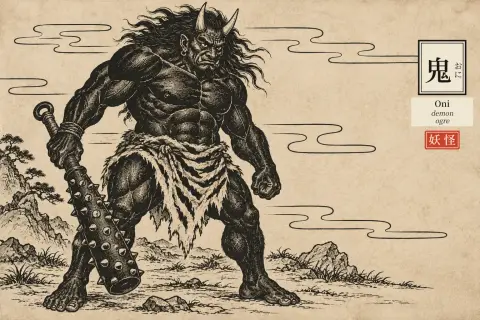
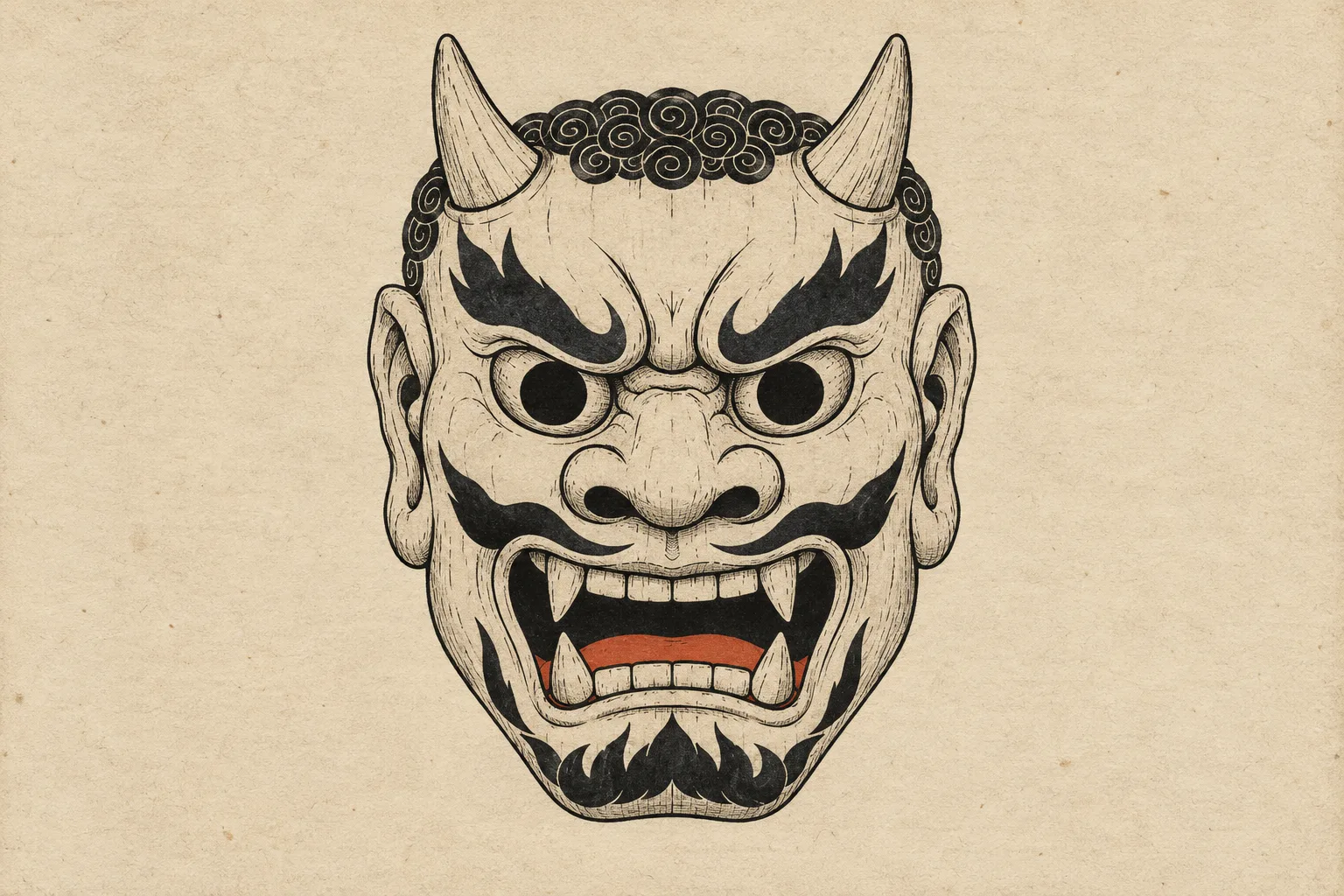
Japanese dictionaries describe the oni with horns, a wide mouth with sharp fangs, and a tiger-skin loincloth. It often carries an iron club.
One encyclopedia says the horns and the tiger skin come from a compass direction. In onmyōdō, an old art of reading good and bad luck from yin and yang, the northeast is the "demon gate," where oni were said to gather. Its old name is ushitora, "ox and tiger." So the oni got an ox's horns and a tiger's skin. Another encyclopedia gives a second account. It says the horns and fangs came slowly from Buddhist and onmyōdō demons, such as yasha and rasetsu.
The skin of an imagined oni is red, blue, black, or yellow. Noh, a classical Japanese theater, has its own demon masks. They add large ears, and their eyes and teeth shine gold. JAANUS, a dictionary of Japanese art, says these masks grew out of older rites to drive out evil spirits and sickness.
Do the colors mean something?
Not as one fixed rule. The meanings we found belong to one temple or one theory.
At Rozan-ji, a temple in Kyoto, three oni dance at the Setsubun rite. Kyoto Prefecture says each one stands for a human weakness. Red is greed. Blue is anger. Black is ignorance. The oni are then driven out with a bow, beans, and rice cakes.
Japanese Wikipedia, citing one book, gives a wider theory. It says five oni colors are linked to five weaknesses: blue to anger, red to greed, yellow to restlessness, green to sleepiness, and black to doubt.
Oni mask or hannya mask?
Ask whose face it is.
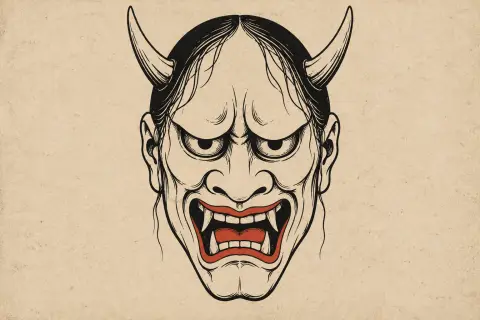
A hannya mask is most often a woman who became a demon through jealousy. JAANUS calls it a female serpent-demon. The-noh.com, a guide to Noh, lists it as a female mask in its group for ghosts, the spirits of the dead with regrets.
In Noh, the shikami is the mask for a bad demon. Its name means a scowling face. It is worn for the demon at the Rashōmon gate in Kyoto and for the spider in the Noh play Tsuchigumo. The tobide, with round gold eyes and an open mouth, is worn for the god of thunder in the play Raiden.
Both can have horns. The hannya has two. An oni mask at the Horniman Museum in London has two deer horns too. The records we read for the shikami and the tobide do not mention horns.
So: a hannya is most often a jealous woman turned demon. It is also worn for a demon that first appears in human form, as in the play Kurozuka. Many other demons and gods get other masks, like the shikami or the tobide.
Where the mask is worn
Setsubun. Setsubun is the day before the start of spring, around February 3. People throw roasted soybeans to drive off bad luck. They shout "Oni wa soto! Fuku wa uchi!", which means "Demons out! Luck in!" The beans are thrown out the front door, or at a family member wearing an oni mask.
The custom grew out of tsuina, a court rite on New Year's Eve to drive out disease. Tsuina is first recorded in 706. A performer called Hōsōshi wore a golden mask with four eyes and chased the disease demons. His strange look later made people think Hōsōshi himself was the oni being chased out. In Kyoto, a performer in a golden four-eyed mask still drives away the oni at Yoshida Shrine.
Kyōgen, the comic plays. Kyōgen is a comic stage art, and its demon mask is called buaku. It glares and bares its teeth, but it looks a little weak, so it is funny or a bit sad. In the kyōgen play Setsubun, a demon visits a woman who is home alone. He falls in love with her, and the play ends with the same shout.
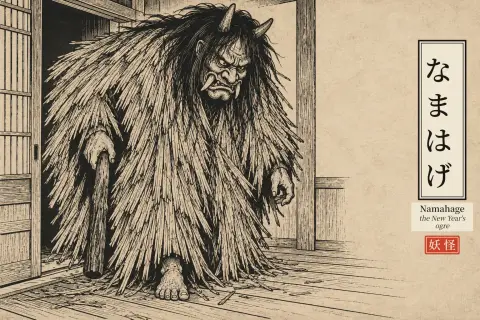
House visits. Namahage is a custom where people in oni masks go from house to house and scold the lazy.
How old is the oni mask?
No source we opened names the first oni mask. A Japanese dictionary quotes a man "wearing an oni mask" in Kanmon Gyoki, a prince's diary, in an entry from 1416. The oldest dated mask we found is a shikami, a Noh mask for a demon, at the V&A museum in London, from the 16th century.
The name
In Japanese the mask is 鬼面, oni and mask. 鬼 is read oni or ki. Dictionaries give it several meanings: the spirit of the dead, a frightening monster, and a cruel person.
One theory says the word oni comes from on, "hidden," for something that cannot be seen. An encyclopedia notes that all such theories are still guesses.
Frequently asked questions
Is an oni mask good luck?
Not as a general rule. At Setsubun, the oni is the one being chased away. But JAANUS suggests that the older rite masks behind Noh demon masks had one protective use. Their stuck-out tongue scared off evil spirits.
Sources
- Kotobank: 鬼, 鬼面, 面, 節分, 追儺, 陰陽道, 看聞御記
- JAANUS: hannya, kijinmen, shikami, tobide, buaku
- the-noh.com: Masks, What is Noh?, What is Kyogen?
- Kyoto: Kyoto Prefecture, Rozan-ji's Setsubun rite, Kyoto City Official Travel Guide, Setsubun
- Museum masks: V&A shikami, 16th century, V&A buaku, Horniman oni mask
- Theatre of Yugen, the kyōgen play Setsubun
- Wikipedia: Japanese, 鬼, English, Setsubun