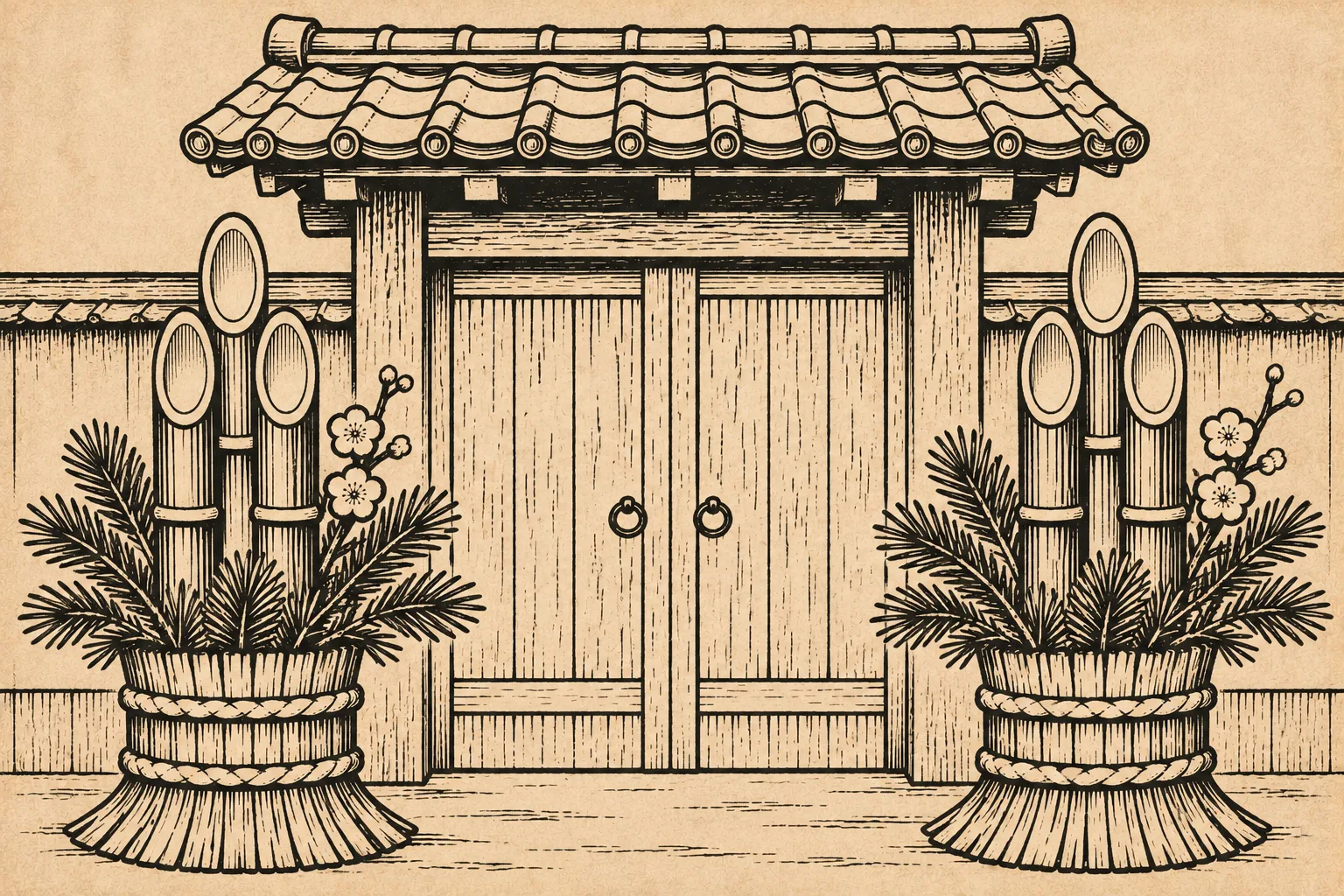
Why it looks like this
The pine is the seat. One Japanese dictionary calls the pine "a tree a god comes to." It is also a sign of long life, because it stays green all winter.
How do we know a god was thought to sit in it? One encyclopedia gives clues. People tie little straw bowls of zōni, New Year soup, to the kadomatsu. In one town, they set rice cakes in front of it. And they call it O-matsu-sama, "Honored Pine," and pray to it. You do not feed or pray to a decoration. You do that for a guest who is there.
Pine was not the only choice. Camellia, sakaki (a tree used at shrines) and cedar were also used, and some places used bamboo or other trees on their own. An encyclopedia says the pine became the usual tree once it was seen as lucky. Bamboo was added for the same reason, from the Middle Ages on.
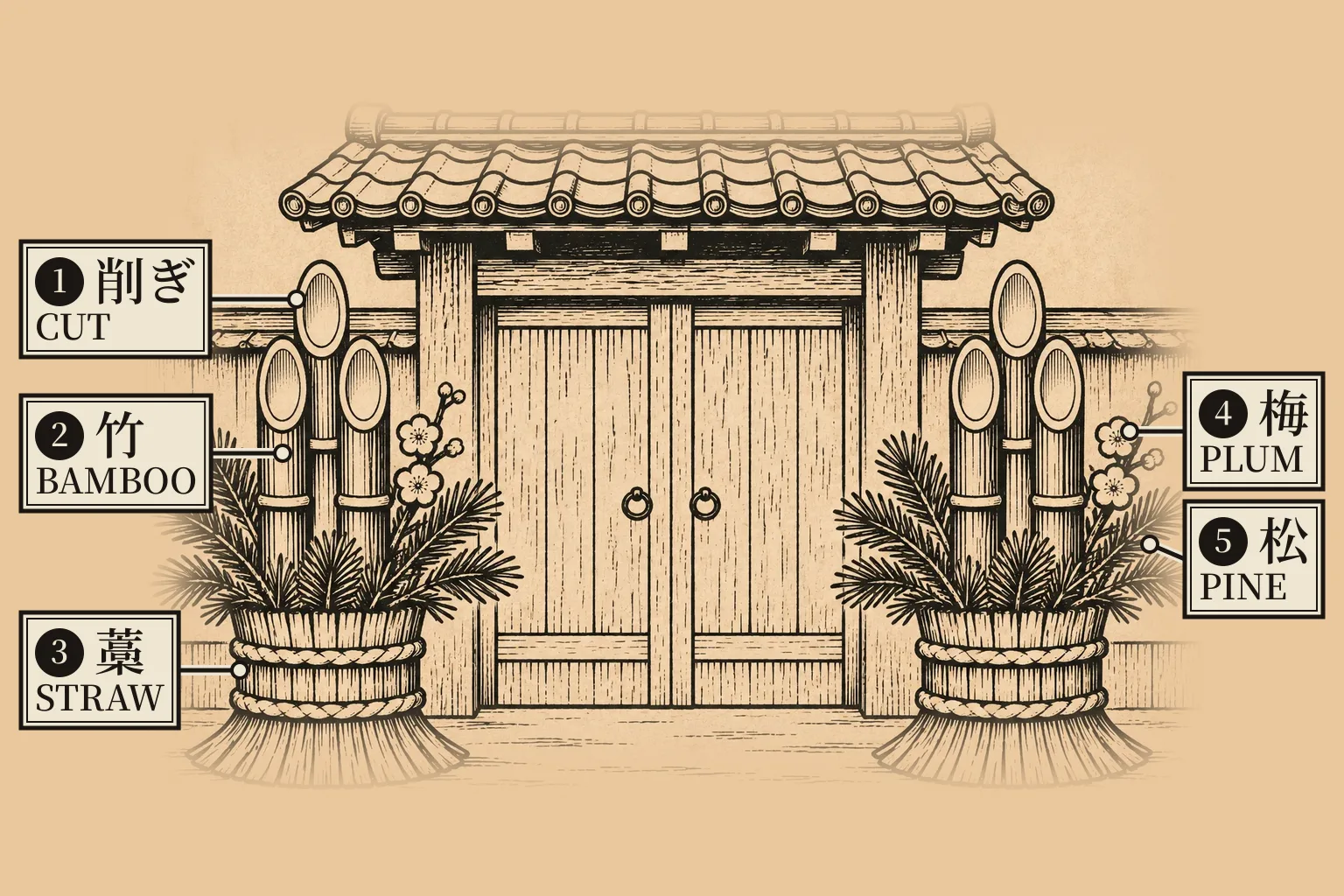 Our diagram. The table gives what the sources say about each part, and how the part fits it.
| # | Part | What the sources say, and how the part fits |
|---|---|---|
| 1 | 削ぎ Slanted cut | No dictionary gives it a meaning. Two popular stories explain it; see below. |
| 2 | 竹 Bamboo | Grows fast, added to the pine for long life (encyclopedia). Grows straight; its shoots mean many children (Settsu City). Bamboo grows very fast, and adding it to the pine made a wish for long life. Each spring, one bamboo sends up many new shoots, like a big family. |
| 3 | 藁 Straw | The Kantō style wraps the base in straw (Japanese Wikipedia). No source gives it a meaning. It holds the stems together. |
| 4 | 梅 Plum | Flowers before other plants, in the cold (encyclopedia). "The start of the year" (Settsu City). In the old calendar, the year began in early spring. The plum flowers ahead of most plants then. |
| 5 | 松 Pine | A tree a god comes to; long life (dictionary). "Eternal life" (Settsu City). It stays green all winter, so it stands for long life. |
The common shape today is three bamboo stems in the middle, with young pine around them. Japanese Wikipedia says the Kantō style, around Tokyo, wraps the base in straw. The Kansai style, around Osaka and Kyoto, wraps the base in bamboo and puts red-and-white ornamental kale in front.
It is still a living custom, but a smaller one at home. Japanese Wikipedia says full kadomatsu are less common as more people live in apartments. In an online survey of 1,685 people across Japan in December 2024, "about 20 percent" said they put up "kadomatsu or other pine decorations." Others gave reasons such as "no such habit," "don't feel the need," "live in an apartment" and "no space." Shops sell small potted kadomatsu, and some people paste up a paper picture of one. Big pairs still stand at the doors of businesses, often set up by craftsmen.
What each plant means
Pine, bamboo and plum have a Chinese name: the "three friends of the cold season." Pine and bamboo stay green in winter, and the plum flowers in the cold. When other plants die back in winter, these three do not give up. In China, an encyclopedia says, they stood for a person who stays true in hard times. In Japan, they became more a sign of good luck.
The sources give each plant a reading, but not one fixed list. See the table above.
A common saying sums it up: "The pine promises a thousand years, the bamboo ten thousand." A thousand and ten thousand just mean "forever." Japanese menus often use pine, bamboo and plum as grades. Settsu City says the trio itself is not a ranking. The plum is not in every kadomatsu. Japanese Wikipedia lists it among the extras on fancier ones.
Why is the bamboo cut at an angle?
No dictionary says why the bamboo is cut at a slant. Two popular stories explain it. One says the cut looks like a smiling mouth, for the saying "good luck comes to a laughing gate." The other is about Tokugawa Ieyasu.
There are two cuts. Sogi is cut at a slant. Zundō is cut straight across, so the top is flat.
A local newspaper column in Hamamatsu, Ieyasu's castle town, tells the story. Japanese Wikipedia calls it "one theory," and Yamanashi Prefecture says the custom "is said" to have spread this way.
In the winter of 1572 to 1573, Tokugawa Ieyasu, the warlord who later became shogun, lost the Battle of Mikatagahara to a rival warlord, Takeda Shingen. Shingen sent him a kadomatsu with a short poem. It said the pine would wither, and the bamboo would thrive. The pine meant Matsudaira, Ieyasu's old family name. The bamboo, take, meant Takeda.
Ieyasu added small marks that change the sounds of a few letters. Now the poem said the pine would not wither, and Takeda would lose his head. He cut the bamboo tops at a slant, like Shingen's cut-off head, and sent it back.
The Takeda side has its own story. In Yamanashi, Takeda's home, a "Takeda-style" kadomatsu cuts the bamboo flat. The Asahi newspaper reported in 2021 that a slanted cut looks like a cut-off head, so they see it as unlucky. Flat cuts are not only a Yamanashi thing, though. The Kabuki-za theater in Tokyo uses them too.
There is a bigger reason to doubt the story. Japanese Wikipedia says kadomatsu in the towns of Edo, old Tokyo, were whole, uncut pines, as tall as a second-floor roof. So read the Ieyasu tale as a story people tell about the cut, not as proof of where it began.
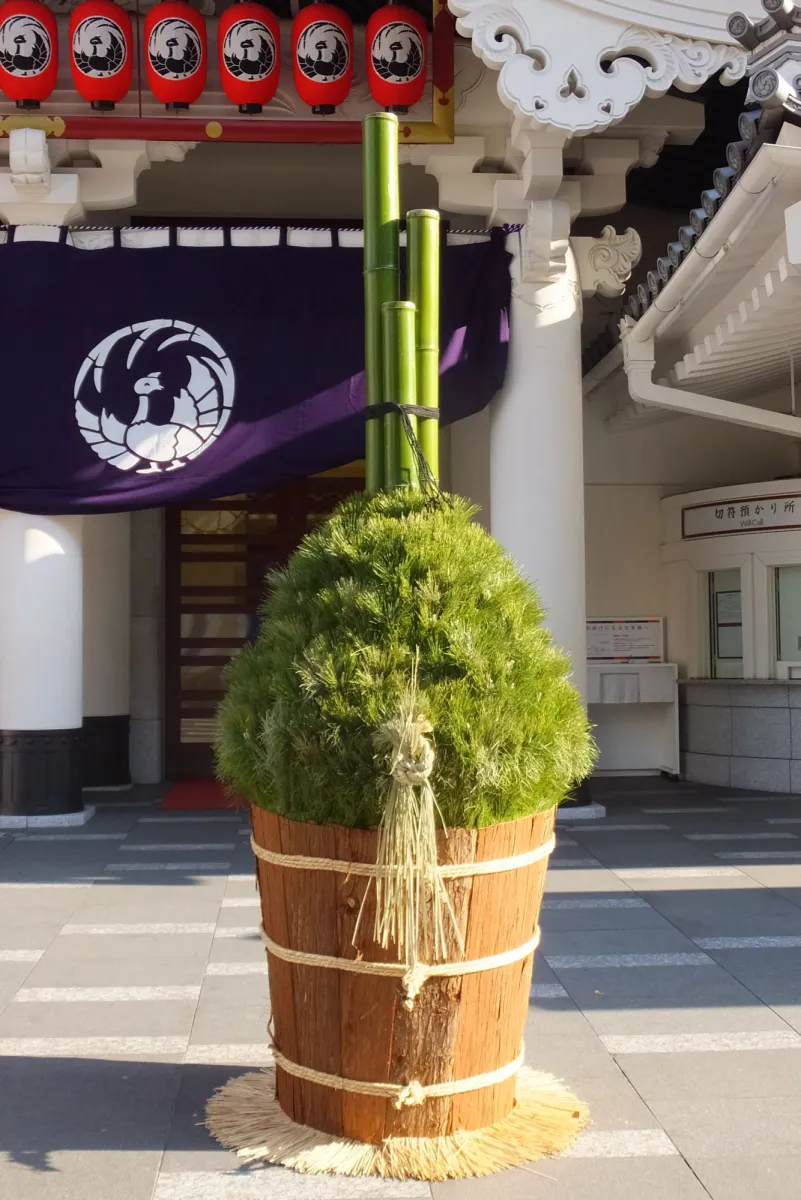 Photo: Tak1701d, public domain. A kadomatsu with flat-cut bamboo at the Kabuki-za, Tokyo, January 2016.
Why two, one on each side of the gate?
The gate is where a visitor arrives. Settsu City says the kadomatsu is a mark, so the year god does not get lost on the way. No source we found says why there are two.
Outside, a kadomatsu usually comes as a pair, one on each side of the gate, like the picture at the top of this page. Inside, people often use just one. A shimenawa, a sacred rope, is sometimes hung between the pair.
A diagram in one encyclopedia calls the left one, as you face the gate, the "male pine," and the right one the "female pine." Some places say it the other way around. These are also everyday tree names. Dictionaries list "male pine" for the black pine and "female pine" for the red pine.
When to put it up and take it down
Long ago, people went to the hills to cut the pine on December 13. Today, a Japanese reference says, most set it up by the 28th, or on the 30th.
Two days are avoided:
- The 29th. Nine is ku, like "suffering," and two can mean "double." So 29 reads as "double suffering." One lifestyle site says some areas read 29 as fuku, "good luck," instead.
- The 31st. This is ichiya-kazari, "one-night decorating." Putting up a seat for the god just one night before is seen as careless. Japanese Wikipedia says some avoid the 30th for the same reason.
The days the pine stays up are called matsu no uchi, "within the pine." One encyclopedia reads this time as the year god's festival. The pine stays up for the festival. After that, the seat is not needed. In the 2024 survey, just over 60 percent answered "by January 7" when asked when they take it down. In Kansai, many still keep it until January 15, the older date.
Then the kadomatsu is burned. Around January 14 or 15, people collect New Year decorations outdoors and burn them in a big fire. It is called dondo-yaki or sagichō. Rice cakes grilled on this fire are said to keep you from getting sick.
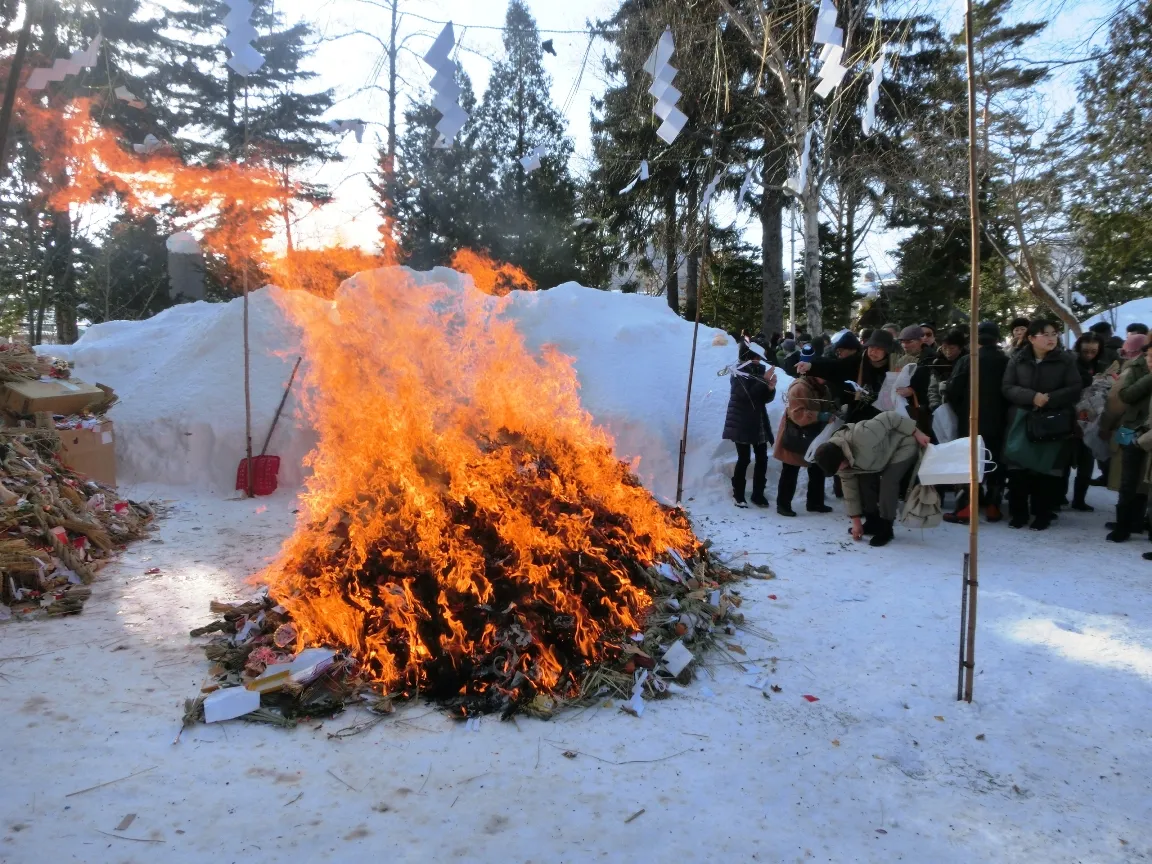 A dondo-yaki fire at Nishino Shrine, January 15, 2015. Photo: 田頭寛, CC BY-SA 4.0
For the other steps of the season, see Japanese New Year, day by day.
The name
Kado (門) is a gate, or the space in front of a house's entrance. Matsu (松) is pine. So the name says what it is: the pine at the gate.
The word is old. A Japanese dictionary's first example is a poem by Fujiwara no Akisue, from around 1105. Roughly: while people are busy setting up the kadomatsu, the night turns into the dawn of spring.
Frequently asked questions
Is a kadomatsu the same as a shimekazari?
No. A shimekazari is a decoration made with a shimenawa, the sacred rope. It hangs on the front door. An old encyclopedia says both mark the house as a sacred place for the god's festival. They are often burned in the same fire, but the shimekazari inside the house often comes down later.
Why January 7?
A late-Edo record, Morisada Mankō, says Edo once took its decorations down on the 16th. In 1662, the shogun's government ordered the 7th, because fires were so frequent. Edo was built of wood and paper, and dry pine stood at every door.
Does every kadomatsu use pine?
No. Ōkunitama Shrine in Fuchū, Tokyo, has no pine in its grounds, and Fuchū's kadomatsu skip it. Its legend says the god was left waiting, and matsu means both "pine" and "to wait." So the pine would remind the god of the wait.
Where did the custom come from?
The "seat for the god" reading is the dictionaries' view. Japanese Wikipedia also gives two other ideas: a Tang Chinese custom of putting pine at the gate, and a Heian court game of pulling up young pines.
Do people in Hawaii make kadomatsu?
Yes. Every year Scouts BSA Troop 201 in Honolulu cuts bamboo and makes kadomatsu. In 2018, HONOLULU Magazine said the troop made more than 1,000 in three days.
Sources
- ITmedia, 2018-01-01: the slanted cut as a smiling mouth; Settsu City handout
- Kotobank: 門松, 松, 松竹梅, 年神, 依代
- Kotobank: 松の内, 左義長, 注連飾り, 雄松, 女松
- Japanese Wikipedia, 門松
- imidas, 門松
- Settsu City, New Year planting class handout (2021)
- Chunichi Shimbun, "Kadomatsu and Tokugawa Ieyasu" (2019, archived) and Asahi Shimbun, Takeda-style kadomatsu (2021)
- Ōkunitama Shrine, seven wonders and OZmall on decorating days (2023)
- Guruppa New Year survey (2024), a garden company's kadomatsu service, Yamanashi Prefecture, Takeda-style kadomatsu (2025), Princess Akiko on matsu no uchi (Waraku web)
- Hawaii News Now (2025) and HONOLULU Magazine (2018)