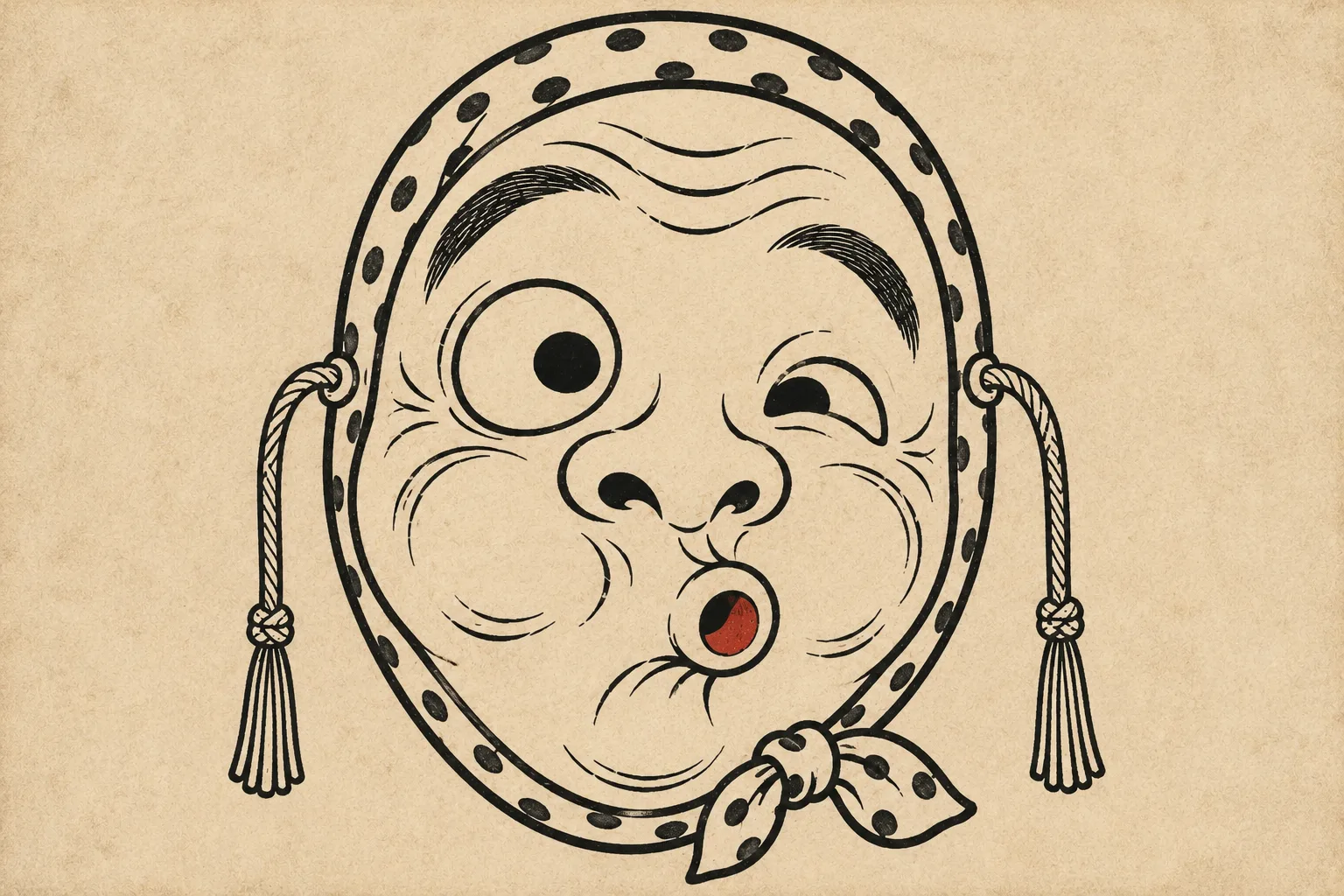
Why the face looks like this
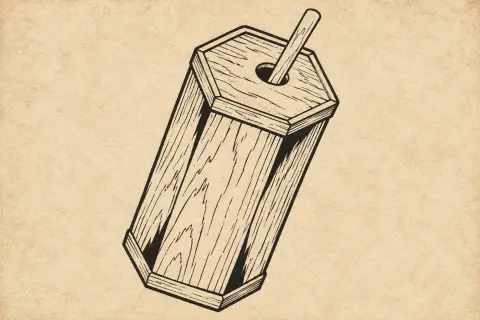
Hyottoko's mouth is pushed far out, as if he is blowing on a fire through a bamboo tube. His eyes sit wide apart, and one is smaller than the other. The whole face is a little off balance, and that is the joke.
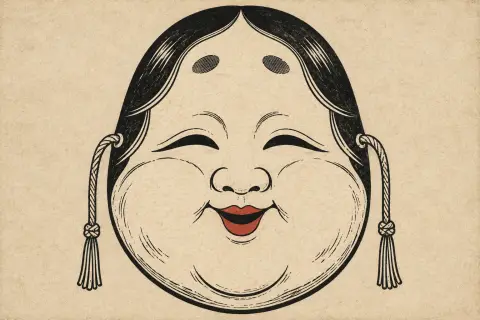
He is the clown of village kagura, the sacred dances at local shrines. He turns up in dances about sowing seeds and catching fish. His comic partner is okame, the round-faced woman.
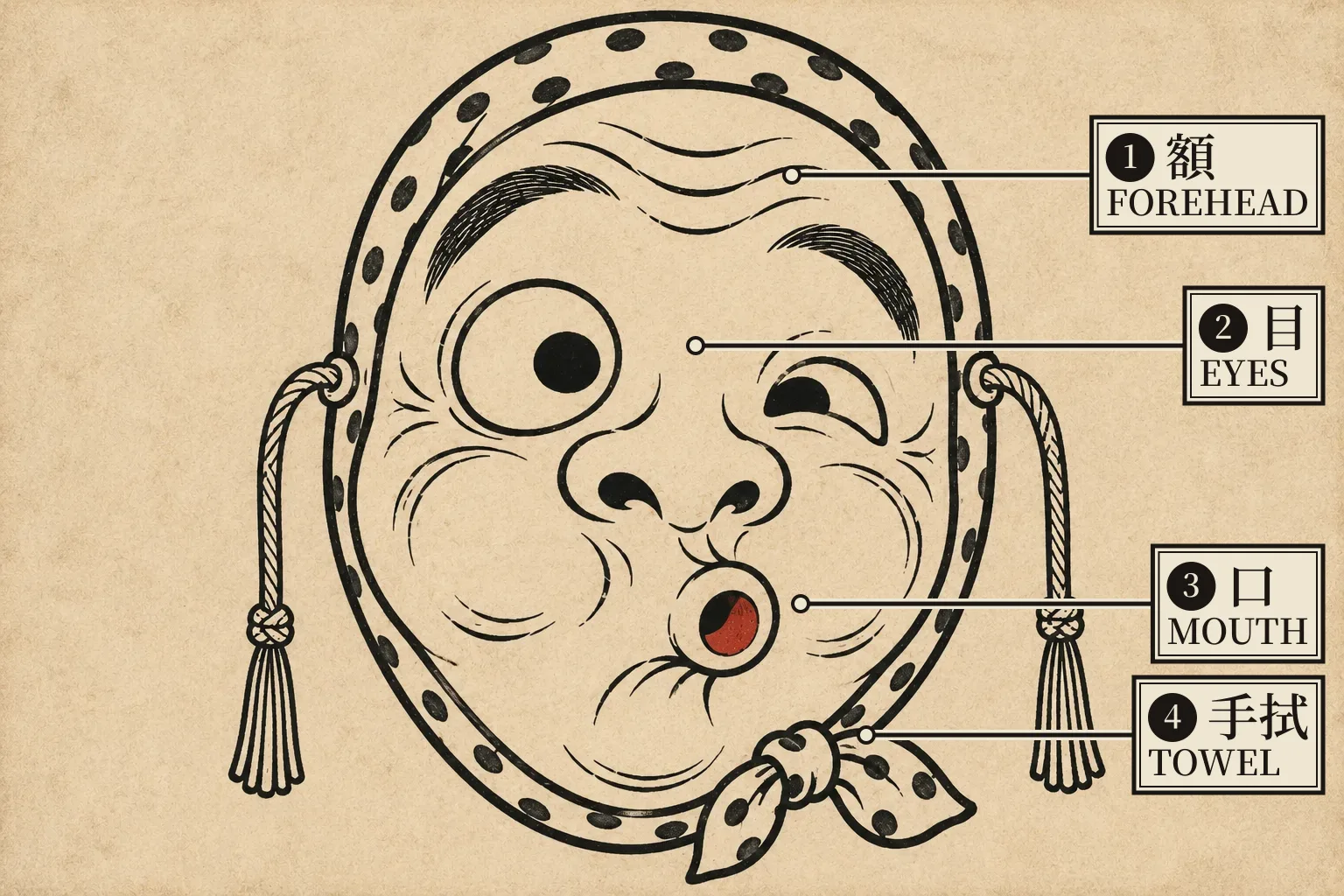 Our diagram. Each row says why that part looks the way it does.
| # | Part | Why it looks like this |
|---|---|---|
| 1 | 額 Forehead | Deep wavy lines cross his forehead. Blow hard through a pipe and your forehead tightens too, so these are the lines of a man blowing with all his strength. (JAANUS; Daijisen) |
| 2 | 目 Eyes | One eye bulges, the other squints. One encyclopedia ties him to one-eyed smith gods, since smiths who stared at fire for years seemed to lose sight in one eye. Dictionaries just call the face lopsided on purpose. (Heibonsha; Nipponica) |
| 3 | 口 Mouth | Lips pushed out into a small tube. His name is said to come from hi-otoko, "fire man": a man blowing on a fire through a bamboo pipe. So the mouth is the fire-blower's. (Daijisen; Nipponica) |
| 4 | 手拭 Towel | A dotted hand towel wraps his head and ties at the chin. Working men in old Japan tied towels this way, so the towel makes him an ordinary working man. (Heibonsha; Kotobank) |
The mouth is older than the fire. Daijisen calls the kyōgen mask usobuki, "the whistler," the model for hyottoko. On the comic stage, that same pursed mouth plays a mosquito, an octopus and a scarecrow.
Why he hangs above the hearth
Because in parts of the northeast he was also a charm, and even a god of the hearth.
The hearth fire cooked every meal, and it could also burn the house down. It is easy to see why a hearth needed guarding.
In the Tōhoku region, in the northeast, clay hyottoko masks were hung over the hearth as a charm against evil. In the Rikuzen area, a large mask was honored there as the hearth god. Local origin tales say a man who tended the fire, called Hyōtoku or Hyottoko, became that god.
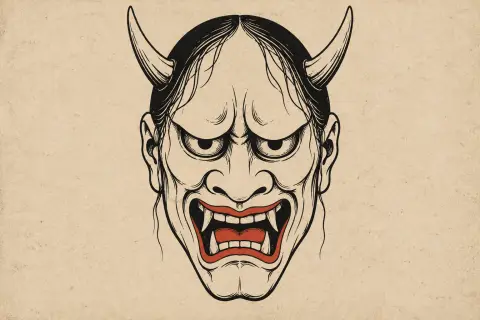
In the same region, other houses hung an angry-faced "hearth god" mask on the kitchen post instead. The clown and the angry face were both meant to keep evil away. The kitchen fire also has its own god, Kōjin.
Where the mask is worn
Mostly at shrine dances and festivals. One encyclopedia links the face to usofuki, a whistling-mouth mask used in kyōgen, the comic plays that go with Noh. It also links him to the clown who copies the main dancer in Edo kagura.
Toy masks of hyottoko, okame, oni and tengu have been sold since the Edo period (1603–1868).
The name
Hyottoko is a sound change of 火男, hi-otoko, "fire man." The dictionaries say the name comes from the face of someone blowing on a fire.
The earliest example in a major Japanese dictionary is a 1790 picture book, which compares a face to a hyottoko.
Some say the name comes from a child called Hyōtoku in an Iwate folktale, from a 1922 collection. A major encyclopedia tells the Hyōtoku story differently: as a man who became the hearth god, not as the source of the word.
Frequently asked questions
Is hyottoko a god? In parts of the northeast, yes. A large hyottoko mask was honored as the god of the hearth.
Is hyottoko the same as okame? No. They are a pair. Hyottoko is the man and okame is the woman.
Sources
- For the diagram: JAANUS usobuki, Kotobank, 嘯, Kotobank, 頬被り, Hyūga Hyottoko Dance, costume guide (PDF), Kotobank, ひょっとこ
- Kotobank: ひょっとこ, 仮面
- Miyagi Prefecture: カマ神
- Japanese Wikipedia: ひょっとこ