Japanese kitchens once kept a god on a shelf. It got a sprig of pine at its monthly rite. Its name was written with two characters that mean "wild god": Kōjin.
Written 荒神, the name breaks down simply. 荒 (kō) means wild or rough. 神 (jin) means god. It is also read aragami. Some places use the two readings to tell two spirits apart. Kōjin is the one that guards the kitchen. Aragami is a fierce, powerful god. Other places call the kitchen god aragami too.
Kōjin is a god, not a yokai. It is also not a god brought over from India. No genuine Buddhist scripture backs it; only apocryphal sutras do. Its Buddhist image grew up inside Japan.
What does Kōjin look like?
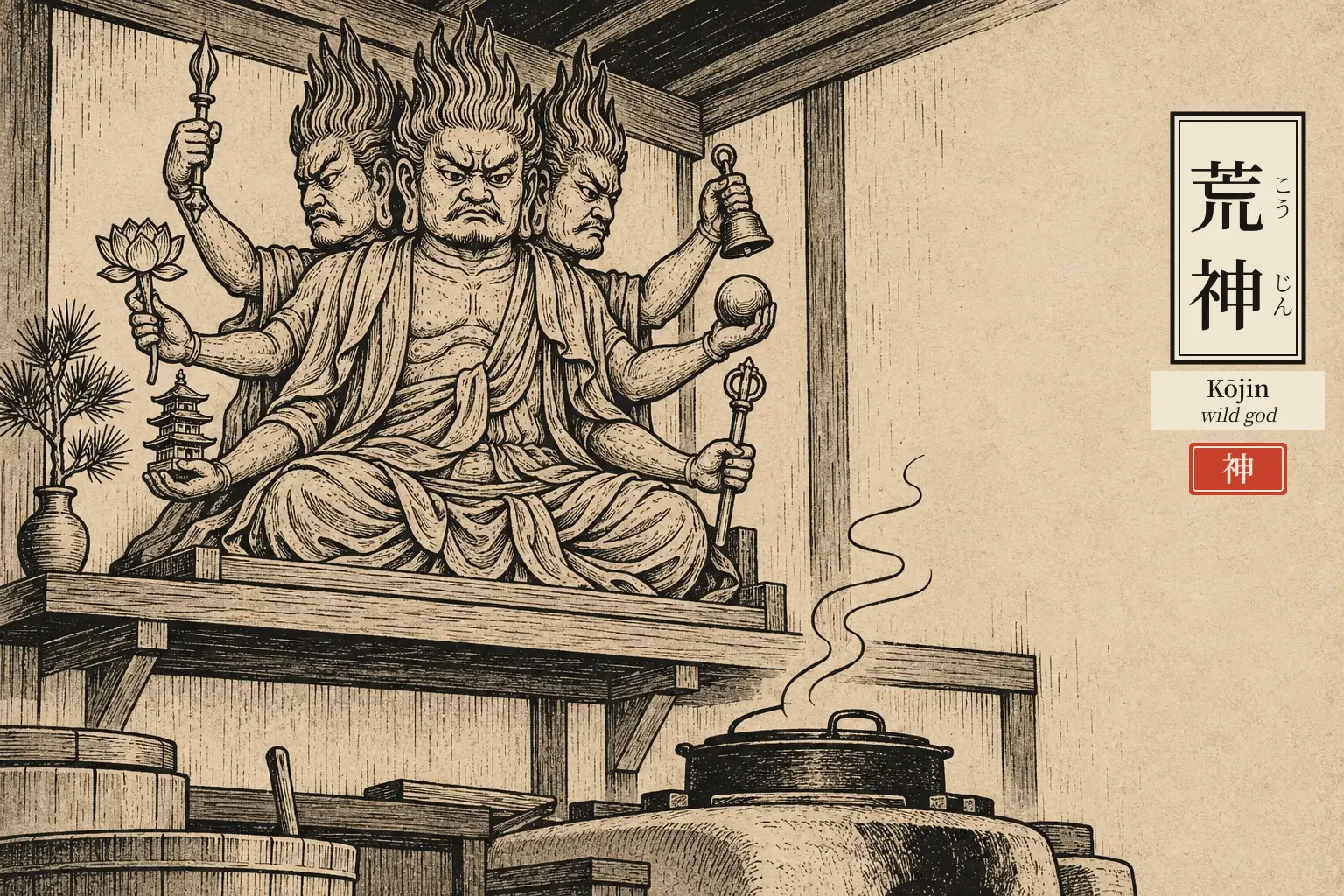
Kōjin has no single face. In Buddhist temple art, the Sanbō Kōjin ("Three-Treasures Kōjin") has three faces and six arms. Some images give it eight faces, with five small ones stacked above the three main ones. Its hair stands on end. Its eyes slant up in anger, like those of the wisdom king Fudō. The anger is described as compassion, aimed at punishing evil. Its six hands usually hold a single-pronged vajra, a lotus and a small pagoda on the right. On the left they hold a bell, a jewel and another ritual tool. The exact objects shift from temple to temple. Most surviving statues date from the late 1500s or later.
One apocryphal sutra written in China, the Mushōge-kyō, splits Kōjin into three beings: Nyorai Kōjin, Sōran Kōjin and Funnu Kōjin. A separate text, the 大荒神経, describes Kōjin as a heavenly maiden.
Inside an ordinary house, Kōjin was often kept without a statue. A paper talisman, a small shrine box or a wand of folded paper strips stood in for a body. Outdoors, a local ji-kōjin often had no image at all. A single tree, or the mound of earth beneath one, was Kōjin enough.
Indoors and outdoors
Kōjin worship splits into two main strands, sometimes counted as three. One lives inside the house: Sanbō Kōjin, god of the kitchen fire. The other lives outside it: ji-kōjin, god of a hamlet, a clan, or one large tree.
The indoor strand likely formed in the medieval period. Mountain ascetics called shugenja, and diviners known as onmyōji, linked older fire and hearth gods to the Buddhist Sanbō Kōjin cult. By the Edo period (1603–1868), nearly every commoner's kitchen in Japan kept some form of Kōjin shelf.
The outdoor strand varies by village. It is found in the Chūgoku mountains, on islands in the Seto Inland Sea, in northwestern Shikoku and in northern Kyūshū. There, whole clans or hamlets gather around one tree or earthen mound. A tree-form Kōjin guards the crops and the safety of farm animals. It is also said to curse easily.
Shrine counts are highest in the Chūgoku region and around the Seto Inland Sea. Okayama alone counts roughly 200 Kōjin shrines. Hiroshima has 140, Shimane 120 and Hyōgo 110. Ehime has 65, and Kagawa, Tottori, Tokushima and Yamaguchi about 30 each. Every other prefecture has ten or fewer.
The soot mark that stopped the kappa
Kōjin's fiercest-sounding job was also its gentlest: guarding children.
In some regions, a baby's forehead was marked at its first shrine visit, called omiyamairi. Soot from the cooking pot (nabe-zumi, or kōjin-zumi) drew an "X" or the character for "dog". Older texts say the mark was drawn in red. The custom is called ayatsuko. In his essay Ayatsuko-kō, the folklorist Yanagita Kunio noted Nara-period pictures of court women. Their makeup seems to show the mark's influence. The mark was a charm against evil. Puppies grow up strong, people said, so the "dog" sign wished the baby the same.
In northwestern Kyūshū, the custom carried one specific fear. Many local stories there claim that kōjin-zumi soot saved someone from a kappa. The fire god inside the house was asked to answer for dangers outside it.
Stories the god left behind
Kōjin turns up at the edge of several much bigger names.
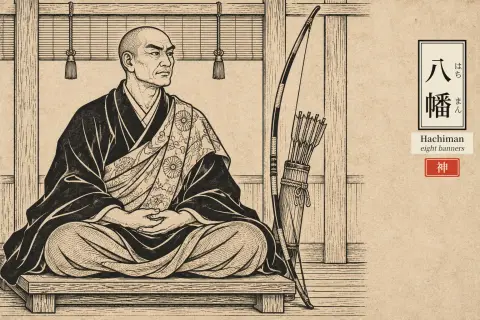
One legend says the ascetic En no Ozunu was praying on Mount Kongō. A red cloud trailed toward the northeast, Kōjin appeared, and En no Ozunu built it a shrine there. Centuries later, the general Minamoto no Yoriyoshi (988–1075) is said to have enshrined Sanbō Kōjin himself. He did it while raising halls to the war god Hachiman, at Kamakura and at Musashi-Ōmiya. A Sanbō Kōjin sub-shrine he founded still stands in the grounds of Ōmiya Hachimangū, in Tokyo's Suginami ward. The sixteenth-century warlord Uesugi Kenshin is said to have owned a helmet with a Sanbō Kōjin figure as its front crest.
Hata no Kawakatsu, an adviser to Prince Shōtoku, became a god of this name too. Zeami's Fūshi Kaden, written from about 1400, says Kawakatsu drifted ashore at Sakoshi, in Harima. There he became 大荒大明神, a great "wild" god. His shrine there, Ōsake Shrine in Akō, writes the name with 避 instead of 荒.
Further west, in northern Hiroshima and western Okayama, a Kōjin rite is still kept. Local groups of households, called myō, hold a sacred dance called Dai-Kagura. It comes round in cycles of 7, 9, 13 or more years. It ends with a trance in which Kōjin is said to speak, delivering an oracle to the gathered houses. Hiba Kōjin Kagura and the related Bitchū Kagura were both designated National Important Intangible Folk Cultural Properties in 1979.
Why keep a wild god in the kitchen?
Put two facts side by side. The name means "wild god." And the god lives at the kitchen fire.
That is less strange than it sounds. In an old wooden house, the hearth was the one wild thing kept indoors. It cooked every meal. It could also burn the house down in a night. The god sat right on top of that danger.
This is our reading, not a record. No old text says villagers chose the name for this reason. But it fits the older idea below: a spirit has a wild side and a calm side, and worship keeps the wild side calm. Every day, a family fed and thanked the fire. Every day, they hoped it would stay in the hearth.
Where Kōjin comes from
No single, agreed story explains how Kōjin began.
One line of thought starts from an old Japanese split between a spirit's two moods: a calm nigimitama and a wild aramitama. In this reading, Kōjin preserves the wild half. Worship, the theory goes, turns the wild half calm.
A second line of thought looks to Buddhism. India had its own tradition of taming fierce spirits, such as yaksha, into guardians. Japanese Buddhism may have done the same to a native fire god. It dressed the god in the wrathful, many-armed look of wisdom-king art. The god then stood as protector of the "three treasures": the Buddha, his teaching and the community of monks.
Some later explanations, traced to Edo-period scholars of kokugaku (National Learning), present Kōjin as a purely Shinto hearth god. The fire god Kagutsuchi is among the deities some Kōjin shrines name. How the cult formed is still debated.
Kōjin today
One living trace of the cult sits in Takarazuka, Hyōgo, at the temple Kiyoshi Kōjin Seichōji. The temple teaches a precise way to pray: one bow, three claps, one more bow. Then come the Heart Sutra and the Kōjin mantra, recited seven times. A household's own talisman belongs on its kamidana shelf, visitors are told, never on the Buddhist altar.
In Kyoto, Gion Shrine, now Yasaka Shrine, once held that Sanbō Kōjin was a retainer of Gozu Tennō, its original god.
The mountain festivals still continue. Every seven years or more in the Chūgoku mountains, the god of the hamlet is said to speak through a trance.