What the shishi is
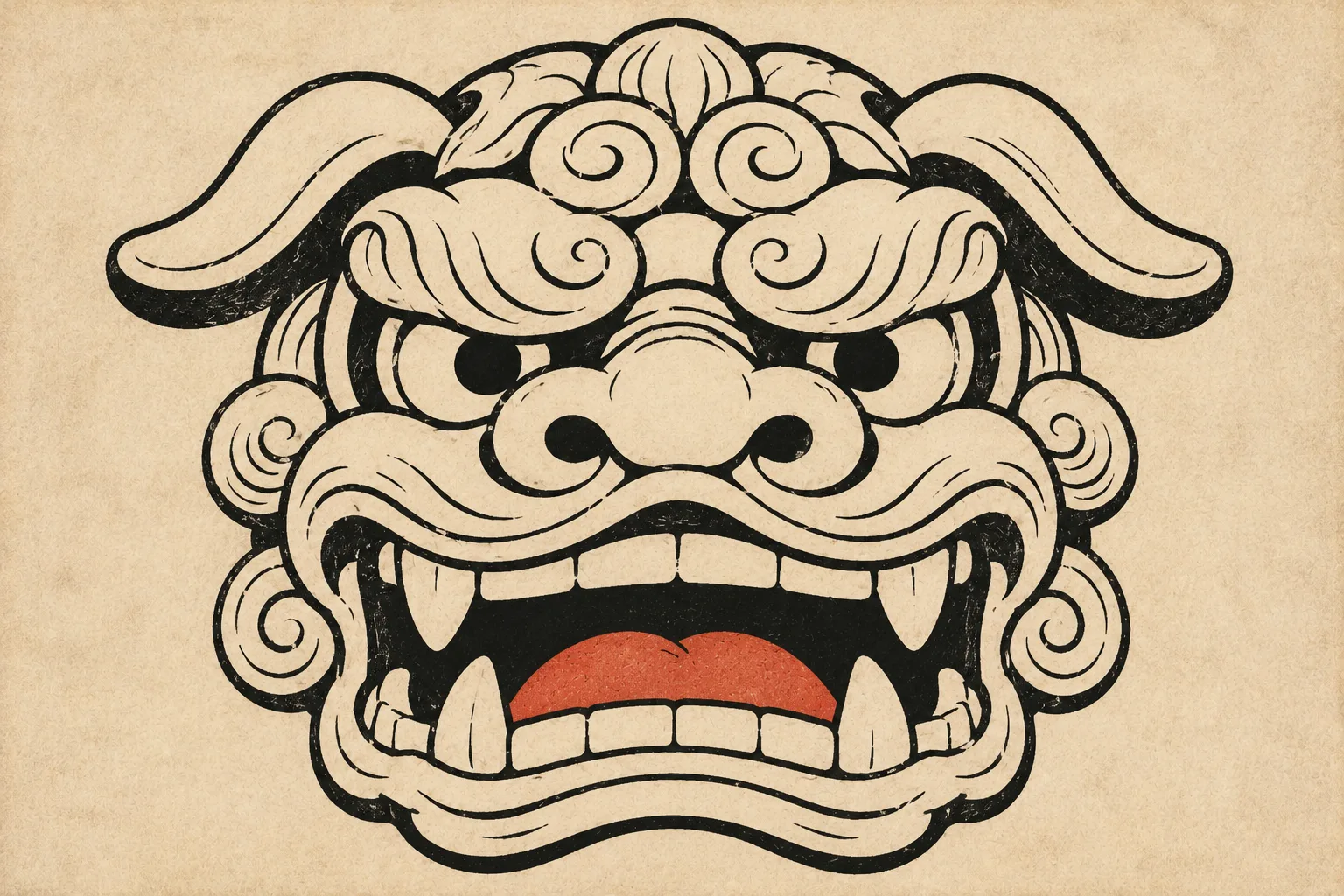
A shishi head is a wooden carving, mostly of a male lion's head. The lion came to Japan with masked dances from the mainland.
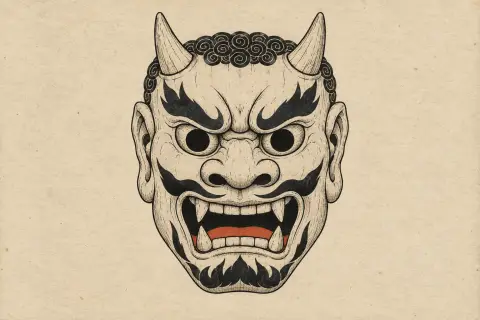
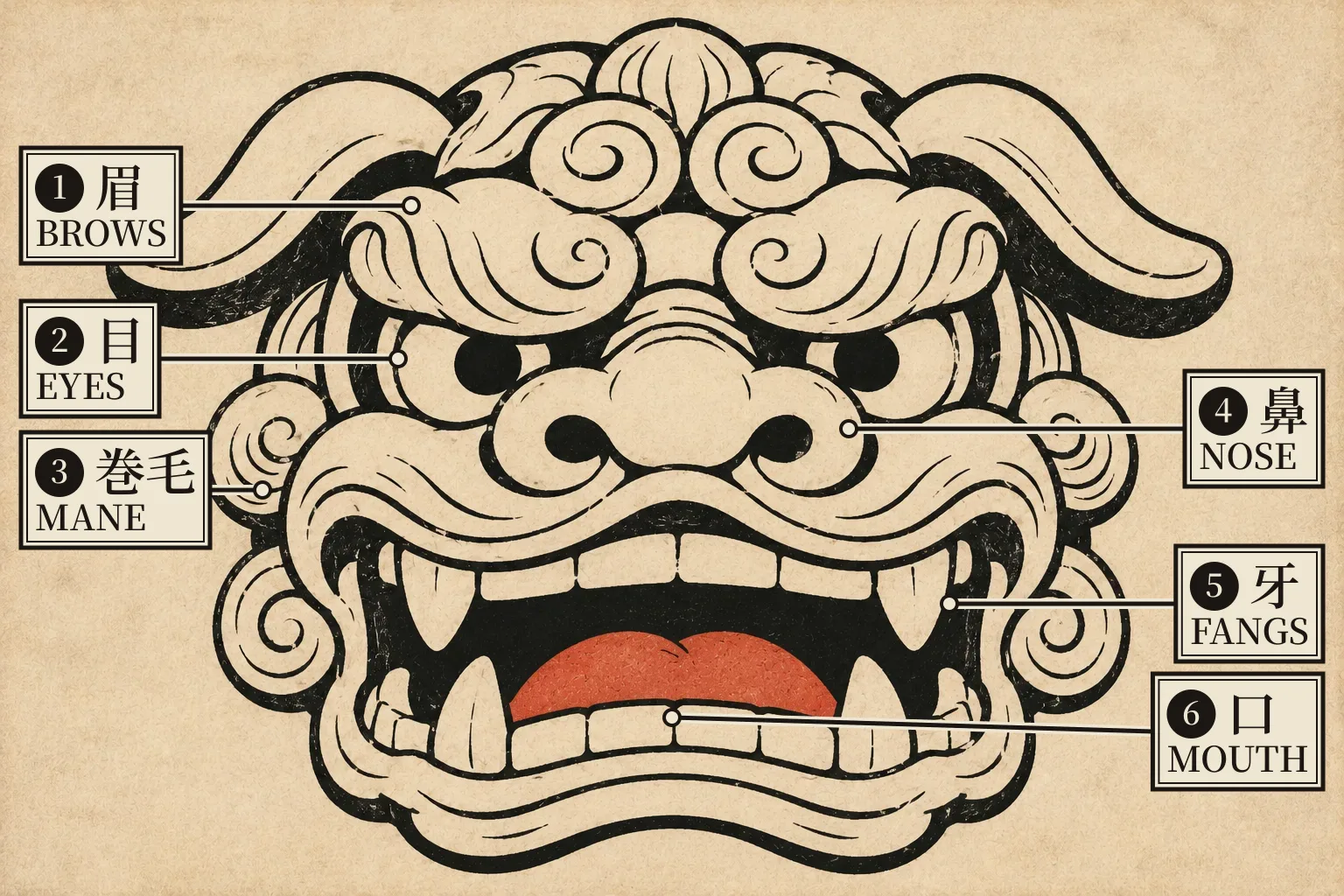 Our diagram. Each row says why that part looks the way it does.
| # | Part | Why it looks like this |
|---|---|---|
| 1 | 眉 Brows | Thick curls pressed low over the eyes. An angry face pulls the brows down, in people too, so low brows read as fury. The lion's job is to drive evil away. (Kotobank; Tezukayama University) |
| 2 | 目 Eyes | Round eyes glare from under the curls. The lion dance is meant to scare off evil spirits and sickness, so the eyes are made to frighten. (Kotobank) |
| 3 | 巻毛 Mane | Tight swirls on top and down the cheeks are the lion's mane. No one in old Japan had seen a real lion, so the mane came from pictures, turned into neat curls. (Kotobank; Cultural Heritage Online) |
| 4 | 鼻 Nose | A big round nose with flared nostrils. An angry animal flares its nostrils, and the oldest lion heads in Japan, from the 700s, already have this nose. So the makers kept it from China. (Kotobank) |
| 5 | 牙 Fangs | Two fangs point down and two point up. People have only small canines, but meat-eating beasts have long fangs, so the fangs say "beast," not "human." (Tezukayama University) |
| 6 | 口 Mouth | Wide open, with a red tongue. At festivals the lion snaps it over your head, and people say it eats the bad spirits on you. So the open mouth is a gift, not only a threat. (Kotobank; Kanko Mie) |
In Buddhism, the Buddha's teaching was called a "lion's roar," because that roar makes every other animal obey. So a beast that never lived in Japan became its guard against evil. No real lion reached Japan until 1866.
What it chases away
One dictionary lists its aims as a good harvest, driving out evil and bringing rain, among others. Other dictionaries add protection from fire and from epidemics.
Why a lion? People in old Japan knew it only by hearsay, as the strongest of all beasts. Buddhism also made it a guardian of the Pure Land, a sacred beast that drives off evil spirits. So the strongest animal anyone had heard of became the one sent against evil.
In the oldest temple dances, the lion seems to have had the same job. It came on stage after the leader of the procession, and it seems to have cleared away evil.
A museum paper records the long-life bite in one village. A Japanese culture magazine says the bite eats up evil. Still, it fits the dance's old job of driving evil away.
Two kinds of lion dance
Japan has two lines of lion dance.
One has two dancers inside one lion. It came from the mainland with gigaku, masked temple dances, between the mid-500s and the 600s. The other has one dancer per lion, and it is an old native style.
The oldest mask on record
Of the ten masks we compare in our guide to Japanese masks, the lion is the first named as a mask in a dated record.
A temple list from Hōryū-ji, dated 747, names "two shishi" among its gigaku gear. The oldest lion head still kept is carving No. 128 at the Shōsōin storehouse in Nara. It has an ink inscription of 752, and it was used at the opening of the Great Buddha at Tōdai-ji.
The name
Together, the two kanji in 獅子 mean lion. In the lion dance, shishi means the carved lion head.
In Japanese, shishi is two words that sound the same. One means lion, a beast Japan knew only through China. The other is an old Japanese word for meat and game animals, mostly deer and boar. To tell them apart, people also called the lion kara-shishi, "foreign shishi," its other name. Some Japanese "lion" dances use a deer or boar head, and a few carry real deer antlers.
Sources
- For the diagram: Tezukayama University Museum paper on its shishi head, Wa-gaku web, 獅子舞, Kotobank, 獅子頭, JAANUS shishi, Kotobank, しし, Kotobank, 獅子舞, Kotobank, 獅子
- Kotobank: 獅子舞, 獅子
- JAANUS: gigaku, gigakumen