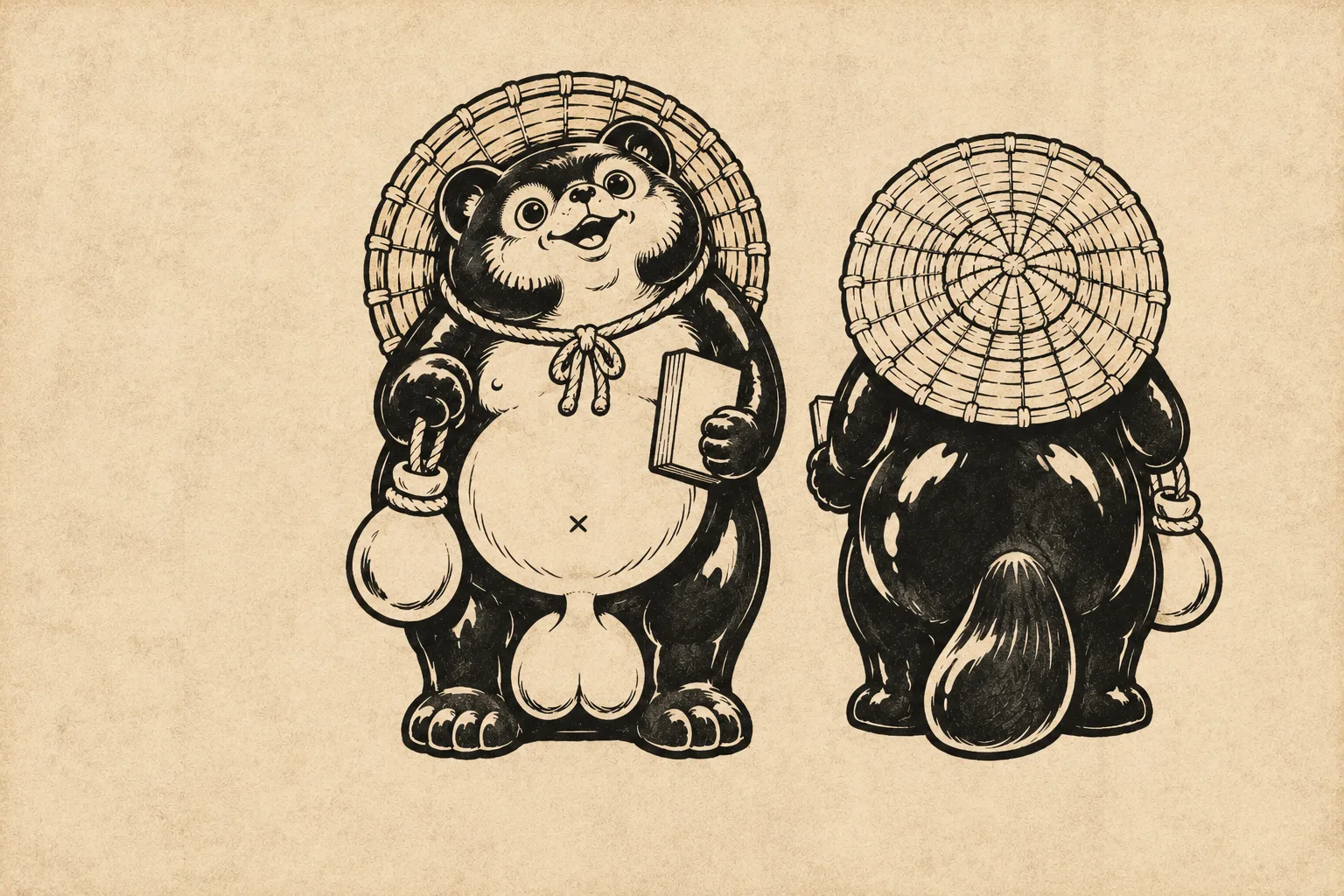
The eight parts and what they mean
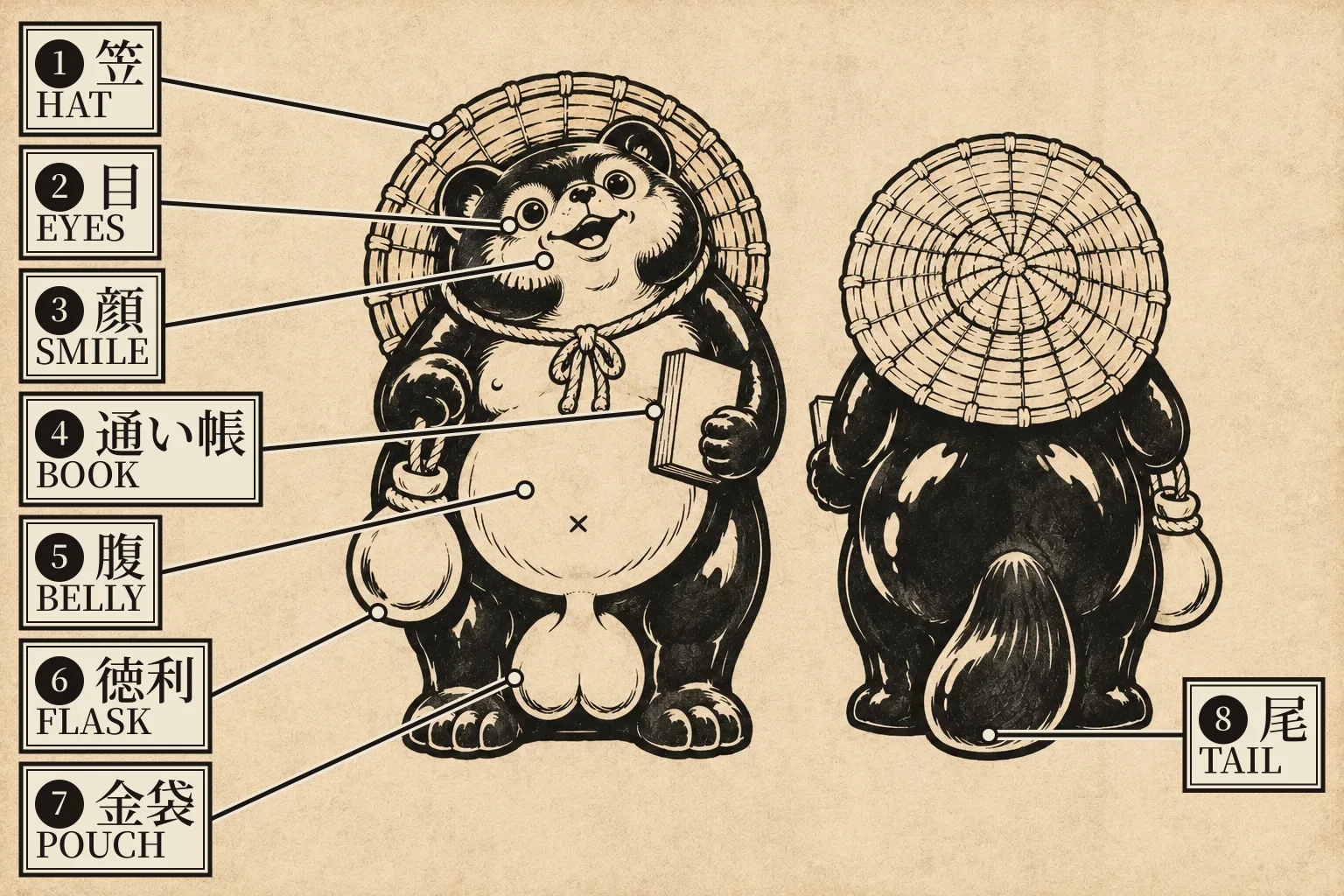 Our diagram of the eight parts that Shiga Prefecture and the town's tourism office list. The table below gives each wish, and how the part fits it.
The set is called hassō engi (八相縁起), or eight lucky features. Shiga Prefecture and Shigaraki's tourism office list the same eight. The shapes came first. The meanings were read into them later.
| # | Part | The wish (Shiga Prefecture's words), and how the part fits it |
|---|---|---|
| 1 | 笠 Hat | Be ready every day for sudden trouble and bad weather. You put a hat on before the rain comes. |
| 2 | 目 Eyes | Look all around and judge things rightly. Big eyes miss nothing. |
| 3 | 顔 Smile | Keep smiling and be friendly. It brings good business. People come back to a friendly shop. |
| 4 | 通い帳 Account book | Trust comes first. It is the basic rule of trade. This book listed what a regular bought on credit. Selling on credit only works on trust. |
| 5 | 腹 Big belly | Stay calm and bold. Nothing should shake you. English says the same thing: a brave person has guts. In Japanese, a big belly means you stay calm and brave. |
| 6 | 徳利 Sake flask | Never go short of food and drink, and build virtue as a person. He carries the flask out to buy sake. We read it as a house that never runs dry. Its name, tokkuri, also starts with toku, virtue. |
| 7 | 金袋 Pouch (money pouch) | Have money luck, enough to spend freely. A pouch is where you keep money, and its first character, 金, means gold. |
| 8 | 尾 Thick tail | Finish everything well and get real results. The tail is where the body ends. Japanese mock a weak finish as "a dragon's head, a snake's tail." A thick tail is the opposite: a strong finish. That is our reading. |
Put the flask and the account book together, and the tanuki is on an errand. It is off to buy sake on the household's tab. That is why this style is called sake-kai kozō, "the sake-buying boy."
The money pouch is a polite name. It is the tanuki's large scrotum, kintama, which means gold balls.
Why a tanuki?
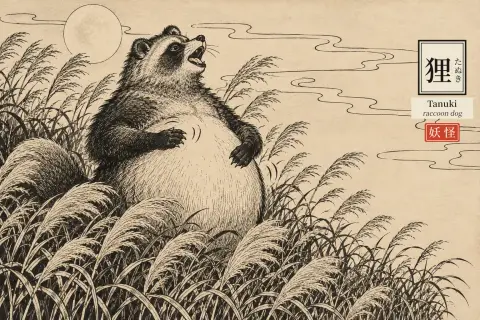
The tanuki is a real wild animal, the raccoon dog. It is not a raccoon but a wild member of the dog family. In old tales it is also a shape-shifter.
Shopkeepers want to beat their rivals. The name helps. Tanuki can be heard as ta-nuki (他抜き), which means pulling ahead of others. Japan's tourism agency gives this pun as a reason shops put one by the door. The town points to the eight wishes instead, like the smile for good business.
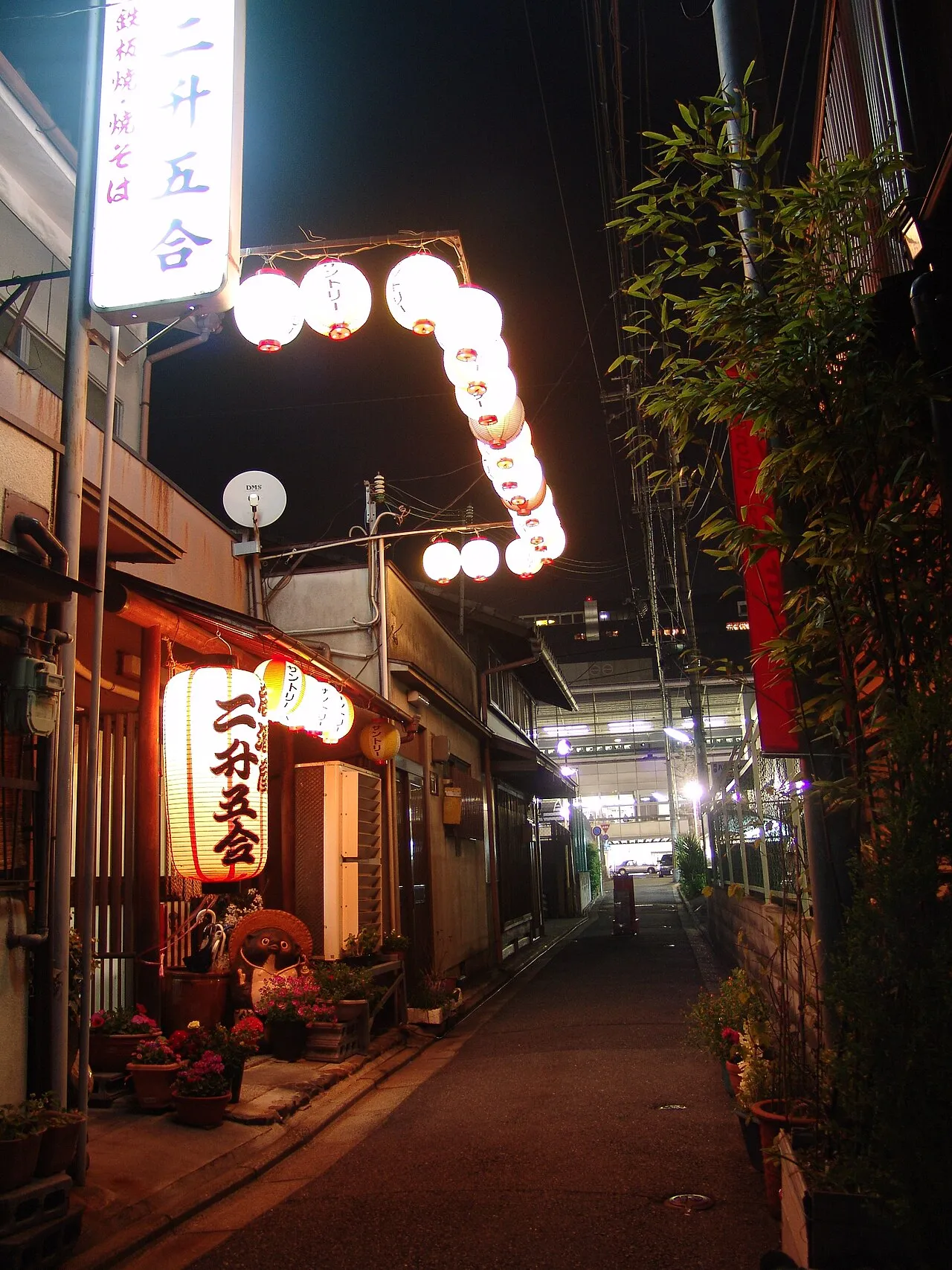 A tanuki by the door of a small restaurant near Kyoto Station. Photo: Wikimedia Commons user “...some guy”, CC BY 2.0
The statue also borrows from older folklore. In Japanese tales, the tanuki is a trickster that fools people and drums on its belly. A joke saying even claims its scrotum spreads over eight tatami mats, the floor of a small room. In old records the tanuki was mostly a frightening yokai. From the late Edo period, in the 1800s, it turned comic. Wa-Raku web, a magazine site, cites researchers who link the sake flask to a children's song from western Japan. In the song, a little tanuki goes to buy sake.
For the yokai behind the statue, see our page on the tanuki.
Who gave the parts their meanings?
The eight meanings are usually credited to Ishida Gōchō (1910–2005). He was a Buddhist monk and a painter who collected writings about tanuki. People called him the tanuki priest. A 2014 Osaka City University report says he put the eight virtues into words in 1952. Wa-Raku web and Japanese Wikipedia give the same year.
The same report says he built them from older lore. On his advice, shops sold the statues with a small leaflet about the eight parts. They then caught on as a lucky charm for home gardens and under the eaves.
Treat the credit as likely, not proven. The town and the prefecture use the name, but they do not say who made it.
How Shigaraki became the tanuki town
On November 15, 1951, Emperor Shōwa (Hirohito) visited Shigaraki. People welcomed him by waving Japanese flags. To liven things up, the town gave flags to the tanuki statues along the road too. The prefecture and the town both tell this story.
The emperor wrote a short poem about the sight. In it, seeing the Shigaraki tanuki brings back the ones he collected as a child. The town says news of the poem made its tanuki famous across Japan.
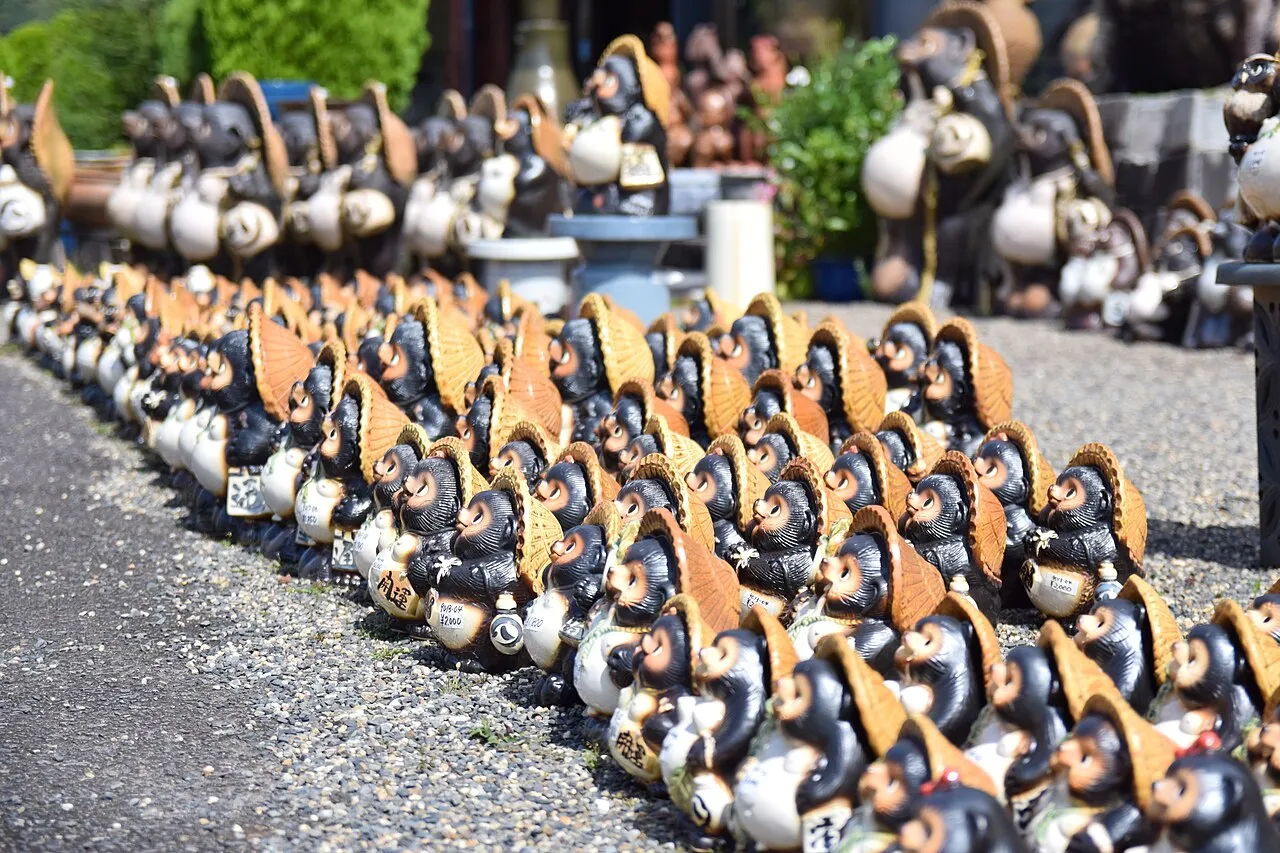 Tanuki statues for sale in Shigaraki. Photo: Raita Futo, CC BY 2.0
A 1981 study dates the poem to New Year's Day 1952. But the palace held no New Year poetry event that year, so that date is unsure.
Japan's national library checked the Asahi, a major newspaper, for November 16–17, 1951. It found no such story. A 1956 magazine still called Shigaraki "the hibachi town," after its charcoal heaters. So "the news made them famous" is the local account. National papers of the time do not show it.
Who made the first ones?
Shigaraki tanuki go back at least to the late Edo period (Edo: 1603–1868). A potter named Okuda Shinsai (奥田信斉) made some then. Early tanuki had thin faces, close to the real animal. Today's round, smiling style grew out of the pottery workshop of Fujiwara Tetsuzō, a potter from Kyoto, and the potters he trained. A shop that sells the workshop's tanuki says the long nose kept breaking in shipping. So the nose was made lower. The workshop also chose a cuter face and a white, fatter belly. Sources disagree on when he moved to Shigaraki, from about 1927 to 1936.
Frequently asked questions
Why do tanuki statues have big balls?
Its polite name, the money pouch, starts with 金, which means money and gold. That likely links it to money luck. Edo-period pictures and tales already showed tanuki with a huge scrotum. Why old tales gave tanuki such a big one is not clear. One theory links the eight-mat joke to gold leaf, beaten thin inside tanuki skin. Shiga Prefecture calls it the money pouch, for money you can spend freely.
Is there a female tanuki statue?
Yes. A 2014 report says female and child tanuki appeared around 1960. Not every statue has all eight parts. Japanese Wikipedia notes that female figures have no money pouch. We found no source that gives them their own eight meanings.
Where should I put one?
The town's tourism office says they watch over people from shop fronts and home gardens. The 2014 report says home gardens and under the eaves became popular spots after the eight-virtue leaflet. We found no rule about which direction it should face.
Is there a tanuki day?
Yes, November 8. In Japanese, 1 can be read i, so 11 sounds like ii, good. The town reads 11/8 as ii hachi, good eight. It does not say why it chose eight. It started in 2008 and took its current name in 2012.
Sources
- Shiga Prefecture: November 8 is Shigaraki Tanuki Day
- Shigaraki Tourism Association: Hassō engi, Shigaraki ware, Tanuki Day
- Japan Tourism Agency: Tanuki Figures of Shigaraki
- Okano Hiroshi (ed.), URP Report Series No. 30, Osaka City University, 2014
- Wa-Raku web: why Shigaraki means tanuki, 2020; Japanese Wikipedia: 通い帳; imidas: 竜頭蛇尾
- Shigaraki Labo (sells tanuki from the Rian workshop): about Shigaraki tanuki
- National Diet Library reference database: the 1951 visit and the newspapers
- Kotobank: 狸, 腹, タヌキ, 狸の睾丸八畳敷き, 信楽たぬきの日
- Japanese Wikipedia: 八相縁起, 信楽焼, 石田豪澄, 藤原銕造, 化け狸; English Wikipedia: Tanuki statue
- Photos: Wikimedia Commons (Kyoto, Shigaraki)