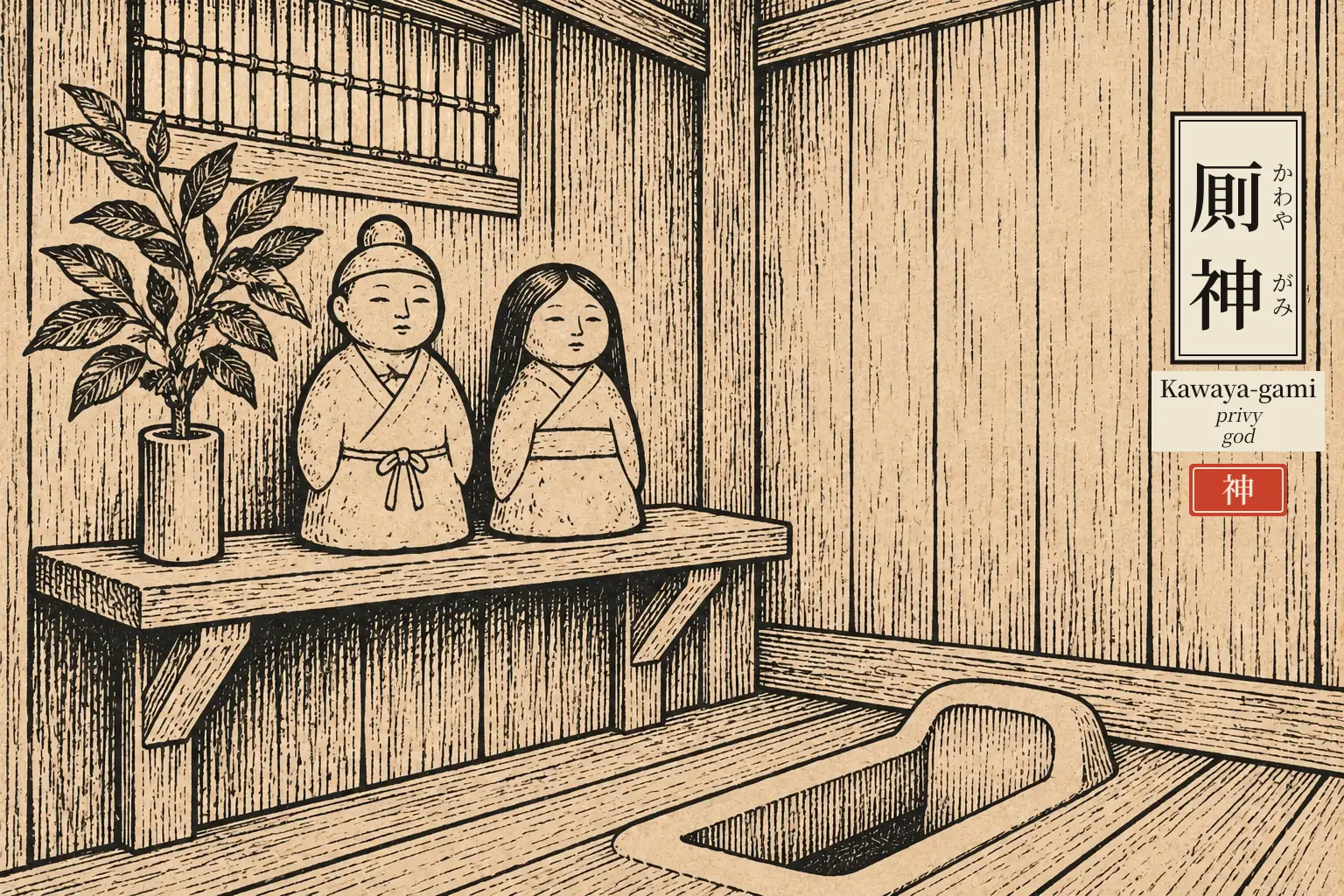
Most Japanese homes kept a god nobody could draw. It lived in the outhouse. Most families owned no statue or picture of it. The name is blunt. 厠 (kawaya) means privy. 神 (gami) means god. Put together, this is Kawaya-gami.
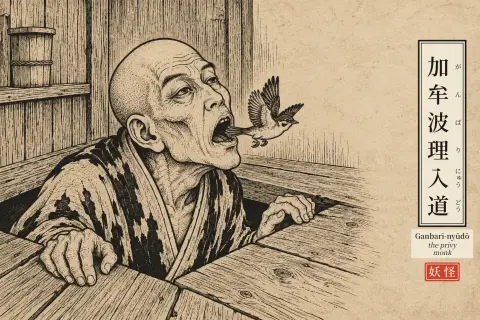
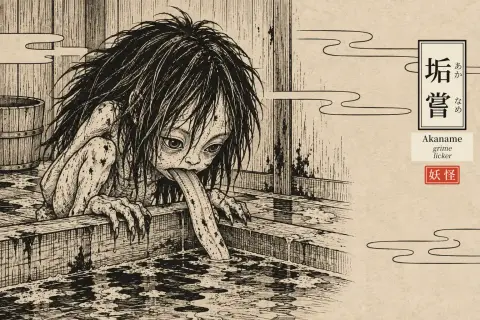
Kawaya-gami is a kami, a god, not a yokai. It is not akaname, the small yokai that licks grime off a dirty bathtub. It is not Ganbari-nyūdō, the bald monk-spirit said to peer through a privy window on New Year's Eve. Those two are monsters that show up when a room is neglected. Kawaya-gami was already there, cared for or not. Families turned to it for many things, but most often for one: an easy birth.
The dolls buried under the floor
Most households used no image at all. At New Year and at Obon, Japan's festival for the dead each August, families made one simple offering. A sprig of green leaves, or a paper shrine charm, stood in for a shrine.
A few places went further. Near Sendai, Kawaya-gami took the shape of two small clay dolls, one male and one female. Builders in Kanazawa still bury a matching pair, unglazed and low-fired, under a new toilet's floor. The burial follows an old Onmyōdō rule: a hole dug into the earth, a well or a privy pit, should not be filled back in empty. A doll, or a folded paper fan, goes in first.
Other households cut the pair from paper instead. The fold matched hina dolls, the paired figures displayed each March for Girls' Day. In one Gunma hamlet, now part of Minakami town, a single doll stood in for the god. It was folded from a New Year's paper wand called gohei. It had its own name too: Secchin-yomego, the privy's young bride.
Accounts disagree on whether the god even has hands. Some regional sayings call it blind, or handless. Others say the opposite. In Aomori, people say it catches urine in its right hand and waste in its left, leaving only its mouth free. That is also given as the reason spitting in an Aomori toilet is taboo. China keeps a different privy goddess, Zigu-shen. She is pictured with a rice-washing basket for a head, dressed in red cloth. Korea has its own household privy goddess. She is pictured as a strict young woman, punishing the house on a guardian god's behalf. Both belong to their own countries. Neither is Kawaya-gami.
Why a newborn was carried to meet it
In a custom recorded from Fukushima down to the Kantō region, a midwife carried the newborn to the toilet on its third day, to be introduced to Kawaya-gami. The visit had its own name, Secchin-mairi, "the privy visit."
In the Hida region of Gifu, people said a birth would not go easily without the god's help. On Iki Island, off Nagasaki, people named two gods of safe childbirth. One was Kawaya-gami. The other was the broom god beside it, Hōki-gami.
Clean the toilet, pray for a beautiful child
One of the most widespread beliefs is simpler than any of this. Clean the toilet, people said across many regions, and your child will be born beautiful. One encyclopedia reads this as a kind of sympathetic magic. A pregnant woman nearing her due month cleaned the toilet to ask for a safe birth. The reasoning: relieving herself there looked, to older eyes, like giving birth itself.
In some regions, people also said that falling or getting hurt in the privy could be fatal. That gave the room a second, more ordinary reason for care.
A word from the Kojiki, a god from the 20th century
No old scripture names a god called Kawaya-gami. Urabe Shinto gave the privy two different names: Haniyamahime-no-kami and Mizuhanome-no-kami. Both are earth and water deities. They trace to the classical myth of Izanami's death, told in the Kojiki and the Nihon Shoki. Esoteric Buddhism used two more names: Uzusama Myōō and Ushisshama Myōō. None of those four names is Kawaya-gami. No Edo-period artist drew this god either, the way Toriyama Sekien drew akaname or Ganbari-nyūdō. The name Kawaya-gami itself surfaces only in the 20th century, in the folklore scholarship that followed Yanagita Kunio.
The room is far older than that. The word kawaya already appears in the Kojiki (712), Japan's oldest chronicle. It named a hut built out over a stream, kawa, with a drain running beneath it. The room had its name a thousand years before anyone wrote the god's name down.
The Nipponica encyclopedia entry adds one more piece. From the Edo period on, it says, these scattered privy beliefs merged into household ancestor worship. That merger is one reason its birth customs are the ones still written about most today.
Still buried, still sung about
The Kanazawa custom of burying a pair of clay dolls under a new toilet has not stopped. Builders there still do it.
In 2010, singer Uemura Kana had a nationwide hit called "Toire no Kamisama," "The Toilet God." She wrote it about her grandmother. Her grandmother grew up on Okinoerabu Island, in Kagoshima. Her family believed a clean toilet made a person beautiful. The song never names Kawaya-gami. The belief inside it is the one villages kept for a century before anyone turned it into a hit song.