A young hunter once stood crying at the tideline. He had borrowed his brother's fishhook, lost it in the waves, and could not find it again. An old man came across him there and did not try to comfort him. He built a small boat instead and told the hunter where to go: down, to the floor of the sea, to a palace with towers that shone like fire.
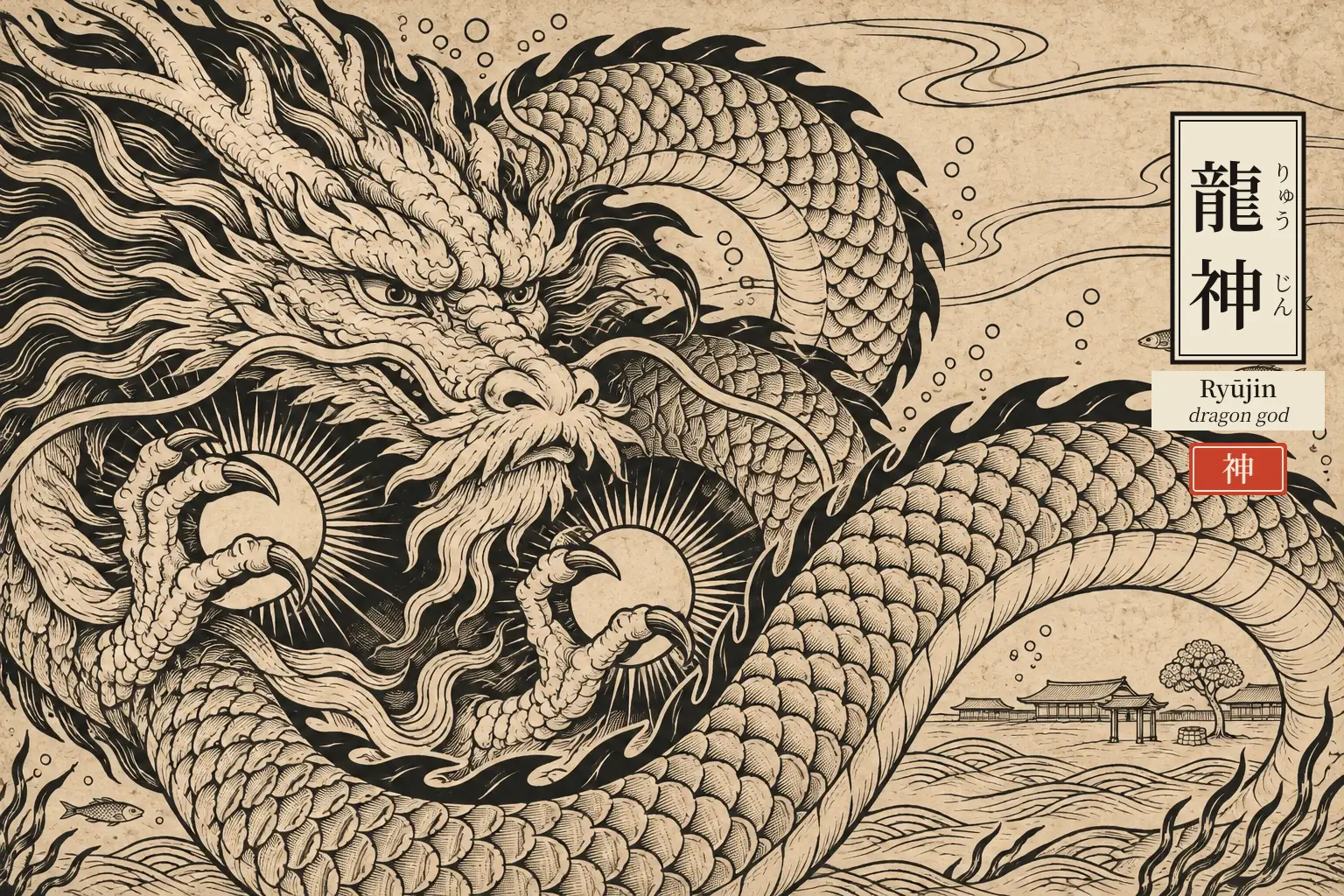
The god who rules that palace is Ryūjin: 龍 (ryū, "dragon") + 神 (jin, "god"). Japan's two oldest histories, the Kojiki (712) and the Nihon Shoki (720), call him other names first. There he is Ōwatatsumi-no-kami, "the great sea god," or Watatsumi Toyotamahiko. He rules the sea and everything that swims in it, and his own daughter marries the hunter who climbs down to find him.
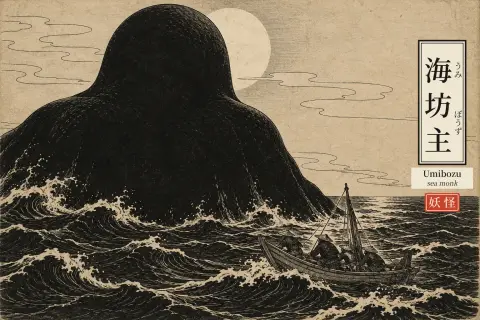
He is not the umibōzu that looms over a ship's rail at night. That is a monster sailors fear. Shrines to this line of sea gods still stand on the coast today.
His own body is never described
Here is the strange part. Neither the Kojiki nor the Nihon Shoki says what Ryūjin looks like. Not once. Both texts describe his palace instead, in real detail: high ramparts, glittering towers, a well by the gate, a katsura tree growing beside it. The god who lives inside gets no body at all.
"Dragon" is a later label. The earliest clear point anyone calls this sea god a dragon king, in writing, is a 12th-century picture scroll, the Hikohohodemi-no-Mikoto Emaki. It names him Ryūō, "dragon king," borrowing an image from Chinese and Buddhist tales of dragon kings who rule undersea courts. Popular texts kept calling his palace by that name afterward — a 1702 retelling of the age of the gods, Fūryū Jindaimaki, still uses "Ryūgū" and "Ryūō" for it.
The one dragon-shaped body the old myths do describe belongs to his daughter, not to him.
Two gods wearing one name
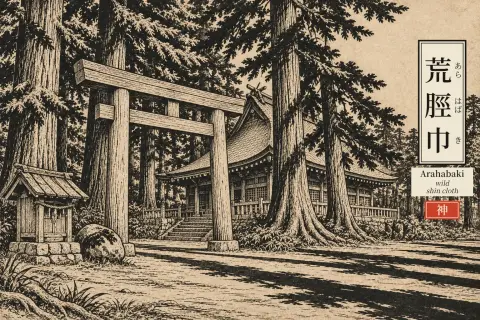
Shikaumi Jinja, on Shikanoshima island in Fukuoka, is usually called Ryūjin's main shrine. The old texts complicate that. They name a second trio of sea gods — Sokotsu-, Nakatsu-, and Uwatsu-Watatsumi — born later, when Izanagi washed himself clean after visiting the land of the dead. The Kojiki and Nihon Shoki treat this trio as different gods from Ōwatatsumi, the dragon king of the fishhook story. Shikaumi Jinja formally enshrines that purification-born trio, together with Toyotama-hime's sister Tamayori-hime, not Ōwatatsumi by name. Worshippers have long folded both sets of gods together under the one word, Watatsumi. The myths keep them apart.
The fishhook and the two tide jewels
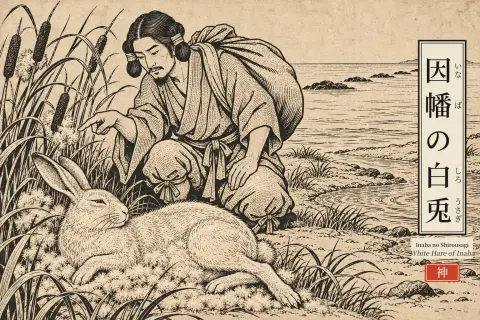
The hunter was Hoori, also called Yamasachi-hiko, "the one skilled at the mountains." His older brother Hoderi, "the one skilled at the sea," had lent him the hook. The old man who found Hoori weeping was Shiotsuchi, a tide god. He built the boat that carried Hoori down to Ryūjin's palace.
There Hoori met and married Ryūjin's daughter Toyotama-hime, and stayed three years. When he finally admitted why he had come, Ryūjin called every fish in the sea together and asked after the missing hook. A red sea bream had it stuck in its throat. Ryūjin pulled it free and gave it back.
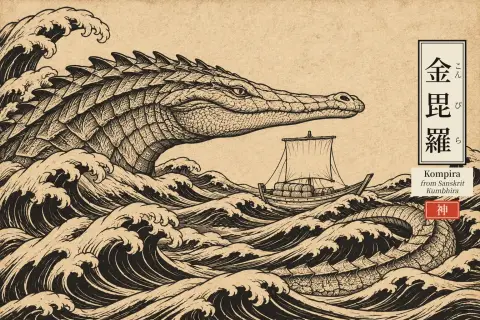
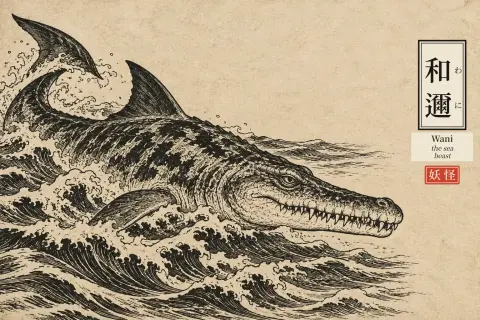
He gave Hoori something else too: two jewels. One, the shiomitsu-tama, makes the tide rise. The other, the shiofuru-tama, makes it fall. Ryūjin sent Hoori home riding a wani — a sea creature — now worshipped under its own name, Saimochi-no-kami. Back on land, Hoori used the jewels to flood his brother and then spare him. Hoderi submitted. The Nihon Shoki names his descendants as ancestors of the Hayato people.
The birth he was not allowed to see
Before Hoori left the palace, Toyotama-hime told him she was pregnant. She would come ashore to give birth, she said, and asked him to build her a hut for it. She kept her word, arriving with her sister Tamayori-hime at her side. Only one thing, she asked: do not look at me while I give birth.
Hoori looked anyway. He saw his wife's true shape: an eight-fathom wani, crawling on its belly and writhing like a serpent. Ashamed at being seen, Toyotama-hime returned to the sea and left her newborn son behind. That son, Ugayafukiaezu, grew up and married his aunt Tamayori-hime. Their child was Jinmu, remembered as Japan's first emperor — which makes Ryūjin his grandfather on his mother's side and his great-grandfather on his father's side.
Where it comes from
Put the pieces together and a pattern shows. The old texts never say Ryūjin looks like a dragon. His daughter's true shape, when she finally reveals it, does. Long before anyone called this god a dragon king, Japan already had a sea god living in an undersea palace. China and Buddhist texts separately had dragon kings ruling courts exactly like it. By the 12th century, the two images had merged into one. The dragon came from outside. The palace, and the god who ruled it, were already here.
Ryūjin today
Worship of this line of sea gods did not stay on the coast. Hotaka Shrine, far inland in Azumino, Nagano Prefecture, honors a Watatsumi sea god from the same family — carried there, tradition holds, by the seafaring Azumi clan, who claim a Watatsumi line as ancestors. Sources don't agree on exactly which Watatsumi god that is.
Two tiny islands off Shimonoseki, in the Seto Inland Sea, are still tied to Hoori's two jewels: Manju-jima and Kanju-jima. One local account says Empress Jingū received the jewels there from a dragon god who was an incarnation of the Sumiyoshi gods. Another says Hoori himself left his own two jewels on the islands. Accounts differ on the details. Either way, visitors still need the local shrine's permission before they can land on either one.