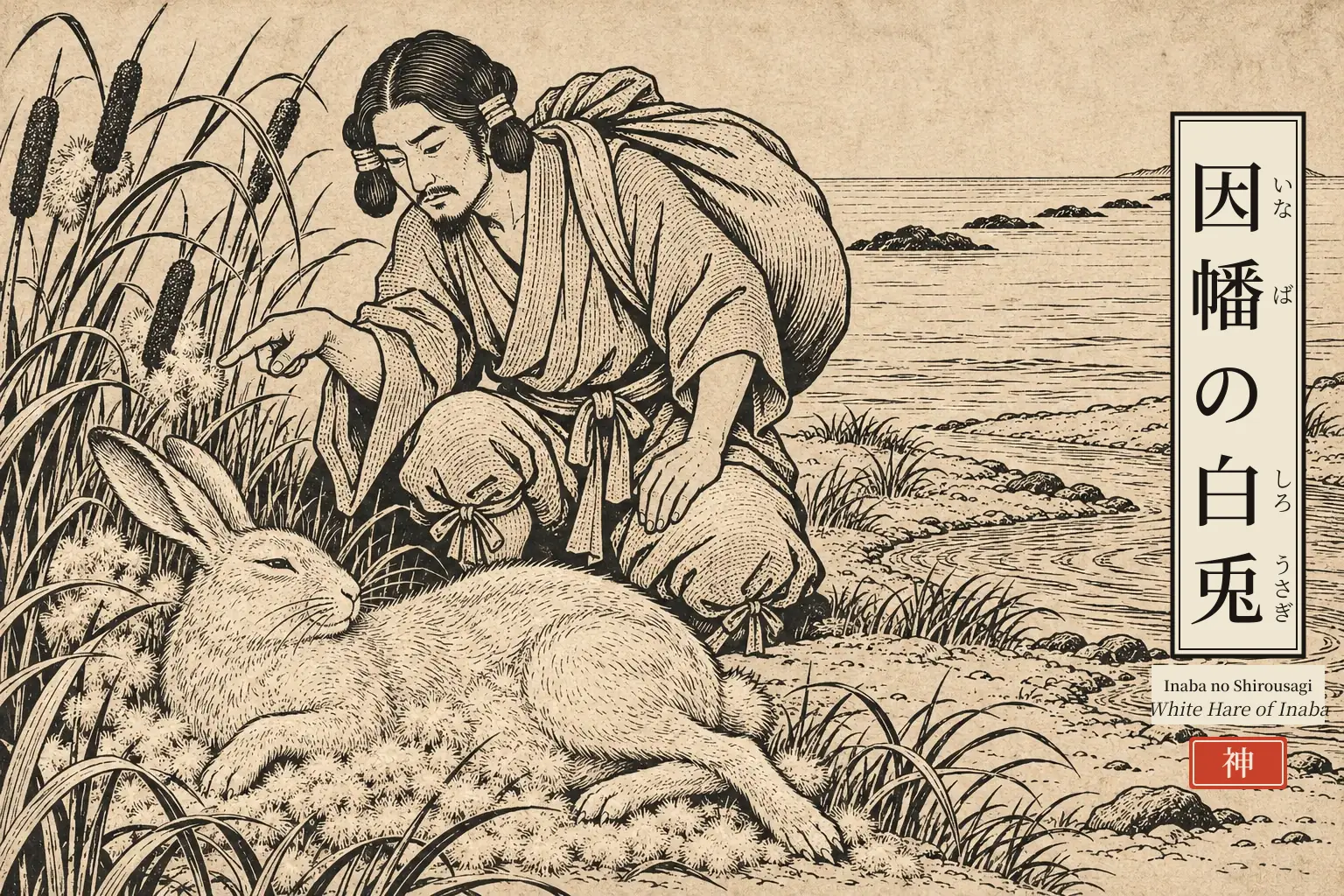
A hare lies on a beach, skinned and crying. By the last line of its own story, Japan's oldest surviving chronicle calls it a god. That is the whole arc of the White Hare of Inaba — 因幡の白兎 (Inaba no Shirousagi), told in the Kojiki, compiled in 712. In the Kojiki's own telling, this hare is written 稻羽之素菟, "the plain hare of Inaba." It was never a monster to fear. It is an animal that an ancient text itself promotes to a kami, in a single word, as the story ends.
What does it look like?
The Kojiki never states the hare's fur color. Its text just calls it usagi — a plain hare, nothing stranger. The familiar name "shiro-usagi," white hare, comes from a later reading. Edo-period scholar Motoori Norinaga read one character in the text, 素, as meaning "undyed" or "bare." A later scholar, Takeda Yūkichi, pushed that reading one step further. He compared the character to 素布, a term for plain, undyed cloth — hence white. That chain of reasoning, not the Kojiki's own words, is the real source of the hare's white coat.
One real detail sits behind that debate. Most Japanese hares turn white for snowy winters. The wild hares on Oki Island, where this story starts, are a subspecies that doesn't turn white in winter. If the myth's hare really came from Oki, it may never have been white at all.
The crossing that cost it its skin
The story opens mid-journey. Okuninushi's eighty brother-gods, the Yasogami, are heading to Inaba to court a princess named Yagami. They make Okuninushi carry their travel bags, like a servant.
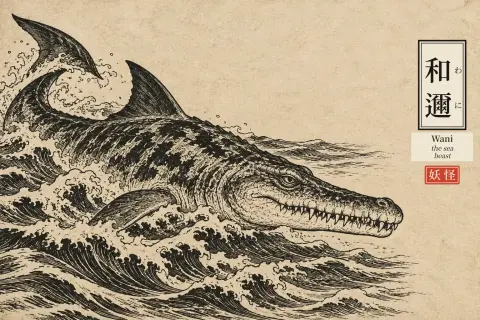
On the way, they pass a skinned hare lying in pain on the beach. It explains how it got there. It wanted to cross the sea from Oki Island to Inaba but had no way to swim that far. So it tricked the wani — sea beasts — into lining up across the water, telling them it wanted to count whose clan was bigger. Then it ran across their backs, counting as it went.
Right before reaching land, the hare admitted the whole count was a trick. The last wani in line caught it and tore off every scrap of its fur.
Bad advice, then a cure
The Yasogami reach the hare first. They tell it to bathe in seawater, then lie on a mountaintop in the wind and sun. It sounds like kindness. It is not. As the salt dries, the hare's torn skin splits further, and it ends up wounded and crying.
Okuninushi arrives last. He asks why it's crying, then gives it real treatment: wash in the water where the river meets the sea, then roll in the pollen of cattail reeds. The hare follows the instructions, and its skin heals back to normal.
Some scholars read this scene as more than a kind gesture. A 1915 medical-history paper reads the river-mouth wash as an early saline cleansing, gentler than the Yasogami's full-strength seawater, and the cattail pollen as possibly the oldest named treatment in Japanese medicine. The Nihon Shoki elsewhere credits Okuninushi, alongside the god Sukunahikona, with setting down the practice of medicine itself. This hare may be the first patient on record.
From animal to god, in one word
The healed hare makes a prediction: the Yasogami will never win Princess Yagami's hand. Okuninushi will. It comes true exactly that way. Right there, the Kojiki's own text shifts how it names the hare. It had called it only usagi, hare. From this point on, it calls it usagi-gami — hare deity.
That single word is the whole claim to godhood here. No altar, no offering, no priest appears anywhere in the episode. The text just changes its own vocabulary, mid-sentence, and the hare becomes a kami.
Where the crossing happened — accounts differ
Scholars don't agree where any of this took place. The text names the hare's starting point "Okinoshima," written with characters that don't quite match the Kojiki's usual spelling for the Oki Islands. Scholar Tobe Tamio reads it as the Oki Islands anyway. Scholar Umehara Takeshi disagrees — he argues the name just means "an island out at sea," no specific place at all.
An Edo-period Inaba record, the Inaba Mindanki, preserves an entirely different telling, credited to a fragment claiming descent from a lost regional gazetteer. In this version, the hare lives in a bamboo-grass thicket on the mainland, gets swept out to an island by a flood, and tricks "a fish called wani" to get back. Whether that fragment is genuine is unclear — even the record that preserves it says so.
Not a yokai — so how did it become a kami?
The hare in this story isn't a yokai. It was never blamed for drownings or ruined crops, the way a kappa was. It isn't an oni, and it isn't a ghost. It is an ordinary animal that briefly suffers, gets healed, and is called a god for it, inside the oldest surviving version of its own story.
How that turned into an actual shrine is murkier. An Edo-period Tottori physician's record ties a real shrine on the coast — worshipping something called "Ōusagi Myōjin," Great Hare Deity — to an even older name recorded in a 1532 religious compilation: "old hare." The shrine's own history before that point is said to be unclear, because worship there had lapsed at some point.
The Heian-period shrine register, the Engishiki, does not list a hare shrine for Inaba province at all, though that alone does not prove none existed yet. A separate shrine inland, in the hills of what is now Yazu-chō, tells a different hare story entirely: a white hare that guided the sun goddess Amaterasu to a campsite, then vanished, and was worshipped there as the moon god Tsukuyomi in animal form. That inland shrine received a court rank from Emperor Ninmyō around 840, centuries before the coastal shrine's own history comes into clear view. It may be a separate hare tradition altogether, not a retelling of the Kojiki's.
Where it comes from
The trick of counting across a line of animals shows up well outside Japan. A Siberian tale has a fox carried to an island by a heron, then escaping by tricking seals into the same false head count and crossing their backs back to the mainland, where a hunter catches and skins it. An Indonesian tale gives the same trick to a mouse-deer crossing a flooded river on crocodiles. An African tale has a hare lose its tail to a crocodile it tried to fool the same way — offered as the reason hares have short tails today.
None of these is claimed as the source for the Kojiki's version. They do suggest the trick itself — cross an obstacle by flattering strangers into forming a bridge — was old and widely told, long before anyone wrote any of these versions down.
The hare today
The coastline where the story is set still carries its names. A line of reefs just offshore is pointed out as the wani itself, turned to stone. A hill called Mikaraboshi-yama is said to be where the hare dried off. A spot called Minato marks where it washed its wounds. A wetland once thick with cattail, until shortly before the Second World War, is called Fuzō-fumetsu — "neither growing nor vanishing" — and tied to the same tale.
The story has traveled past Tottori, too. ispace, a Japanese company building private lunar landers, named its program HAKUTO-R after the hare that crossed the sea to reach the mainland — this time, racing to reach the surface of the Moon.