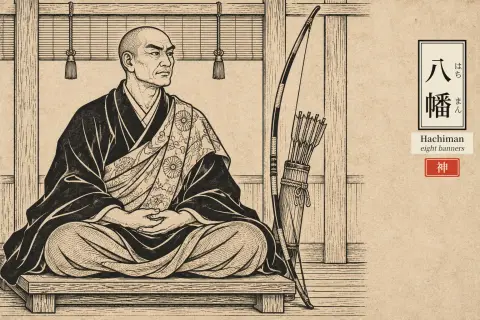
Walk into certain old shrines in Japan. You may find two gods, not one. The first is whoever the shrine is named for. The second has no shrine of its own anymore. It stands off to the side, by the gate. It is only a "guest" there. That second name is usually Arahabaki.
Arahabaki is not a yokai. No story has anyone seeing it. No story has anyone fleeing it or being harmed by it. It is a kami, a god with shrines, offerings, and priests. What makes it strange is rank, not menace. Again and again, it turns up demoted. It seems to have once mattered. Now it is kept as an afterthought, at someone else's altar.
A name with no settled spelling
Even the name will not sit still. Shrines across Japan write it as 荒覇吐, 荒吐, 荒脛巾, 阿良波々岐, 荒波々幾, and 荒羽々気. All are read the same way, roughly "Arahabaki." None of them has won out as the standard form. Japanese Wikipedia's own article treats this spelling chaos as part of the mystery. Here is a god enshrined across several regions. Yet its name was never fixed in writing.
Arahabaki also never appears in the Kojiki (712). It is missing from the Nihon Shoki (720) too. Those are the two court histories that name most of Japan's major gods. Whatever Arahabaki was, it mattered to people. But the court's scribes did not bother to record it.
The gatekeeper pattern
At many shrines, Arahabaki is not the main deity. It is a guest deity (marōdo-gami). That means a secondary god, installed near the gate or in a small annex building. One theory reads this literally: the guest was once the host. A newer, more prestigious god moved in. The original local god was kept on. But it kept on only as staff.
The clearest case is Hikawa Shrine, in Ōmiya, Saitama. Its grandest hall now belongs to a god from the Izumo tradition. The ruling Musashi clan brought that god in. But a smaller sub-shrine on the grounds tells another story. It is called Monkyakujin Shrine today. It was once named Arahabaki Shrine outright. Some scholars, citing Ōbayashi Taryō, argue Arahabaki was Hikawa's original land-god. They say it held that place before the newcomer arrived.
The same pattern shows up far from Saitama. Toga Shrine sits in old Mikawa, now Aichi. It keeps an inner sub-shrine called Arahabaki Shrine. Its actual occupant, though, is listed differently. It is named as a fierce aspect of the god Ōkuninushi. Guest-deity shrines bearing the Arahabaki name turn up elsewhere too, as far as Izumo and Iyo. Each is tied to a clan. Those clans are historically linked to the iron-working Mononobe family.
Three competing theories, and no winner
Nobody agrees on what Arahabaki originally was. Japanese Wikipedia lays out several theories side by side. It treats none of them as settled.
| Theory | Who argued it | Core claim |
|---|---|---|
| Border god | Tanigawa Ken'ichi | Arahabaki was installed near the Tagajō fortress in Miyagi. It stood as a sae-no-kami, a god meant to block outside threats. The threat, in this case, was the Emishi people the Nara/Heian-period court was fighting |
| Snake god | Yoshino Hiroko | The "haha" in Arahabaki is an old word for snake. The name ties into snake-ancestor worship. It also connects to a rite held at Ise Shrine |
| Iron god | Ōmi Masakazu | "Ara" is read here as an old word for iron. That links Arahabaki to mountain ascetics who smelted iron sand |
A separate claim exists too. It holds that an Ainu chief once said the name meant female genitals. He paired it with a male god named Kunato. Japanese Wikipedia flags this one as unverified. A fourth scholar, Mayumi Tsunetada, makes a different claim. He argues the related term sae-no-kami actually derives from an old word for iron. But Japanese Wikipedia adds a caution here. It says this reading conflicts with the mainstream etymology. It has no supporters. None of these theories has displaced the others. Accounts simply differ. The god's true origin stays unresolved.
The forged book that rewrote its image
One text shaped the modern picture of Arahabaki more than any academic theory did. It is the Tsugaru Sotogunshi, published under Wada Kihachirō's name. It presents itself as an ancient regional chronicle. It is not. Historians treat it as a 20th-century forgery.
That has not stopped its influence. The forged text popularized one idea: that Arahabaki was a god of the Jōmon period, or specifically a god of the Emishi people. It is also the source of a now-common image. That image pairs Arahabaki with the goggle-eyed clay dogū figurines of the Jōmon era. Neither claim rests on anything older. Treat both as modern invention, layered onto an older, genuinely unexplained name.
Where it comes from
Strip away the forged chronicle. One theory still recurs across most retellings: demotion. Shrine after shrine shows the same shape. This happens in regions as far apart as Saitama and Ehime. A god, once central enough to be named, gets pushed to the gate when a bigger name moves in. The Meiji government later ordered shrines to match their gods to named figures. Those figures had to come from the old court histories. For Arahabaki, with no Kojiki entry to claim, this only deepened the problem. It got reassigned piecemeal. At one shrine, it was folded into Nagasunehiko, the chieftain defeated in the founding myth of the imperial line. At another, it was simply left at the gate, still guarding, under its own unexplained name.
Arahabaki today
Arahabaki now has a second life online. That life runs almost entirely downstream of the forged Tsugaru Sotogunshi. Search its name and one framing dominates: ancient northern kingdom, goggle-eyed idols, a lost Jōmon religion. The actual shrines tell a quieter story. A small roadside hokora to "Arahabaki-jin" still stands in Sakae-ku, Yokohama. It is ordinary and unremarkable, a long way from any Jōmon theory. At Tannai-yama Shrine, in Hanamaki, Iwate, the shrine keeps its own sacred object. It is a boulder, called the Arahabaki Ōkami's tainai-seki — its "womb stone."