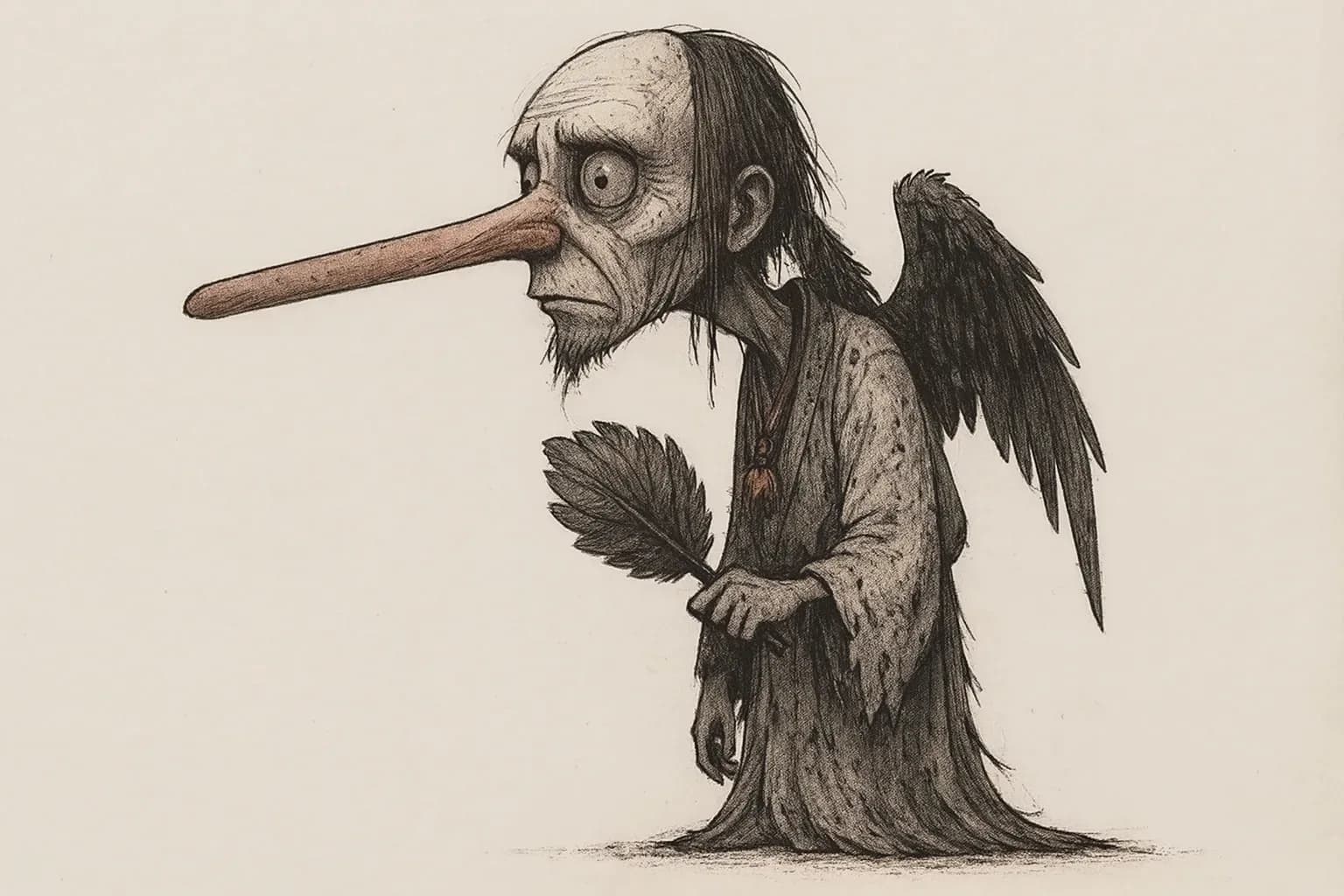
Picture a tengu and you see a red face with a long nose. Every festival mask has it. So why the nose?
For its first nine hundred years on record, the tengu had no long nose. It began as a noise in the sky. Then it became a bird. The long nose arrived late, around the 16th century. Even the famous story of who drew it first was written down long after.
In 637 the tengu was a falling star
The word first appears in the Nihon Shoki, Japan's official history, finished in 720. Its entry for the year 637 tells of a great star. It crossed the sky from east to west with a sound like thunder.
People said it was a shooting star. A monk said no. It was a tengu, he said, and the thunder was its bark.
The name means "heaven dog." It came from China, where it meant a falling star that brought bad luck. The old reading was amatsukitsune, "heaven fox." This tengu had no face at all. It was a light and a sound.
Heian tengu were kites
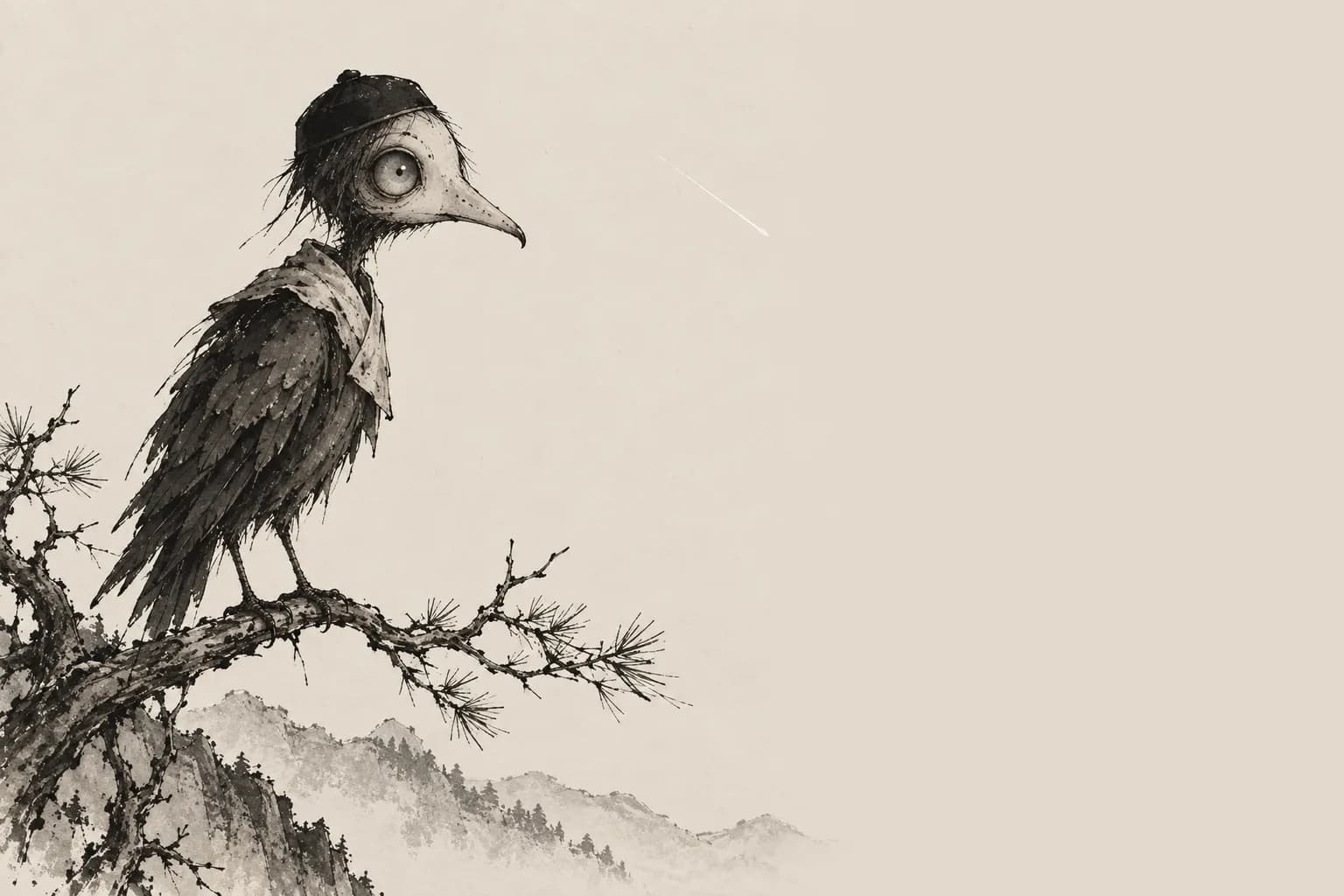
By the Heian period, the tengu had a body, and it was a bird's. People pictured it as a kite, the hawk that circles over Japanese towns. The Konjaku Monogatarishū, a 12th-century story collection, keeps showing tengu in bird form.
The old scrolls agree. Tengu have beaks, wings and claws. Some wear monks' robes over a bird's body. This is the form now called the karasu-tengu, or "crow tengu," though the bird was usually a kite.
The first long nose in 1296 was the odd one out
The Tengu Zōshi, a picture scroll from 1296, mocked the proud monks of seven great temples. It drew them as tengu. Most of its tengu still have beaks.
But the Mii-dera part of the scroll has a tengu with a high nose. Japanese reference works treat it as an early case. It did not catch on. In the late Kamakura period, the beaked tengu was still the normal one.
The famous painter's credit is a later story
The usual answer names one painter. Kanō Motonobu (1476–1559) led the Kanō school in the Muromachi period. Tradition says he was asked to paint a tengu and did not know how. Then a strange figure came to him in a dream, and he drew it.
The result is said to be the Kurama Daisōjōbō-zu, the great tengu of Mount Kurama. It is kept at Kurama-dera in Kyoto. Popular tradition calls it the first great tengu anyone imagined.
The weak point is the date of the story. The oldest record of it we could find is a painting manual by Ōoka Shunboku, printed in 1720. That is over 160 years after Motonobu died. Even his own birth year comes from Edo-period records.
Japan had long noses long before tengu did
The nose itself was not new. In 612, says the Nihon Shoki, a man from Baekje brought gigaku to Japan. This was a masked dance from the mainland.
One gigaku mask was the Chidō. It had a high nose and led the procession, clearing evil from the road. Masks used at Tōdaiji in 752 still survive in the Shōsōin storehouse.
The Nihon Shoki also describes the god Sarutahiko. His nose was seven hand-spans long. His eyes shone like a mirror. He stood at a crossroads and guided the gods down to earth.
Histories of gigaku say the Chidō role later turned into Sarutahiko, tengu and other long-nosed road-clearers. You can still see it today. At many shrine festivals, a man in a red long-nosed mask walks in front of the portable shrine. He plays Sarutahiko, but the mask looks like a tengu.
Two theories meet at the nose
So where did the tengu's nose come from? Scholars split into two camps.
The folklorist Gorai Shigeru linked it to masks like the Chidō. Katsumata Takashi and Sugihara Takuya disagree. They found no written link to the masks. They argue the nose is what is left of the beak.
They point to a medieval scroll, the Zegaibō-e. In one scene, a tengu in human shape turns back into a kite. Its nose stretches into the top half of a beak. Its jaw becomes the lower half.
The two ideas may not fight as much as they seem. A beak that was slowly turning human could take its shape from masks people already knew.
Pride came first, and the nose came after
Many pages say the long nose stands for pride. In Japanese, a proud person "has a high nose," hana ga takai. A person who gets full of himself "becomes a tengu," tengu ni naru.
The order is the other way round, though. Tengu meant pride long before they had noses. Medieval Buddhism added a "tengu realm" to the six realms of rebirth. Proud monks were said to fall into it. The Tengu Zōshi of 1296 mocked proud monks by drawing them as tengu, and most of them had beaks.
Reading the nose as a sign of pride is a later fit, like the ox-and-tiger story told about the oni's horns.
The red face and the monk's robes came as one package
The red face has no dated story of its own. We found no record that says when it began. It shows up together with the long nose, in the same late figure.
That figure came as a full outfit. It has a red face and a high nose. It wears the clothes of a yamabushi, a mountain monk. It stands on tall one-tooth sandals and holds a feather fan. Japanese sources say this whole package spread only in the early modern period.
The Muromachi-period tale Tengu no Dairi, about the young Yoshitsune visiting the tengu of Kurama, is said to have helped fix it. The monk's clothes were not new, either. The tengu had worn robes since the scrolls of the 1290s.
The beak became the servant
We checked our ledger of 327 entries. Only three have a long nose: the tengu, Sarutahiko and the goddess Amanozako. The other two are gods, not yokai. Sarutahiko is on record in 720, centuries before the long-nosed tengu.
The bird did not vanish. It moved down the ranks. The long-nosed tengu became the daitengu, the great leader. The crow tengu became the kotengu, the small tengu who serves him. The oldest face of the tengu now plays the follower.
| Form | Face | Rank today | Oldest dated sighting |
|---|---|---|---|
| Falling star | none | gone | 637, Nihon Shoki |
| Karasu-tengu | kite's beak | follower (kotengu) | 12th century, Konjaku Monogatarishū |
| Hanataka-tengu | red face, long nose | leader (daitengu) | 1296 as a rare case; the norm from the early modern period |
We cannot say who drew the first long-nosed tengu that stuck. The dated record only shows that the nose came last, and that the beak was there first.