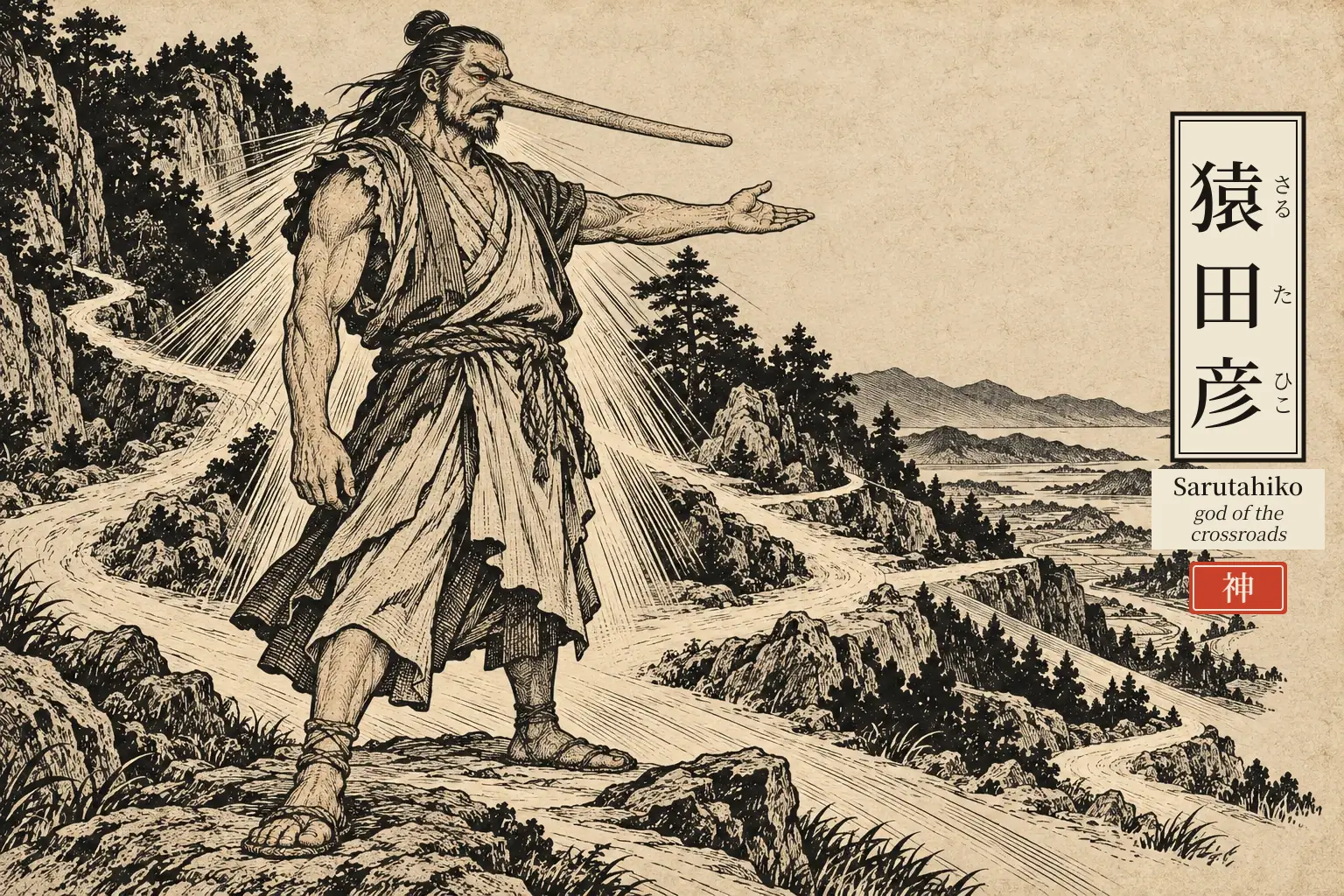
Before the sun goddess's grandson could set foot on earth, something was already standing at the crossroads, glowing. A figure stood where the path split into many branches. His light ran from heaven down to the human world below. The gods above sent someone to ask who he was. He answered, then went out to guide them down himself.
He guided gods down from heaven. Later, a shellfish drowned him. And from that drowning, three more gods were born.
This is Sarutahiko, written 猿田彦: 猿 (saru, "monkey"), 田 (ta, "field") and 彦 (hiko, "young man" or "prince"). He is a kami, not a yokai. His oldest record is not a woodblock print of monsters. It is Japan's two oldest surviving histories, the Kojiki (712) and the Nihon Shoki (720). Festival performers often play him in a red, long-nosed, tengu-like mask. Some festivals even identify that tengu with him. But in the myths he is an earthly kami (kunitsukami), not a mountain goblin.
What did he look like?
The Nihon Shoki gives him a real, measured body. His nose was seven ata long. An ata is the span from thumb-tip to middle-fingertip, hand stretched wide. His back was seven saka, a still larger old unit. His eyes shone like the sacred mirror Yata-no-Kagami. They also glowed red like an akakagachi, a bright nightshade fruit. He stood at the "heavenly crossroads." In the Kojiki, his light reached from the heavenly plain down to the earthly land below.
The god who was already there
Ninigi, grandson of the sun goddess Amaterasu, prepared to descend from heaven. Amaterasu and the god Takagi-no-Kami sent the goddess Ame-no-Uzume to ask the shining figure his name. Sarutahiko answered her, then went out himself to meet Ninigi's party. He led them down to earth.
The party arrived safely. Ninigi then told Ame-no-Uzume to escort Sarutahiko home. She was to carry his name afterward as her own. She became known as Sarume-no-Kimi. The Nihon Shoki tells this part slightly differently. There, it is Sarutahiko who asks her to see him home. Later tradition holds that the two married, though neither book says so outright. The Nihon Shoki also records a separate detail: when Ame-no-Uzume first confronted him, she bared her breasts and loosened her sash — a sexual gesture. Afterward Sarutahiko returned to his own country, Ise. He settled by the upper Isuzu River.
Drowned at Azaka, reborn three times
Sarutahiko's story does not end with the guiding. Later, he went fishing in the sea at Azaka, now part of Matsusaka in Mie. A shellfish called a hirafugai caught his hand. He drowned. Out of that single drowning, three gods were born: one as he sank, one as the bubbles of his breath rose, and one as those bubbles burst on the surface. Azaka Shrine, in Matsusaka, still enshrines Sarutahiko today.
Two other shrines claim pieces of this story as their own. Tsubaki Ōkami Shrine, in Suzuka, says Sarutahiko was buried there after the drowning. It treats a mound on its grounds as his tomb. Futami Okitama Shrine, in Futami, Ise, points to a sacred rock sitting in the sea within its grounds. Its own records call that rock the exact spot where Sarutahiko first touched down from heaven.
Accounts differ on what came after
Centuries later, two Kamakura-period shrine texts named Ōta-no-Mikoto as Sarutahiko's descendant. Ōta was the divine ancestor of an Ise priestly family. The Yamatohime-no-Mikoto Seiki tells how he guided the princess Yamatohime to the upper Isuzu River. That story is older. The Kōtai Jingū Gishikichō (804) already has Ōta showing her the site. But the 804 text never links him to Sarutahiko. A 2001 paper by Hōga Toshio argues the Kamakura-era link was added later. A famous ancestor, it argues, was grafted onto an existing family line.
A separate old source does not mention Sarutahiko by that name at all. The Izumo no Kuni Fudoki (733) gives Sada Shrine, in Matsue, its own god, Sada-no-Ōkami. He was born at a sea cave to the goddess Kisagai-hime. The text never calls him Sarutahiko. The scholar Hirata Atsutane later identified the two. In 1870 the Matsue domain ordered the shrine to name its god Sarutahiko. The shrine refused, and settled on another name, Sada-no-Miko-no-Kami. Today it does treat that god as Sarutahiko.
Where it comes from
One old description calls Sarutahiko "the god who illuminates heaven and earth." One theory reads that title as a memory of something older. Before Amaterasu, it holds, Sarutahiko may have been a sun god worshipped in Ise.
The scholar Kamata Tōji, in a 2006 paper, reads the story differently. He does not read Sarutahiko's work with Ame-no-Uzume as a betrayal by the local god. He reads it as a reconciliation, one that let a new order begin. In this view, Sarutahiko stands for something distinctly Japanese in spirit.
Whichever reading is right, the guiding is what stuck. He showed the heavenly party the way, and that one act defined him. From the medieval period, Sarutahiko was folded into the nationwide worship of road gods. He became identified with dosojin and sae-no-kami, the stone guardians set at crossroads and village boundaries. In that role he is usually enshrined together with his wife, Ame-no-Uzume.
Sarutahiko today
The identification runs even further. Shirahige Shrine, in Shiga, enshrines him as Shirahige Myōjin. Under that name he is worshipped at shrines nationwide. His name contains saru, "monkey." Because of that sound, later belief also tied him to Kōshin-kō, a vigil cult tied to "monkey" days. Accounts date this to the medieval or the Edo period. Aiki Shrine, built by aikido's founder Ueshiba Morihei in Ibaraki, treats him as Morihei's guardian deity.
At some shrine festivals, a man plays Sarutahiko and leads the portable shrine through the streets. He wears a bright red, long-nosed mask. He wears high wooden clogs and carries a hoko, a spear-like pole. The Menkake Gyōretsu parade, at Goryō Shrine in Kamakura, keeps this up. A god wears a tengu's face to do the job the myth gave him: standing where the road forks, and showing people which way to go.