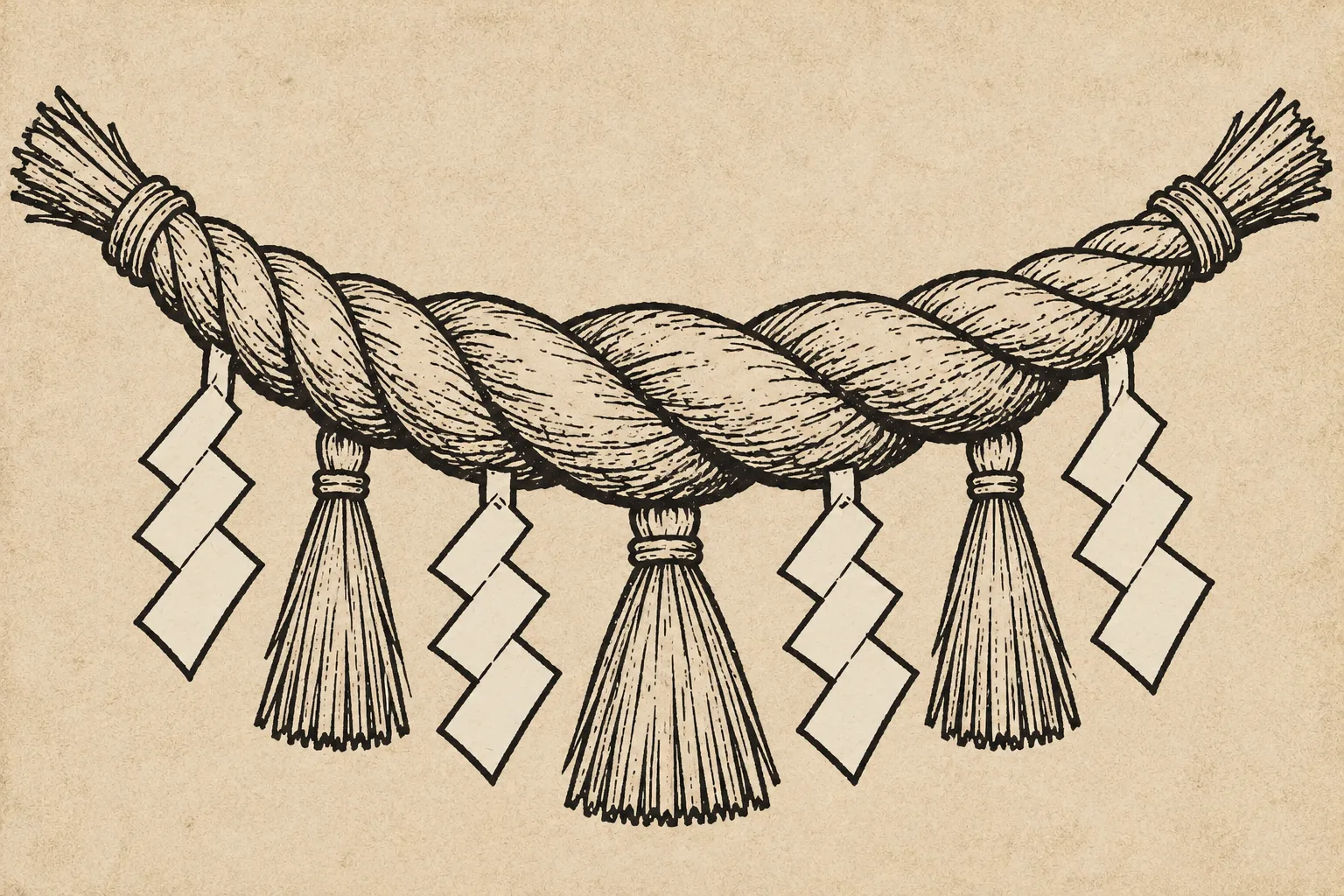
The rope that kept the sun goddess out
The Kojiki, written in 712, tells the story. The sun goddess Amaterasu hid in a rock cave, and the world went dark. A god took Amaterasu's hand and pulled her out. Then the god Futodama stretched a rope behind her. He warned her: "You cannot go back in."
That rope was called shirikumenawa. The Nihon Shoki, finished in 720, calls it "a rope with protruding ends." In one reading, the straw ends were left sticking out.
Why a rope?
Kokugakuin University's encyclopedia says shime once marked that something was taken. People used ropes to mark land they claimed. A rope was the most common way to show it.
What each part means
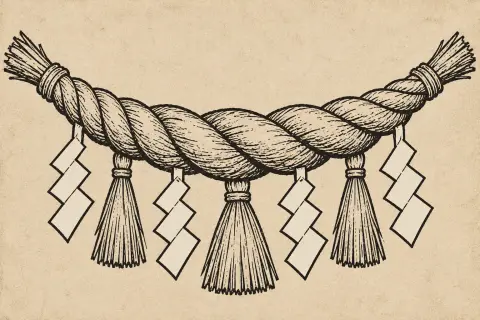
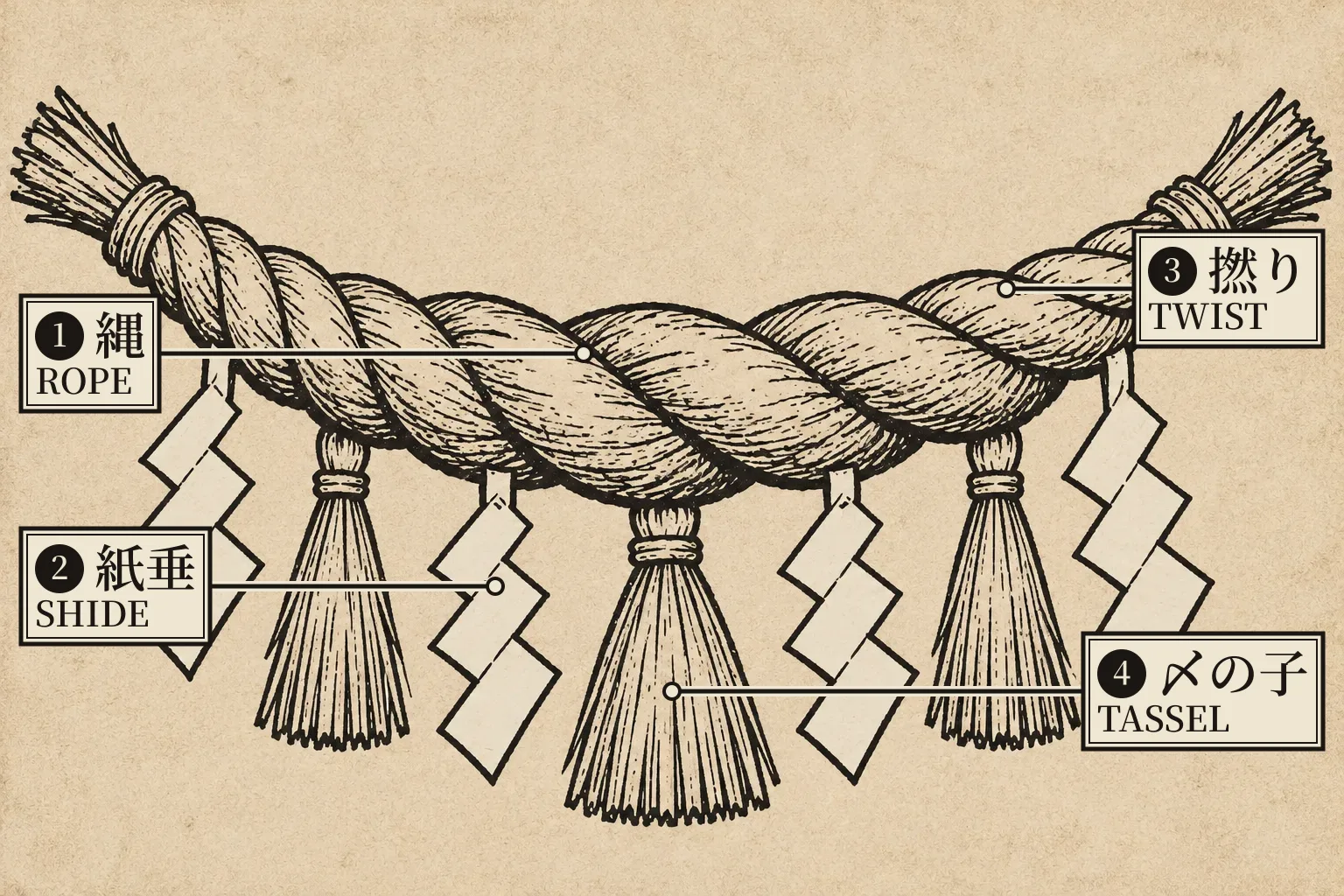 Our diagram. The table says what each part means, where a source says.
| # | Part | Why it looks like this |
|---|---|---|
| 1 | Rope | Fresh straw twisted into a rope. Ropes were the most common way to mark land someone claimed. (Kokugakuin) |
| 2 | Shide (paper) | Zigzag strips cut and folded from white paper. With the rope, they mark the space near the kami as pure. (Okayama Shrine Association) |
| 3 | Twist | The straw strands usually have a left-hand twist. Some local ropes join left- and right-twisted strands. (Kokugakuin, Okayama Shrine Association) |
| 4 | Tassels | Bundles of straw. Izumo Taisha's Saitama branch calls them shimenoko, and reads them as rain. (Izumo Taisha Saitama Branch) |
The zigzag paper
The white strips are called shide. Earlier shide used cloth made from paper mulberry fiber. Today most are paper, cut and folded so the outline steps down in a zigzag.
Izumo Taisha's Saitama branch reads the paper as lightning and the straw tassels as rain. Both, it says, carry a wish for a good harvest. It does not say when the zigzag shape began.
Three spellings, and the numbers 7-5-3
Three ways to write shimenawa are 注連縄, 標縄 and 七五三縄. The middle one, 標, means "a mark." The last one is written "seven, five, three."
Tamagawa University's museum says it refers to straw hanging in groups of three, five and seven. Kokugakuin's encyclopedia ties the numbers to counts of straw in the braiding. Accounts differ on the details.
Ropes on trees and rocks
You can see these ropes on sacred trees and rocks. Jinja Honchō says a rope around an object or a tree can mark the presence of a kami.
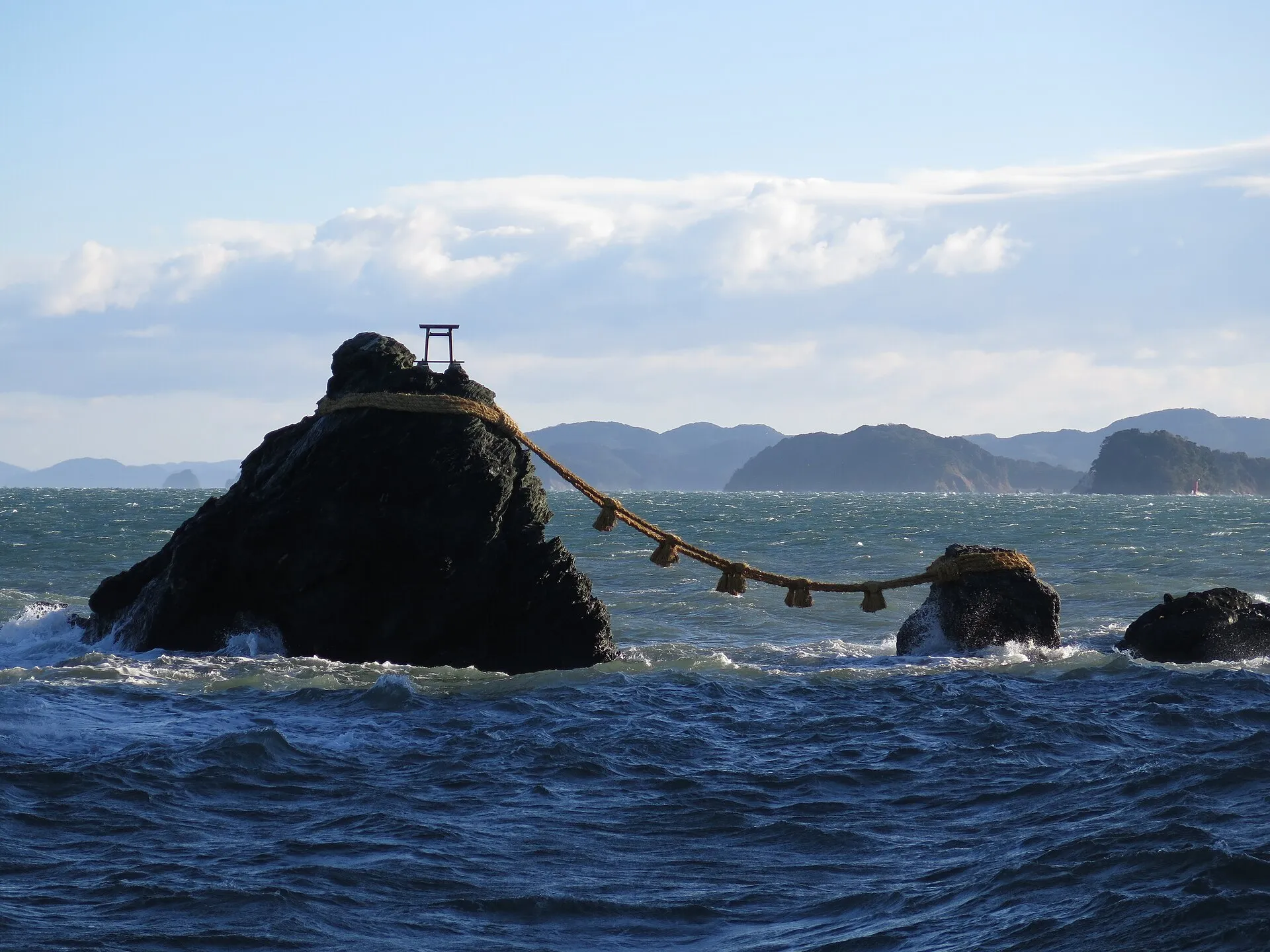 The Wedded Rocks at Futami, Mie Prefecture. Photo: Douglas Perkins, CC BY 4.0
At Futami, sacred ropes link two rocks in the sea, the Wedded Rocks. Futami Okitama Shrine calls the rope the boundary between the world of gods and the world of humans. Each rope is 35 meters long, but only 9 meters crosses the gap. The rest wraps around the two rocks. The shrine replaces the ropes three times a year.
Izumo's giant rope
Izumo Taisha's Kaguraden hall has one of the biggest shimenawa in Japan. The new rope went up on July 21, 2026, after eight years. Iinan Town, where it was made, puts the 2026 rope at 13.6 meters and 4.7 metric tons. Shimane's tourism report gives 13.5 meters.
A tapered rope has a thick start and a thin finish. Izumo Taisha says it hangs the thick end on the left, because it traditionally ranks that side higher.
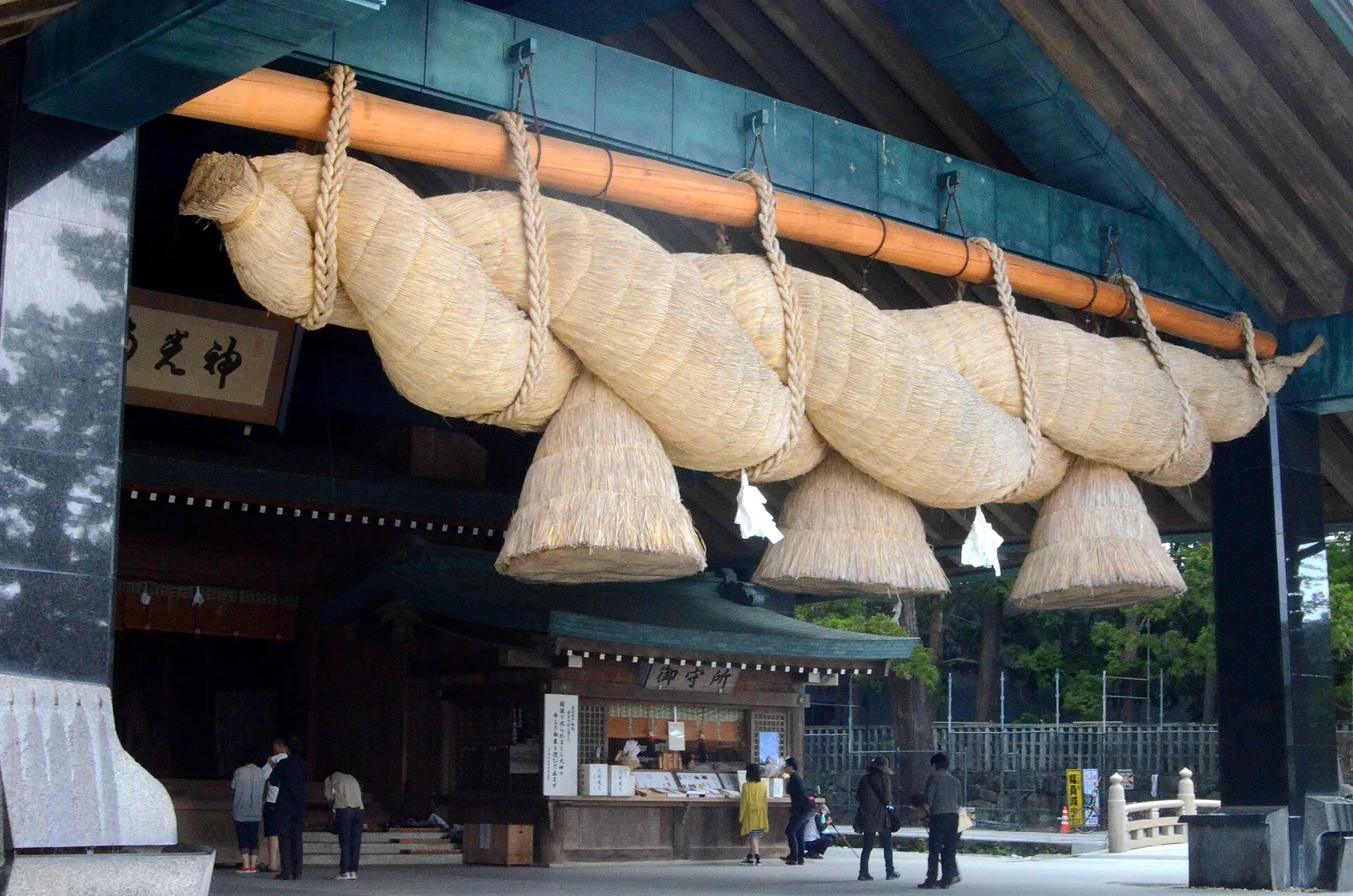 The Kaguraden rope at Izumo Taisha in May 2013, before the 2026 replacement. Photo: the.Firebottle, CC BY-SA 2.0
Frequently asked questions
Is the yokozuna's rope related to shimenawa?
The yokozuna's rope carries the same white shide paper. The Japan Sumo Association names a shrine shimenawa as one proposed origin, but calls the origin uncertain.
What about the New Year rope decorations?
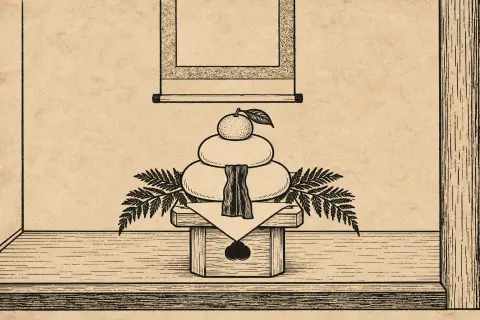
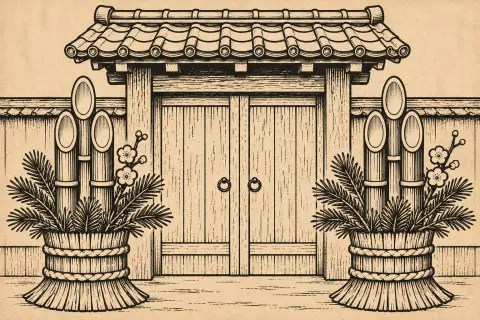
Shimekazari are decorated forms of the rope, hung at house entrances at New Year. Some add a bitter orange, kelp or a spiny lobster.
Sources
- Kotobank: 注連縄 (世界大百科事典, 精選版 日本国語大辞典)
- Kokugakuin University: Encyclopedia of Shinto: Shimenawa, Shide, museum object, Kojiki text and commentary, Nihon Shoki date
- Okayama Prefectural Association of Shinto Shrines, Q&A; Jinja Honchō pamphlet (PDF)
- Tamagawa University Museum of Education
- Futami Okitama Jinja: ropes, about
- Izumo Taisha: FAQ, Kaguraden; Saitama Branch; Iinan Town report
- Shimane tourism report; Japan Tourism Agency guide (PDF)
- Japan Sumo Association: the shide on the rope, the rope's origin