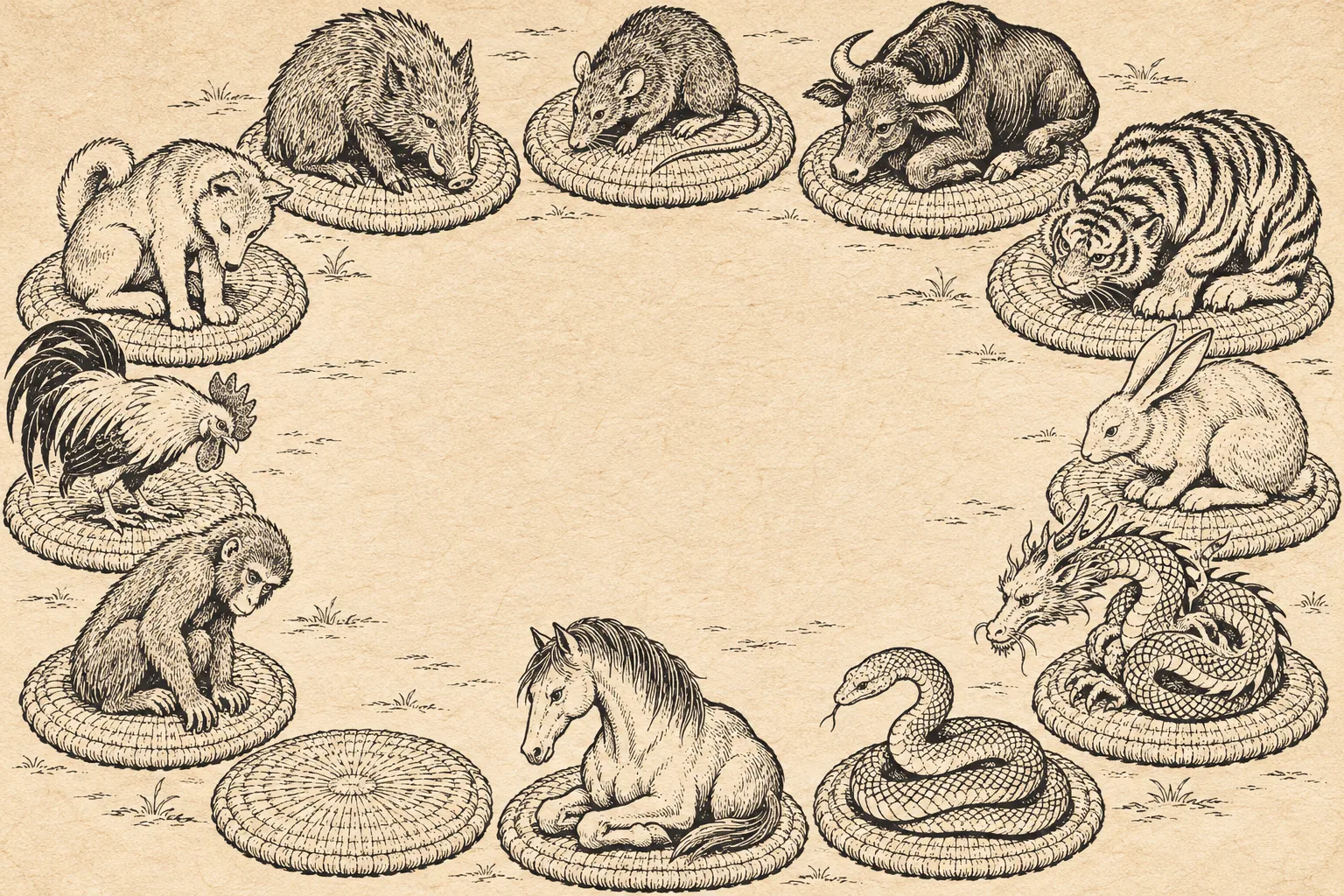
Japan has yokai foxes, cats, snakes, even a boar ghost. But 2027 is the Year of the Sheep, and Japan has no sheep yokai. We checked all twelve animals of the Chinese zodiac. Ten of them have a Japanese yokai. The rabbit has only a god and a few odd beliefs. The sheep has nothing at all.
For most of history, Japan had no sheep. A Chinese history book of the 3rd century, the Wei Zhi, already says so.
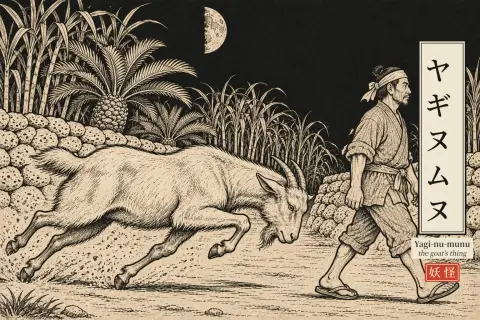
But where people kept goats, there are goat spirits. On Yoron, a small island far south of mainland Japan, a goat runs at you on the night road.
Find your sign below. Then read on for the strangest gaps. One is a rabbit that slips out of a locked box by moonlight.
Find your sign
In Japan, the zodiac year changes on 1 January, as it has since the 1873 switch to the Western calendar. China still uses Lunar New Year, so your Japanese sign can be a year ahead.
The last column says how close each yokai is to its animal. "The animal" means it is that animal. "Part of its body" means it only has, say, an ox's head.
| Sign | Years | Your yokai | What it is | Oldest record | How close |
|---|---|---|---|---|---|
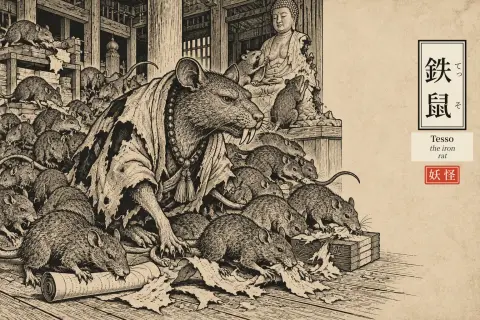
| Rat | 1984, 1996, 2008, 2020 | Tesso | A dead monk's grudge, back as a swarm of rats | War tales, 1300s. The name: 1776 | The animal |
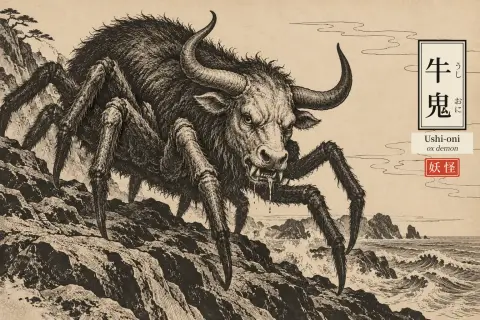
| Ox | 1985, 1997, 2009, 2021 | Ushi-oni | An ox-headed demon of western coasts | A court lady's notebook, about 1000 | Part of its body (the head) |
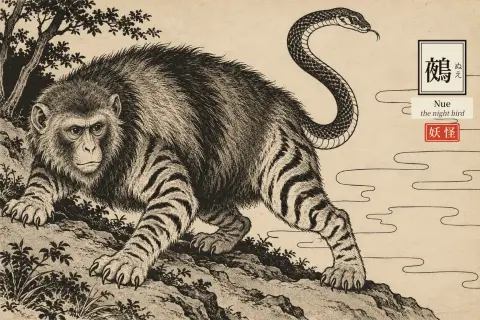
| Tiger | 1986, 1998, 2010, 2022 | Nue | A night beast shot down over the emperor's palace | A war tale, 1200s–1300s | Part of its body (the legs) |
| Rabbit | 1987, 1999, 2011, 2023 | No yokai. Closest: the White Hare of Inaba | A hare that tricks sea beasts. The oldest myths call it a god | 712 | The animal, but a god |
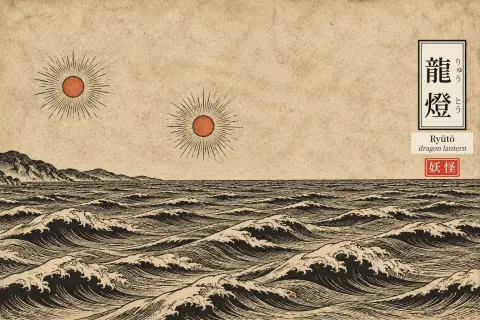
| Dragon | 1988, 2000, 2012, 2024 | Ryujin | The dragon god of a palace under the sea. A yokai cousin: Ryūtō, his lanterns | 712, under other names | The animal (a god) |
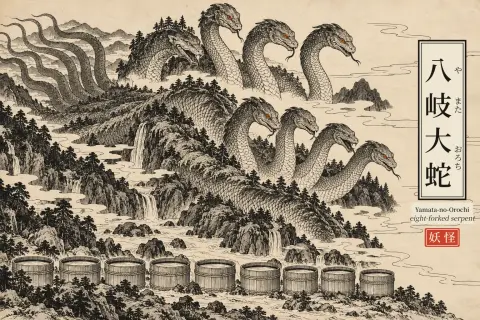
| Snake | 1989, 2001, 2013, 2025 | Yamata-no-Orochi | An eight-headed serpent, made drunk and killed | 712 | The animal |
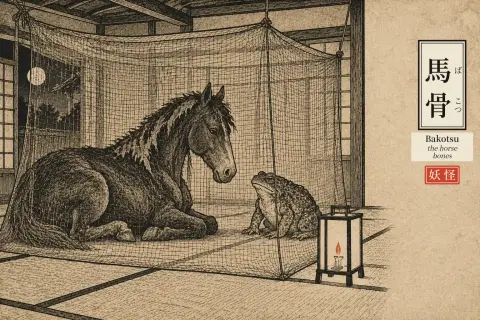
| Horse | 1990, 2002, 2014, 2026 | Bakotsu | The ghost of a horse that burned to death | A picture scroll, one copy dated 1859 | The animal |
| Sheep or goat | 1991, 2003, 2015, 2027 | No sheep yokai. Closest: Yagi-nu-munu | A goat that runs at you on a night road | 1961 | A goat, not a sheep |
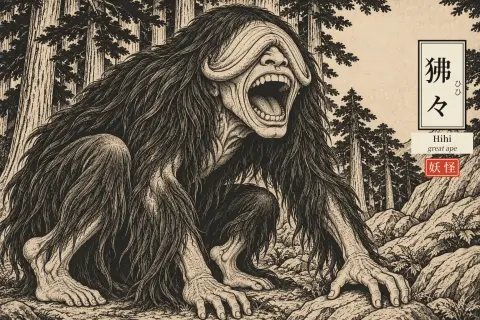
| Monkey | 1992, 2004, 2016, 2028 | Hihi | A giant mountain ape that laughs itself blind | As a girl-taking monkey god, about 1120. As "hihi", 1712 | The animal |
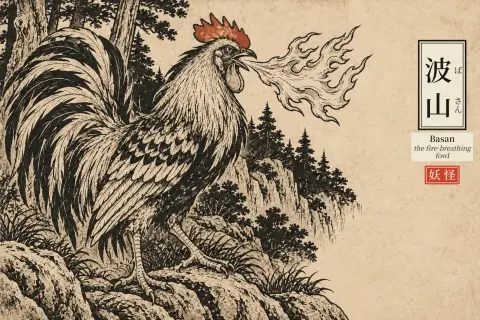
| Rooster | 1993, 2005, 2017, 2029 | Basan | A chicken-like bird that breathes cold fire | 1841 | The animal (a chicken-like bird) |
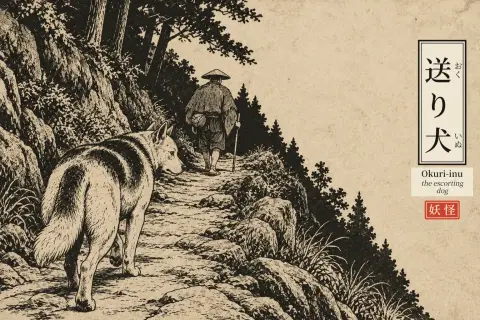
| Dog | 1994, 2006, 2018, 2030 | Okuri-inu | A dog that follows you on mountain paths | As a wolf, 1697 | The animal |
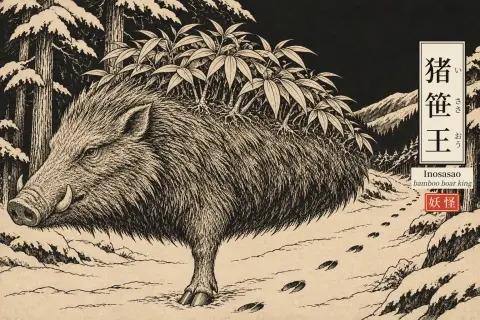
| Boar or pig | 1995, 2007, 2019, 2031 | Inosasao | A giant boar's ghost, free one day a year | A local history book, 1988 | The animal |
712 is the year of the Kojiki, Japan's oldest book. Its myths hold the hare, the sea god and the eight-headed serpent.
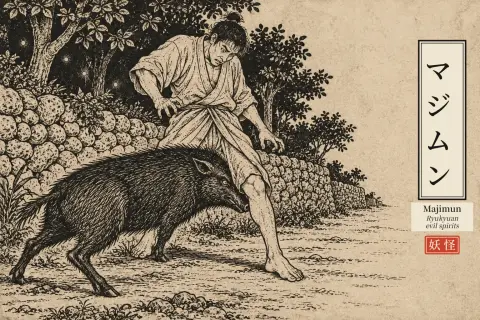
Your last sign may surprise you. In China, the twelfth animal is the pig. Japan uses the wild boar instead. Okinawa, in the far south, keeps a pig spirit too: a majimun that waits on dark roads.
Why Japan has no sheep yokai
Japan has no sheep yokai because almost nobody in Japan ever saw a sheep. The Wei Zhi describes the islands of Japan, and it says they had no sheep. Archaeologists have found no sheep bones there either.
In 599, Baekje, a kingdom in Korea, sent Japan two sheep. A camel and a donkey came with them. They were rare foreign gifts, like animals for a zoo. More sheep arrived as gifts in 820, 903 and 996. None of them took hold. Sheep farming began in earnest only in 1875, at a government farm near Tokyo.
Japan's biggest yokai database, run by Nichibunken, a national research centre, finds the word "sheep" four times. Two of those are goats. The others are a place and a whirlwind.
Goats were different. On the Amami Islands and in Okinawa, people kept goats. There, and only there, goat yokai appear. On Yoron, if the goat runs at you, stay silent. Never speak of goats, or bad luck follows. In Okinawa, a man once carried a "goat" home. It turned into a tree branch.
Our reading: many animal yokai are a familiar animal, met in the dark and not quite seen. You cannot half-see an animal you have never seen at all. The records do not say this. That step is ours.
Why does the goat count for 2027? The Chinese word for this sign covers both sheep and goats. That is why English says both "Year of the Sheep" and "Year of the Goat."
The rabbit lived in Japan, and still has no yokai
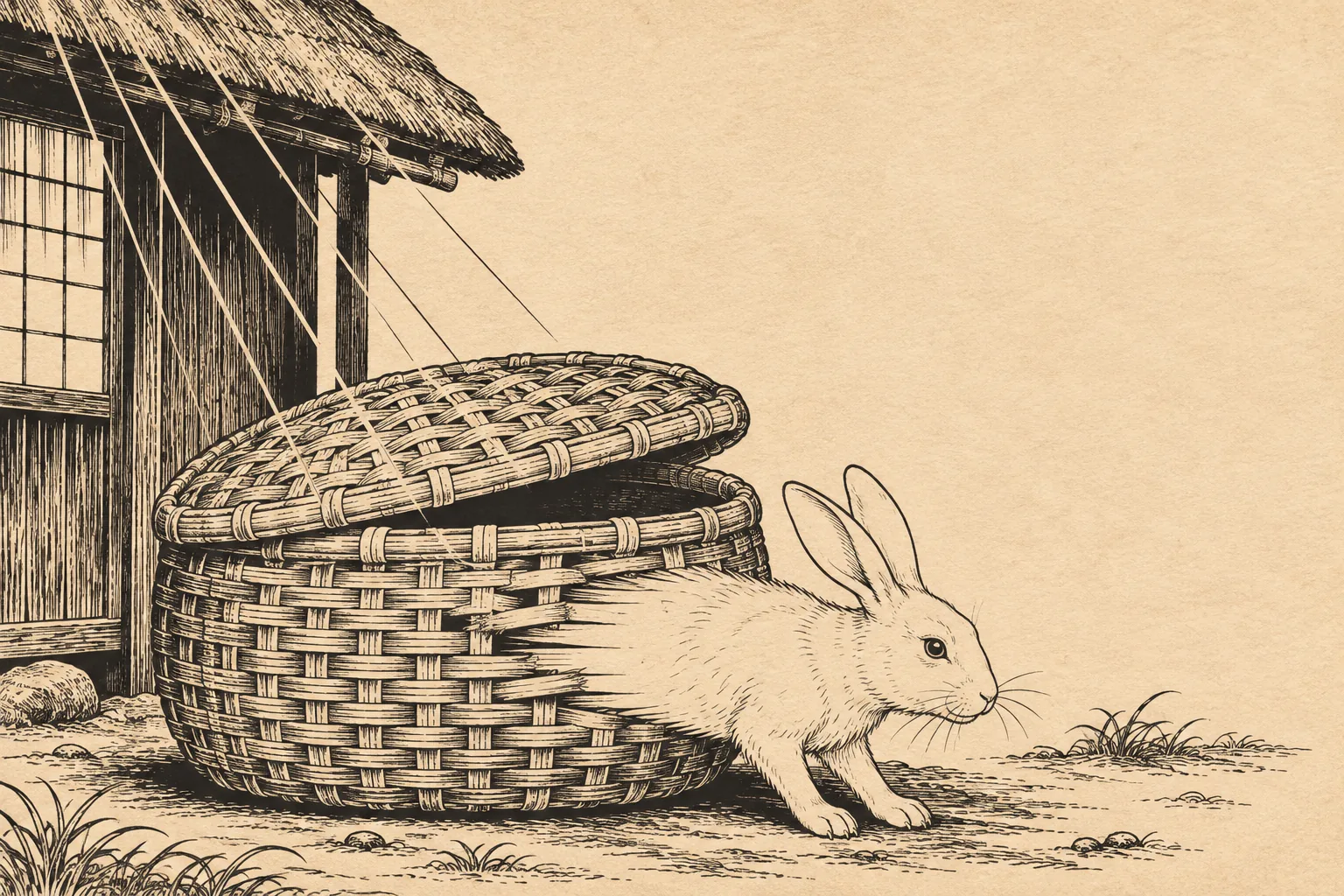 Our illustration.
The rabbit breaks the sheep rule. Wild hares lived in Japan all along. Yet the same database finds only 12 rabbit records by name. Snakes have 946.
The twelve are odd little beliefs, not monsters. A book from the Edo period (1603–1868), the Gūigusa, tells of rabbits kept in a fine-mesh cage. On a bright autumn moon night, they got out. They ran away across the river. The belief: in moonlight, a rabbit can change its body and slip through any gap. People in Gifu, in central Japan, still said so in 1941. A locked box could not hold a rabbit that saw the moon.
On Sakurajima, a volcano island in southern Kyushu, people called the rabbit O-mimi-naga-sama, "Honourable Long-Ears." They feared it as a god. Dream of a rabbit, and you fall ill. Eat one, and your stomach hurts. An Edo-period writer, Satō Chūryō (1762–1848), wrote this down.
In Chiba, near Tokyo, people even gave the wild hare another yokai's name, mujina. They said it threw sand at people. And in the mountains of Nagano, a three-eyed rabbit lives in one small wood. When it shows itself, something bad happens to the village. That is the closest Japan comes to a rabbit yokai.
Why tiger yokai came from books
Japan has no wild tigers. The first tiger in Japanese writing is in the Nihon Shoki (720), Japan's second-oldest history. In 545, a Japanese envoy, sent abroad by the court, kills a tiger that ate a child. It happens in Baekje, in Korea, not in Japan.
Tigers arrived as skins. A skin from overseas was rare and costly, so it showed rank. Court rules allowed tiger skins only to high-ranking nobles. People used them as charms against illness and curses. People even thought the leopard was the female tiger.
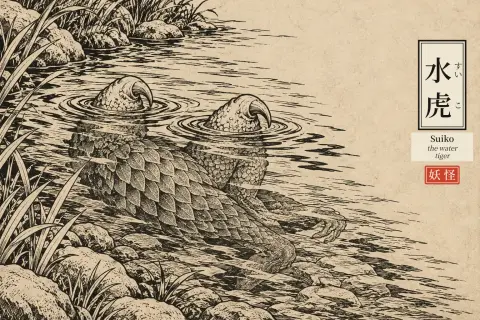
So Japan's tigers stayed on paper and in wood. The suiko, a "water tiger" with tiger claws on its knees, came from Chinese books. A carved tiger at Anrakuji, a temple north of Tokyo, was said to walk out at night and ruin the fields. So people cut off its back legs. No legs, no night walks.
Even the nue has only a tiger's legs. In 1850, a scholar named Asakawa Zen'an gave a reason. Old China gave each of twelve directions a zodiac animal, like the hours on a clock. That compass puts the tiger in the northeast, the snake in the southeast and the monkey in the southwest. So the nue's monkey face, tiger legs and snake tail come from three corners of that compass. That was his theory, not the old tale. The same compass dresses the demon in an ox's horns and a tiger skin: see why oni have horns.
A golden rooster crows on New Year's morning
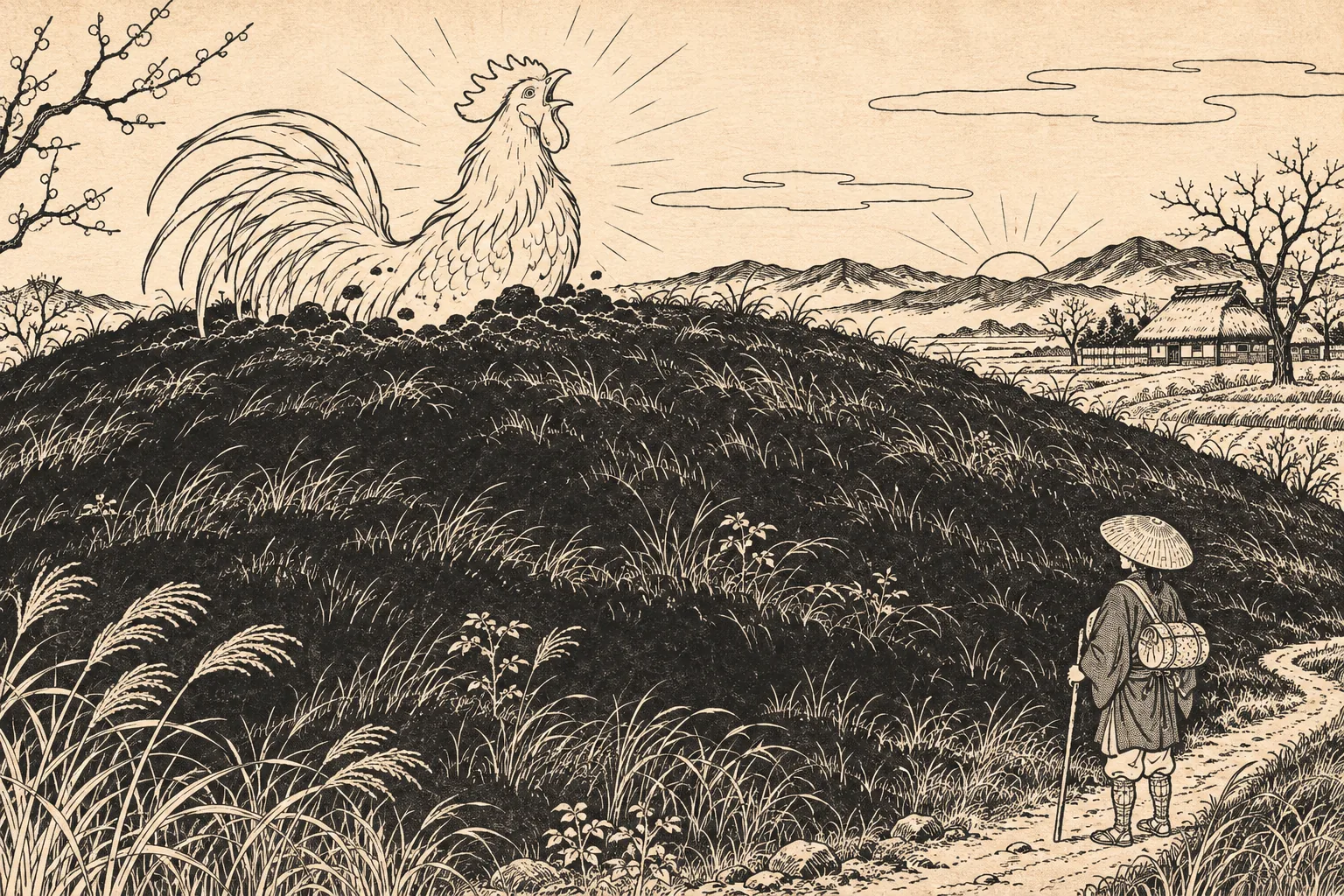 Our illustration.
The basan is a rooster yokai from a book of 1841. Folk records hold a far more common one: a golden rooster. It lies buried in an old tomb. A rooster crows at dawn. This one waits for the first dawn of the year, and crows only then. About 20 records tell of it.
What happens when you hear it depends on where you live. In Kameoka, near Kyoto, a 1936 record says it brings success. In Mitsue, a mountain village in Nara, a 1988 record says it brings death. Same bird, same morning, opposite luck.
In monkey-god tales, a dog saves the day
In Japan, the dog is the monkey's enemy, and old tales show it. The monkey poses as a god. Every year it asks the village for a girl. And almost always, a dog helps to stop it.
In a tale collection of about 1120, a hunter and a dog stop a monkey god in Mimasaka, in western Japan. In a legend that starts in 1308, a temple dog named Hayatarō kills a hihi. The hihi had posed as a god in Iwata, Shizuoka, and taken a girl each year. The dog came from Kōzen-ji, a temple in the mountains of Nagano.
Why a dog? A hunter's dog chases wild animals for him. Japanese even has a saying for two people who always fight: "like dog and monkey" (犬猿の仲, ken'en no naka). The monkey and the dog sit only two signs apart. If your sign is one of them, these tales are yours.
What we can say, and what we can't
- We can say: Japan had almost no sheep until 1875, and we found no sheep yokai. We found goat yokai only on islands that kept goats.
- We can't say: that the missing sheep caused the missing yokai. That link is our reading.
- We can't say: why the rabbit, which lived in Japan, never became a named yokai.
- We can't say: why the golden rooster brings success in one place and death in another, or why Japan swapped the pig for the boar.
- We can't say: how old Inosasao is. Its oldest record we found is from 1988.
- Our counts come from a name search. A full-text search might find more.
Meet your yokai
Each name in the table opens that yokai's full story. Born in 2007? Yours is a boar ghost that walks free every December 20. Born in 2003 or 2015? You get a silent goat on a night road.
Want a yokai that matches your personality, not your birth year? Try our quiz, Which Yokai Are You?