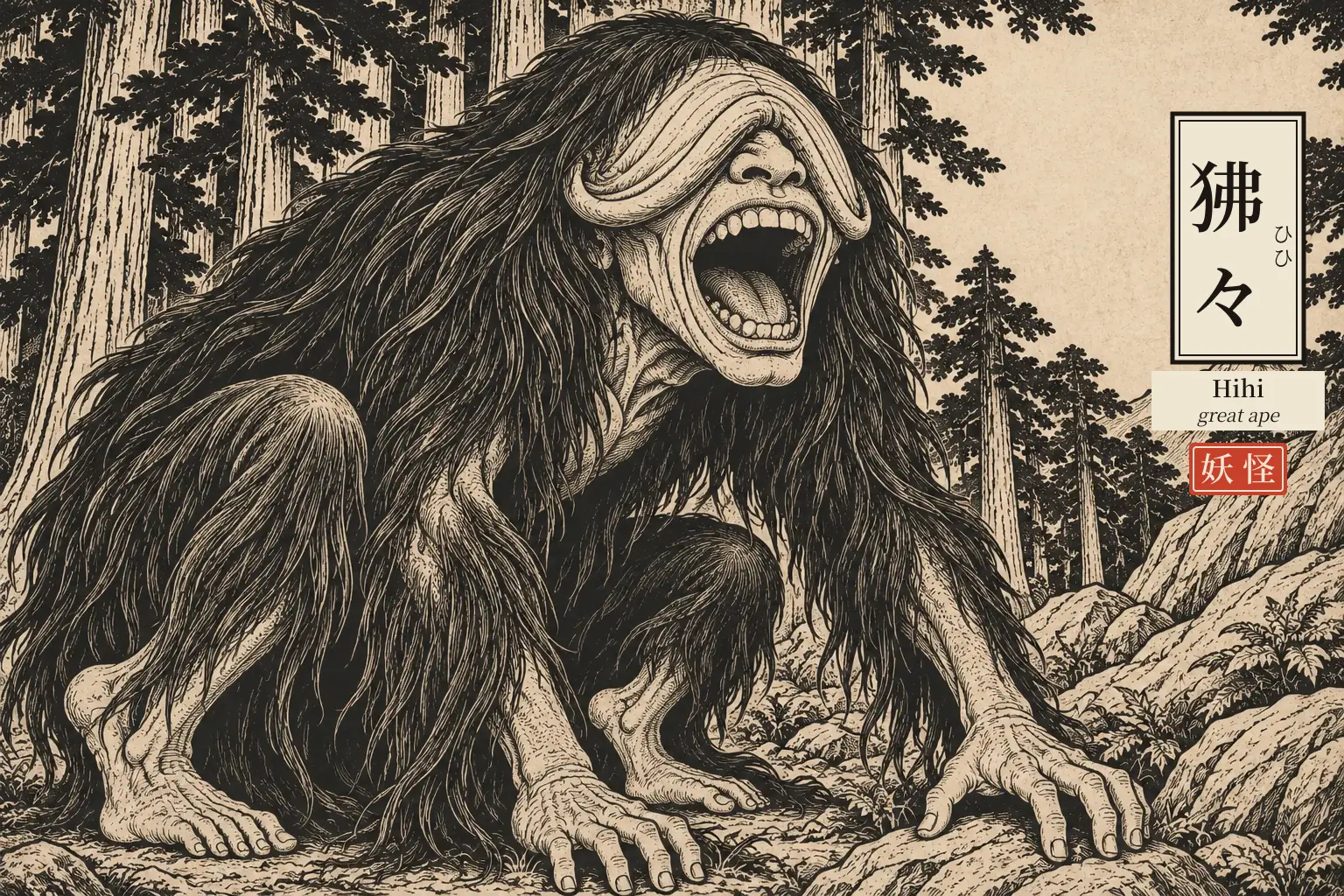
Deep in Japan's mountains lives an ape far bigger than any monkey. It has superhuman strength, and old tellings say it often drags off human women. Its name, 狒々, repeats one character twice: 狒, which on its own can simply mean "baboon." That double stutter may come from the creature's own voice. Hihi is famous for one habit above all others: when it sees a person, it bursts out laughing.
What does a hihi look like?
Most tellings picture the hihi as an oversized monkey, roaming the deep mountains on its own strength. Some stories go further, claiming an old monkey can grow into one over time. It lives deep in the mountains, far from people, and it is strong enough to overpower a person without much effort.
Its older ancestor comes from China. The Erya, an ancient Chinese dictionary, describes a creature with a human face, long lips, a black hairy body, and heels that bend backward. A separate old Chinese source gives it an even bigger scale: the largest stand over one jō tall, roughly three meters, covered head to foot in black hair. Japan's Edo-period encyclopedia, the Wakan Sansai Zue, repeats this description from a Chinese natural history text. It adds that the creature can speak human language, foretell whether a person will live or die, and that its long hair makes good wig material.
Another detail: hihi blood is said to run a deep scarlet. Dye cloth with it, and the color never fades. Drink the blood, and a person gains the power to see oni.
The laugh that gives it away
For all its strength, the hihi has one fatal weakness. Yanagita Kunio's folklore collection Yokai Dangi explains it plainly. The hihi is fierce by nature, but the moment it sees a human, it laughs out loud. Its lips curl up so far that they cover its own eyes.
That single second is the creature's downfall. Catch it laughing, with its lips over its eyes, and you can stab its forehead with an awl before it sees you coming. One theory holds that the name hihi comes directly from the sound of that laugh.
Two hihi on record
Yokai Dangi does not treat the hihi as pure legend. It records two supposed captures, with dates and measurements.
One was taken in Echigo province, now Niigata, in 1683. It measured about 1.45 meters long. A second was caught in Izu, now part of Shizuoka, in 1714. This one was larger: roughly 2.36 meters from end to end. Whatever these animals actually were, someone wrote down their size as if measuring real catches, not telling a ghost story.
A fight in the mountains
One story from the Hida mountains, in the Japanese Alps of Toyama, turns the hihi into a real threat rather than a punchline.
A local logging boss, known for killing bears and monkeys with his bare hands, was working with a young companion. A storm blew up without warning, and a hihi-like creature seized the young man, trying to lift him into the air and tear him apart. The boss grabbed hold and pulled back. The two wrestled in a tug-of-war that lasted long enough to exhaust them both. Only when the boss swore to kill the creature in return did it finally let go and vanish into the trees.
The dog that killed a hihi
A shrine and a temple each keep their own hihi-slaying legend, with heroes of a different kind.
At Soshino Hachimangu, a shrine in Gero, Gifu, the hero carries a blade. Local tradition says a hihi once terrorized the area, until a warrior cut it down with a sword in 1159. The shrine still keeps that sword, called Soshinomaru, and it was founded in 1181 specifically to honor the kill.
At Kozen-ji temple in Komagane, Nagano, the hero has four legs. A dog the temple raised from a puppy is said to have killed a hihi in 1308. That hihi had been posing as a god at a shrine in what is now Iwata, Shizuoka, and demanding a girl in yearly sacrifice. The dog is called Hayataro at Kozen-ji itself, and Shippei Taro in the version of the story told where the sacrifice happened.
Where it comes from
The hihi's roots sit outside Japan entirely. Old Chinese texts describe a giant, man-faced ape living in the far south. Japan's own scholars imported that description wholesale through encyclopedias like the Wakan Sansai Zue. But Japan had no real apes to match it.
One theory holds that the description simply landed on the wrong animal: an unusually large monkey living deep in the mountains. The laughing, the strength, and the taste for human victims may all be details borrowed from a creature that was never native to begin with.
The hihi gets mixed up with other mountain spirits, too. One idea traces the word yamawaro, "mountain child," back to an older phrase meaning "the thing that laughs in the mountains" — a description that fits the hihi just as well. Storytellers have also linked it to saru-gami, a monkey god said to demand a human woman as yearly sacrifice, and noted that its mind-reading trick resembles the satori, another mountain-dwelling yokai.
See the original print
Toriyama Sekien drew Hihi in Konjaku Gazu Zoku Hyakki (1779). This book has that picture, with its caption in English.
- Japandemonium Illustrated: The Yokai Encyclopedias of Toriyama Sekien →trans. Hiroko Yoda & Matt AltThe complete Edo-period bestiaries that so many of these entries trace back to, in full English translation.
- The Book of Yokai →Michael Dylan FosterThe most readable scholarly introduction to yokai — where they come from, what they mean, and the major creatures.
Some links are affiliate links; if you buy through them we may earn a small commission at no extra cost to you.
Hihi today
In 1877, the American zoologist Edward S. Morse excavated the Omori shell mound in Tokyo and turned up bones that looked like they came from a large ape. Curious, he went looking through old Japanese records for any mention of oversized monkeys. He found the hihi legends instead, and floated an idea of his own: that the bones in his hands might be hihi bones.
No one ever confirmed it. The bones stayed bones, and the hihi stayed a story — one more mountain legend that a scientist, for a moment, took seriously enough to check.