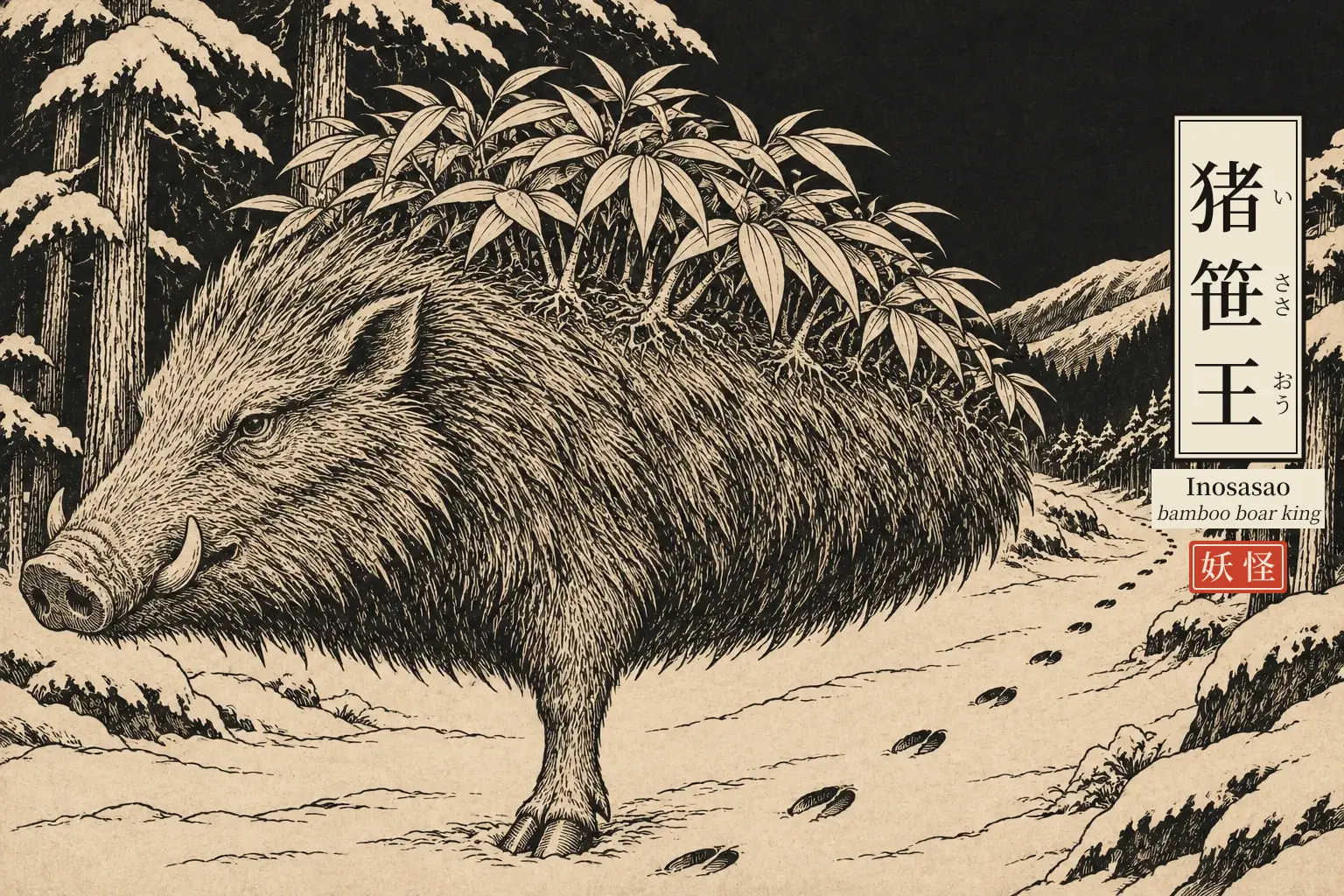
Mount Obagamine sits deep in Nara's Kii mountains. Local tradition still treats one day there as dangerous. That day is called Hate no Hatsuka, roughly "the last twentieth." It belongs to Inosasao (猪笹王). The name reads straight off its old body. 猪 (i, "wild boar") + 笹 (sasa, "bamboo grass") + 王 (ō, "king"). Together they spell a boar king, with bamboo growing on its own back. A hunter killed that boar once. Its ghost did not stay put.
What does Inosasao look like?
The core story describes Inosasao as a huge wild boar. Low bamboo grass, called kumazasa, grew straight out of its back. A hunter shot it dead on Obagamine. Its ghost rose again as a one-legged oni. It attacked people crossing the pass.
Local tellings of Obagamine's one-legged ghost go under one broader name: ippon-datara (a one-legged yokai). They do not always agree on how it looks. One account pictures something closer to a utility pole, fitted with eyes and a nose. On snowy days it somersaults through the air. It leaves behind a single footprint. That same account calls the figure frightening, but harmless to people. It is a gentler picture. It sits uneasily beside Inosasao's reputation for attacking travelers. Accounts differ on just how dangerous this ghost really is.
A separate telling comes from the Hatenashi mountain range, on the border with Wakayama. There, the one-legged ghost has eyes like plates. It keeps the same December 20 taboo. It even keeps the same name, Hate no Hatsuka. But it belongs to a different peak entirely.
Not every version agrees on what Inosasao even used to be. In Kashiwagi, a village inside Kawakami, people call the same figure Ippon-ashi. They say its earlier body was an old cat, not a boar.
A spell with one loophole
After the ghost began attacking travelers, a high priest sealed it away. The attacks stopped. But the seal came with one condition. Once a year, on December 20, Inosasao would be set free again. That is why the mountain is still watched on that single day. It is also why the date keeps its own name, Hate no Hatsuka.
The fear reached beyond Obagamine itself. In Nakaryūmon, a village now part of Yoshino town, people kept a Setsubun custom. Setsubun is a festival marking the end of winter. The custom was hanging a roasted sardine head on a thorny branch, at the front door. This custom was done to keep Ippon-ashi away.
The ghost that went to a hot spring
One story follows Inosasao's ghost off the mountain entirely. Disguised as a wandering warrior, it traveled to Yunomine Onsen. This hot spring sits in what is now Tanabe, Wakayama. It went there to take the waters. The innkeeper looked into its room. Instead of a guest, he found it packed with one enormous, sleeping boar.
Where it comes from
Japan has many one-legged ghosts like Inosasao, under names such as Ippon-ashi or Yuki-nyūdō. Most are tied to the same small piece of evidence. Someone finds a single footprint-shaped dent in fresh snow. It is usually the morning after a storm. Scholars connect the whole family to an older tradition. In that tradition, mountain gods and roadside guardian deities have a sacred body with only one leg. Seen that way, Inosasao looks less like a new invention. It looks more like a local memory of that same one-legged god. Some writers also note a resemblance to Sanshō, a one-legged creature from older Chinese sources.
A separate folk theory links the Obagamine ghost to Tatekurikaeshi. Tatekurikaeshi is a pestle-shaped yokai from Kochi. It is said to roll down roads at night. Another account traces its origin differently. It was once the horse of the warrior Minamoto no Yoshitsune. Turned loose in the mountains, it changed into the creature. The sources do not settle on one version. What they agree on is simpler. Local tradition still treats that pass as dangerous, one day a year.
Inosasao today
Inosasao has stayed almost entirely local. Since 2005, a craft workshop in Yoshino has sold a kokeshi. A kokeshi is a turned wooden doll. This one is called the Ippon-ashi Datara Kokeshi, built around this same legend and sold as a yokai souvenir. Away from that one shop shelf, the story still belongs mostly to the mountain itself, and to one date on its calendar: December 20.