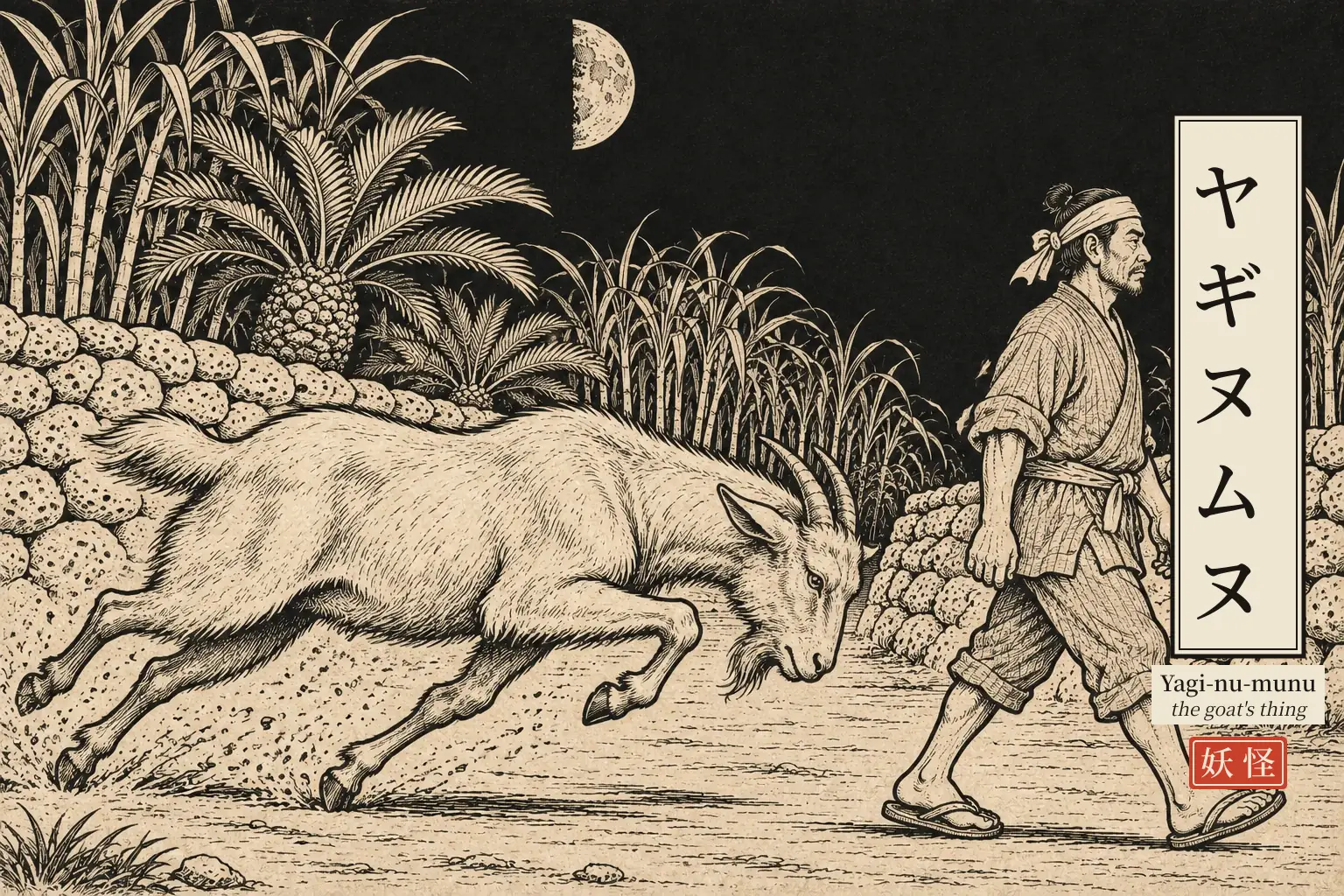
On Yoron Island, the southernmost of the Amami Islands, there is a thing that waits on the night road. It is shaped like a goat. It has no clear purpose. It simply jumps out, runs straight at whoever is passing, and gives them one single rule to follow. Break it, and something bad happens. Keep it, and the goat leaves you alone.
Its name is yagi-nu-munu — in the island's own speech, "the goat's thing." Yagi is the ordinary Japanese word for goat. Munu is the local word for "thing," close to the standard Japanese mono. Put together, the name doesn't call it a spirit, a demon, or a god. It calls it a thing, the way you'd describe something you saw but couldn't explain.
What does it look like?
The only description that survives is the shape: a goat. Nothing is recorded about its size, its color, or anything else about its body. What is recorded, in detail, is what it does. It rushes toward a person on the road as if it is about to collide with them. It never actually does.
That one detail — close contact, no actual harm — is the whole shape of the encounter. The danger in this story isn't the goat's teeth or horns. It's what a startled person might do next.
The rule of silence
The record is short and specific, and worth repeating almost whole: a person who meets the yagi-nu-munu must pretend not to have seen it. Walk past without a word, and nothing happens, even if the goat comes charging straight at you. But cry out in fright, or say anything at all about goats, and misfortune follows.
This is a strange kind of monster. It isn't attacking you — your own reaction is what decides the outcome. The goat does the frightening part, the sudden rush on a dark road, and the human has to supply the self-control. Scream, and you've done the damage yourself.
It's easy to imagine how a real goat, loose after dark on an island without streetlights, could read as something else charging at you. The rule — don't react, don't speak of goats — turns an ordinary startle into something with consequences, and gives islanders a ready answer for why some people had bad luck after a night walk and others didn't: they talked about it afterward.
Where it comes from
The only source for the yagi-nu-munu is a single academic paper: Tabata Hidekatsu's "Amami no yōkai ni tsuite" ("On the Yōkai of Amami"), published in 1974 in Ryūdai Shigaku, the history journal of the Ryukyu University History Society. Tabata's paper records the yagi-nu-munu in a few sentences, as one entry among many Amami beliefs, with no further elaboration — the note is the whole tradition as it survives in writing.
Night-road apparitions that respond to a traveler's own reaction, rather than attacking outright, turn up elsewhere in Japanese folklore too — the okuri-ōkami, a wolf said to follow travelers on mountain roads, is one well-known type. The yagi-nu-munu reads as Yoron's own local answer to that same old worry about walking home after dark.
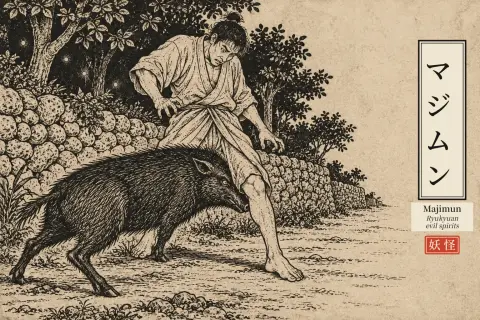
Nothing here claims the yagi-nu-munu is formally one of the majimun, the broader Ryukyuan word for the region's evil spirits and omens. Tabata's record simply calls it by its own name. But it belongs to the same stretch of the Amami and Okinawa islands where majimun stories are told, and some majimun share a similar pattern: an animal on the road at night, with its own rule for surviving it.
Yoron itself is a small coral island at the far southern edge of Kagoshima Prefecture, closer to Okinawa than to the Japanese mainland — close enough that its folklore sits between the two traditions. Goats are said to have long been kept there as livestock, which may be exactly why the island's own night-road spirit took a goat's shape rather than a dog's or a wolf's, the animals more usually blamed elsewhere in Japan.