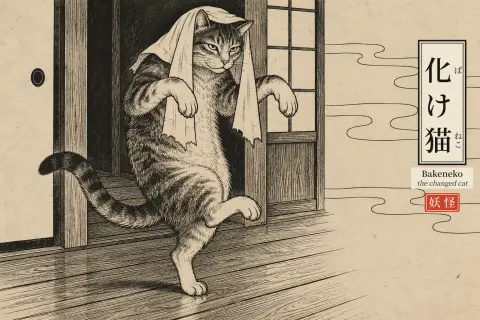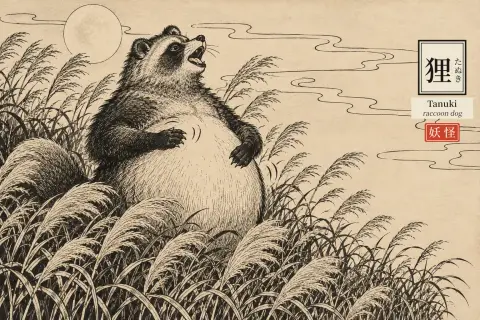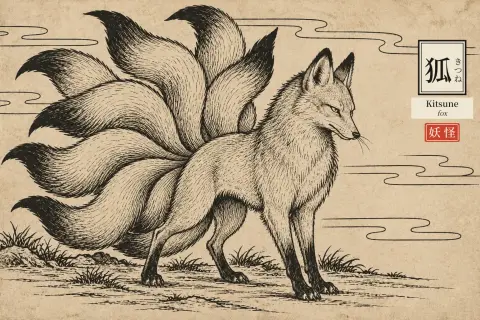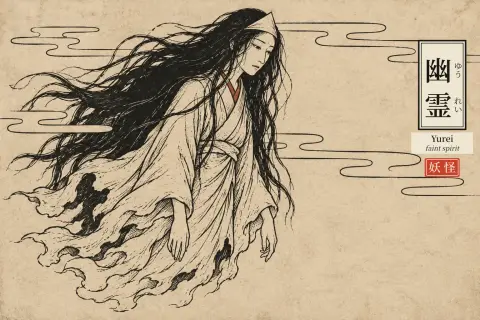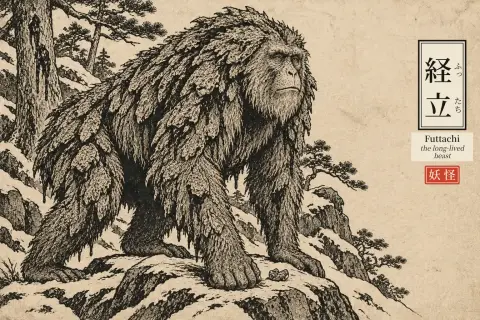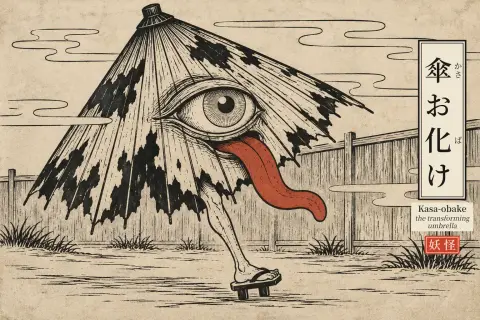
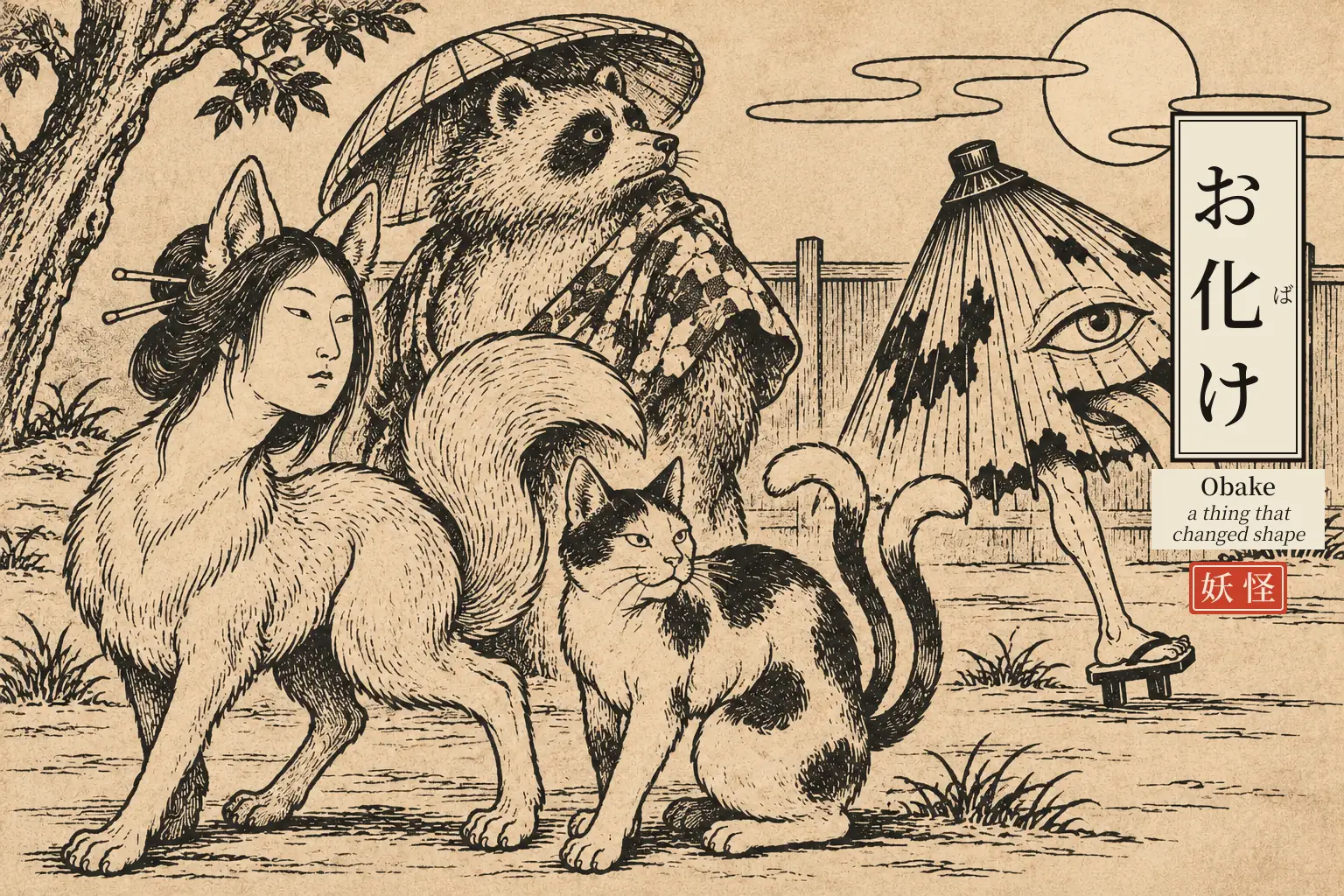
Ask a Japanese speaker what an obake is, and they won't describe one creature. They'll shrug and list several: a fox wearing a human face, a cat with a forked tail, an umbrella that grew a leg. Obake doesn't name a monster. It names a condition: something that stopped being what it was supposed to be. A fox is not supposed to look human. An umbrella is not supposed to walk. Anything caught doing that earns the label.
Not a creature. A category
The root is the verb bakeru, "to change into something else." Add the polite prefix o- and the noun ending -ke, and you get obake: roughly, "a changed thing." In practice, the word covers two quite different groups. One is shapeshifting animals, like the fox (kitsune) and raccoon dog (bake-danuki). The other is objects that woke up after years of neglect, the tsukumogami (付喪神), "tool spirits," like the umbrella kasa-obake and the paper lantern chochin-obake. Japanese reference works group both by name: any yokai with "bake" built into it, from bake-neko (the transformed cat) to bake-gani (a monstrous crab), counts as one of the family, whatever tradition it actually grew out of.
A blob with a face, and no feet
Obake is so generic that it has its own default picture, used only when no specific creature is named. Drawn with no particular shape in mind, an obake becomes a plain white, balloon-shaped body with a round, friendly face and simple hands. Much like the Western Halloween ghost it resembles. It is usually drawn with no feet at all, the same convention Japanese art uses for a yurei, a ghost. The two words overlap in speech, too: the dictionary definition of obake lists bakemono, yokai, henge, and yurei together as near-synonyms, even though folklorists have spent decades trying to keep the last one separate from the rest.
A word older than you'd think
The oldest form of the word is bakemono (化物), not obake. It shows up in Ariake no Wakare, a tale from the late 12th century, in a line that reads, roughly, "it felt as though even my mother had turned into a bakemono." The polite short form obake is newer, first attested in the Edo period (1603-1868). Dictionaries first cite it for the "monster" meaning in an 1881 kabuki play, where a rumbling sound makes a character ask if an obake is coming out. Before that, it meant something else entirely: a comic novel from 1809-13 puns on obake as a patched-up scrap of old cloth, and one from 1857 uses it for anything bizarrely oversized, like an enormous helping of rice. That oversized sense survives today in phrases like obake-kabocha, a giant pumpkin.
Obake or yurei? A rule, and its exceptions
The folklorist Yanagita Kunio tried to draw a clean line between the two, in his 1956 book Yokai Dangi (妖怪談義). An obake, he said, is tied to a place. It shows itself to anyone who happens to pass, usually at dusk or dawn. A yurei is tied to a person. It travels to find them, and it comes at the Hour of the Ox, roughly 2am. A good obake, Yanagita joked, would never appear in total darkness: bad for business if nobody can see you.
The rule does not survive contact with Japan's most famous ghosts. Okiku, the servant who counts plates forever at the bottom of a well, is bound to a single place, exactly like an obake. Most tellings still call her a yurei. Oiwa, from the kabuki play Yotsuya Kaidan, ignores the Hour of the Ox completely: she shows up at her husband's wedding in broad daylight. Otsuyu, the ghost of Botan Doro (the Peony Lantern story), follows almost none of Yanagita's rules and fits neither box cleanly. Three of Japan's best-known ghosts all break the rule in one way or another. For the fuller comparison, see our guide on yokai versus yurei.
When obake means something else
One older use of the word has nothing to do with monsters at all. A magazine from 1899 describes a Setsubun custom, on the day marking winter's turn to spring: old women in the city dressed up as young girls and called it "obake." The idea, by one modern account, was to dress differently than usual and startle off the oni said to wander on Setsubun night. Ordinary households once did this. Today it survives mostly in Kyoto's hanamachi, its geisha districts: on Setsubun, geiko and maiko, Kyoto's professional entertainers and their apprentices, dress up in Gion and put on a show of disguise that has mostly disappeared everywhere else.
Obake today
The word still does ordinary work in modern Japan. A haunted-house attraction is an obake yashiki. A long-running hit television show gets called an obake bangumi, "a monster of a program," using the same "abnormally large" sense the 1857 comic novel did. The word has even crossed into English-language gaming: the horror game Phasmophobia added a ghost type simply named "Obake" in its October 2021 update, alongside new types named Onryo, The Twins, and Raiju. One new way to die in a haunted house, named after a word whose older form was already in writing eight hundred years ago.