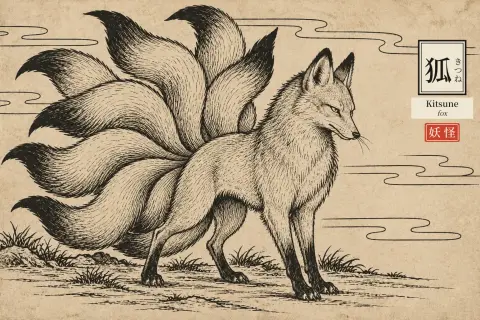
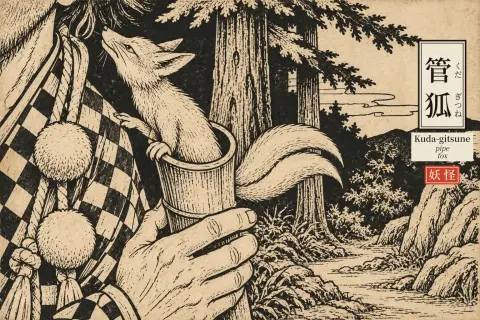
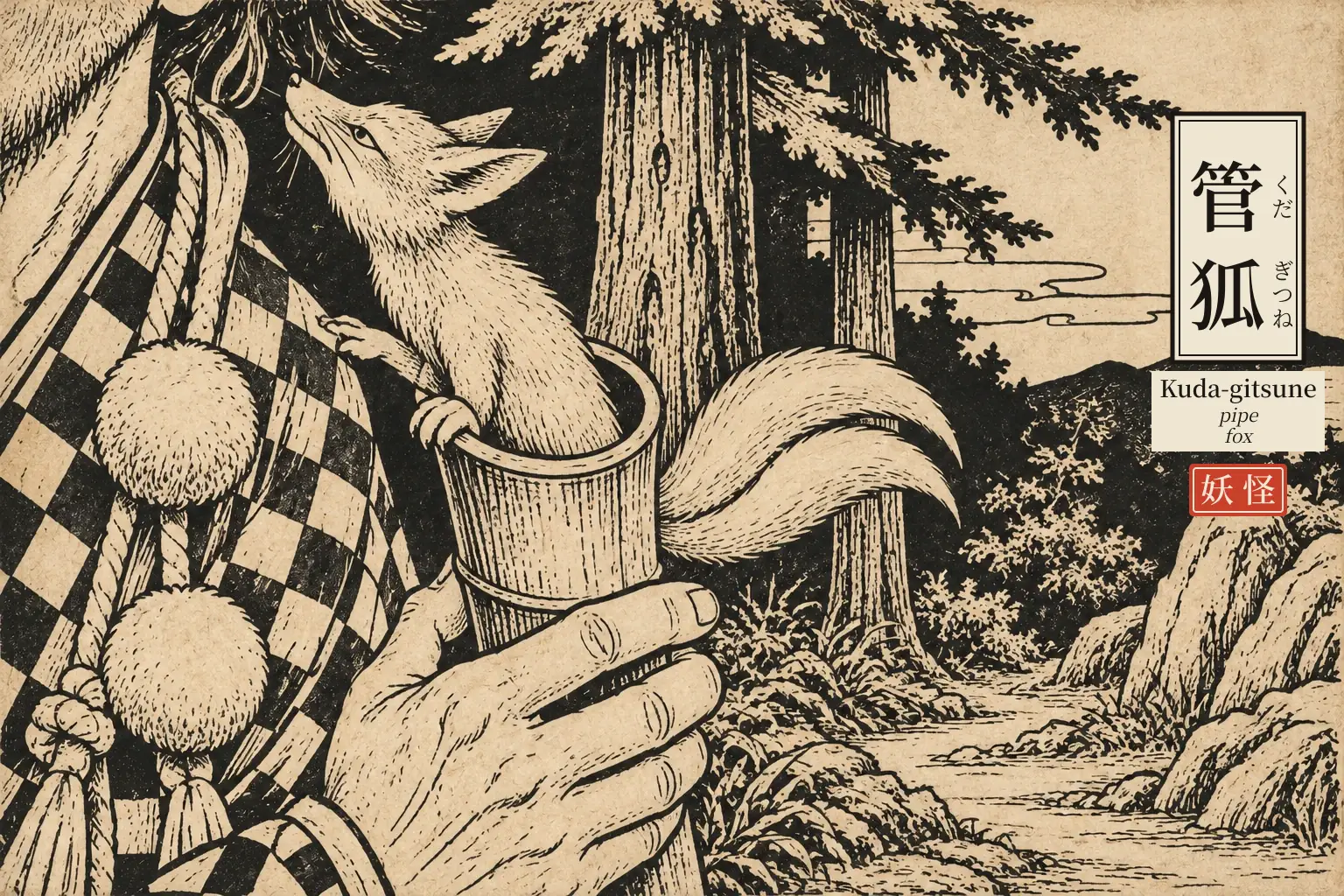
The kuda-gitsune is a fox small enough, many tellings say, to fit inside a tube. Its name means "pipe fox": 管 (kuda) is a tube, 狐 (gitsune) a fox. In Nagano, people said its keeper carried it inside his kimono. It whispered secrets into his ear. Usually, no one else could see it.
Then, in 1822, one went on public show. A kuda-gitsune obtained in Osaka was exhibited in Edo, today's Tokyo. It was about 58 cm long from nose to tail tip. And in Japanese, one real animal still carries the name today.
A fox that fits in a tube
Most accounts make it small. After that, they stop agreeing. A Meiji newspaper report from Nagano said it was the size of a house mouse. Its tail looked like a tube split down the middle. Other accounts say "about the size of a matchbox."
Miyoshi Shōzan was a collector of strange tales. His book Shōzan Chomon Kishū, printed in 1850, has a picture of one. In his story, a doctor named Agata Dōgen stabbed a strange beast in the Kyōwa era (1801–1804). It happened at Matsushima, a post town in Ina, southern Nagano. The beast was as big as a large cat. It had a cat's face, an otter's body and a very thick tail. Its fur was grey all over, like a squirrel's. In Ina, Shōzan adds, people called it simply kuda.
The scholar Asakawa Zen'an saw only a skin. To him it was weasel-sized and much like a wild fox. But its eyes were set vertically, and its fur was full but not matted. The Edo show animal was the giant of the group. The folklorist Yanagita Kunio called it the largest kind.
Whispering in the keeper's ear
The kuda-gitsune was a working animal. Yamabushi, wandering mountain ascetics, carried it in a bamboo tube and made it appear and vanish. Its keeper fed it. In return it read people's thoughts and reported them. So the keeper could tell a stranger's past and future, like a fortune-teller with a spy.
The same fox could do harm. A Japanese folklore dictionary says the izuna, its northern twin, could be sent at a client's request into a person the client hated. The fox would possess that person and make them sick.
How did you get one? Zen'an said that the mountain itself had to grant it. A yamabushi received the power with his rank, at Kinpusen or Ōmine in Nara. An older collection of tales, Rōō Sawa (dated 1742), gives a stranger method for a fox helper. The user purified himself and went alone into the hills. He found a pregnant vixen and adopted her young as his own. He fed her until the birth. After that, a fox came whenever he called.
Three names for a fox
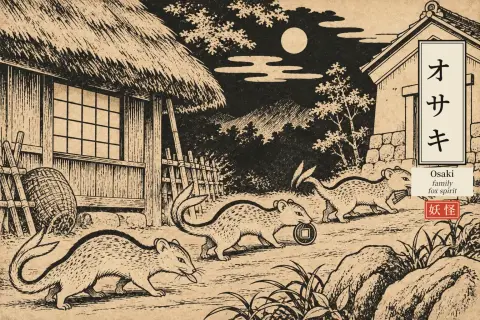
In central Japan, people said kuda-gitsune. In Tōhoku, the north, a similar spirit was usually called izuna (飯綱). That name comes from Mt. Iizuna, near Togakushi in Nagano. The fox was called the messenger of Izuna Gongen, the mountain's god. Its users were izuna-tsukai, "izuna handlers." In northern Kanto, people usually said osaki instead.
The folklorist Ishizuka Takatoshi found almost no kuda in Kanto, outside Chiba and Kanagawa. It is said that Kanto belonged to the osaki. Other writers see no border at all. To them, kuda, izuna and osaki are one creature under three names.
How it differs from the hitogitsune
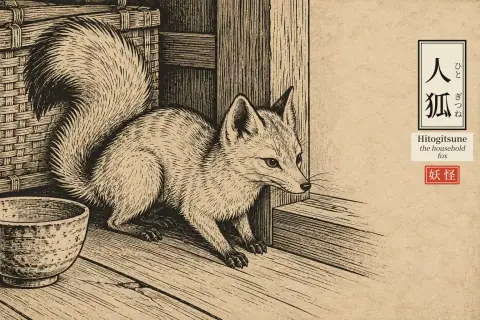
A close relative is the hitogitsune of Izumo, in Shimane. Both were said to live with a family and make it rich. In both regions, mountain ascetics also used foxes for pay. So the line between them is not the keeper.
Yanagita drew it at the tail. The kuda and the osaki, he noted, have a thick, split tail. Shimane's hitogitsune has a thin one, shorter than a rat's. Lafcadio Hearn, a writer who lived in Izumo, heard otherwise: an ordinary fox's tail.
Ishizuka drew another line, this time against the osaki. In his account, an osaki acts on its own, even when its master wants nothing. A kuda acts when its master chooses to use it.
Not every record agrees. Yanagita wrote of kuda in Tōtōmi and Suruga (today's Shizuoka) that acted even when their master was not greedy. Out of loyalty to the house, a kuda chased anyone who carried off its goods. Then it possessed someone in that person's family.
Seventy-five mouths
A kuda-keeping house was said to grow rich. At its master's wish, the fox brought in goods from other households. One trick was simple. The invisible fox hung on the scale weight when the family bought, and sat on the goods when it sold. But the deal went bad. The foxes multiplied to seventy-five, ate the house out, and it fell.
The neighbors had names for such homes: kuda-mochi, kuda-ya, kuda-tsukai, kudashō. All of them meant one thing. Stay away, and do not marry in.
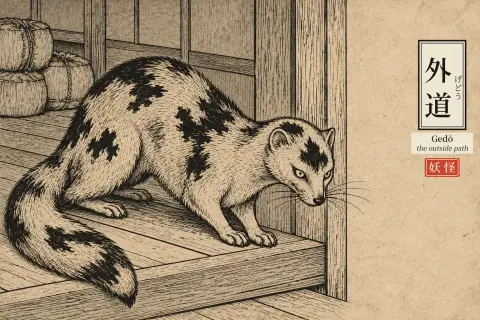
Where does the number come from? Yanagita traced the label to the sick. A possessed person would cry out which house the fox came from. That house became kuda-mochi or osaki-mochi. Such families kept growing in number. To explain them, people borrowed what Yanagita called a silly saying. Every bride brought seventy-five foxes with her. The same number was already told of other spirits. The gedō of Shimane and the tōbyō of Hiroshima and Tottori also travel in groups of seventy-five.
Why "kuda"?
The tube story is the plain one. Ishizuka said it is small enough to fit inside a bamboo tube. Inoue Enryō, the Meiji scholar of yokai, preferred the tail, shaped like a split pipe.
Yanagita went somewhere else. He heard kuda as kudaru, "to come down." In his reading, the fox guided the field god down from the mountain for the rice season. Accounts differ.
The pipe fox today
One real animal still carries the name: the stoat. One of its Japanese names is kudagitsune, written 管狐. In parts of Gunma, Nagano and Yamanashi, the stoat serves Jūni-sama, a mountain god. There it can curse or possess people. In some of those areas, people said the stoat was the true kuda or osaki. Across most of Japan, though, the kuda was counted as a kind of fox.
The least weasel kept the other name. In Japanese it is iizuna. A government wildlife leaflet traces the name to the izuna handlers of Mt. Iizuna. A 1940 report from Akita says weasels were called izuna there, and some female mediums used them.
Folklore adds one last rule. When a fox-user died, his kuda went to Ōji, home of the boss of all Kanto foxes. A kuda with no master, they said, possesses no one.