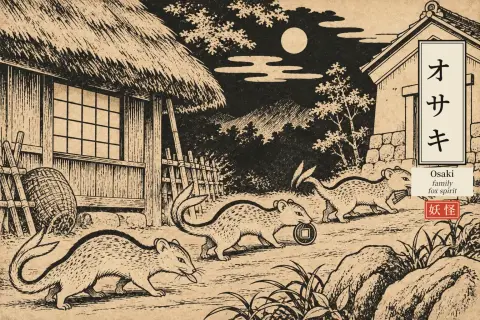
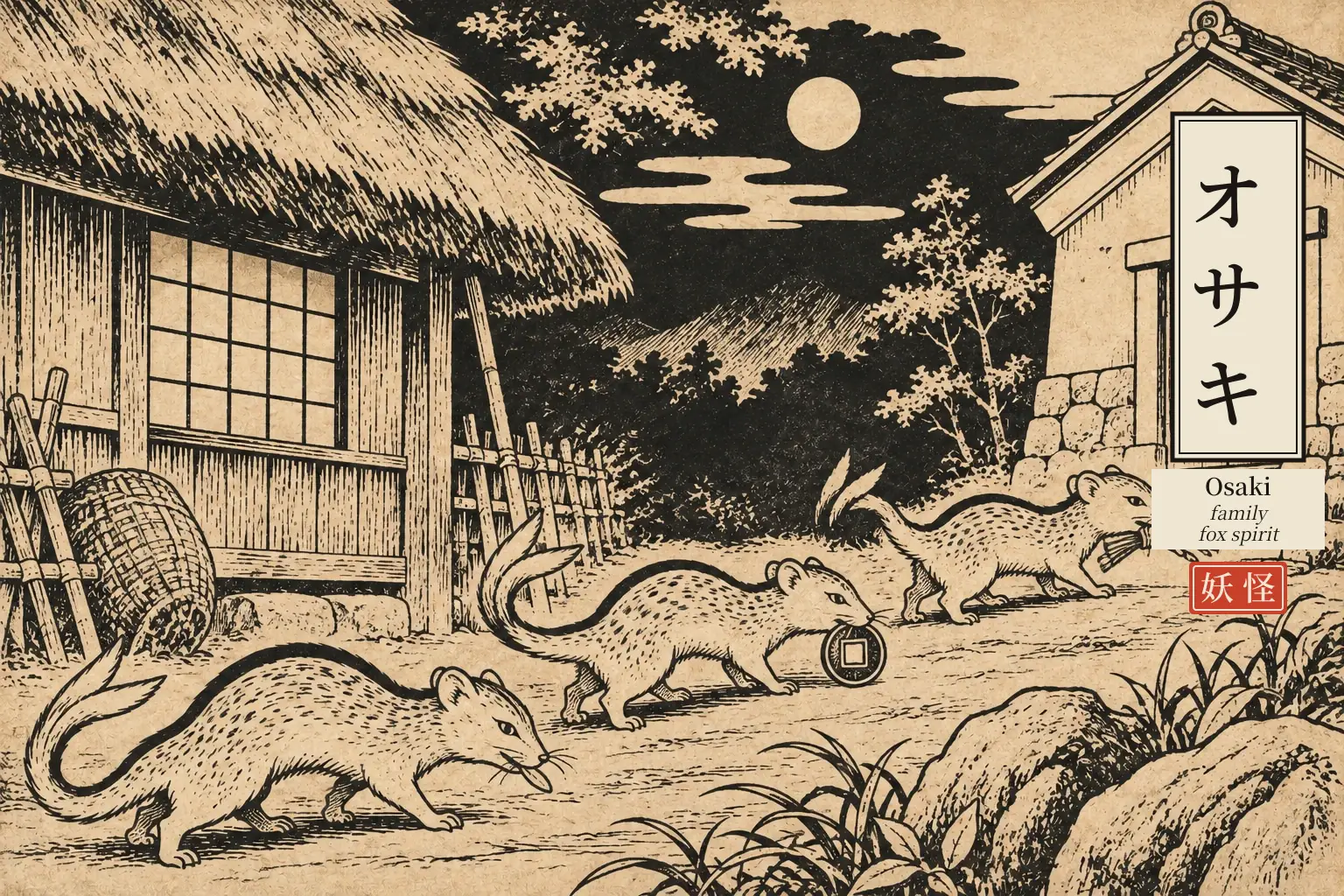
In some mountain villages around Tokyo, certain houses were said to keep a fox. It usually stayed out of sight. People knew it by what it was said to do. This was the osaki, a small spirit of the Kantō region. It lived with one family and moved gold, silver and rice wherever it pleased. It was believed to come with the bride when a daughter of that house married.
The belief ran through Chichibu in Saitama, Okutama in Tokyo, and Gunma, Tochigi and Ibaraki. It also reached the Saku area of Nagano. Yet Tokyo itself, once the city of Edo, has no osaki stories outside the Tama area in the west. One answer says a fox boss at a Tokyo shrine kept it out.
A fox not much bigger than a mouse
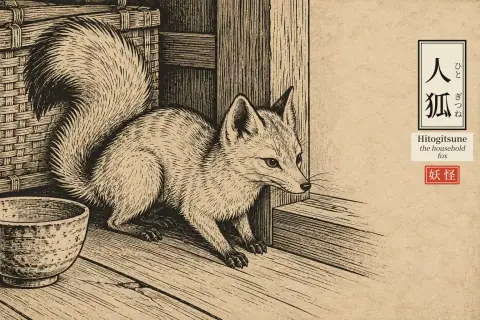
The osaki is called a fox, but its descriptions rarely sound like one. They differ wildly from village to village and book to book.
Kyokutei Bakin, a famous Edo-period novelist, described a weasel-like beast, smaller than a fox. Near Nanmoku, in Gunma, people said it looked like a weasel crossed with a mouse. Others said an owl crossed with a mouse. It was a little bigger than a house mouse. Its color was mottled, or orange, or a mix of brown and gray. A single black line ran from its head to its tail. The tail was split. In nearby Shimonita, it had ears like a person's, a square mouth, and a white tip on its nose.
An 1853 picture book of comic verse, Kyōka Hyaku Monogatari, drew it too. A man holds a weighing scale. Small osaki peek out from the front of his kimono and from under his right sleeve.
A piece of the nine-tailed fox
The name has no fixed spelling. It is written 尾先, 尾裂, 御先 or 尾崎. Three theories explain the name.
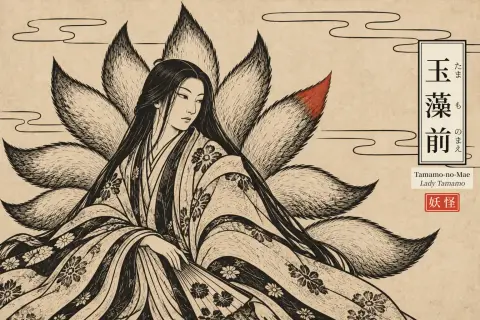
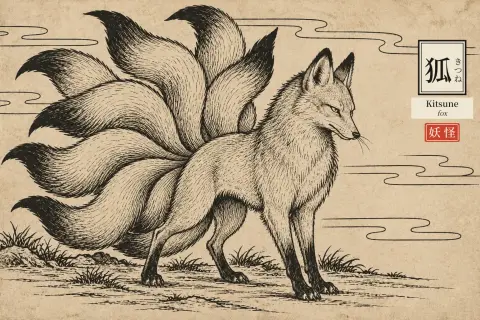
Written 尾先, "tail tip," the name is said to come from its birth. It was born from the tail of the nine-tailed fox, the fox of the Tamamo-no-mae legend. Other legends tell its origin in two ways. In one, the fox was killed on the moor of Nasu. Its golden hairs flew off and became spirits. In the other, the fox turned into the Killing Stone. The monk Gennō split the stone to end its curse. One piece flew to Kōzuke, today's Gunma, and became the osaki. The same story sends other pieces to Hida and to Shikoku, where they became other spirits.
Written 尾裂, "split tail," the name points to the body instead. The Toen Shōsetsu, a collection of strange tales put together by Bakin and his friends in 1825, gives this reason. Its tail was split in two. A third theory links the name to misaki, the spirit servants of a god.
Why it never reached Edo
The sources give two explanations for the gap around the city.
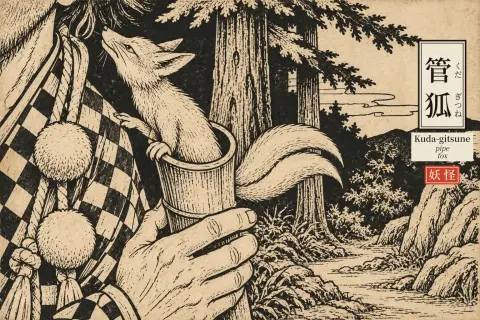
The first says the osaki cannot cross the Toda River. That was the old name of the stretch of the Arakawa where travelers took a ferry toward Edo. The second names a shrine. Ōji Inari Shrine, in today's Kita Ward of Tokyo, came to be known as the head of the Inari shrines of all eight Kantō provinces. Inari is the god whose messengers are foxes. With the boss of the foxes there, the osaki could not come in. Ōji turns up in kuda-gitsune lore too. When a fox-user dies, his foxes are said to go and live at Ōji, where they possess no one.
The osaki-mochi: a fox in the family
A house said to keep one was called osaki-mochi, "osaki-holding," or osaki-ya and osaki-tsukai. The osaki worked unseen. It was said to carry gold, silver, rice or anything else, as it pleased.
Its neighbors kept their distance. Other families would not marry into an osaki-mochi house. Osaki-mochi families married each other instead. The reason was simple and harsh. A family that took a bride from an osaki house was said to become osaki-mochi too. So a marriage with an osaki house could carry the fox. Marriages like this were often a cause of tension in the villages. In parts of Gunma there were unspoken rules. You ran when you passed an osaki-mochi house. You did not rent its fields.
An Edo-period essay collection adds something heavier. Once an osaki attached to a family line, no method could remove it from the house.
The osaki could also enter a single person. That person showed fever, wild excitement, disturbed thinking, huge hunger and strange behavior. These were the same signs as kitsune-tsuki, fox possession.
Which houses got the label
Why these families? Folklorists have looked at who was named. Spirit-owning lines, called tsukimono-suji, were often fairly rich. Many were not old landholding families. They had moved in from outside and then done well.
The scholar Komatsu Kazuhiko explained this with an idea from the American anthropologist George Foster. In a closed farming village, people saw wealth as a fixed amount. If a newcomer got rich fast, someone else must have lost. An invisible fox that carried goods was a ready answer. Komatsu also noted that Ishizuka's fieldwork found poor spirit-owning families as well. So wealth was a common pattern, not a rule.
Komatsu compared the zashiki-warashi of northern Japan. It is a child spirit also said to live in newly rich houses. Yet people usually saw it as a luck god, not a curse. His guess was that those villages had more contact with the outside world.
Yanagita Kunio, the founder of Japanese folklore studies, made a related point about numbers. A bride was said to bring 75 spirits with her. He thought that story grew to explain why so many houses carried the label.
Mountain osaki, village osaki
In Ueno, a village in Gunma, people gave the name yama-osaki, "mountain osaki," to the stoat. A stoat often runs after people, they said, and anyone who bullies one is cursed. In another Gunma village, osaki came in two kinds. Yama-osaki of the mountains never possessed people. Sato-osaki, the village osaki, did.
Kuda-gitsune, hitogitsune and kitsune
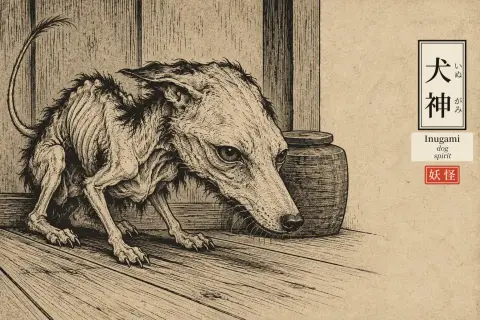
The osaki's nearest relative is the kuda-gitsune, the "tube fox," known mainly in central Japan. Some writers treat the two as one creature. One reference says it is often called kuda in central Japan, izuna in the northeast and osaki in northern Kantō. Ishizuka kept them apart. A kuda-gitsune acted when its master chose to use it. The osaki acted on its own, even when the head of the house wanted nothing. In Kantō, he noted, kuda-gitsune stories are missing outside Chiba and Kanagawa. Kantō was osaki country.
The hitogitsune of Izumo, far to the west, is the same kind of belief in another region. It is also kept by a family line and also follows the bride. The osaki has its own local pieces: a river it cannot cross, a shrine that keeps it out of Edo, and a stoat in the hills that shares its name.
The kitsune is the fox of the open country and of Inari shrines. It tricks travelers and takes human shape. The sources on the osaki describe no human shape. It is tied to a family line instead.
The osaki on paper
The osaki shows up in writing from about the middle of the Edo period, according to Ishizuka's Nihon no Tsukimono (1959). One theory says it began in Chichibu.
The 1853 picture of the man with the scale was reprinted in a modern edition in 2008. Ōji Inari Shrine, the fox boss of the story, still stands in Kita Ward.