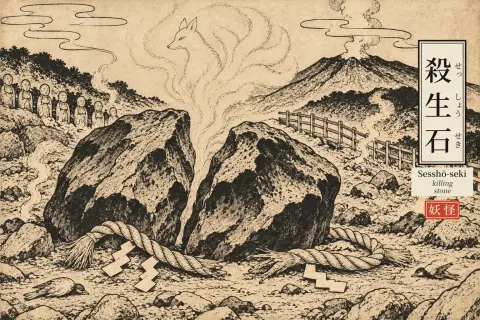
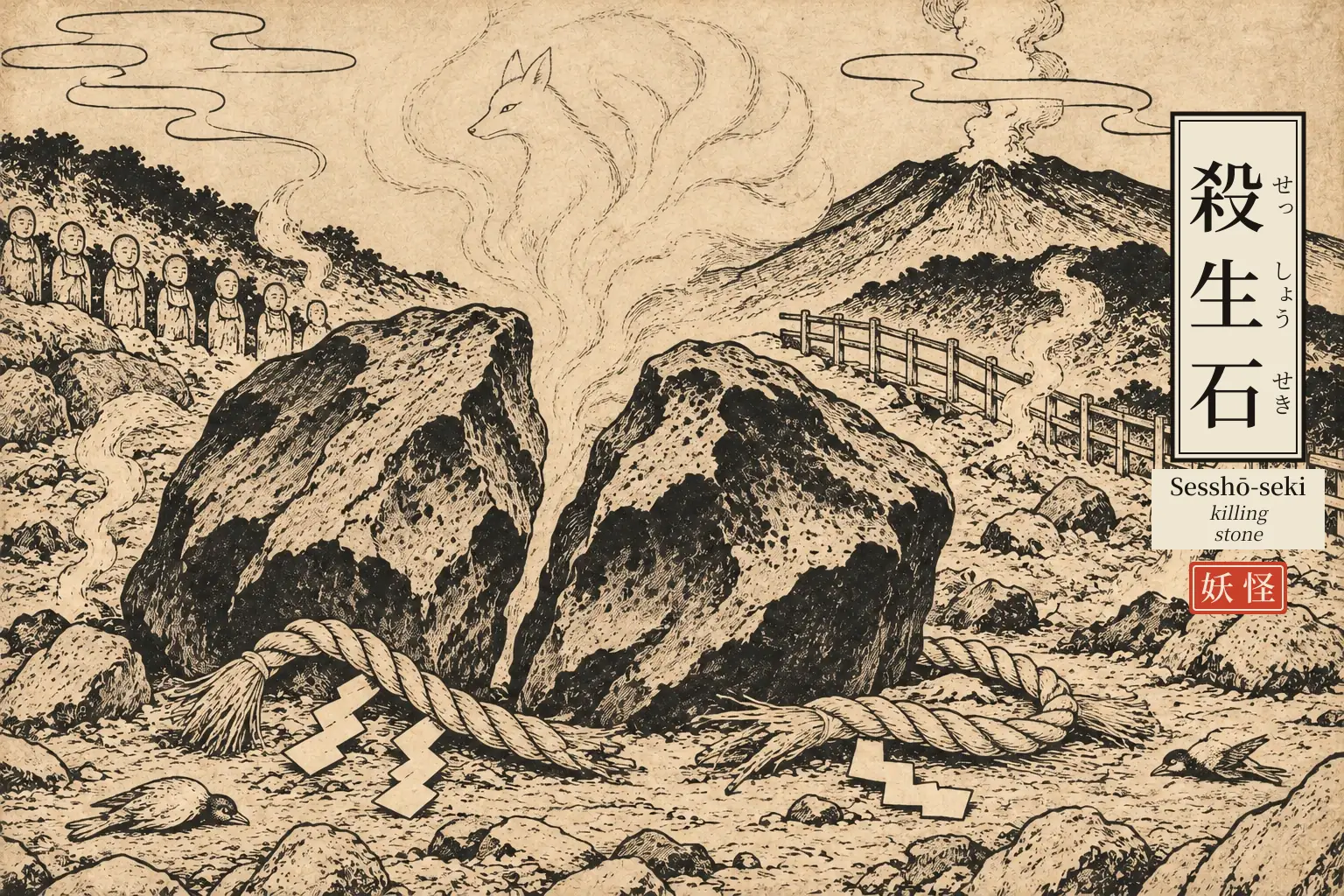
In early March 2022, a tourist in Nasu, Tochigi, posted a photo of a broken rock. By 5 March, the news was out. The rock was Sesshō-seki, the Killing Stone. Legend says the spirit of a nine-tailed fox is sealed inside it. Now the boulder lay in two halves, split almost down the middle. Online, people asked: had the fox got out?
The odd part is that this had happened before, on stage. In a Noh play performed by 1503, the same stone splits in two. The fox spirit comes out of the crack.
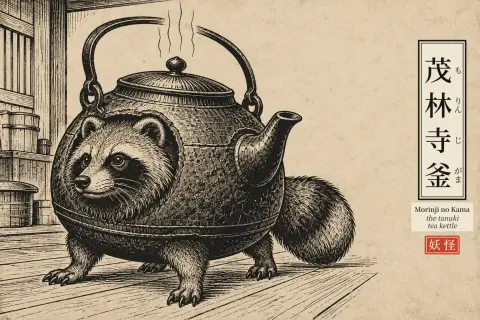
The stone is real, and so is its danger. Poison gas from the volcano seeps out of the ground around it. Birds, foxes and tanuki have died there. In December 2022, eight wild boars were found dead beside it.
Two halves and a cut rope
A sacred rope, called a shimenawa, used to circle the boulder. When it split, the rope snapped too. The local paper, the Shimotsuke Shimbun, reported that cracks had been seen for several years. The town said the rock had most likely broken by itself. The Sankei newspaper wrote that it looked as if a blade had cut it.
The town still took it seriously. At the end of March 2022, the Nasu tourism association held a memorial rite and a prayer for peace.
Before 2022, the stone was one dark boulder in a bare field of rocks. It sits at the southeastern foot of Mt. Chausu, a volcano. Paper streamers hung from its rope, the sign of a sacred place. The ground smells of sulfur. The rock itself is lava.
A fox inside the stone
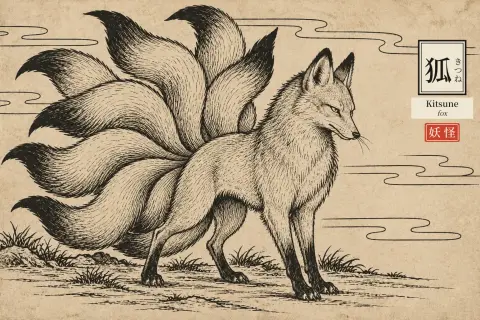
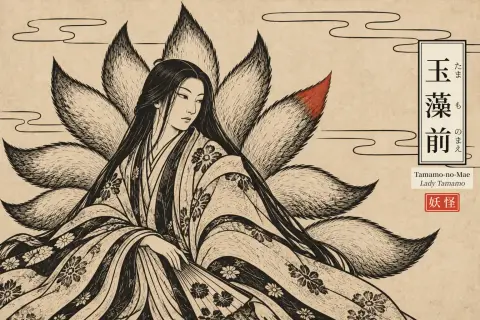
The fox is Tamamo-no-Mae. In the legend, she was a favored lady of the retired Emperor Toba in the 1100s. In truth she was a fox with nine tails. A court diviner exposed her, and she ran east to the plain of Nasu. Warriors hunted her down there. Her whole story has its own page; this one follows the rock.
What became of her at Nasu depends on who tells it. In the Noh play, her spirit haunts a big stone. Nasu town says the fox itself turned into a giant stone. Either way, the stone breathed poison. People, livestock, birds and beasts that passed it died. So it got its name: sesshō is the Buddhist word for taking life.
Tamamo-no-Mae is a kitsune, a Japanese fox spirit, but not a local one. Nasu town's version says the fox flew in from India and China. In the Noh play, she lists her past lives in both countries.
The monk with the hammer
The stone kept killing until a monk came. His name was Gennō Shinshō (1329 to 1400), and he was a real person. He was a Zen monk of the Sōtō school, born in Echigo, on the Sea of Japan coast. Many temples are said to have been founded by him.
The Noh play Sesshōseki is one of the oldest tellings. Noh is Japan's old masked theater. A court diary records a performance of this play in 1503. In the play, Gennō crosses the Nasu plain. He sees birds fly over a stone and drop dead. A woman appears and warns him away. She tells him Tamamo's story, then reveals she is Tamamo's ghost.
Gennō offers flowers and incense to the stone. Then he speaks to it in Zen words: "Where did you come from? Go, go at once!" The stone splits in two. Inside the light, the monk sees the shape of a fox. The spirit recalls its past in India, China and Japan. Then it promises to do no more harm, and vanishes.
Accounts differ on how he broke it, and where the pieces went:
| Who tells it | How Gennō broke it | Where the pieces went |
|---|---|---|
| Noh play Sesshōseki | Incense, then Zen words; it splits in two | Not told. The fox spirit leaves |
| Nasu town | He shouted at it, and it split into three | Two flew away, one stayed in Nasu |
| Ministry of the Environment | He struck it with a great hammer | One to Fukushima, one to Hiroshima, one stayed |
| A common telling | It shattered | To three places called Takada |
One account dates the breaking to 1385. The monk's name also lives on in a tool. A heavy iron hammer is called a gennō, said to be named after him.
Bees, butterflies and boars
The poet Matsuo Bashō walked past in 1689, on the journey he wrote up as Oku no Hosomichi (printed 1702). He saw that the stone's poison "had not died out." Dead bees and butterflies lay in heaps. They were so thick that he could not see the sand beneath them. He left a haiku there: ishi no ka ya / natsukusa akaku / tsuyu atsushi. "The smell of the stone. The summer grass is red, the dew is hot."
The killer is volcanic gas: hydrogen sulfide and sulfur dioxide. The Ministry of the Environment explains it on its visitor center page. Warm vapor heats the ground near the boulder. Small animals come to lie on it, mostly in winter. The fumes kill them in their sleep.
That still happens. On 7 December 2022, eight wild boars lay dead near the stone, three adults and five young. Tanuki and foxes had been found dead there before. A Ministry of the Environment officer could not recall boars dying there before. Tests for swine fever came back negative, which makes the gas the likely cause. He noted that animals breathe close to the ground, where the gas is thicker.
People are safe if they do not go too close, officials say. Signs warn people with small children or pets. When the gas is strong, entry is restricted.
Shards all over Japan
If the stone flew apart, where did it land? Many places claim a piece. The common telling names towns called Takada, but which ones is disputed. Candidates sit in Okayama, Niigata, Hiroshima, Ōita and Fukushima.
In Fukushima, Isasumi Shrine has a small Sesshōseki Inari shrine for its fragment. That shared legend made Aizumisato and Nasu friendship towns in 2015. In Kyoto, a statue of Jizō at the temple Shinnyodō is said to be carved from the stone.
Some shards, in other tellings, became new monsters. In Shikoku they turned into the inugami, a possessing dog spirit. In Gunma they became the osaki, and in Hida the gobōdane. Both are spirits said to possess people.
How the stone joined the fox story
In the prose tale, the stone seems to be a late addition. The versions of the prose tale Tamamo no Sōshi thought to be oldest have no Killing Stone at all. In those, her body is stored in a treasure house or set adrift. One study thinks the stone was added later.
Why Nasu? The deaths are a real thing about this place. Even in the play, birds drop dead as they fly over the stone. Volcanic gas still kills small animals there today. The Ministry of the Environment's visitor center text says science offers "a partial explanation" for the legend.
Which came first, the dead animals or the story, the sources do not say. Among the sources we found, the play itself is the oldest to show animals dying there. Gennō's temples may matter too. Temples linked to him in Okayama and Fukushima keep pieces of the stone. One also keeps a picture scroll of its story.
Toriyama Sekien, the Edo artist whose picture books gave many yokai their look, drew the stone in Konjaku Hyakki Shūi (1781).
The Killing Stone today
The stone became a Tochigi historic site in 1957 and a national Place of Scenic Beauty in 2014. The second listing counts it among the scenery of Bashō's journey. Rows of Jizō statues stand nearby.
Since 1989, on the last Sunday in May, the Gojinka-sai fire festival comes down to the stone. Torch bearers walk from Nasu Onsen Shrine. In front of a huge bonfire, drummers in white robes, gold wigs and fox masks play the Nine-Tailed Taiko.
The split boulder is still there, beside the hot spring town. Its rope used to hold one rock. Visitors now look at two.