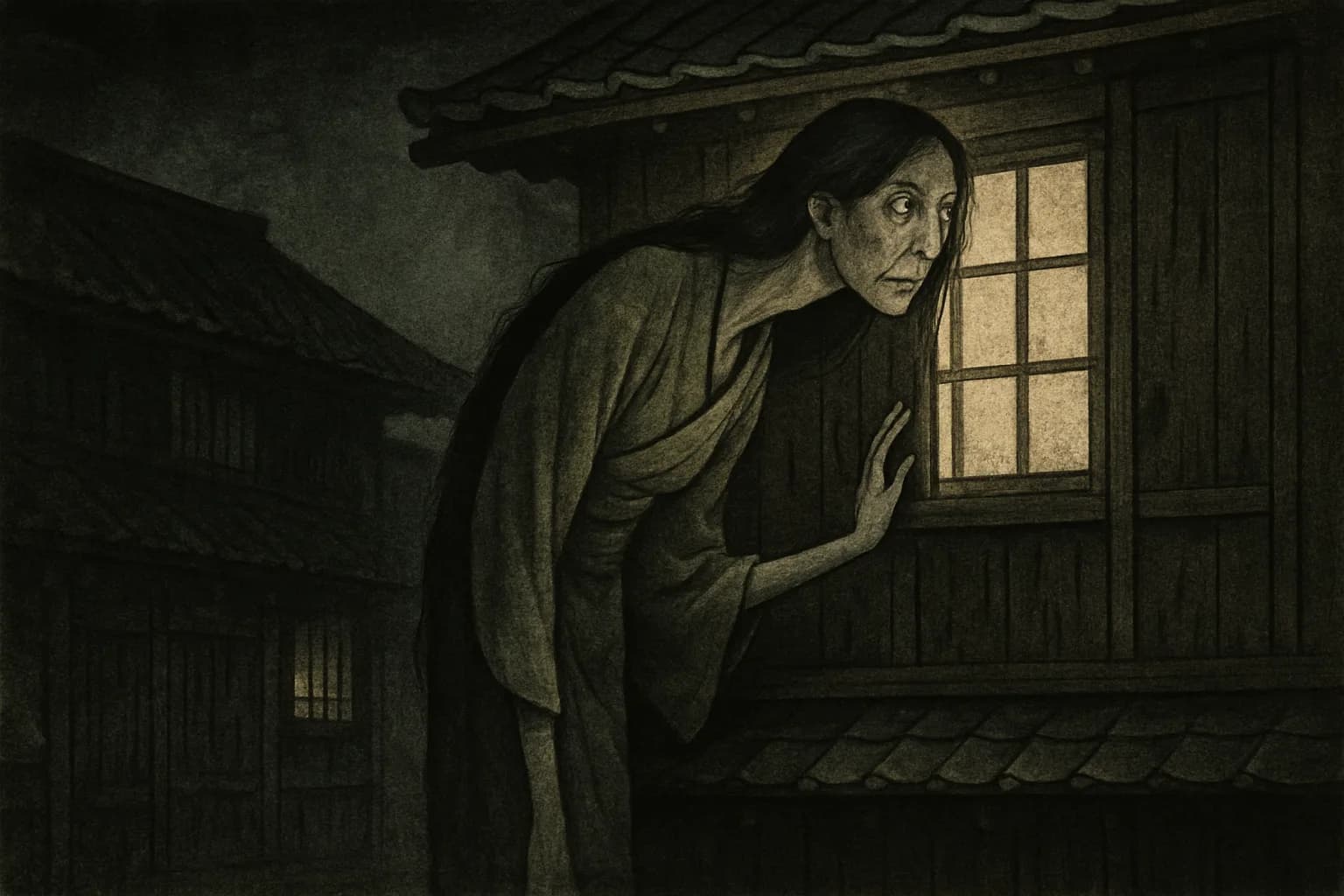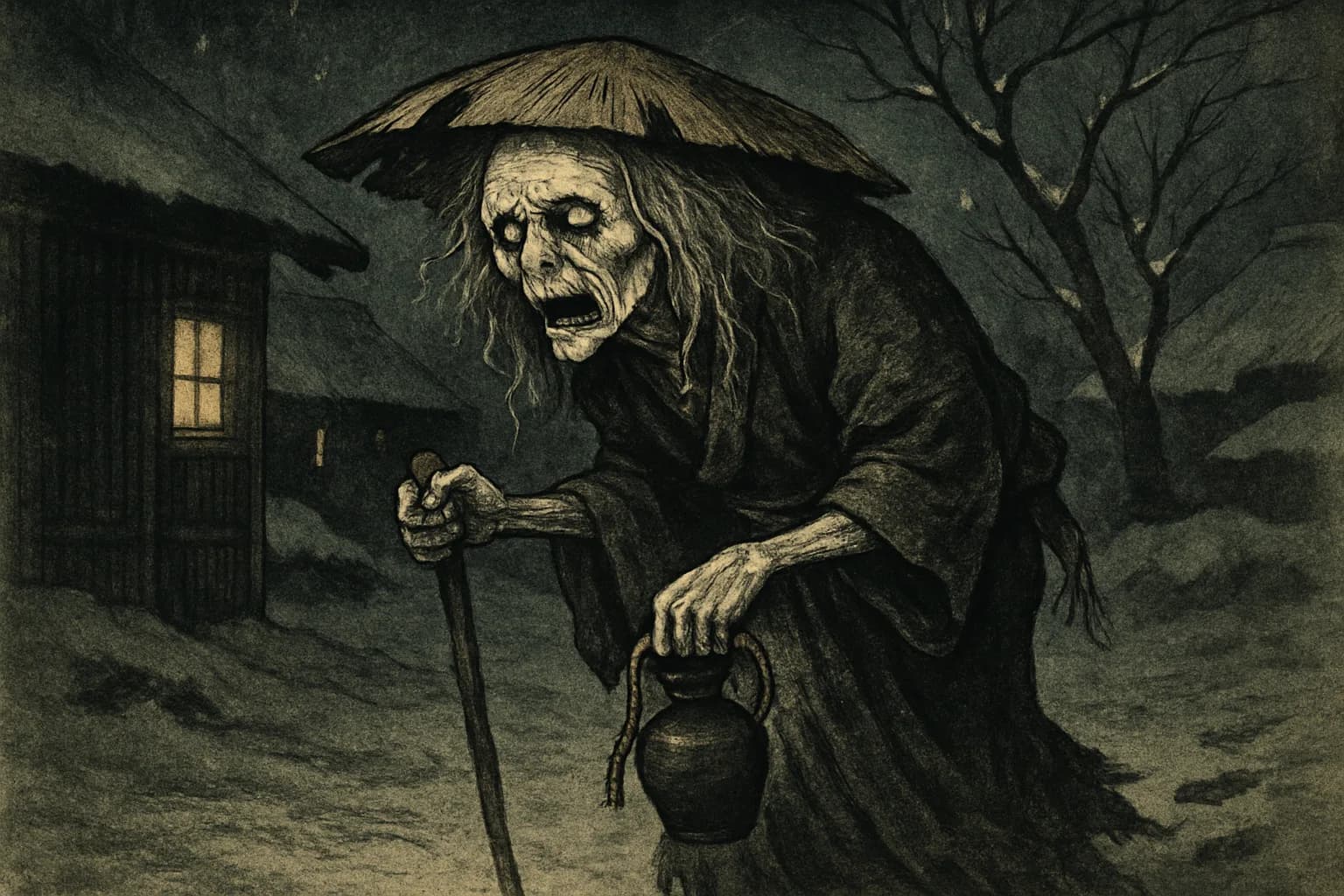
Walk a lonely road in old Izumo after dark and you might meet an ordinary-looking woman standing a little way off. Nothing about her seems wrong at first. Then you notice her neck has started to rise. It keeps rising, past the rooftops, past the pines, until she is looking down at you from seven fathoms up — nearly twelve metres, the height of a four-story building. That is Nanahiro-nyōbō, the Seven-Fathom Wife, a night apparition of Japan's San'in coast.
What does it look like?
By most accounts she begins as a perfectly normal woman, dressed like anyone you'd pass on a country road. The transformation is in the neck alone. It draws upward, thin and unnaturally long. Her head rises higher and higher above her own body, until it hangs over the witness like a lantern on a pole. Her face, when it finally comes down to meet your eyes, is the whole point of the encounter. Nothing else about her changes. The horror is entirely in the stretch.
The name says the measurement plainly. Nana (七) is seven, and hiro (尋) is a fathom — an old unit close to 1.8 metres, once used to measure rope and water depth. Nyōbō (女房) simply means wife. Seven fathoms runs to roughly twelve metres. Whoever first told this story wanted a specific, almost surveyable height. Not a vague "very tall."
A growing apparition, and kin who share the trick
Nanahiro-nyōbō belongs to a small family of Japanese yokai built around a single gimmick. A human shape keeps extending upward or outward, past what a body should do. Rokurokubi's neck creeps down a corridor while she sleeps. Taka-onna hauls her whole body past the rooftops to peer into an upstairs window. Nanahiro-nyōbō does both at once. The neck alone does the growing, but the distance it covers rivals Taka-onna's full-body stretch.
Folklorists group these "growing yokai" together because they share more than a shape. Across the type, the common thread is a traveler caught alone after dark. An ordinary encounter turns wrong by degrees. The threat rarely comes from teeth or claws. It comes from scale itself refusing to behave.
Where the Seven-Fathom Wife walks
The tale is anchored to a specific stretch of coastline, not told nationwide. It comes from Izumo and the Oki Islands, both in modern Shimane Prefecture. It also comes from Hōki, the old province covering western Tottori. This is the San'in coast, the old heartland of Izumo myth. The Sea of Japan sits on one side, the isolated Oki archipelago on the other. Roads here ran between fishing villages and rice paddies, with long, unlit stretches between them. That is exactly the setting this kind of story needs. A shape ahead of you has room to keep changing before you can be sure what you saw.
Where it comes from
The earliest written record of Nanahiro-nyōbō is the Edo-period kaidan (ghost story) collection Sanshū Kidan. Beyond that entry, the tale seems to belong to oral tradition. It passed between villages along the coast, with no single named author or dated print behind it. That places it with the region's broader stock of roadside apparitions. These are figures invented, or repeated, to give a shape to one specific fear: an empty road at night, where a shadow's size is the one thing you can't check twice.
Nanahiro-nyōbō today
Nanahiro-nyōbō hasn't crossed into games or anime the way Rokurokubi has. She survives mainly in yokai reference works and regional folklore collections. These catalogue the lesser-known apparitions of the San'in coast, alongside neighbors like the ushi-oni and nure-onna of the same Shimane shoreline. There's no signature legend beyond the encounter itself, no named victim, no ritual for driving her off. Just a woman on a dark road whose neck won't stop rising, and twelve metres of night sky between her ordinary face and yours.