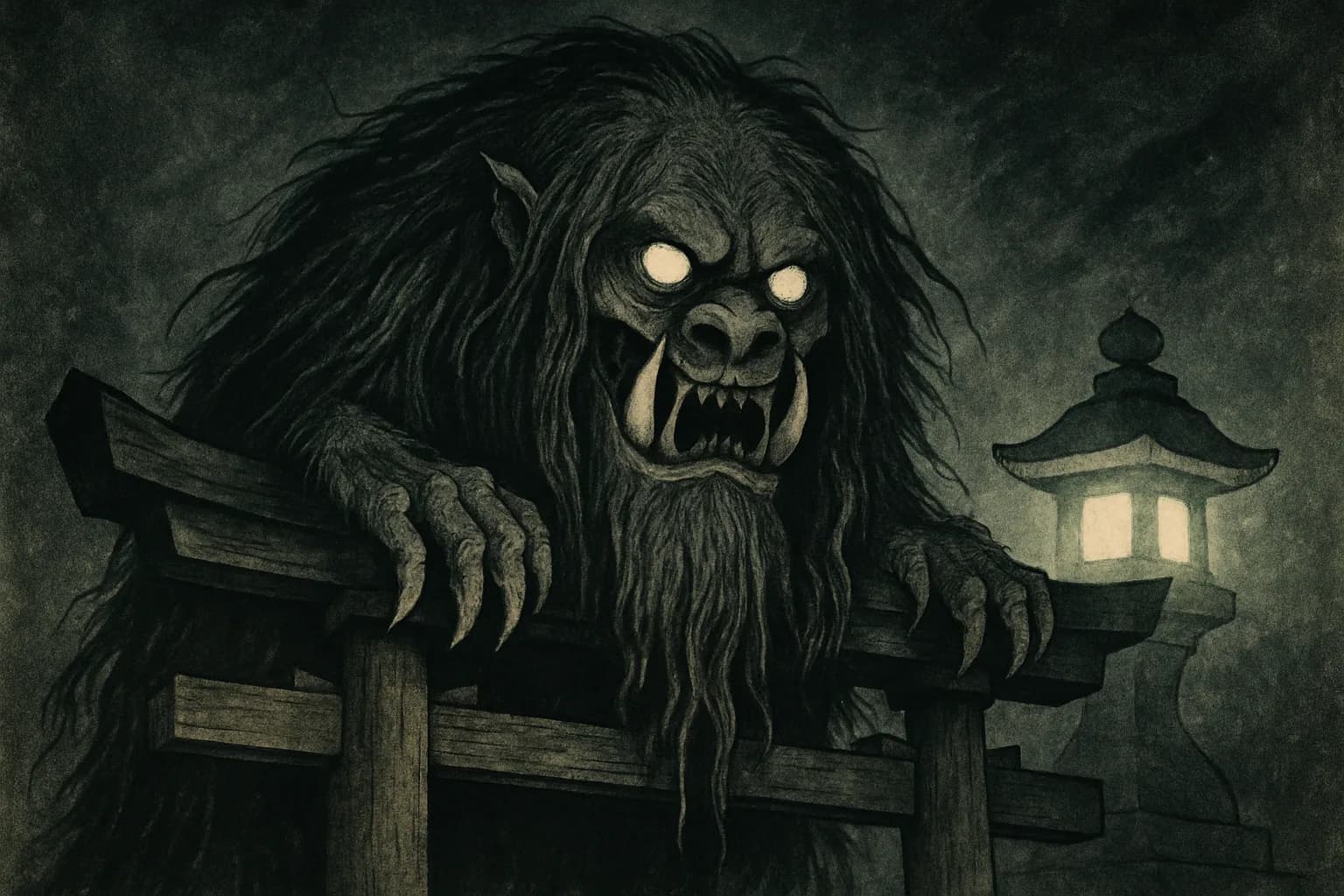
Walk under a shrine's torii gate without looking up, and you'll never know what you passed beneath. According to Edo-period lore, something is up there — a mound of shaggy hair, claws, and teeth, folded flat against the top beam, watching the worshippers file through below. It only moves for the ones who deserve it.
That is otoroshi, and even its name is a kind of warning. It isn't a compound of meaningful kanji the way kappa or tengu are — it's usually written in plain hiragana, おとろし, because it's essentially a twist on the ordinary Japanese word osoroshii (恐ろしい), "dreadful" or "terrifying." The creature is named after the reaction it's supposed to cause, not after any story about where it came from.
What does it look like?
Otoroshi first appears in Toriyama Sekien's 1776 print collection Gazu Hyakki Yagyō ("The Illustrated Night Parade of a Hundred Demons"), crouched on top of a torii gate above a shrine path. Sekien draws it as a squat, powerfully built mass of matted, shaggy fur, with a wide, snarling mouth full of fangs, glaring eyes, and long claws tucked under its body. There's no elegant silhouette here — it reads as something closer to a filthy, oversized animal than a spirit, pressed flat against the crossbeam like it's trying not to be noticed until the moment it isn't trying anymore.
A guardian that only the guilty ever see
Otoroshi's whole job is tied to the torii it sits on. A torii marks the line between the ordinary world and the sacred ground of a shrine, and in the folklore, otoroshi is what enforces that line. Devout visitors who bow, purify themselves, and pass through with proper respect walk on without ever noticing it's there. It's said to reveal itself only to people who behave badly on shrine grounds — the disrespectful, the impure, the ones who treat sacred space carelessly — dropping down from its perch onto the head of whoever has earned it.
There's no dramatic battle in the way there is with an oni or a tengu. Otoroshi doesn't chase, bargain, or haunt a whole village. It waits in one specific place, tied to one specific kind of offense, and does nothing at all to anyone who simply minds their manners.
Where it comes from
Sekien's yokai catalogues are full of creatures built less from long oral traditions and more from a single striking idea, sketched and captioned to sit alongside older, better-known monsters — and otoroshi reads as one of these. Shrine gates in Edo-period Japan were already treated as thresholds worth being careful about: you were expected to bow before entering, keep to the side rather than the center of the path reserved for the deity, and generally behave as though you were being watched. Otoroshi gives that expectation a face. It's less a monster to be defeated than a personification of shrine etiquette — the folkloric version of the stone lion-dog statues, the komainu, that flank a shrine's entrance to ward off evil, except this one is alive, hidden, and judging.
Otoroshi today
Otoroshi never developed the rich cast of regional legends or the festivals that grew up around figures like the kappa or the tengu. Its afterlife has mostly been a quieter one: it endures because later yokai researchers, most notably Shigeru Mizuki, spent decades compiling exhaustive illustrated encyclopedias of Japanese yokai that kept minor, single-appearance figures like this one catalogued and in print rather than left to fade inside a two-century-old woodblock book. It surfaces today mostly in that context — yokai reference guides, folklore art collections, and the shrines themselves, where the torii gate still stands as the one place otoroshi was ever said to be.