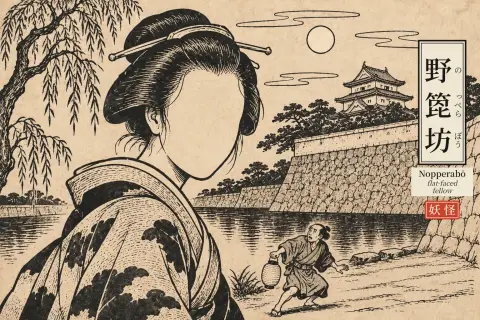
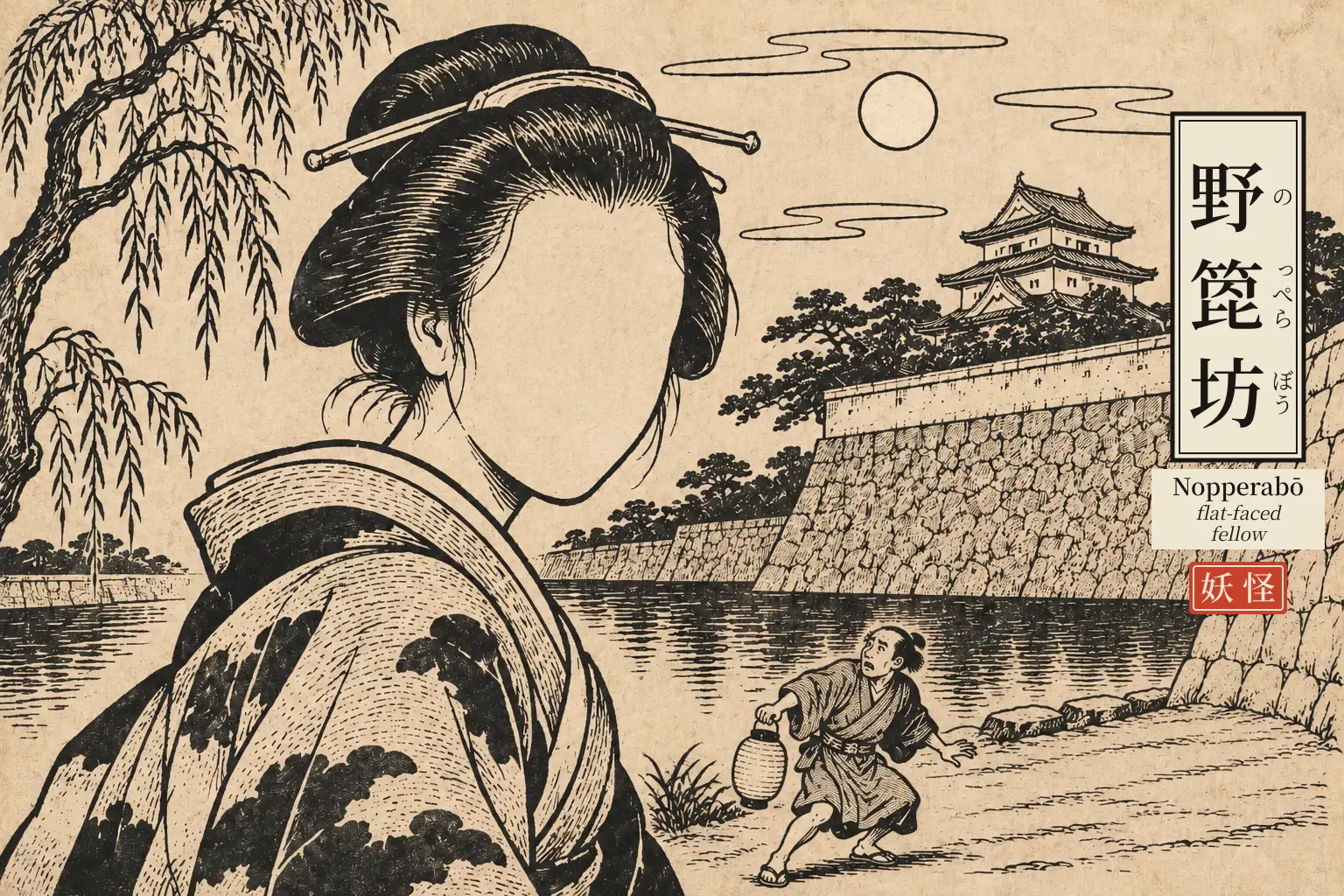
In its best-known version, a man is hurrying home at night when he sees someone crouched by the road, crying. He stops to help. The stranger turns, and there is nothing where a face should be: no eyes, no nose, no mouth. He runs. That is the shape of the nopperabō's (野箆坊) most famous story, and it almost never ends there. Somewhere ahead, someone else is about to turn around too.
As yokai go, this one is strangely gentle. Old sources say its only harm is startling people; stories where it does worse are rare. Its best-known shape is not about violence at all. It is the blank space where a face should be, and a trick: making you meet that same blank face twice in one night.
The blank where a face should be
A nopperabō looks like an ordinary person, the right height and shape, right up until it turns around. Then the face is simply smooth: no eyes, no nose, no mouth, nothing. One of the oldest written sightings, from 1663, describes one standing about 2.1 meters tall in Kyoto. Most other tellings give no measurement at all, though a Sengoku-era account does call its apparition huge.
The word did not stay inside ghost stories. In everyday Japanese, nopperabō can describe anything flat and featureless, the way English might call a bare wall "blank": a smooth egg, or a person with no real opinions of their own. The ghost's name is usually traced to the same root as that plain adjective, nopperi, meaning "flat-faced."
Told twice in one night
The nopperabō's signature move is not the blank face. It is making you see it twice.
Folklorists call this pattern saido no kai, the "twice-repeated fright." A traveler meets something terrifying, flees to safety, and tells someone what happened, only for that second person to turn around and show the same blank face. The scare simply resets.
The best-known version in English is Lafcadio Hearn's 1904 story "Mujina," from his collection Kwaidan. A Tokyo merchant meets a crying woman on a lonely slope, then a soba-stall keeper who asks, "Was it anything like this that she showed you?" before showing his own blank face. The word "nopperabō" never actually appears in Hearn's text. He explains to his foreign readers what soba is, but never what a mujina is. He had already been drawn to stories of faceless women in his own writing, years before he ever set foot in Japan. Whether the mujina really belongs in this story is its own question, one the mujina's own entry on this site goes into.
Older Edo ghost-story collections run the same structure without any animal at all. A separate local legend, one of the "Seven Wonders of Honjo" in old Edo, built it into three acts: a fisherman flees a voice calling from a moat, meets a faceless soba vendor, flees again, and finds his own wife turned faceless when he gets home.
Across Japan, the same blank face
Local versions of this story turn up far from Edo, usually with their own name for the monster.
In Kyoto, the 1767 ghost-story collection Shinsetsu Hyaku Monogatari places a faceless thing at Nijō-gawara. Whoever it attacked came away with coarse animal hair stuck to their clothes, a hint that some beast was behind the mask, though the text never says which one.
In Tsugaru, in what is now Aomori, a 1935 collection tells of a man named Yohei who hears someone singing his own song back to him on a mountain path. He calls out, asking who is there. A voice answers, "It's me." That is the Zunbera-bō, a northern name for the same blank-faced thing. He runs to a neighbor's house to tell the story and finds the neighbor's face gone too.
Kumamoto has its own version, recorded in 1944: a figure called Jūbako-baba haunts a teahouse on a hillside road. A traveler who sees her bare face flees downhill to a second teahouse, where it happens all over again. A Hyōgo town, now part of Tamba-Sasayama, tells something similar about a girl on a wooded path named Ochobo.
Even a Sengoku-era war chronicle has a version. It describes a young warrior wrestling a huge mountain ascetic on a Gifu hillside at night. The ascetic vanishes. At a nearby temple, a monk asks what its face looked like, and faces "like white melons," with no eyes or nose, pour out of the building in answer.
Not quite the same monster
A few yokai get lumped in with the nopperabō, and some fit better than others.
Nuppeppō sounds almost identical and gets confused with it constantly, but it is a different creature. One account gives it a real face, with eyes, nose, and mouth; another says what looks like a face is really just hanging folds of skin. Either way, its limbs grow straight out of its head, with no proper body in between, more a walking lump of flesh than a faceless person.
Ohaguro-bettari belongs more comfortably in the family. She has no eyes or nose, but her mouth, stained black in the old tooth-dyeing fashion called ohaguro, grins wide open.
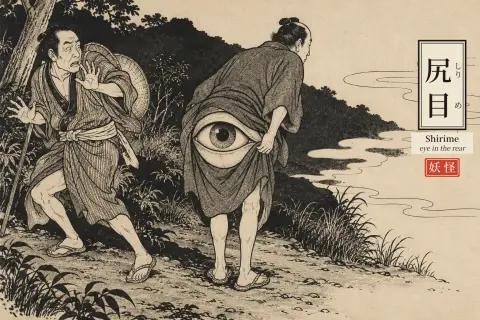
A separate Kyoto creature, painted by the poet Yosa Buson and known today as shirime, drops the face entirely in favor of a single eye on its rear end that flashes like lightning. It is sometimes filed under the nopperabō name too, though it earns an entry of its own here.
Where it comes from
The faceless figure is older than any of its named tellings. The Tale of Genji, an 11th-century court novel, mentions in passing an old story about a demon with no eyes or nose. Some scholars read that line as an ancestor of the nopperabō, centuries before anyone wrote the word down.
A faceless figure shows up outside Japan too. A Chinese ghost-story collection first published in 1791 describes a servant who grabs a crouching woman by a tree, only to find her face pure white and featureless. The resemblance did not go unnoticed. The scholar Minakata Kumagusu pointed out that the "white melon" face in the Gifu war chronicle reads almost exactly like Hearn's "face like an egg" in "Mujina," and guessed Hearn's version might simply be a retelling of the old Japanese motif.
At least one researcher of Hearn's work argues the opposite: that the twice-repeated fright was already an old story pattern, and Hearn was the one who thought to drop a faceless figure into it. On this reading, the regional tales that use the same blank face, collected decades after Hearn published, may be echoing his story rather than preserving something older. No source settles which came first.
Nopperabō today
The ordinary meaning never left the language, either: a blank wall or an empty expression can still be called nopperabō today. A bronze version of the ghost itself now stands among the statues on Mizuki Shigeru Road in Sakaiminato, the hometown of the manga artist who did more than anyone to popularize yokai in modern Japan. His books also classed two other faceless figures, Shirobōzu and Kurobōzu, as kinds of nopperabō.