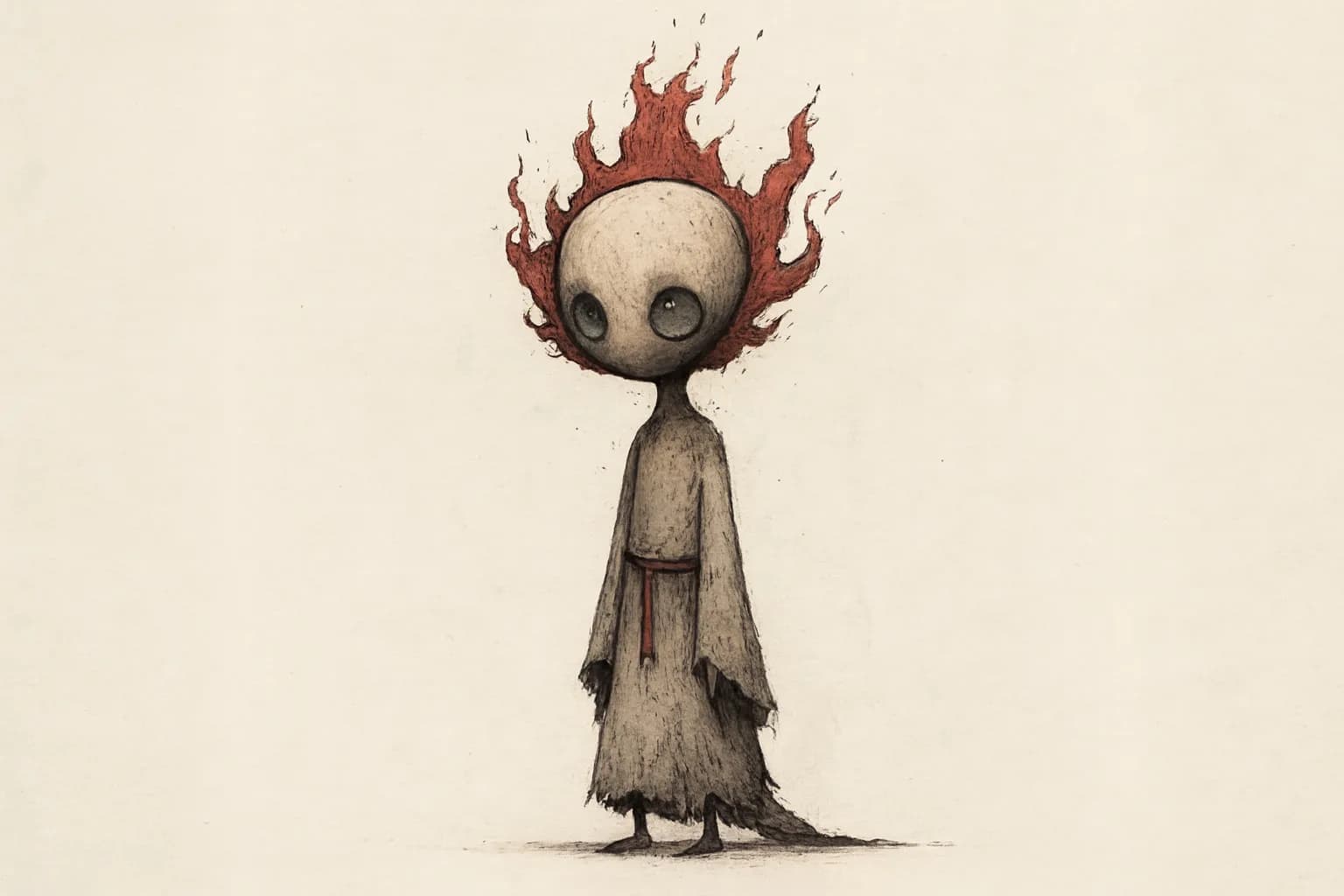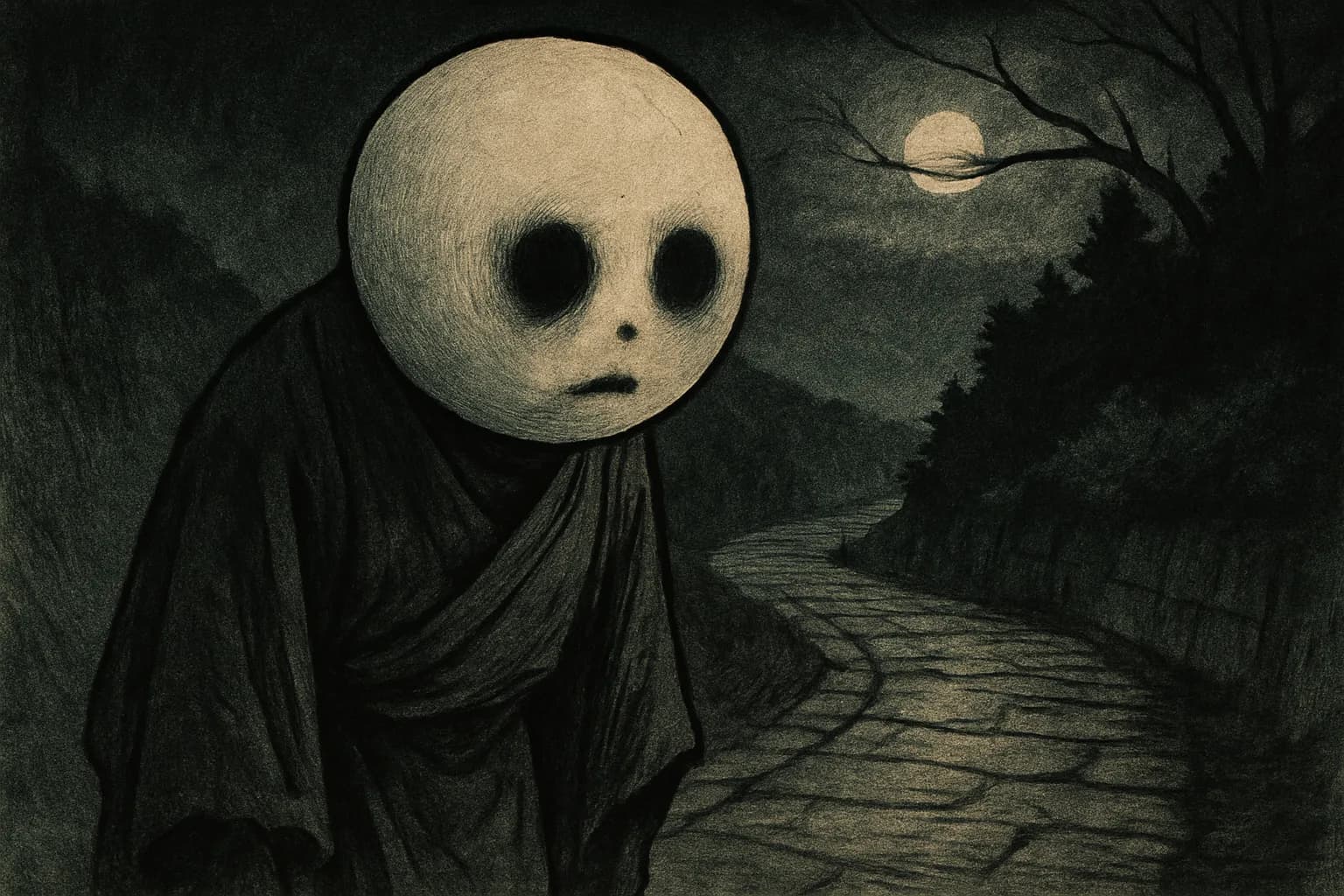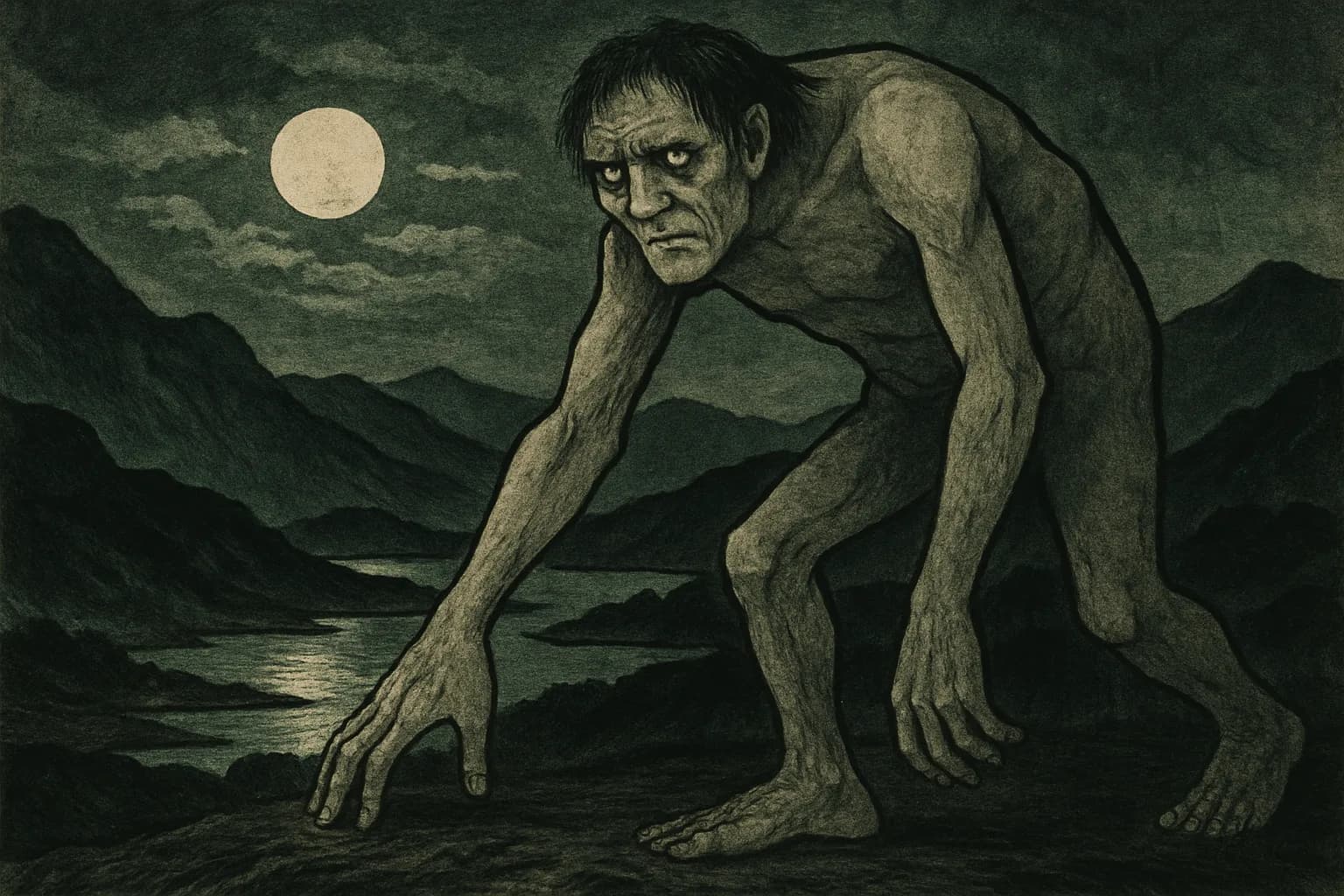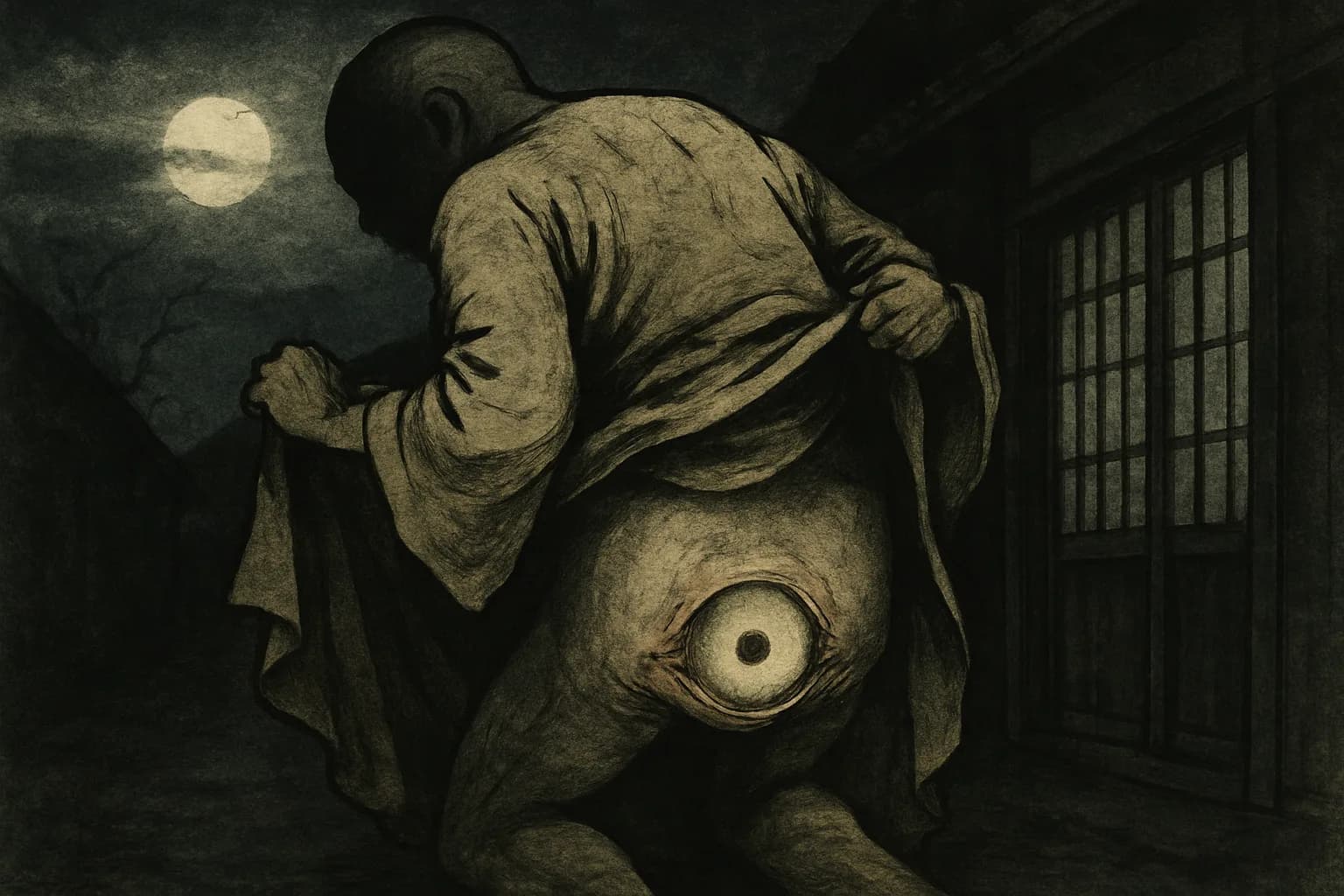
A samurai is walking a lonely road outside Kyoto after dark when a voice calls out behind him: matarareyo — "wait a moment." He turns. A man in traveling clothes is standing there, apparently wanting to speak. Then the stranger says nothing at all. He unties his robe, bends forward, and where his face should be turning to look back over his shoulder, there is instead a single enormous eye, glowing, set into his backside. The samurai bolts. That is the entire story, and it is the only story Shirime has ever needed.
What does it look like?
Shirime has no dramatic true form to describe, which is itself the joke. In the picture scroll that first recorded him, he is drawn as a naked, bald man — no horns, no claws, nothing that marks him as inhuman at a glance. The reveal happens only when he turns his back and opens his robe: a wide, luminous eye sits where a person's anus would be, staring out at whoever made the mistake of stopping to see what he wanted. His actual face is never shown. In some tellings it's simply blank, in others the artist doesn't bother drawing it at all, because by the time anyone would look for it, they're already looking at the other eye.
The trick on the road at night
The scene is always the same shape: a solitary traveler, a dark stretch of road near Kyoto, and a voice asking them to stop. Shirime doesn't chase, doesn't threaten, and doesn't seem to want anything beyond the moment of exposure itself. He does the one trick he has and lets the traveler's own fright do the rest of the work. There's no robbery, no curse, no injury reported in any version of the tale — just a badly frightened man running the rest of the way home with a story that no one back in town has heard the like of before.
That restraint is part of what makes Shirime distinct from the road-yokai he's usually filed alongside, like the faceless noppera-bō. A noppera-bō erases a face. Shirime relocates one, and the joke depends entirely on the location.
Where it comes from
Shirime survives today because of a single, specific piece of paper: an illustrated scroll of yokai attributed to the haiku poet and painter Yosa Buson (1716–1784), better known to most readers for verse than for monsters. Buson worked in Kyoto for much of his life, and his yokai emaki captures the kind of story that would have circulated as travelers' gossip rather than religious teaching — a strange thing that supposedly happened to somebody, somewhere on a road at night, retold until it had a name. Nothing about Shirime connects to shrine ritual or seasonal custom the way a yokai like the kappa does. He belongs to the same loose Edo-period tradition of yokai emaki that also produced Toriyama Sekien's catalogs a few decades later: single-scene, often comic, drawn as much to entertain as to warn.
Shirime today
Shirime has never carried the folkloric weight of a kappa or a tengu, and no local shrine keeps his story alive the way a village might keep a river god's. What he has instead is durability of a different kind: yokai encyclopedias and modern retellings of Edo-period ghost art keep returning to him precisely because the image is so absurd and so complete in a single panel. He needs no sequel, no explanation of powers, no backstory about how he came to be — just a dark road, a polite request to wait, and a robe coming open.